Weekend links 635

bubble.jpg

A close-up image of the surface of a soap bubble. The image reveals ‘lipid islands’ of soap floating on a very thin film of water. The film on which the soap floats is so thin that it does not interfere with the light hitting it, therefore allowing the light to pass through. This creates an appearance of a black abyss. Magnification x250.”

• Coming soon from Strange Attractor Press: Everything Keeps Dissolving, Conversations with Coil edited by Nick Soulsby. I helped out a little with this one so I’m looking forward to seeing it. And since the cult fervour around the group remains undiminished, anyone interested in buying a copy is advised to do so sooner rather than later.

• There are over 90 stories in The Complete Short Stories of JG Ballard (quantities vary according to edition) but few of them have been adapted into other media. The Drowned Giant is an exception, an animated short directed by Tim Miller.

• “You could spend your life exploring its dream logic without arriving at a definitive destination.” Anne Billson on the mysteries of Lucile Hadžihalilović’s Earwig.

• Meta-mix of the week: links to yearly mixes of favourite ambient releases by A Strangely Isolated Place.

• At Spoon & Tamago: Matchstick cookies keep the flame of tradition alive.

• At Dennis Cooper’s: George A. Romero Day.

Felicia Atkinson’s favourite music.

• RIP Wolfgang Petersen.

Das Boot: Titel (1981) by Klaus Doldinger | Martin (1983) by Soft Cell | Everything Keeps Dissolving (2000) by Coil

Weekend links 634

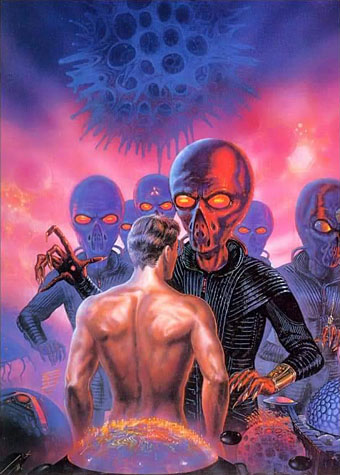
chaffee.jpg

Cover for Amazing Stories, October 1992, by Douglas Chaffee. A delightfully strange painting that suggests a no doubt unintentional homoerotic scenario when divorced from its original context. Via.

• “The most curious aspect of Buckminster Fuller’s arc is that he became a counterculture icon while entrenched in the very things that betrayed its spirit.” Pradeep Niroula on Buckminster Fuller (again) whose self-importance is deflated in a new biography, Inventor of the Future: The Visionary Life of Buckminster Fuller by Alec Nevala-Lee.

• “I love both King Diamond and Weird Al. Lana del Rey and Anna von Hausswolff. Golden age illustrations of elegantly levitating fairies in a lush vibrant summer garden and the gothic charcoal rendering of melancholy moth singed by a candle’s flame.” S. Elizabeth talking to Luna Luna Magazine about inspirations and The Art of Darkness.

• “I’m writing this from my office which has a record player, currently about eight thousand records, and just one CD.” Vinyl-head Jonny Trunk talking to Norman Records about the finding and releasing of rare music.

A painter’s brilliant achievements, the unique traits of his particular style, rest on an abiding substratum of coordinated specialized crafts, a body of knowledge and practice safeguarded by a tradition upheld by the guilds. Beneath the glimmer and foreground of art history, like a powerful underground river, flow the patterns of training and production developed in the crafts. Art history is centred on individual talents romantically bringing forth their creations on their own, out of nothing. Craft is collective and anonymous. Someone had to weave the pieces of cloth that form the giant canvas of Las Meninas. Someone had to sew them together so that the stitching would show as little as possible. Someone had to cut and to assemble the struts for its support and then nail to them a canvas which in fact is not of the highest quality. It seems that Velázquez enjoyed the roughness of a surface that favoured his subtle veils and ambiguities. The loose manner of painting developed in Venice is linked to the quality of the pigments that could be purchased there, as well as to the oil medium and the thick, porous quality of a cloth that allowed subtle veils and ambiguities that are impossible to achieve on the surface of a wood panel.

Antonio Muñoz Molina on the materiality of painting, and its highest expression in the art of Diego Velázquez

• The films of Japanese director Kinuyo Tanaka are criminally overlooked, says James Balmont.

Winners of the Nature TTL Photographer of the Year 2022.

• From 2012: The Disappeared by Salman Rushdie.

• At Dennis Cooper’s: Standish Lawder Day.

• New music: Octopus by Sunfear.

Come Sta, La Luna (1974) by Can | Fontana Di Luna (1978) by Michael Rother | La Luna En Tu Mirada (2003) by Ry Cooder & Manuel Galbán

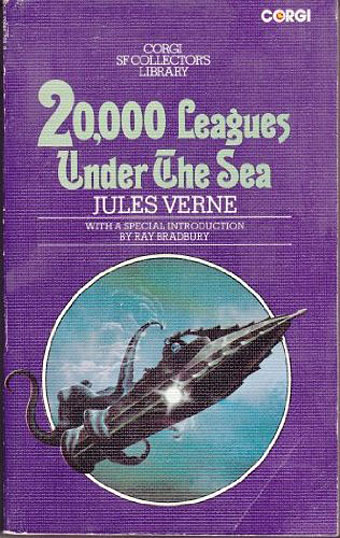
Corgi SF Collector’s Library

corgi02.jpg

Cover artist unknown.

“Here, for the connoisseur, for the devotee of the SF genre, and for those who like their reading to combine excitement with good writing, is the Corgi SF Collector’s Library – a series that brings, in a uniform edition, many of the Greats of SF – standard classics, contemporary prizewinners, and controversial fiction, fantasy, and fact…”

Only in the 1970s would you find a line of SF paperbacks with all the titles set in Thalia, a Victorian typeface revived by the post-psychedelia predilection for any design that was florid and ornate. Corgi’s SF Collector’s Library was published from 1973 to 1976, arriving just as my reading was moving from child-friendly SF to adult fiction. Consequently, I bought quite a few of these books, and still own a couple of them. The design was uniform but with a surprising amount of variation for such a short-lived series. The background colours ranged from deep blue to purple, while the card used for the covers was regular paperback stock for some of the titles with the majority using textured card, a treatment that further distinguished the series from its rivals on the bookshelves.

corgi12.jpg

Art by Joe Petagno.

Looking at these covers again I’ve been wondering if the idea of framing the artwork in a circle was borrowed from Penguin’s run of HG Wells reprints from 1967. Corgi had done something similar the same year with their Ray Bradbury series (all with art by Bruce Pennington) but the Wells editions went through several reprints, and the SF Collector’s Library follows their form even down to allowing the artwork to break the frame.

corgi03.jpg

Art by Bruce Pennington.

The samples here are a small selection of the series which featured a fair representation of British SF illustrators of the time. None of the artists were credited on the covers, however—a poor showing on the part of Corgi—so a few of them remain unidentified.

corgi01.jpg

Art by Tony Roberts.

corgi05.jpg

Cover artist unknown.

Continue reading “Corgi SF Collector’s Library”

Weekend links 633

fuller.jpg

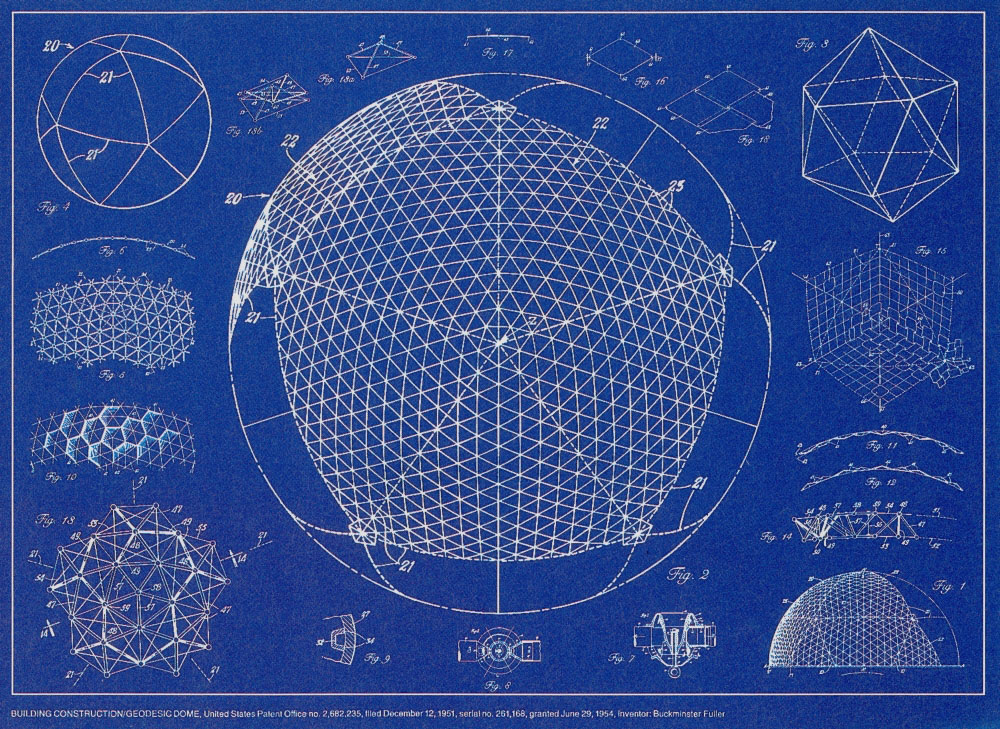
A blueprint by Buckminster Fuller for the first geodesic dome.

• “That opening sequence on the train, it’s got the dynamic of a wonderful pop video. It’s one of the world’s greatest actors who understood the power of small gestures.” Jah Wobble enthusing about Roy Budd, Michael Caine, and Mike Hodges’ baleful revenge drama, Get Carter.

• One of the BFI’s Halloween releases this year will be The Ballad of Tam Lin (1971), the blu-ray debut of a cult film that blends folk horror with modish melodrama. Direction by Roddy McDowall, music by Pentangle, and a cast that includes Ava Gardner and Ian McShane.

• New from A Year In The Country: Cathode Ray And Celluloid Hinterlands, a book exploring weird film and TV, not all of which is from the over-ploughed folk-horror furrows.

The whole notion of the Diggers kind of evolved out of the anarchism thing. And also there was more than a little social conscience. Because, by now, in ‘66, people started to come to the Haight Ashbury from all over. And that was when, in ‘66, it was still, really… Before the “Summer of Love,” it really was the Summer of Love. The “Summer of Love” [in 1967] was Life Magazine’s version. That’s what created the homeless on the streets and all that shit, because so many people came with absolutely no understanding of what they were about.

The role of the Diggers in this period was an outlaw, romantic, feed-the-people, anarchist, ‘Who’s in charge?—YOU ARE’, that kind of thing. That line in Apocalypse Now when he gets to the bridge and the little string of Christmas lights are hanging and he gets to one guy who’s guarding one end of the bridge and he says, Who’s in charge here? He says, I thought you were. And that’s so true. That is so true. Then Grogan, whenever anyone would ask, where’s Emmett Grogan… anyone could say “I’m Emmett Grogan.” So you could deflect a lot of shit.

Harvey Korspan of the San Francisco Diggers talking to Jay Babcock in another installment of Jay’s verbal history of the hippie anarchists

• “Buckminster Fuller patented the geodesic dome on June 29, 1954. Two decades later, it was everywhere in science fiction.”

• At Dennis Cooper’s: Spotlight on…Harry Mathews Tlooth (1966).

• Mix of the week: A mix for The Wire by Cheri Knight.

• Steven Heller’s font of the month is Bangel.

Tam Lin (1969) by Fairport Convention | Young Tambling (1971) by Anne Briggs | Tamlane (2016) by Dylan Carlson & Coleman Grey

The hashish eaters of Monte Cristo

dumas.jpg

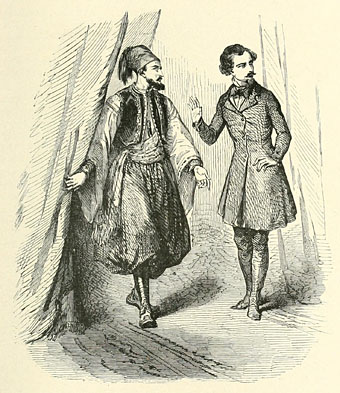
Illustration by Pierre-Gustave-Eugène Staal.

I mentioned at the weekend that my current reading is the Dumas père doorstop The Count of Monte Cristo. One of the things I enjoy about reading novels like these that “everyone knows” (ie: everyone knows mostly from truncated film or television adaptations) is finding something surprising about the story that you’ve never seen mentioned before. The following passage from chapter 31 turns out to be quite well-known as it happens, but only to those who’ve read the original text, not the Reader’s Digest version.

The story so far: Baron Franz d’Épinay has hired a boat to take him to the uninhabited Mediterranean island of Monte Cristo where he hopes to do a spot of hunting. On reaching the island Franz and his crew discover a small group of bandits camped there, with a leader dressed in Arabian clothes. This man—our hero, Edmond Dantès—insists on concealing his identity with a pseudonym, “Sinbad the Sailor”, and suggests that Franz might wish to do the same. The latter chooses the name “Aladdin”, and the pair retire to a sumptuously decorated cave for an evening meal. When the meal is over “Sinbad” offers “Aladdin” a special treat:

“You cannot guess,” said he, “what there is in that small vase, can you?”

“No, I really cannot.”

“Well, then, that green preserve is nothing less than the ambrosia which Hebe served at the table of Jupiter.”

“But,” replied Franz, “this ambrosia, no doubt, in passing through mortal hands has lost its heavenly appellation and assumed a human name; in vulgar phrase, what may you term this composition, for which, to tell the truth, I do not feel any particular desire?”

“Ah, thus it is that our material origin is revealed,” cried Sinbad; “we frequently pass so near to happiness without seeing, without regarding it, or if we do see and regard it, yet without recognizing it. Are you a man for the substantials, and is gold your god? taste this, and the mines of Peru, Guzerat, and Golconda are opened to you. Are you a man of imagination—a poet? taste this, and the boundaries of possibility disappear; the fields of infinite space open to you, you advance free in heart, free in mind, into the boundless realms of unfettered reverie. Are you ambitious, and do you seek after the greatnesses of the earth? taste this, and in an hour you will be a king, not a king of a petty kingdom hidden in some corner of Europe like France, Spain, or England, but king of the world, king of the universe, king of creation; without bowing at the feet of Satan, you will be king and master of all the kingdoms of the earth. Is it not tempting what I offer you, and is it not an easy thing, since it is only to do thus? look!”

At these words he uncovered the small cup which contained the substance so lauded, took a teaspoonful of the magic sweetmeat, raised it to his lips, and swallowed it slowly with his eyes half shut and his head bent backwards. Franz did not disturb him whilst he absorbed his favourite sweetmeat, but when he had finished, he inquired:

“What, then, is this precious stuff?”

“Did you ever hear,” he replied, “of the Old Man of the Mountain, who attempted to assassinate Philippe Auguste?”

“Of course I have.”

“Well, you know he reigned over a rich valley which was overhung by the mountain whence he derived his picturesque name. In this valley were magnificent gardens planted by Hassen-ben-Sabah, and in these gardens isolated pavilions. Into these pavilions he admitted the elect, and there, says Marco Polo, gave them to eat a certain herb, which transported them to Paradise, in the midst of ever-blooming shrubs, ever-ripe fruit, and ever-lovely virgins. What these happy persons took for reality was but a dream; but it was a dream so soft, so voluptuous, so enthralling, that they sold themselves body and soul to him who gave it to them, and obedient to his orders as to those of a deity, struck down the designated victim, died in torture without a murmur, believing that the death they underwent was but a quick transition to that life of delights of which the holy herb, now before you, had given them a slight foretaste.”

“Then,” cried Franz, “it is hashish! I know that—by name at least.”

“That is it precisely, Signor Aladdin; it is hashish—the purest and most unadulterated hashish of Alexandria—the hashish of Abou-Gor, the celebrated maker, the only man, the man to whom there should be built a palace, inscribed with these words, A grateful world to the dealer in happiness.”

“Do you know,” said Franz, “I have a very great inclination to judge for myself of the truth or exaggeration of your eulogies.”

“Judge for yourself, Signor Aladdin—judge, but do not confine yourself to one trial. Like everything else, we must habituate the senses to a fresh impression, gentle or violent, sad or joyous. There is a struggle in nature against this divine substance—in nature which is not made for joy and clings to pain. Nature subdued must yield in the combat, the dream must succeed to reality, and then the dream reigns supreme, then the dream becomes life, and life becomes the dream. But what changes occur! It is only by comparing the pains of actual being with the joys of the assumed existence, that you would desire to live no longer, but to dream thus forever. When you return to this mundane sphere from your visionary world, you would seem to leave a Neapolitan spring for a Lapland winter—to quit paradise for earth—heaven for hell! Taste the hashish, guest of mine—taste the hashish.”

Franz does as requested and thereafter passes the night in an erotic delirium. The whole sequence is an example of the personal preoccupations of the author entering his fiction, Dumas having been a member of the Club des Hashishins in Paris, whose monthly “séances” took place at a hotel on the Île Saint-Louis. Other members of the club included Victor Hugo, Charles Baudelaire, Gérard de Nerval, and Honoré de Balzac. The “magic sweetmeat” which Franz is offered was just that, a greenish paste from Algeria known as Dawamesc which disguises the bitter taste of the hashish with honey, pistachio and spices. (This page has a recipe should you require it.) Reading about the history of the hashish club I see that the hotel was located on the Quay d’Anjou, the river-facing street which is also the location of Baroness Ungern’s occult library in The Dumas Club by Arturo Pérez-Reverte. The Dumas thread in that novel (which is omitted from the film adaptation, The Ninth Gate) concerns rare manuscript pages of the “Anjou Wine” chapter from The Three Musketeers yet I don’t recall any mention of the Club des Hashishins in the story. I wish now I’d known all this before I spent a week in Paris; the Île Saint-Louis was one of my favourite places in the city, and I walked along the Quay d’Anjou one evening, photographing the river views.

Further reading: Franz d’Épinay’s night of dreams is recounted in The Green Jam of Doctor X, an essay by Mike Jay which explores the history of the literary hashish club.

Previously on { feuilleton }
More trip texts
The Art of Tripping, a documentary by Storm Thorgerson
Haschisch Hallucinations by HE Gowers