Reversible men and Lipský’s Happy End

overloaded.jpg

A paperback ravaged by the passage of time. Art by Ray Ginghofer.

Time of Passage, a piece of short fiction by JG Ballard, received its first publication in Science Fantasy magazine in February, 1964. The piece was subsequently collected in two paperbacks, The Impossible Man and Other Stories (Berkley Medallion, 1966), and The Overloaded Man (Panther, 1967). Time of Passage is more of a biographical sketch than a story, describing in reverse the life of a stockbroker, James Falkman, a man “born” in 1963 by being dug out of a grave while surrounded by tearful relatives. Ballard goes on to describe the major events of Falkman’s life, from retirement to career to marriage, charting the man’s gradual descent into youth and eventual infant helplessness. The story ends with Falkman bheing taken to a hospital in 1900 for a final encounter with his mother, his “death” in Ballard’s words.

venus.jpg

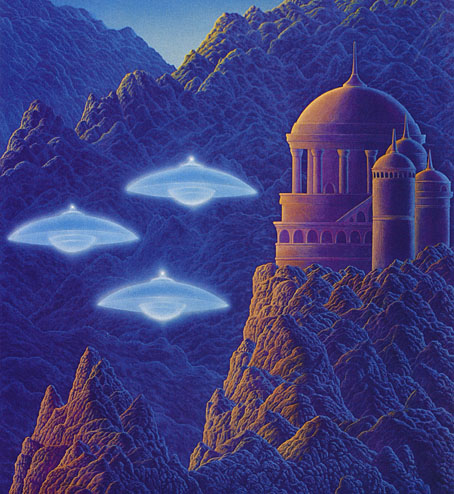
A revised reprint of The Overloaded Man, 1980. The artwork by Peter Gudynas may be the only Ballard cover to feature flying saucers.

There may be earlier literary examples of the life described in reverse but Ballard’s is the earliest one I know of. I’m thinking here of explicit reversals of human circumstance, as opposed to the more common reverse chronology whereby an otherwise forward-flowing story is chopped into episodes which are then presented in a reversed order. Philip K. Dick’s Counter-Clock World (1967) is a novel-length extrapolation of Ballard’s concept, set in a future where time has started to run backwards, and the dead are being born again in cemeteries. The 1960s saw a peculiar spate of fiction along these lines; to paraphrase Charles Fort, it must have been time-reversal time. In an earlier Ballard story, Mr. F is Mr. F, the titular character finds himself aging in reverse while time continues to run forward for his wife and the world outside their home; in An Age (1967) by Brian Aldiss scientific experiments reveal that time is actually moving in reverse despite our perceptions to the contrary.

reversible.jpg

Art by Mike White.

Alan Moore would no doubt have been familiar with one or more of these stories when he wrote The Reversible Man for 2000 AD in 1983, a four-page strip which shows the life of an ordinary man from death to birth. Moore freshens the concept a little by the use of first-person narration. The most well-known treatment of the idea is Time’s Arrow by Martin Amis, a novel whose structure was taken by some reviewers as wholly original even though Amis said he was inspired by a passage in Kurt Vonnegut’s Slaughterhouse-Five. I’ve always felt Amis was being evasive on this point; he was very familiar with Ballard’s fiction, he interviewed Ballard and reviewed his novels on several occasions. Anyone with this much interest in Ballard’s work would have read Time of Passage in one of its many reprintings.

happy-end.jpg

Design by Milan Grygar.

When it comes to authorial influence it seems unlikely that Czech film-maker Oldřich Lipský could have been influenced by Ballard or Dick’s time-reversals, which makes the appearance of Happy End in 1967 all the more remarkable. Lipský’s feature film, which I watched last week, is essentially Ballard’s death-to-life narrative played for its comic potential, with the film itself running in reverse for much of the time. Happy End opens with a title card in Czech—”Konec” (“The End”)—before presenting the “birth” of its protagonist by means of a guillotine. The decapitated head of Bedřich Frydrych (Vladimír Menšík) is attached to his body, after which the guards lead him (backwards) to the place described by his cheerful voiceover as a school (aka prison) where he says he’s being prepared for life in the outside world. Before he sets off to his waiting apartment the police give him a suitcase containing the body of his wife, Julie (Jaroslava Obermaierová), the pieces of which he assembles in the bath in his apartment. Julie is “revived” when Frydrych pulls an axe from her forehead, after which Julie’s lover, Ptáček (Josef Abrhám), makes his first arrival, jumping backwards into the bedroom through the window.

he1.jpg

The love-triangle between Frydrych, Julie and Ptáček forms the bulk of the story, and also the basis for much of the film’s black humour. One of the hallmarks of the reversed biography is ironic reinterpretation, something that Amis makes a substantial meal of in his novel. In many cases it’s easier to do this with film than it is with words: a fight between Frydrych and Ptáček becomes an energetic “tidying up” of the apartment, with the cuckolded husband and the wife’s lover reassembling broken furniture and clearing away all the signs of destruction. Happy End is a long procession of these reversals, accompanied by Frydrych’s voiceover narration which persists in giving any tragic and difficult moments a positive gloss. Most of them, anyway. A substantial win at the racetrack becomes a negative incident when the events are played in reverse. But the loss of money is offset by Frydrych and Julie’s young daughter who pulls fresh banknotes out of an impromptu fire on the kitchen floor.

he2.jpg

For non-Czech speakers the humour and invention of Happy End is undermined by the effort required to keep up with the film’s frenetic pace (many of the scenes are speeded-up as well as running in reverse) while reading subtitles which reinterpret everything you’re seeing on the screen. My own viewing was further compromised by amateurish subtitles, but this is all the more reason to watch it again. Second Run have recently released Happy End as a region-free blu-ray with “new and improved English subtitle translation”. This is the second Lipský film I’ve watched to date (thanks, Jay!). I’ll be looking for more.

Previously on { feuilleton }
Art on film: Je t’aime, Je t’aime

Snowbound by Bram Stoker

snowbound00.jpg

The artwork is mine; the cover design is by Lookatcia.

Presenting my latest book for Alma, the Spanish publisher for whom I’ve illustrated several classic novels and story collections. The new volume is my second Bram Stoker title after Dracula in 2018 which, for the sake of convenience, I’ll refer to it by its English title. Snowbound: The Record of a Theatrical Touring Party was a collection of connected stories first published in 1908, 11 years after Dracula had established Stoker’s reputation. I wouldn’t call Snowbound a bad book but if you’ve read Dracula or Stoker’s more popular short stories it’s a disappointment, with no supernatural content and little to recommend it elsewhere. The first episode introduces the framing device: a group of travelling players are marooned by heavy snow while travelling on a train through the wilds of Scotland. To pass a dark and freezing night the troupe entertain themselves by relating memorable anecdotes from their careers, anecdotes which I imagine Stoker either heard from others or experienced himself during his years working for actor-manager Henry Irving. In place of the spooky tales one might expect from such a premise we’re offered a succession of vaguely comic episodes mixed with more serious drama, with a couple of the pieces being related in very broad “Oirish” and Cockney accents. The Irish episode is especially bizarre considering that Stoker was Irish himself; it reads like the kind of thing you’d get from an English writer trotting out lazy stereotypes.

endpapers.jpg

My endpapers design.

There are other flaws I could mention but I’ve undersold the book enough as it is. Snowbound has never received much attention in the past, it wasn’t even reprinted in English until 2000. In my previous books for Alma I utilised a style which combined collaged backgrounds with hand-drawn elements in order to create illustrations whose engraved appearance made them seem like products of the period in which the stories were written. More recently I’ve been moving away from this style but the success of the previous Alma editions, Frankenstein in particular, obliged me to maintain some continuity with the look I’d created for Dracula. As it turned out, several of the Snowbound illustrations are entirely hand-drawn, with engraving-like textures used in the shading. The biggest departure from the previous books is the addition of an extra ink colour to the artwork, an effect that was fun to play with when creating different lighting effects. As to the pictorial details, several of the anedotes take place in the United States, hence the presence of an American steam train with an elevated smokestack, the spelling of the word “theater” on a poster, and so on.

snowbound01.jpg

Having mentioned Frankenstein I ought to also mention the recent Polish edition of the novel which reprints my Alma illustrations. This is a large-format hardback from Materia, a pubisher who don’t seem to have a proper web presence outside those Meta plague sites that I never link to. The book is on sale anyway. Meanwhile, I’m currently working on another new book for Alma which will feature ten full-colour double-page illustrations. More about this later.

snowbound02.jpg

snowbound03.jpg

snowbound04.jpg

Continue reading “Snowbound by Bram Stoker”

Weekend links 818

paunzen.jpg

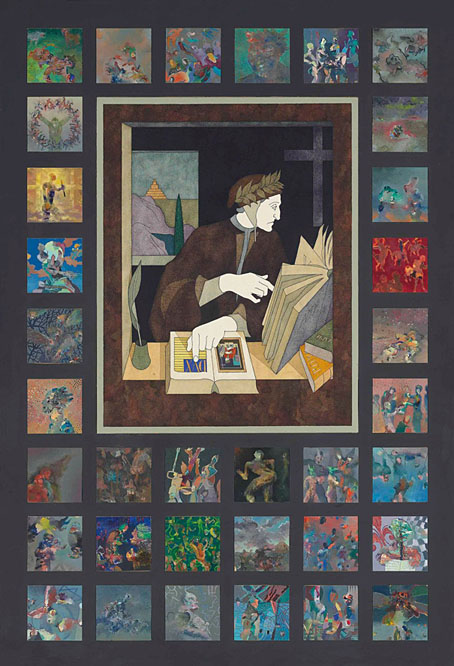
The Bookworm (no date) by Arthur Paunzen.

• New Cabaret Voltaire: Nag Nag Nag (Live 2025 Single Edit). Good to hear they’ve reinstated the Patrick Moore dialogue sample, something that’s on the studio version but usually missing from live recordings. The single is a trailer for a forthcoming album based on the group’s recent anniversary tour.

The Mysterious Castle in the Carpathians (1981), a wacky Czech comedy, one of many directed by Oldřich Lipský. With a story by Jules Verne, music by Luboš Fišer, and steampunk props by Jan Švankmajer.

• More new music: Butch’s Guns by Sunn O))); Sidings by Craven Faults; Frequencies In The Fog by Rod Modell.

What strikes me most is the difference between people who’ve learned to construct what I call “containers for attention”—bounded spaces and practices where different modes of engagement become possible—and those who haven’t. The distinction isn’t about intelligence or discipline. It’s about environmental architecture. Some people have learned to watch documentaries with a notebook, listen to podcasts during walks when their minds can wander productively, read physical books in deliberately quiet spaces with phones left behind. They’re not rejecting technology. They’re choreographing it.

What we think is a decline in literacy is a design problem, says librarian Carlo Iacono

• At Colossal: “Striking photos by Peter Li capture the soaring majesty of sacred spaces.”

• At Public Domain Review: The Eight Horses of King Mu, Son of Heaven (ca. 1300).

• At the BFI: Brogan Morris selects 10 great political thrillers.

• At Dennis Cooper’s: Roland Topor’s Brain.

• RIP Robert Duvall and Tom Noonan.

The Book Lovers (1997) by Broadcast | Tiny Golden Books (2000) by Coil | Library Of Solomon Book 2 (2011) by Demdike Stare

The Kingdom of the Gods

quail01.jpg

Looking for more Theosophist art turned up The Kingdom of the Gods (1952), a book by Geoffrey Hodson with illustrations by Ethelwynne M. Quail. Hodson was a Theosophist scholar with a predilection for the clairvoyant visualising of transcendent beings. Several of his books are descriptions of encounters made on his travels, commencing at a modest level in 1925 with Fairies at Work and Play. Fairies are a somewhat trivial subject for Theosophical students, which may explain why Hodson’s later books move on to accounts of angels in their various forms, before arriving at descriptions of fully-fledged gods, a type of divine life which in Hodson’s telling is more populous than we realise. A note at the beginning of The Kingdom of the Gods states that Ethelwynne Quail’s paintings were made originally for slide projections which Hodson used in his lectures.

quail02.jpg

Most of Hodson’s gods are lower-order beings of a kind that the Romans termed genius loci, the spirit of a place, while their depictions are nebulous, bird-like renderings like some of the “thought-forms” depicted in the 1905 book of that name by Charles Webster Leadbeater and Annie Besant. The determination of the Theosophists to make the invisible manifest on paper or canvas may explain the attraction of the religion for so many artists. One of the illustrations in Thought-Forms shows Gounod’s music forming over a cathedral tower like a polychrome mushroom cloud; a decade later, the Theosophy-inspired Luigi Russolo was doing something similar with his Futurist painting, La Musica. Geoffrey Hodson would have been delighted by the mystical artists of the 1970s, especially Gilbert Williams and Robert Venosa. Some of Ethelwynne Quail’s spirits might be sketches for Venosa paintings, his early works in particular, which have the same sweeping lines but rendered in a meticulous, crystalline manner.

quail03.jpg

quail04.jpg

quail05.jpg

Continue reading “The Kingdom of the Gods”

Weekend links 817

paolozzi.jpg

The Silken World of Michelangelo (1967) by Eduardo Paolozzi.

• “By the late 19th century, representing time as a line was not just widespread—it was natural. Like today, it would have been hard to imagine how else we could represent time. And this affected how people understood the world.” Emily Thomas on the evolution of our thinking about the nature of time.

• At Green Arrow Radio: Bill Laswell and the Cosmic Trip, in which the indefatigable performer/producer talks about his career and Cosmic Trip, a new album by saxophonist Sam Morrison.

• At Public Domain Review: Snail Homes, Bog Bodies, and Mechanical Flies: Robert Testard’s Illustrations for Les secretz de l’histoire naturelle (ca. 1485).

• Among the new titles at Standard Ebooks, the home of free, high-quality, public-domain texts: Continental Op Stories by Dashiell Hammett.

• The winter catalogue of lots for the After Dark: Gay Art and Culture online auction. Homoerotic art, photos, historic porn, etc.

• New music: The Third Mind. A Sonic Tribute to the Dreamachine by Various Artists.

• Mix of the week: DreamScenes – February 2026 at Ambientblog.

A Conversation with Tarotplane by AJ Kaufmann.

• RIP Bud Cort.

Timewhys (1971) by Tonto’s Expanding Head Band | Time Be Time (1990) by Ginger Baker | Time Scale (2009) by Belbury Poly