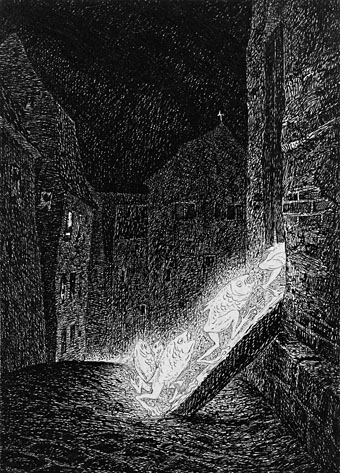
Kafka’s machine

kafka.jpg

In der Strafkolonie (In the Penal Colony, 1919), a short story by Franz Kafka

“Yes, the harrow,” said the Officer. “The name fits. The needles are arranged as in a harrow, and the whole thing is driven like a harrow, although it stays in one place and is, in principle, much more artistic. You’ll understand in a moment. The condemned is laid out here on the bed. First, I’ll describe the apparatus and only then let the procedure go to work. That way you’ll be able to follow it better. Also a sprocket in the inscriber is excessively worn. It really squeaks. When it’s in motion one can hardly make oneself understood. Unfortunately replacement parts are difficult to come by in this place. So, here is the bed, as I said. The whole thing is completely covered with a layer of cotton wool, the purpose of which you’ll find out in a moment. The condemned man is laid out on his stomach on the cotton wool—naked, of course. There are straps for the hands here, for the feet here, and for the throat here, to tie him in securely. At the head of the bed here, where the man, as I have mentioned, first lies face down, is this small protruding lump of felt, which can easily be adjusted so that it presses right into the man’s mouth. Its purpose is to prevent him screaming and biting his tongue to pieces. Of course, the man has to let the felt in his mouth—otherwise the straps around his throat would break his neck.” “That’s cotton wool?” asked the Traveler and bent down. “Yes, it is,” said the Officer smiling, “feel it for yourself.”

He took the Traveler’s hand and led him over to the bed. “It’s a specially prepared cotton wool. That’s why it looks so unrecognizable. I’ll get around to mentioning its purpose in a moment.” The Traveler was already being won over a little to the apparatus. With his hand over his eyes to protect them from the sun, he looked at the apparatus in the hole. It was a massive construction. The bed and the inscriber were the same size and looked like two dark chests. The inscriber was set about two metres above the bed, and the two were joined together at the corners by four brass rods, which almost reflected the sun. The harrow hung between the chests on a band of steel.

The Officer had hardly noticed the earlier indifference of the Traveler, but he did have a sense now of how the latter’s interest was being aroused for the first time. So he paused in his explanation in order to allow the Traveler time to observe the apparatus undisturbed. The Condemned Man imitated the Traveler, but since he could not put his hand over his eyes, he blinked upward with his eyes uncovered.

“So now the man is lying down,” said the Traveler. He leaned back in his chair and crossed his legs.

“Yes,” said the Officer, pushing his cap back a little and running his hand over his hot face. “Now, listen. Both the bed and the inscriber have their own electric batteries. The bed needs them for itself, and the inscriber for the harrow. As soon as the man is strapped in securely, the bed is set in motion. It quivers with tiny, very rapid oscillations from side to side and up and down simultaneously. You will have seen similar devices in mental hospitals. Only with our bed all movements are precisely calibrated, for they must be meticulously coordinated with the movements of the harrow. But it’s the harrow which has the job of actually carrying out the sentence.”

(Translation by Ian Johnston)


An authorless construction for The Bachelor Machines, 1975–77, an exhibition curated by by Harald Szeemann

szeemann.jpg


Kafka: The Execution (1989), a comic strip by Leopoldo Duranona

duranona.jpg

Read the full strip.


A page from Introducing Kafka (1993), an illustrated biography of Franz Kafka by David Zane Mairowitz and Robert Crumb

crumb.jpg


In the Penal Colony, 1920, from Franz Kafka: Dreams, Diaries, and Fragments (1994), a print by Robert Andrew Parker

parker.jpg


Zoetrope (1999), a short film by Charlie Deaux

zoetrope.jpg


Franz Kafka: The Peculiar Apparatus from the Story In the Penal Colony (undated), a sculpture by Martin Senn

senn.jpg

Previously on { feuilleton }
The Metamorphosis of Mr Samsa, a film by Caroline Leaf
Kafkaesque
Screening Kafka
Designs on Kafka
Kafka’s porn unveiled
A postcard from Doctor Kafka
Steven Soderbergh’s Kafka
Kafka and Kupka

Weekend links 647

oneill.jpg

A local dispute on the planet Mars. Art by Kevin O’Neill from The League of Extraordinary Gentlemen.

• “…this image has puzzled enthusiasts of the scientific mystic’s works, both for its obscure provenance and cryptic symbolism. With its pastiche of Renaissance visual style and medieval caption — “A missionary of the Middle Ages tells that he had found the point where the sky and the Earth touch” — the illustration was once thought to have originated centuries before Flammarion published his text.” Hunter Dukes on the enduring mystery of the “Flammarion Engraving”.

• “For Spare, radio, and the waves that carried the music he loved to listen to, were more than just a metaphor for the spirit world. They were an active mode of conveyance for occult energies and vibrations – the swirling, ectoplasmic tendrils from which odd figures emerge in some of his most dense and haunting work.” Mark Pilkington explores Austin Osman Spare’s influence on the world of music.

• At Spine: Design studio Milk & Bone’s designer Alicia Raitt re-imagines all 14 of Kurt Vonnegut’s book covers to celebrate his 100th birthday.

• Farewell to Kevin O’Neill and Nik Turner, both of whom headed to the Western Lands this week.

Mean, moody and magnificent: film noir studio portraits – in pictures.

• Mix of the week: XLR8R Podcast 773 by Roméo Poirier.

• New music: Evergreen by Patrick Shiroishi.

Brainstorm (1972) by Hawkwind | Hurricane Fighter Plane (1985) by Inner City Unit | Brainstorm (1993) by Monster Magnet

The Legend of Charlie Fish

charliefish.jpg

I’ve had several new book covers waiting in the wings for the past few months. The most recent of these, the cover for The Legend of Charlie Fish by Josh Rountree, was made public earlier this week so I can reveal it here.

In this debut, neo-gothic Western novel, an unlikely found family flees to Galveston, Texas, and a psychic young girl bonds with an enigmatic gill-man. While two bounty hunters are determined to profit by the spectacle Charlie Fish, the Great Storm—the worst natural disaster in US history—is on its way.

The brief for this one was to create something similar to the covers I designed for Mike Shevdon’s Courts of the Fayre series. Having already been asked to imitate the look of that series for a Marianne Williamson cover I was a little reluctant to do so again, but the final version of this one feels sufficiently different from the others to stand apart. One advantage of the graphic treatment was being able to use silhouettes to hint at the nature of the “enigmatic gill-man” without being too specific. When the appearance of characters is more alluded to than described you have to take care that your artwork isn’t too literal.

The Legend of Charlie Fish will be published by Tachyon in July 2023.

Weekend links 646

wallpaper.jpg

It’s that lethal book again. A sample of wallpaper impregnated with arsenic, one of many such pages in Shadows from the Walls of Death: Facts and Inferences Prefacing a Book of Specimens of Arsenical Wall Papers (1874) by RC Kedzie.

• “I like to spend time in the now because there I can create something new but in the past I cannot.” Damo Suzuki, former vocalist in Can, on creativity and his resilience in the face of long-term illness. Related: a trailer for Energy: A Documentary about Damo Suzuki.

• “I enjoy Carnival of Souls, but it is a dark form of enjoyment, with high stakes, because the enjoyment is predicated on me being able to shake myself free of the film after it is over, and that can be a struggle.” Colin Fleming on fear as entertainment.

• “Some people like fantasy epics or Regency romance or Sudoku or science-fiction world-building or the gentle challenge of cozy mysteries; I like the undead.” Sadie Stein on encounters with ghosts.

• “You’re now standing on the blocks of the Great Pyramid at Giza. For the first time ever you can explore the entire pyramid interior.” The Giza Project.

• “What do we think about when we watch films set in vanished decades that many of us experienced at first hand?” asks Anne Billson.

• At Bandcamp: Touch celebrates forty years of not being a record label.

• “Why scientists are sending radio signals to the Moon and Jupiter.”

• At DJ Food’s: Retinal Circus gig posters 1966–68.

• Steven Heller’s font of the month is Feneon.

The Pyramid Spell (1978) by Nik Turner | I Am Damo Suzuki (1985) by The Fall | Carnival Of Souls Goes To Rio (2001) by Pram

Marabout Fantastique book covers

marabout15.jpg

A post for Halloween featuring a selection of covers from the “Fantastique” imprint of Belgian publisher Bibliothèque Marabout. The imprint, which was only labelled “Fantastique” on later editions, was launched around 1969 and ran through the 1970s before petering out in the early 1980s. The uniform cover design—almost always black with titles set in Roberta—is an attraction for paperback collectors even when the titles are very familiar ones, and when the cover art, most of which was the work of Henri Lievens (1920–2000), is sketchy and vague.

marabout02.jpg

Among the Belgian writers rubbing shoulders with their more famous foreign counterparts are Jean Ray, author of the cult novel Malpertuis, playwright Michel de Ghelderode, and Thomas Owen (the pen-name of Gérald Bertot). Not all of the artwork is credited but most of the examples here are the work of the prolific Lievens, an artist whose cobwebbed eccentricities sometimes exceed the bounds of their brief; that flapping creature on the cover of The White People by Arthur Machen has no analogue in any of Machen’s stories. Later covers in the series saw contributions from Jean Alessandrini, with collages that were the subject of an earlier post. Marabout is still publishing today, albeit in a reduced fashion, having relocated to France where the company is now a tiny part of the Hachette empire.

marabout03.jpg

marabout01.jpg

marabout07.jpg

Continue reading “Marabout Fantastique book covers”