Weekend links 640

ewers-wunderwald.jpg

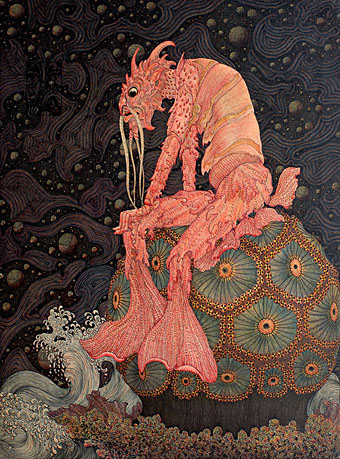
Aquarius (1910–1914) by Ilna Ewers-Wunderwald.

• “…they created a unique Afro-Caribbean soundscape—Battiste’s exceptional skills saw him use the studio as an instrument, voices flutter in and out, instruments shiver and shriek, over which Rebennack mutters and chants, a shaman of sorts.” Garth Cartwright on the life and works of Mac Rebennack, better known to the world as Dr John.

• Issue 3 of Man Is The Animal: A Coil Zine is now available for pre-order. I contributed to this one with a piece entitled “Singularities of Art and Nature”, an examination of the Coil discography via the Wunderkammer concept and the Musaeum Clausum of Thomas Browne.

• Among the recent arrivals at Standard Ebooks, the home of free, high-quality, public-domain texts, is Arthur Machen’s episodic and influential horror novel The Three Imposters (1895).

Media History Digital Library: “A free online resource, featuring millions of pages of books and magazines from the histories of film, broadcasting, and recorded sound.”

• At Dennis Cooper’s: Shall I, Jean Eugène Robert-Houdin, conjurer, introduce myself to you, viewer? And why not?

• At Public Domain Review: The Blood Collages of John Bingley Garland (ca. 1850–60).

• Mix of the week: Endymion, an autumnal ambient mix by The Ephemeral Man.

• “New Webb image captures clearest view of Neptune’s rings in decades.”

• New music: Of Endless Light by Cleared.

• RIP jazz giant Pharoah Sanders.

Conjuration (1977) by Tangerine Dream | Necronomicon—Conjurations (2004) by John Zorn | A Boy Called Conjuror (2020) by Teleplasmiste
Georges Méliès, Mage

melies01.jpg

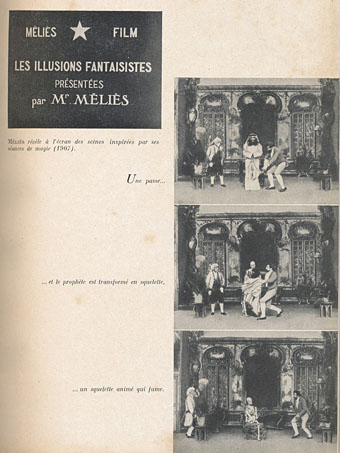
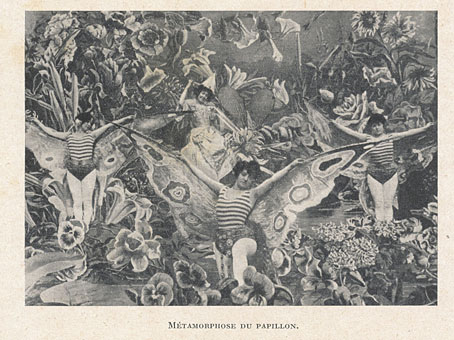
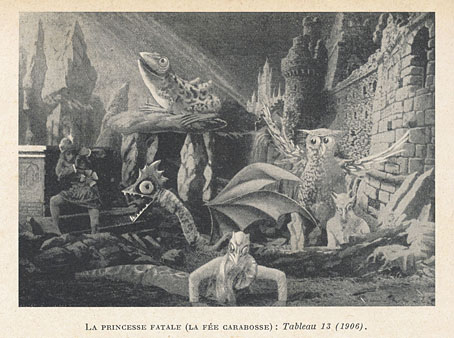
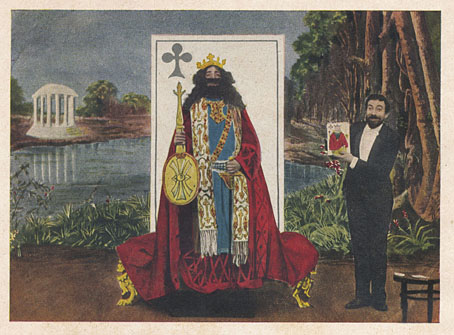
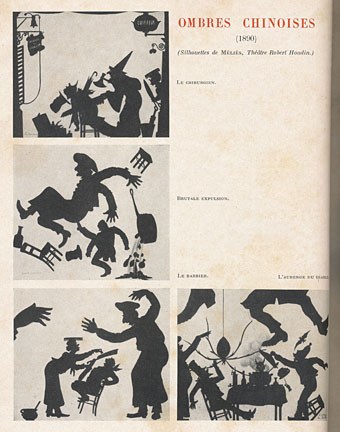
Georges Méliès: magician. Yes, indeed. I was watching Martin Scorsese’s Hugo again recently, a film I found more enjoyable the second time around mostly for the Méliès side of the story. The flashback to the Star Films studio offers in miniature a history that this book delivers in detail. Georges Méliès, Mage (1945) by Maurice Bessy and Joseph-Marie Lo Duca is a copiously illustrated guide to Méliès’ entire career, beginning with his early years as a conjuror and a creator of the kinds of theatrical fantasies that formed the basis for his first films. The text is in French throughout but there’s a wealth of pictorial material, with many production sketches and drawings that show how some of his more complex effects were achieved.

melies02.jpg

One of the things I’ve always found attractive about Méliès’ films is the way they resemble 19th-century illustrations brought to life. The same can be said about some of the later Hollywood productions, especially the Douglas Fairbanks Thief of Bagdad, but they lack the overt theatricality of Méliès. For a taste of those hand-tinted marvels, go here.

melies03.jpg

melies04.jpg

melies05.jpg

Continue reading “Georges Méliès, Mage”

Ralph Steadman, 1977

steadman1.jpg

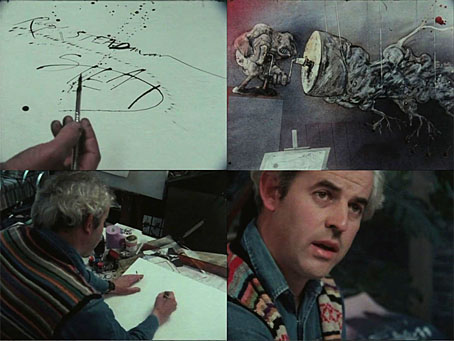
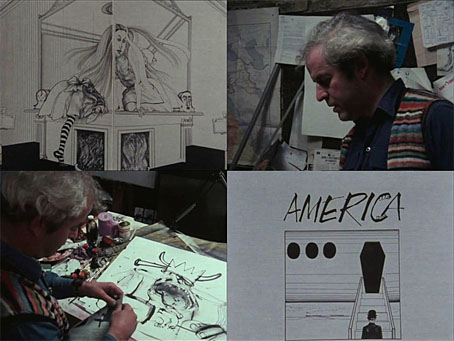
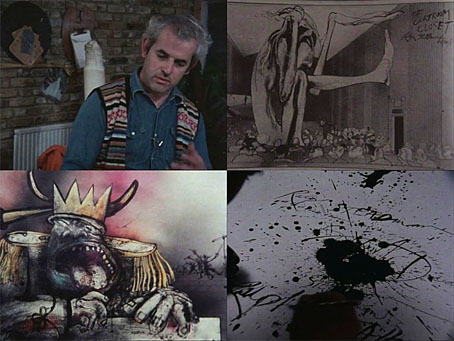
This is the kind of thing I like to see: 35 minutes of an artist doing nothing but drawing or talking about drawing. Michael Dibb’s profile of Ralph Steadman is the earliest BBC portrait of the artist, made for the long-running Arena arts series. Arena was launched in 1975 but films from the series prior to 1980 are rare things on the internet. This one concentrates on Steadman’s creation of a drawing for a new book, The Cherrywood Cannon, an anti-war story by Dimitri Sidjanski. In between work on the drawing Steadman describes how he approached illustrating Alice Through the Looking-Glass, and his drawings of the Patty Hearst trial, before repairing to the local pub where he sketches the regulars. Hunter S. Thompson only receives a passing mention, which may surprise some viewers; if it’s Thompson you’re after then you’ll want to see Fear and Loathing on the Road to Hollywood, the 1978 Omnibus profile of the writer which features Steadman again, plus many more of his drawings.

steadman2.jpg

The Arena film is relatively short but valuable for the insight it gives into Steadman’s technique: no preliminary drawing, for example, he starts with ink on a blank sheet of paper. I was amused to see him using a spray diffuser to fill in the background. This is a kind of lung-powered airbrush, an angled tube which you place in your bottle of ink then blow through to create spray effects. I used one myself for a while as a rougher (and cheaper) alternative to an airbrush, before graduating to using old toothbrushes which are easier to control when spattering ink. I’d always assumed that Steadman used an airbrush himself but seeing his loose approach to sketching it makes sense that he’d like the grainier, less predictable textures created by a diffuser.

steadman3.jpg

Michael Dibb’s film is at the producer’s Vimeo channel together with many other excellent documentaries, including John Berger’s landmark Ways of Seeing series.  Vimeo changed its policies recently, insisting that you sign in if you want to see something that hasn’t been rated by the user (ie: most of the things there). This can be avoided by using the mobile Vimeo app, an option which also gives you better search facilities.

Elsewhere on { feuilleton }
The illustrators archive

Previously on { feuilleton }
Ralph Steadman record covers
Beardsley and His Work

Weekend links 639

alphaville.jpg

Japanese poster for Alphaville (1965).

Peter Bogdanovich: I think we’d better have your thoughts on Godard.

Orson Welles: Well, since you’re so very firm about it. He’s the definitive influence if not really the first film artist of this last decade, and his gifts as a director are enormous. I just can’t take him very seriously as a thinker—and that’s where we seem to differ, because he does. His message is what he cares about these days, and, like most movie messages, it could be written on the head of a pin. But what’s so admirable about him is his marvellous contempt for the machinery of movies and even movies themselves—a kind of anarchistic, nihilistic contempt for the medium—which, when he’s at his best and most vigorous, is very exciting.

• RIP JLG. I was watching Alphaville again just two weeks ago after a DVD turned up in the local charity shop. Still the only Godard film I like 100% but “liking” seems beside the point. His influence today is everywhere, so fully absorbed into the language of cinema that people barely notice it.

• “The things that cause my gaze to linger are usually the portraits or landscapes that spark a feeling of unease, disquiet and discomfort. A shadow amongst the summer trees, a lurking silhouette reflected in a perfect blue iris, a vibrant flower in the early stages of decay.” S. Elizabeth talking to Beautiful Bizarre about her new book, The Art of Darkness: A Treasury of the Morbid, Melancholic and Macabre.

• Allow John Waters (again) to dictate your film viewing with a Letterboxd list of his favourite films, based on comments in his writings and interviews. On the subject of Godard, Waters’ Crackpot book contains a whole chapter about Hail Mary.

• Astor’s Electrical Future: Iwan Rhys Morus explores a vision of the year 2000 recounted in A Journey in Other Worlds (1894), a “scientific romance” by John Jacob Astor IV, with illustrations by Daniel Carter Beard.

• Strange Attractor has announced a Kickstarter campaign to fund the publication of an Austin Osman Spare Tarot deck.

• At Wormwoodiana: The Parrot, the Unicorn and the Golden Dragon: Some 17th Century Booksellers’ Signs.

• At Bandcamp: Andy Thomas on Chris Watson‘s post-Cabaret Voltaire career in nature recordings.

• A new outlet for cinematic obscurities: Radiance Films.

Alphaville (1978) by Klaus Schulze | Alphaville (1979) by The Monochrome Set | Alphaville (1999) by Scanner

What A Life! An Autobiography by EVL and GM

whatalife1.jpg

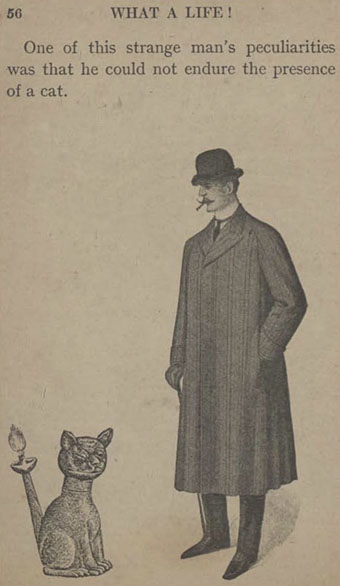
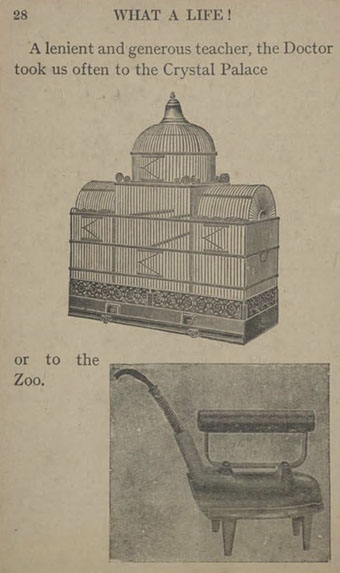
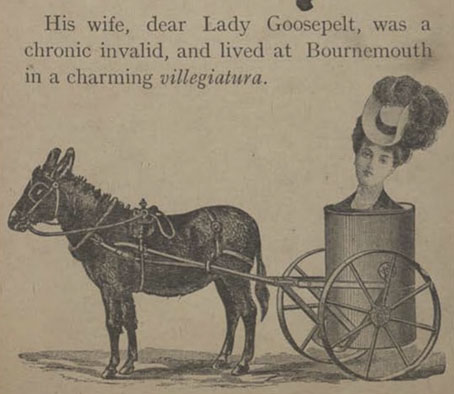
In last week’s post about Norman Rubington/Akbar Del Piombo I said that Rubington’s collages “were probably the first to use the form developed by Max Ernst for explicitly humorous purposes.” That “probably” was well-placed since it turns out that Rubington wasn’t quite the first to reuse engraved illustrations to comic effect, something I was unaware of until a few days ago. What A Life! An Autobiography (1911) is a short book credited to “EVL & GM”, or Edward Verrall Lucas and George Morrow, in which Lucas wrote captions for illustrations selected by Morrow from a catalogue for Whiteley’s, one of the first London department stores. The “autobiography” recounts the upbringing and adulthood of an English aristocrat, Baron Dropmore, with much of the humour being derived not from the text itself but from the mislabelling of various household items. Lucas and Morrow both worked for Punch magazine, and the humour is very much in the older Punch mode but given a fresh twist by the use of pre-existing illustrations.

whatalife2.jpg

In addition to the mislabelling there’s also some rudimentary collage work from Morrow which is easy to overlook after a century of similar examples. Whiteley’s catalogue seems to have been a more fertile source for this than the publications produced by the store’s rivals. I have a facsimile reprint of the 1895 catalogue for Harrod’s, a literal doorstop of 1000 pages. It’s a useful reference if you want to know how much the upper classes were paying for their goods in the Victorian era but it’s never been very good for collage purposes. This smaller Whiteley’s catalogue has many more illustrations plus a number of those florid title designs festooned with combination ornaments that you often find in 19th-century books.

whatalife3.jpg

The pages here are taken from a scan at the Internet Archive but What A Life! has been reprinted several times, including an edition published by Dover in 1975 for which John Ashbery provided an introduction. Ashbery enjoyed this kind of pictorial eccentricity; one of his art essays is The Joys and Enigmas of a Strange Hour, an appraisal of A Glove (1881) by Max Klinger, a series of etchings that prefigure the Surrealists in their dreamlike strangeness. Ashbery also made collages of his own, one of which, Summer Dream (2008), contains a detail borrowed from What A Life!

(Thanks to Allan and Andrew for the tip!)

Previously on { feuilleton }
Fuzz Against Junk & The Hero Maker
Nathaniel Krill at the Time Node
Initiations in the Abyss: A Surrealist Apocalypse
Wilfried Sätty: Artist of the occult
Illustrating Poe #4: Wilfried Sätty
Metamorphosis Victorianus
Max (The Birdman) Ernst
The art of Stephen Aldrich