Paisley patterns

paisley1.jpg

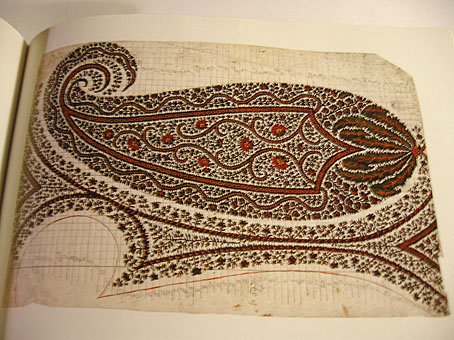
Kirking shawl design (1850).

December is a month when I normally shun the secondhand shops so as to avoid being taken for a cheapskate trying to save money while Christmas shopping. Sometimes it pays to break your own rules, however, as with this discovery, Paisley Patterns: A Design Source Book (Studio Editions, 1989) by Valerie Reilly. This falls into the class of those books you didn’t know you’d wanted for years until you hold it in your hands, being a marvellous history of the evolution of the Paisley pattern from its origin in Kashmiri shawls to its development among the shawl weavers in the Scottish town of Paisley (and elsewhere) during the 19th century. With 100 colour plates it’s impossible to give a fair representation of the book’s contents but many of the examples are astonishingly abstract and worlds away from what we normally consider Victorian design.
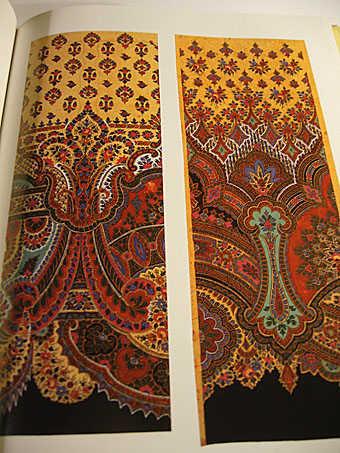
paisley2.jpg

Silk shawl design (1860).

The pre-psychedelic splendour of Paisley (and its “Oriental” character) was what led to its popularity during the 1960s. There was plenty of Paisley clothing around in the 1970s as a result, I had a particularly garish turquoise tie when I was about 11-years old and I think it was this which first set me wondering what the design was and who invented it. As Valerie Reilly notes, the boteh teardrop shape is a motif that’s as old as civilisation and its original use in patterns can’t be pinned to a single location. One of the nice things about this book is the quantity of shawl designs taken from the Paisley Museum that have sufficient detail for you to see how the pattern makers went about creating a design. The book is out of print but a swift search on Amazon reveals a couple of similar titles. The article below is a good overview of the evolution of the shawls and their designs.

Kashmir and Shawls of Paisley Design at Victoriana.com

Previously on { feuilleton }
Flowers of Love

Stevenson and the dynamiters

dynamiter.jpg

The Dynamiter: More New Arabian Nights (Longmans, London; 1914).

I’ve mentioned before that I’m a sporadic collector of the Tusitala Edition of Robert Louis Stevenson’s works, 35 small blue volumes published by Heinemann, London in 1924. I’ve found 15 of them so far and today turned up another one, volume 25, Virginibus Pueresque and Other Essays in Belles Lettres. Most of the ones I’ve collected are later reprints and this is no exception, being a sixth edition from 1928. The popularity of the series and the many reprint editions is the main reason they still appear with such frequency. Another reason is that these small pocket books, which were very common before and after the First World War, were well-made and have easily outlasted the first generation of paperbacks that eventually replaced them. I’d have no trouble ordering a complete set of the Stevensons from a book dealer but prefer to let chance find new additions. Given the dearth of good secondhand shops this is becoming increasingly difficult.

dynamiter2.jpg

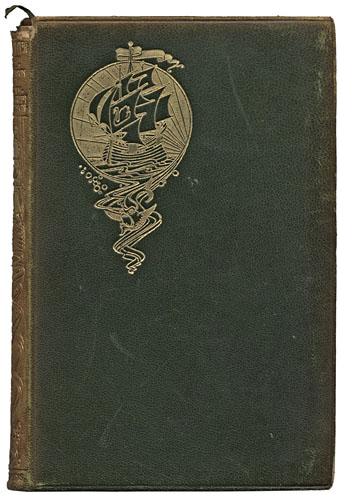
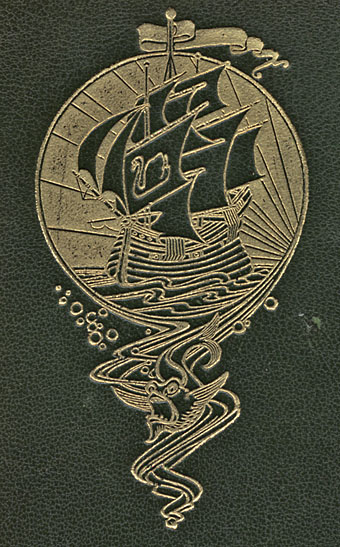
Also in today’s book haul was an earlier Stevenson, The Dynamiter: More New Arabian Nights, in a rather battered leather binding from 1914. I bought it almost solely for the Art Nouveau motif on the cover whose ship suits the author of Treasure Island but doesn’t really fit with the London setting of this particular book. I seem to recall having seen this design before which means it’s probably part of a uniform set like the Tusitala Edition, each volume of which bears a palm tree design on the spine and the signature of RLS blocked on the front board.

The only number of the Tusitala Edition I have in a leather binding is this book’s precursor, volume 1, New Arabian Nights. The Dynamiters is a collection of linked stories that Stevenson wrote with his wife, the Arabian Nights conceit being an attempt to transplant the telling of tall tales from medieval Baghdad to Victorian London. The dynamiters are a group of inept terrorists whose comic exploits were based on the real Fenian bombings that took place in London in the 1880s. A later attempted bomb attack on the Greenwich Observatory inspired the unsuccessful anarchists in Joseph Conrad’s The Secret Agent. Whatever some contemporary commentators might have us believe, terrorist attacks in cities are nothing new at all, only in Stevenson’s day they were labelled “dynamite outrages”. Stevenson dedicates his stories to the police officers charged with protecting the capital and apologises for making light of a serious matter. I have to wonder what he would have made of modern Baghdad being plagued by dynamite outrages on such a regular basis. And I also wonder how much real dynamite many of these Longmans’ books might have encountered, having been published just in time to be packed in the kit of soldiers going to the Western Front.

Elsewhere on { feuilleton }
The book covers archive

Previously on { feuilleton }
The Chronicles of Clovis and other sarcastic delights

The Age of Enchantment: Beardsley, Dulac and their Contemporaries

dulac.jpg

“Everything about her was white.” Illustration by Edmund Dulac for
The Dreamer of Dreams by Queen Marie of Roumania (1915).

A major exhibition of British fantasy illustration opens at the Dulwich Picture Gallery this Wednesday, running to February 17th, 2008. Considering the huge resurgence of popularity in fantasy for children I’m surprised none of the UK galleries have done this before now. The Dulwich organisers have chosen a suitably wintry picture by the wonderful Edmund Dulac to promote the exhibition which—intentionally or not—happens to look like a precursor of the poster art for The Golden Compass.

With the death of Aubrey Beardsley in 1898, the world of the illustrated book underwent a dramatic change. Gone were the degenerate images of scandal and deviance. The age of decadence was softened to delight rather than to shock. Whimsy and a pastel toned world of childish delights and an innocent exoticism unfolded in the pages of familiar fables, classic tales and those children’s stories like The Arabian Nights and Hans Andersens’ Stories. These were published with lavish colour plates and fine bindings: these were the coffee table books of a new age.

As a result a new generation of illustrators emerged. This new group of artists was intent upon borrowing from the past, especially the fantasies of the rococo, the rich decorative elements of the Orient, the Near East, and fairy worlds of the Victorians. The masters of this new art form were artists like Edmund Dulac and Kay Nielson, whose inventive book productions, with those of Arthur Rackham, became legendary. Disciples gathered, like Jessie King and Annie French, the Scottish masters of the ethereal and the poetic, the Detmold Brothers, masters of natural fantasy, as well as those who remained in Beardsley’s shadow: the warped yet fascinating works of Sidney Sime, a joyously eccentric coal-miner turned artist, Laurence Housman, master of the fairy tale, the precious inventions from the classics by Charles Ricketts, the Irish fantasies of Harry Clarke, himself a master of stained glass as well as the gift book, and the rich and exotic world of Alaistair. Children’s stories were transformed by the imaginations of a group still bowing to the Victorians Walter Crane, Randolph Caldecott and Kate Greenaway and the fairies of Richard Doyle but these were now given a more colourful intensity by Charles Robinson, Patten Wilson, Anning Bell, Bernard Sleigh and Maxwell Armfield.

The exhibition of British fantasy illustration will be the first such exhibition in Britain and the first worldwide for over 20 years (the last being in New York in 1979). All works, of which over 100 are planned, will come largely from British museums and private collections, many of these will never have been seen publicly before in Britain.

The exhibition is curated by Rodney Engen.

AS Byatt reviewed the exhibition for The Guardian and also looked at the sinister perversity underlying many of the Edwardian fairy tales.

Edmund Dulac at Art Passions

Books by Queen Marie of Roumania:
The Dreamer of Dreams (1915; illus: Edmund Dulac)
The Stealers of Light (1916; illus: Edmund Dulac)
Vom Wunder der Tränen (1938; illus: Sulamith Wülfing)

Elsewhere on { feuilleton }
The illustrators archive

Previously on { feuilleton }
Masonic fonts and the designer’s dark materials

New things for November II

newthings_0711.jpg

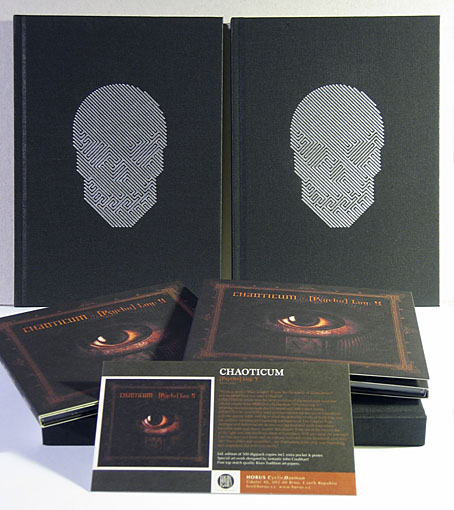
It’s always nice when something you’ve worked on turns up in the post and there’s been a double helping of that this week with the arrival of the Chaoticum CD and the catalogue for the Maison D’Ailleurs exhibition. Since both of these are either partly or wholly connected to HP Lovecraft, their simultaneous arrival is fitting.

The CD is a digipak on textured art paper and another quality production from Horus CyclicDaemon. The exhibition catalogue manifested as a small hardback book which was a pleasant surprise, with the skull maze design blocked in silver on the cover. Each artist is allotted a single page and the book also includes some original fiction based on Lovecraft’s story notes by a number of well-known writers. My picture is rather shrunken the way it’s positioned across the centre of a page (would have been better running vertically) but then it was my decision to make it so wide in the first place.

The Chaoticum CD is limited to 500 copies and can be ordered here. The catalogue is available from Maison D’Ailleurs or the Payot Libraire bookstore for CHF 37.00 + p&p (or 38, depending on which page you look at).

bishop.jpg

Also arriving this week is my illustration of ex-Sun City Girls guitarist Sir Richard Bishop for an Arthur Magazine interview by Erik Davis. Arthur #27 will be hitting the stands in the US and Canada shortly but for now you can download it in PDF form here.

Previously on { feuilleton }
Lovecraftian horror at Maison d’Ailleurs
New things for October

William Burroughs gives thanks again

wsb.jpg

I posted the text of William Burroughs’ Thanksgiving Prayer last year as there wasn’t a copy of Gus Van Sant’s film version available anywhere. YouTube has now filled that gap.

Previously on { feuilleton }
William Burroughs gives thanks
The Final Academy
William Burroughs book covers
Towers Open Fire