The Best of Michael Moorcock

mm1.jpg

The first of the books I’ve been designing for Tachyon Publications appears this month. Two more are due to follow and I’m working on another at the moment; more about those titles later.

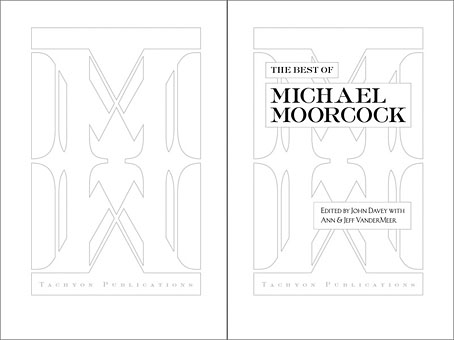
The Best of Michael Moorcock was a pleasure to be involved with not only because I’ve been reading Moorcock’s fiction for a very long time but I’ve also been fortunate during that time to get to know the writer and Linda Moorcock, his wife. Mike likes the work I’ve done in the past for Savoy Books and we did have an anthology of his favourite pieces by other writers planned for Constable & Robinson back in 2005. That book didn’t work out so this makes up for its cancellation. This is an excellent anthology, put together initially as a private enterprise by editor John Davey who managed the difficult task of compiling a collection which ranges over forty years of writing. Ann and Jeff VanderMeer came aboard as co-editors for the Tachyon edition.

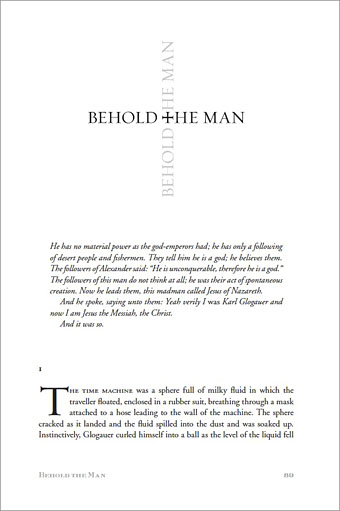
I’ve been working mainly on the interior design of the Tachyon volumes (although I’ve also done the cover for Jeff VanderMeer’s forthcoming Booklife) and for this title I took a cue from Ann Morn’s cover design which features a pair of gates emblazoned with large letter Ms. The title spread above takes the letter M from the typeface used for the author’s name and multiplies that to create an equivalent set of gates for the reader to pass through. I try to play down the pyrotechnics for fiction—the words are the important thing, not the graphic design—but since this was a story collection I thought I’d try illustrating each piece using the title typography alone. Most of these are done by using a suitable typeface but for a few pieces I managed to create an arrangement that reflected the story. Behold the Man (below) is the Nebula Award-winning story of a journey back in time to find the historical Jesus. The cross shape not only relates to the Biblical theme but also implies the crossed time streams and Moorcock’s layered, cross-cut narrative.
mm2.jpg

The Best of Michael Moorcock is available now from the usual sources and received a glowing review in the Guardian. Later this month, and other work permitting, I’m hoping to make a start on what will effectively be a companion volume, Savoy’s long-delayed Into the Media Web, another collection by John Davey which this time collects the best of Moorcock’s copious essays, reviews and other non-fiction.

Previously on { feuilleton }
Designing Booklife
The Sonic Assassins
Revenant volumes: Bob Haberfield, New Worlds and others
An announcement redux

Gramato-graphices

gramato-graphices.jpg

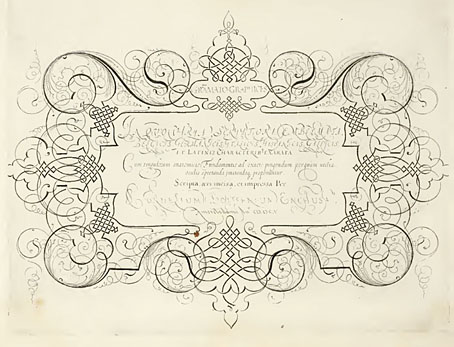
Or Gramato-graphices. In quo varia scripturae emblemata, belgicis, germanicis, italicis, hispanicis, gallicis characteribus exaata… scripta, aeri incisa, et impressa per Cornelium Boissenium Enchusanum to give the full title. A treatise on penmanship and calligraphy from 1605 by Cornelis Dirckszoon Boissens. Also another free scan at the Internet Archive. Searching for better reproductions turned up this stunning engraving by Boissens in the Rijksmuseum collection.

Elsewhere on { feuilleton }
The illustrators archive
The etching and engraving archive

Previously on { feuilleton }
John Bickham’s Fables and other short poems
Letters and Lettering
Studies in Pen Art
Flourishes

Marbled papers

endpapers.jpg

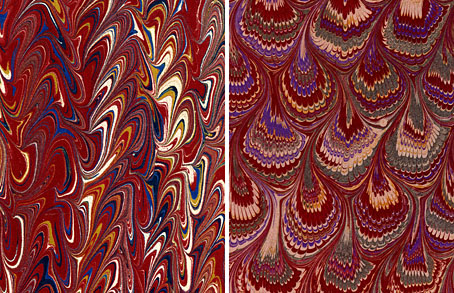
left: Serpentine pattern; right: Bouquet pattern, both 19th c.

Regular readers here will have seen a number of posts recently concerning psychedelic culture, a perennial fascination/obsession of mine. One of the notable qualities of movements such as psychedelia or Surrealism is the way they highlight what seem to be previous manifestations of themselves which, until their emergence, lacked a specific label. Borges examined the literary version of this phenomenon in his 1951 essay, Kafka and His Precursors. In art and design, the vivid and chaotic appearance of psychedelic visuals cause us to class certain products of earlier centuries as psychedelic even though they were never intended as such. The Victorian era is especially rich in this regard with its proliferation of Paisley textile designs—which saw a resurgence in the 1960s—the fractal cats of artist Louis Wain, and incredible marbled papers such as these, the samples above being from a University of Washington collection. Of particular interest is the details of their creation; the look is familiar enough but one rarely sees any mention of how paper manufacturers went about designing or even making new works. I selected a red and black marbled paper for the endpapers of The Adventures of Little Lou which we produced at Savoy Books in 2007. The sheets used for that book were handmade, not printed copies, and had to be ordered from a specialist supplier in Scotland.

Via Design Observer.

Previously on { feuilleton }
Paisley patterns
The Adventures of Little Lou

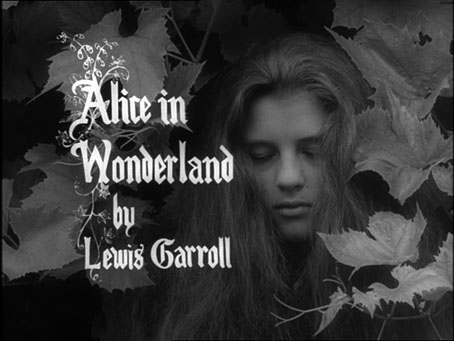
Alice in Wonderland by Jonathan Miller

miller1.jpg

I said, “Girl, you drank a lot of Drink Me,
But you ain’t in a Wonderland
You know I might-a be there to greet you, child,
When your trippin’ ship touches sand.”

Donovan, The Trip (1966)

Most of the key texts of the psychedelic period tend to be either non-fiction—Aldous Huxley’s Doors of Perception, Timothy Leary’s The Psychedelic Experience—or spiritual works such as The Tibetan Book of the Dead, the volume upon which Leary’s book is based and which subsequently provided John Lennon with lines for Tomorrow Never Knows. The key fictional work of the era has to be Lewis Carroll’s Alice in Wonderland, a fact that would no doubt have surprised the book’s legions of enthusiastic Victorian readers, never mind its author. Grace Slick created the definitive Alice song with White Rabbit in 1965, written while she was with the Great Society but only recorded properly in 1967 after she’d joined Jefferson Airplane. But Alice’s adventures run a rich seam of Victorian whimsy through the music of 1966 to ’69, especially among the British bands whose lyrics tend to be far more childish and frivolous than their American counterparts. Donovan probably got there first among the Brits with The Trip on his Sunshine Superman album. Among the profusion of later references can be found one-off singles such as Alice in Wonderland (1967) by the Dave Heenan Set (who recorded songs for the Barbarella soundtrack as The Glitterhouse) and Jabberwock/Which Dreamed It? (1968) by Boeing Duveen & The Beautiful Soup, a band whose songwriter is better known today as Hank Wangford.

Continue reading “Alice in Wonderland by Jonathan Miller”

Penguin science fiction

drought.jpg

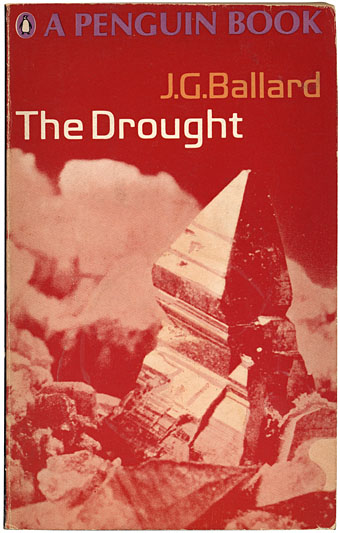
The Drought, 1968; design by Richard Hollis, photography by Dr. J Comroe.

James Pardey contacted me earlier this week announcing his site devoted to Penguin Books’ science fiction covers. I posted some of my own dishevelled copies a while back and this news gives me an excuse to throw up another Ballard cover. Pardey’s site is just the kind of thing I enjoy seeing, with a comprehensive collection and detailed notes for each design. The front page is especially good since you can see immediately how the look of the titles evolved, from spare layouts and pictorial covers through to bold graphic design which culminates in David Pelham’s great run as designer during the 1970s. Creative Review posted a talk Pelham gave a couple of years ago which explores his work at Penguin and touches on the covers he did for Ballard. A shame they didn’t do a complete set of Ballard’s titles at the time, I’d have loved to see how he treated the other books.

Elsewhere on { feuilleton }
The book covers archive

Previously on { feuilleton }
Penguin Labyrinths and the Thief’s Journal
Penguin Surrealism
Penguin book covers