L’Hôtel, Paris

lhotel1.jpg

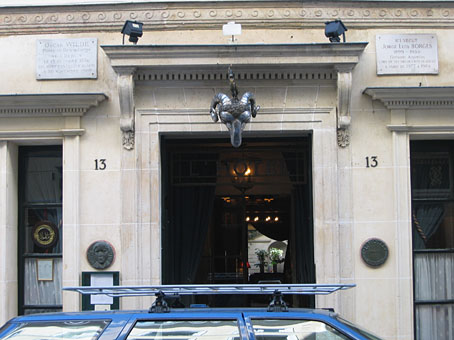
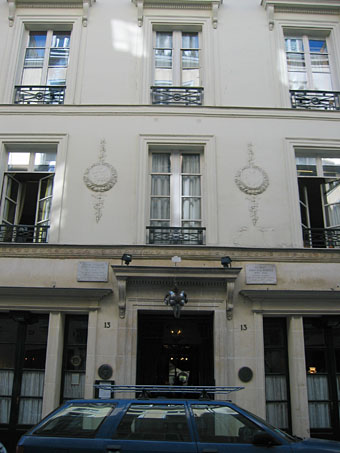
The London broadsheets have been in a ferment for the past few days over a forthcoming exhibition at the V&A, The Cult of Beauty: The Aesthetic Movement 1860–1900 which opens on April 2nd. The Guardian‘s Jonathan Jones wrote a piece pointing out the French associations of the British Aesthetes in which he mentions the Hôtel d’Alsace at 13 Rue des Beaux-Arts, Paris, the place where Oscar Wilde spent his last few months in 1900 prior to expiring in room no. 16. By coincidence I’d been looking at my own photos of the hotel only the day before so here they are, little more than snapshots but they give an idea of the building at least.
lhotel2.jpg

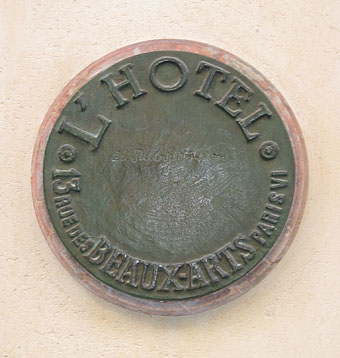
The hotel is now merely L’Hôtel, and I had a couple of surprises when I went to find the place the last time I was in Paris. The first is that the Rue des Beaux-Arts is some distance away from any main thoroughfares, although this perhaps isn’t so surprising given Wilde’s straitened circumstances. The second was seeing a plaque to Jorge Luis Borges (see below) on the wall opposite the one for Oscar Wilde with its incorrect year of birth. Borges had a lifelong fascination with Wilde, the first piece he had published was a translation into Spanish of The Happy Prince (and The Modern Word has a short essay by Borges about Wilde). I knew that Borges had stayed in the hotel (there’s a famous photo of him standing in the atrium) but didn’t expect his patronage to be commemorated in this way; once again, Paris has a respect for writers that puts many other cities to shame. Wilde is celebrated with two plaques—there’s another beside the door which can be seen here—but what these pictures don’t show is the atrium itself, a small space in the centre of the building which gives the hotel a distinction Wilde might have appreciated even if he would have preferred to spend his final hours in one of the more luxurious establishments.

There are more views of the narrow Rue des Beaux-Arts at Google Maps while the hotel has a website here.
lhotel3.jpg

Continue reading “L’Hôtel, Paris”

The Vengeance of Nitocris

weirdtales.jpg

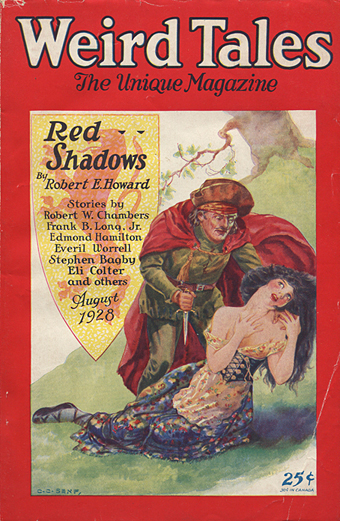
Cover illustration by CC Senf.

In her mind the queen Nitocris was seeing a ghastly picture. It was the picture of a room of orgy and feasting suddenly converted into a room of terror and horror, human beings one moment drunken and lustful, the next screaming in the seizure of sudden and awful death. If any of those present had been empowered to see also that picture of dire horror, they would have clambered wildly to make their escape. But none was so empowered.

Everyone today will be marking the Tennessee Williams centenary by noting his theatre work, of course, or his subversive celebration of outsiders and, yes, the gays. I’ll confine myself to reminding people that Williams’ first published work was a short story entitled The Vengeance of Nitocris in Weird Tales for August 1928, written when he was only 17. The story reads like the work of a teenager but editor Farnsworth Wright evidently enjoyed an atmosphere of lurid Egyptian melodrama which you can appraise for yourself here. Also in this issue was the debut appearance of Robert E Howard’s Solomon Kane, and The Demoiselle d’Ys by Robert Chambers. Seeing the name Nitocris I have to wonder whether Williams chose it after reading HP Lovecraft who used the name twice in earlier stories published in the same magazine, Imprisoned With the Pharaohs (1924) and The Outsider (1926). That last piece was one of Lovecraft’s most popular tales, and it’s easy to imagine its grotesque parable of alienation making an impression on a would-be writer who, as a gay youth, would have looked upon himself as another kind of outsider.

Previously on { feuilleton }
The King in Yellow

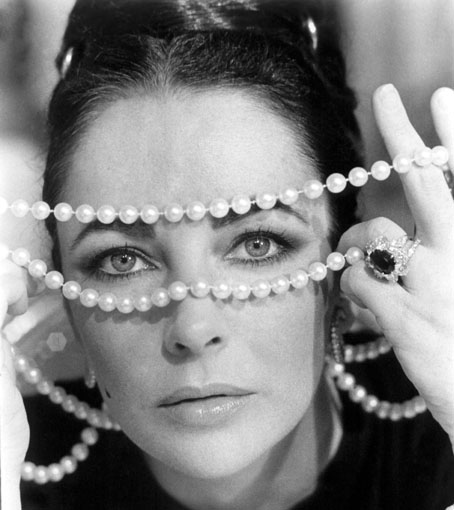
Elizabeth Taylor, 1932–2011

liz.jpg

Remember her for her incomparable beauty, her great performances in great films, the camp confections like Cleopatra and Boom, and years of activism on behalf of gay people:

There is no gay agenda, it’s a human agenda. Why shouldn’t gay people be able to live as open and freely as everybody else? What it comes down to, ultimately, is love. How can anything bad come out of love? The bad stuff comes out of mistrust, misunderstanding and, God knows, from hate and from ignorance.

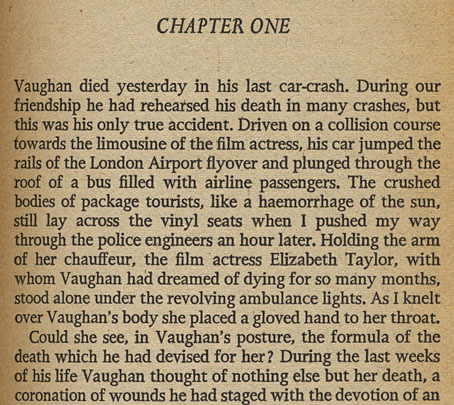
It would also be remiss of me (since no obituaries will be tasteless enough to mention it) if I didn’t note her presence at the heart of one of the more notorious novels of the past fifty years. I often used to wonder whether anyone had told her about Crash. Not that she’d want to know about it if they did; who would be eager to read detailed plans for their own horrific death? But it was her status as a 20th century icon, the nonpareil of film stardom, that made her the perfect choice as the focus of Vaughan’s obsessions in Ballard’s novel.

crash.jpg

Elizabeth Taylor: a career in clips
RIP Elizabeth Taylor: A Ballardian Primer

Thomas Mackenzie’s Aladdin

aladdin1.jpg

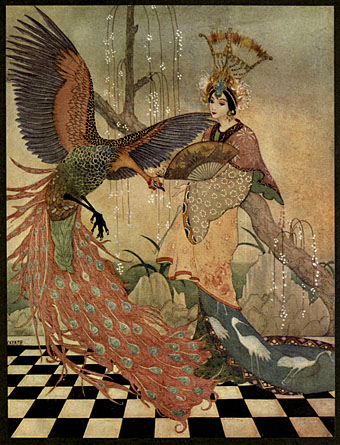
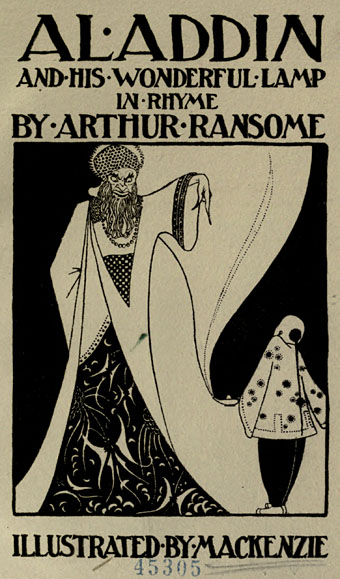
The tip for this one came via Beautiful Century. Thomas Mackenzie (1887–1944) was a minor British illustrator whose work I hadn’t seen before, and if I’d seen the picture above uncredited I might have taken it for something by Kay Nielsen or Edmund Dulac. Mackenzie’s colour plates for the 1919 edition of Aladdin and His Wonderful Lamp in Rhyme by Arthur Ransome are very similar to his more famous contemporaries, while the black-and-white pieces owe a considerable debt to Aubrey Beardsley, especially the title page below. Not all the drawing is as assured as one might hope but the book as a whole is still worth a look.

aladdin2.jpg

Continue reading “Thomas Mackenzie’s Aladdin”

Weekend links 51

narcissus.jpg

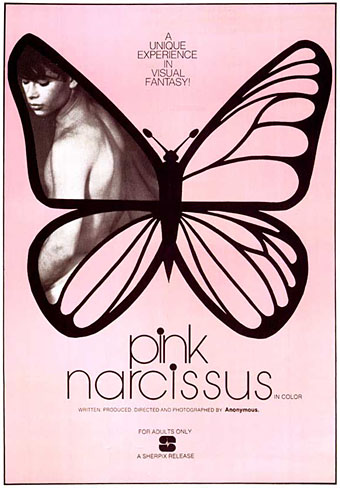
James Bidgood’s luscious and erotic micro-budget masterpiece Pink Narcissus (1971) receives a screening at the IFC Center Queer/Art/Film festival, NYC, on Monday. The film is presented by Jonathan Katz, curator of the Hide/Seek gay art show whose controversial history was recounted here in December. The NYT ran a short piece about Bidgood, now 77 and not the first artist to be disappointed by his past work; they also have a Bidgood slideshow. Hide/Seek, meanwhile, is now a touring exhibition.

• Related: the delightful Drew Daniel of Matmos (and Soft Pink Truth) posing in a jockstrap at the Club Uranus, San Francisco circa 1990; he also used to go-go dance wearing a fish.

• The Isle of Man may have one of the oldest parliaments in the world but its laws have often been out of step with its neighbour across the Irish Sea. This week the island joined the rest of the UK in granting civil partnerships to its citizens. Now the name whose punning appeal so delighted James Joyce doesn’t seem as inappropriate.

Howard Jacobson: “The novelist Yukio Mishima posed pointing a Samurai sword to his chest and ultimately had himself beheaded in public. This is what’s called taking your art seriously.”

hutter.jpg

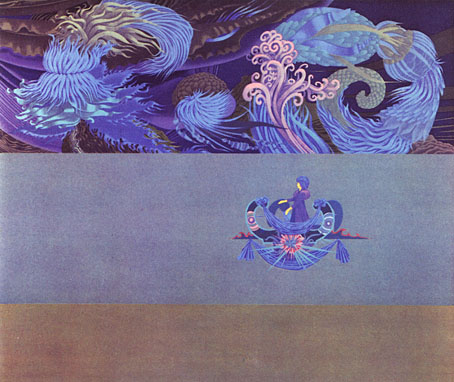
The Realm of the Queen of the Night (1974) by Wolfgang Hutter from Zauberflote at 50 Watts.

The revelatory operations of the chance encounter lie at the heart of le merveilleux (“the marvelous”)—the Surrealist conception of beauty. You find something marvelous in the world (an object, an image, a person, a place) that corresponds, like a piece clicking into a puzzle, to a deep inner need.

Slicing Open the Eyeball: Rick Poynor on Surrealism and the Visual Unconscious by Mark Dery.

Boy from the Boroughs: Alan Moore interviewed by Pádraig Ó Méalóid; Michael Moorcock interviewed at Suicide Girls.

• Illustrations from Quark, the anthology of speculative fiction edited by Samuel Delany & Marilyn Hacker in 1970.

The Residents, sans masks, filmed at their San Francisco home in the 1970s.

• Bach’s Toccata and Fugue in D minor played on a glass harp.

What art can do for science (and vice versa).

• You can never have too much Virgil Finlay.

• Lydia Kiesling reviews Lolita.

Alain Resnais film posters.

Red Mug, Blue Linen.

No GDM (dub version) (1979) by Gina X | L. Voag’s Kitchen (2004) by Soft Pink Truth.