Weekend links 193

gauger.jpg

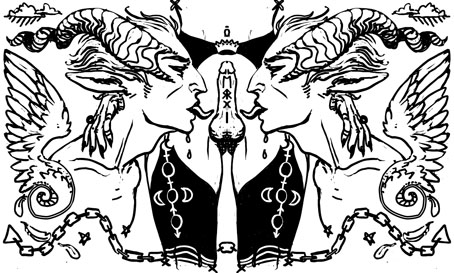
A Problem Glyph by Eliza Gauger. Problem Glyphs are “symbolic illustrations … drawn in response to problems sent in by tumblr users”.

Kosmische Night takes place at the Museum of Bath at Work, Bath, Somerset, on January 25th (Rescheduled to February 22nd).  “…a celebration of all things Teutonic for anyone who enjoys Neu!, Can, Tangerine Dream, Stockhausen and Kraftwerk,” say the organisers. Also on the bill, The Electric Pentacle, a Carnacki-esque collaboration between Narco Lounge Combo and The Levels.

• Shock Headed Peters’ Fear Engine II: Almost As If It Had Never Happened. Joe Banks on Karl Blake, “…one of the most fascinating and colourful characters to emerge from the fertile loam of the post-punk scene”.

• “The great question in the film and the tale is not the existence of the ghosts but the way the governess understands their no-longer-lived lives and desires.” Michael Wood on The Innocents.

Nobody, however, is a greater authority on the intersection of porn and alternative spirituality than Annie Sprinkle. Beginning as a prostitute in the 1960s and 70s, she entered porn in the pre-AIDS era and made over two hundred films. She then jumped into a career as a sex-positive author and educator, which brought her into close conflict not only with feminists like Andrea Dworkin and Catharine MacKinnon, but also right-wing patriarch Jesse Helms, who denounced one of her sex magick performance pieces on the floor of the Senate. For Sprinkle, both sexuality and performance are explicitly spiritual and magical, part of her role as a cultural shaman.

In the Valley of the Porn Witches by Jason Louv.

Stars of the Lid and Wordless Music Orchestra playing for two hours last month at the Basilica of Our Lady of Perpetual Help in Sunset Park, Brooklyn.

Rick Poynor on the late Martin Sharp’s contributions to People, Politics and Pop: Australians in the Sixties (1968) by Craig McGregor.

Maggie Greene on The Woman in Green: A Chinese Ghost Tale from Mao to Ming, 1981–1381.

• “TED actually stands for: middlebrow megachurch infotainment,” says Benjamin H Bratton.

Geoff Manaugh on how corpses helped shape the London Underground.

Tony White on Eduardo Paolozzi at New Worlds by David Brittain.

• Mix of the week: Secret Thirteen Mix 102 by Frank Bretschneider.

• At Dangerous Minds: film of Syd Barrett‘s first psychedelic trip.

NYPL Wire: a New York Public Library Tumblr.

Microbial art by Eshel Ben-Jacob and others.

Interstellar Rock: Kosmische Musik (1974) by The Cosmic Jokers | I, Bloodbrother Be (1984) by Shock Headed Peters | Obscene and Pornographic Art (1991) by Bongwater
Robert Louis Stevenson’s Moral Emblems

rls01.jpg

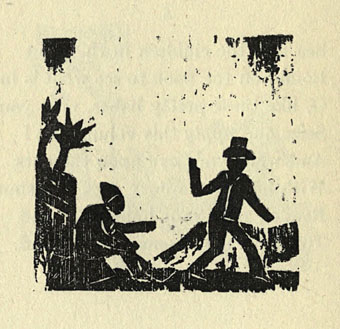
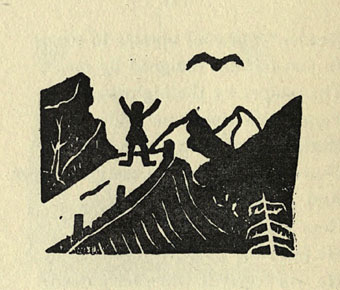
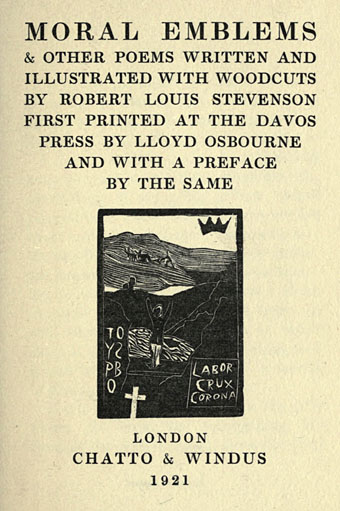
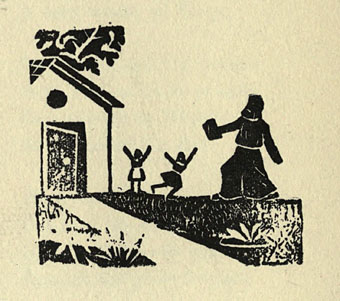
Being the owner of half the volumes in the Tusitala Edition of Robert Louis Stevenson’s collected works I’m not exactly unacquainted with the author’s books but this is one I hadn’t seen before. It is included in the Tusitala set (vol. 22) but this is one of the books I don’t own. The Moral Emblems & Other Poems Written and Illustrated with Woodcuts were published originally in Edinburgh Edition in 1898. The copies here are from a book edition prepared by Stevenson’s stepson, Lloyd Osbourne, in 1921. The 35 Tusitala volumes followed in 1924. Stevenson enjoyed sketching while on his travels so these crude woodcuts aren’t without precedent even if he didn’t make a habit of adding illustrations to his writing.

Emblem books were a popular form of moral instruction from the 16th century on. This particular example shares some of the pious qualities of its ancestors albeit with a wry attitude typical of its author. Regarding a man (“who might be you or me”) who pushes another into the sea, we’re told “And he will spoil his evening toddy / By dwelling on that mangled body.” The verses being written some years after Treasure Island, pirates appear in a couple of places, especially in the last sequence: Robin and Ben: Or, The Pirate and The Apothecary. The final illustrations aren’t as successful as his rough little vignettes but for someone with no reputation as a draughtsman they’re better than you’d expect. See the rest of the book here or download it here.

rls02.jpg

rls03.jpg

rls04.jpg

Continue reading “Robert Louis Stevenson’s Moral Emblems”

The weekend artists, 2013

fournier.jpg

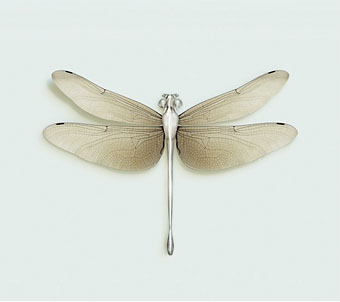
“Chloromgonfus detectis, a dragonfly that can detect volatile pollutants.” A speculative insect by artist Vincent Fournier.

The annual review of artists/designers/photographers featured in the weekend posts should have run at the end of December but MR James got in the way. Big thanks, and happy new year to Form is Void and Beautiful Century for pointing the way to many of these people.

strongowski.jpg

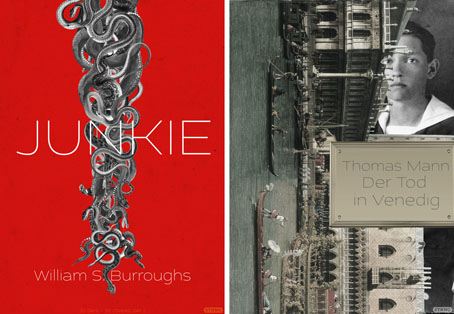
Two cover designs from Eliash Strongowski’s 30 Days—30 Covers project.

gebbie.jpg

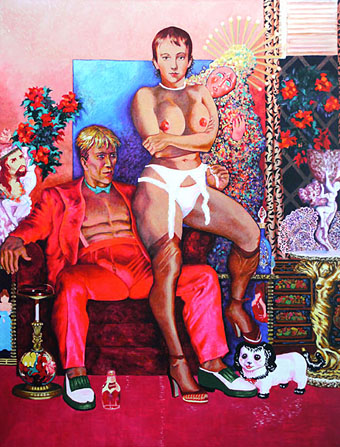
Pink Boy by Melinda Gebbie.

lipton.jpg

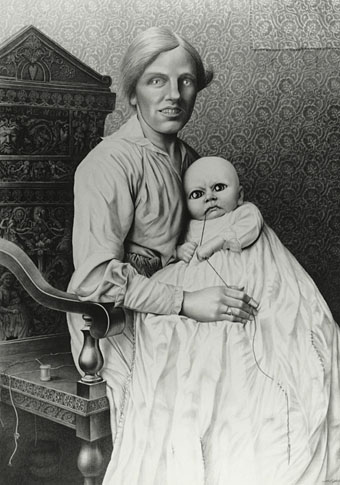
Seam Stress (1987) by Laurie Lipton. The Drawings of Laurie Lipton is out now from Last Gasp.

blackwell.jpg

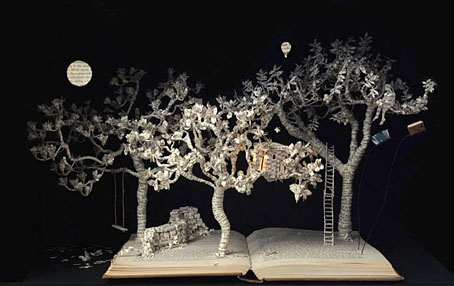
The Baron in the Trees (2011), a book-cut sculpture by Su Blackwell.

Continue reading “The weekend artists, 2013”

Abbeys by MR James

abbeys01.jpg

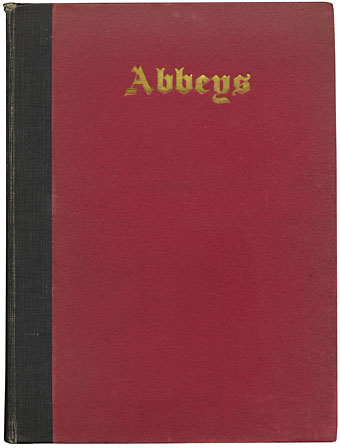
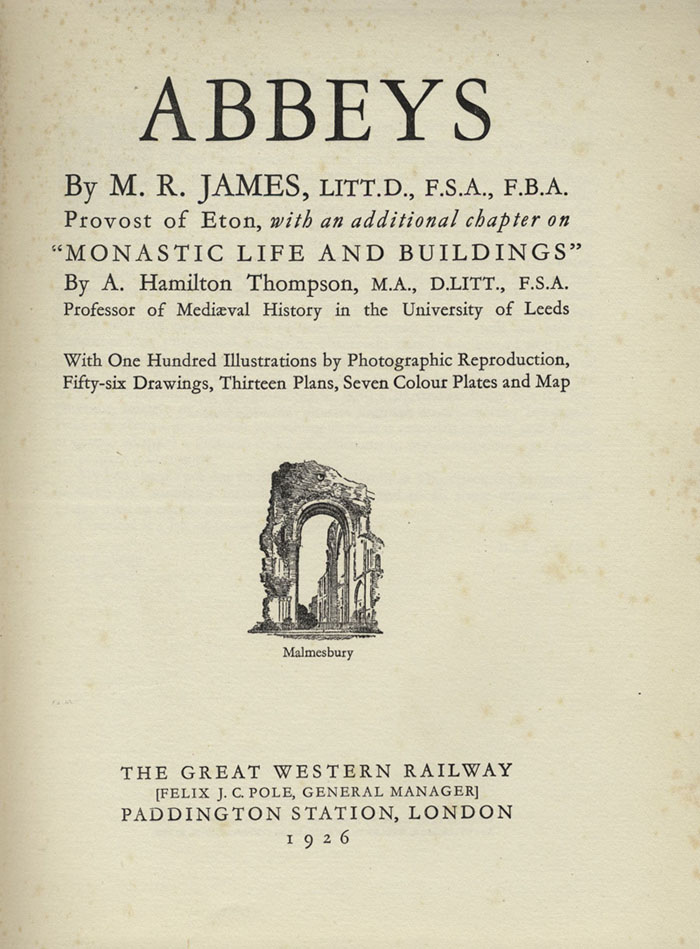
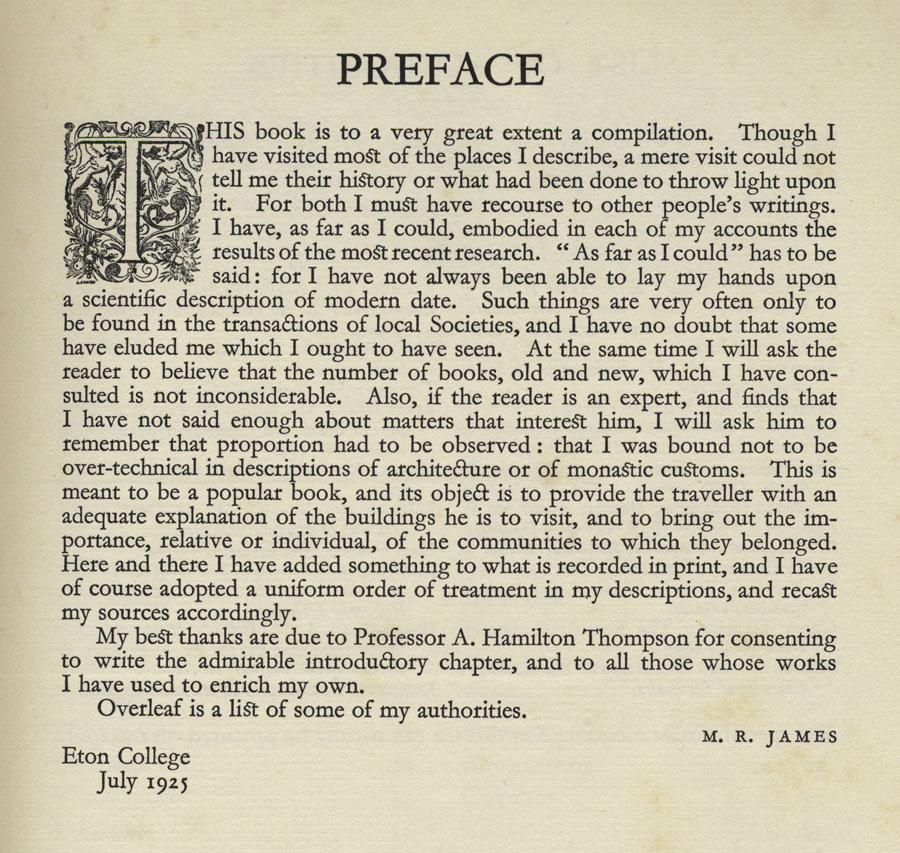
MR James is remembered today for his ghost stories but the four collections published during his lifetime represent a small percentage of his written work. His scholarly studies inform his stories, of course, but they also contribute to a pair of popular non-fiction books which have peripheral associations with the ghost collections: Suffolk and Norfolk: A Perambulation of the Two Counties with Notices of Their History and Their Ancient Buildings (1930) is a guide to the low-lying eastern counties where a number of the stories are set; Abbeys (1925) is a guide to the monastic ruins of the south-western counties and central England, locations which the author and his characters would enjoy visiting. This is a favourite book of mine, and one I often recommend to James enthusiasts.

abbeys03.jpg

Abbeys is one of a three-volume set of illustrated guides published by the Great Western Railway company in 1925, (my copy is a second edition from 1926) the other titles being Cathedrals (1924), with no author credited, and Castles (1926) by Charles Oman. The books detail the ancient attractions a traveller in Britain might wish to explore using the services of Great Western Railway. Many of the more celebrated buildings in England and Wales are covered but the lines only travel as far north as Manchester and as far east as London. In addition to photo plates and illustrations, each book contains a removable map of the rail network folded into a pocket inside the back of the book. The coloured boards (red for Abbeys, blue for Cathedrals and brown for Castles) are sturdy enough to withstand the rigours of travel.

abbeys02.jpg

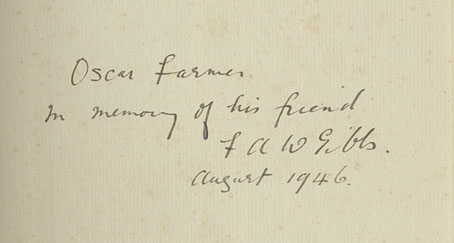
Another of those poignant inscriptions.

abbeys04.jpg

abbeys05.jpg

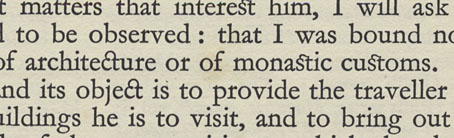
Although Abbeys lacks any credits for its photos and illustrations, Cathedrals states that the photos are the work of the railway’s staff photographers while the pen-and-ink illustrations are by William M. Hendy. There’s also a credit for the typographer, William Gordon Tucker, who not only provides many fine illuminated capitals but also uses ligatures for “ct” and “st”. Abbeys has an additional feature in the form of several fold-out plans of the larger buildings.

Continue reading “Abbeys by MR James”

The Tractate Middoth

tractate1.jpg

The recent interest in the BBC’s Ghost Story for Christmas series has been a thing of mixed blessings, as is often the case when nostalgia fuels a reappraisal. On the one hand aficionados such as myself no longer have to hoard and swap rare tapes or video files now that the BFI has made all the films available on DVD; the interest in those films, and in similar works, has had the additional benefit of resurrecting related TV dramas and series such as Dead of Night (1972), and Leslie Megahey’s exceptional Schalcken the Painter (1979).

On the debit side, the revival of the series in 2005 has been a patchy affair, with results ranging from the very good (A View from a Hill), to the not-so-bad (Number 13), to the disgracefully bad (the 2010 adaptation of Whistle and I’ll Come to You). All these dramas continue the tradition of adapting stories by MR James, a writer whose work is now the first choice for any future stories in the series, and whose oeuvre overshadows that of other possible candidates for adaptation. Whether this last development is a good or bad one depends on your view of James’s fiction.

tractate2.jpg

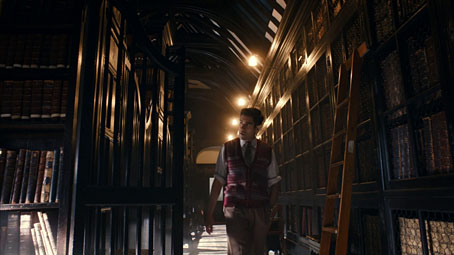
Sacha Dhawan among the dusty tomes.

This year we had a new James adaptation, The Tractate Middoth, written and directed by Mark Gatiss, followed by an hour-long documentary about MR James which Gatiss presented. Gatiss and his League of Gentlemen colleagues have been vocal in their enthusiasm for the British film and television ghost story, and for its literary antecedents: last year the team contributed a commentary track to the recent reissue of Blood on Satan’s Claw; League writer Jeremy Dyson has an essay in the BFI’s DVD/BR release of The Innocents; Reece Shearsmith has recorded several readings of Robert Aickman’s superb short stories; Dyson directed, and Gatiss acted in, The Cicerones (aka The Guides, 2002), an adaptation of an Aickman story. The latter was well-intentioned but a short running time combined with a very literal transcription of Aickman’s ambiguities made for a disappointing end result. The Cicerones made me apprehensive for what we might see with The Tractate Middoth but I’m pleased to report that all concerns were unfounded: Gatiss’s film is not only the best MR James adaptation since The Ash Tree (1975) but is the best film in this series since The Signalman in 1976. (Although Schalcken the Painter was screened during Christmas 1979 it wasn’t intended as a continuation of the Christmas ghost stories.) This bodes well for the future of the series, and confirms the importance of having a writer and director with a sympathy for the material.

Continue reading “The Tractate Middoth”