More vapour trails

jeter.jpg

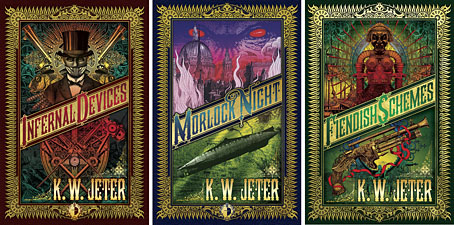
Those covers everyone likes. My designs for KW Jeter’s steampunk novels from Angry Robot and Tor Books.

When I wrote a brief history of steampunk for Eye magazine last year I ended by somewhat provocatively declaring that until something better appeared this was the defining aesthetic of the moment. A year later, the movement (if we can use that term) continues to evolve despite the steady drip of complaints that it’s all reactionary, historically illiterate, and so on. Much of the ire remains nonsensical, and often seems to boil down to a common disdain for people enjoying themselves in some unorthodox manner.

manual.jpg

Design by Galen Smith after the Hetzel editions of Jules Verne’s novels.

If I hadn’t got involved on the art side I would have found it difficult to avoid being attracted by steampunk in one form or another since so much of it originates in areas I was already interested in, not least HG Wells and Victorian science fiction. The rapid evolution of the past few years means we’re currently seeing an aesthetic leaving behind its origins to become an international subculture. What’s striking about this activity—and this is something that doesn’t seem to have been discussed very much—is the way the whole thing has been birthed by genre fiction rather than by pop music, as was the case for the second half of the 20th century. This piece is meant to be a news post, however, not another cultural critique, but if I happen to write any more on the subject there’s something there that’s worth exploring.

manual2.jpg

As to the news: this month finds my steampunk artwork manifesting in three very different locations in one of those odd coincidences of timing that occur now and then. First up there’s the Steampunk User’s Manual edited by Jeff VanderMeer & Desirina Boskovich, a follow-up to 2011’s Steampunk Bible. For the new volume I designed spreads for three entries by Jess Nevins from The Encyclopedia of Fantastic Victoriana: Alternative History Edition.

Continue reading “More vapour trails”

Weekend links 228

moss.jpg

White, Red and Black (1949) by Marlow Moss.

• British television’s greatest director, Alan Clarke, rates on the cult scale here for his work on Penda’s Fen but his career was long, uncompromising and still hasn’t received the full appraisal it deserves. His more violent dramas—Scum, Made in Britain, The Firm, etc—have all appeared on DVD but many of his less notorious films can be hard to find. Paul Duane looks back at the remarkable Contact (1985), an hour-long study of the conflict in Northern Ireland, and a better film about soldiering than any number of big-budget features.

• I’ve wondered for years why one of the Daft Punk helmets seemed so familiar. It’s because they swiped the design from industrial designer and visual futurist, Syd Mead. Mark Wilson talked to Mead about wearable technology; Mr Mead, it seems, isn’t impressed by the French popsters. Related: paintings from Mead’s Sentinel (1979), and Syd Mead designs at Pinterest.

• Remembering that time in 1982 when Alan Moore interviewed Hawkwind. More interviews: Adam Bychawski talks to Jenny Hval about “sonic extremity, the violence of voyeurism and inhabiting bodies”, and Laurent Fintoni talks to (that man again) Bernard Szajner about Visions Of Dune, laser shows, and finding his way back to music.

Our attitudes towards work are extremely schizophrenic: we secretly aspire to sloth, while we loudly praise work. There isn’t an election poster that doesn’t promise more jobs. The call for more work is similar to the Stockholm syndrome, in which the victims of hostage-taking eventually develop a positive relationship with their captors.

Patrick Spaet on the universal employment fetish

• “Marlow Moss was one of Britain’s most important Constructivist artists…a radical lesbian and Drag King,” says Dal Chodha. An exhibition of Moss’s work has just opened at Tate Britain. Related: Marlow Moss: forgotten art maverick.

Yuki Koshimoto plays the Hang, aka the Spacedrum. Via Metafilter where there are more Hang links. The instrument was prominently featured in the score Cliff Martinez wrote for Solaris (2002).

• Broadcast’s Trish Keenan would have been 46 last week. James Cargill posted two demo songs for her birthday.

• At the BFI: Exclusive materials from the making of Powell and Pressburger’s The Tales of Hoffmann.

• Of Tutus and Tortures: Thoughts on the Decadent and the Weird by Christopher Burke.

Faber has launched a Modern Classics imprint with some smart cover designs.

• At Dangerous Minds: Good to see big scans of the Surrealists’ playing cards.

• Mix of the week: Afrofuturist Flowering by Nigel Rampant.

• Writer and editor Russ Kick has a new website.

Infographic: Why Readers Still Prefer Paper.

Superficial Music 1–3 (1981) by Bernard Szajner | Fahrenheit 451 (1982) by Hawkwind | Black Lake (2014) by Jenny Hval & Susanna

George Barbier’s Mirages

barbier1.jpg

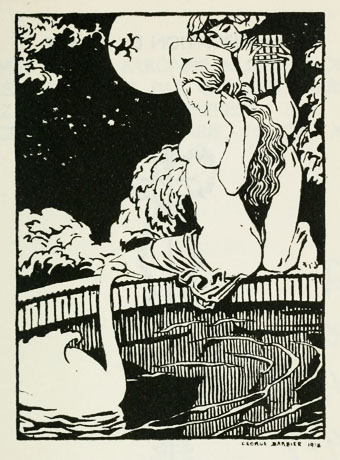
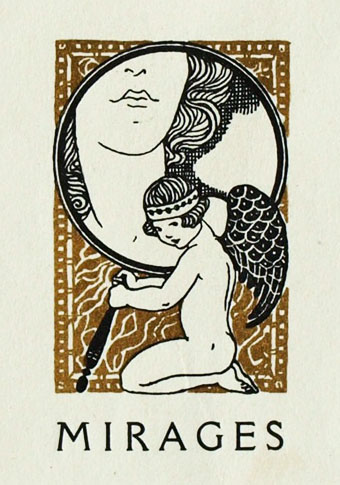
Mirages (1919) is a book of poems by Renée de Brimont with illustrations by George Barbier, an artist whose work has featured here on several occasions. This is a minor addition to the Barbier oeuvre with fewer illustrations than I would have hoped for, a handful of designs that show a different style to his more familiar pochoir prints. Many illustrators vary their styles—even Beardsley did—but Barbier seemed happy maintaining a single drawing style. (Note: The copy of this book at the Internet Archive is missing the cover picture above.)

barbier2.jpg

barbier3.jpg

Continue reading “George Barbier’s Mirages”

Shapeshifters

arvin.jpg

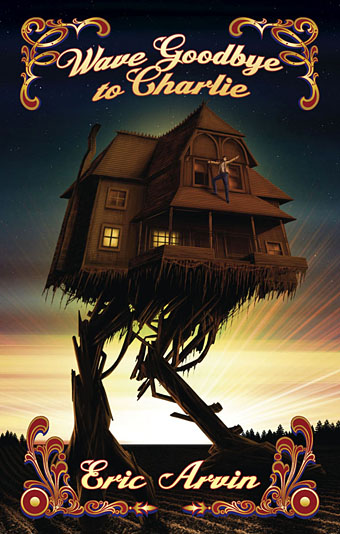
Time for another work update. These are three covers for fantasy novels from LGB imprints due for release in the next week or so. The brief for Eric Arvin’s cover was walking house plus some kind of fairground (or carnival) decoration. I found a nice trove of fairground art at Sheffield University but the picture was working so well I didn’t want to clutter it with extraneous detail. Wave Goodbye to Charlie is published by Wilde City Press.

hale1.jpg

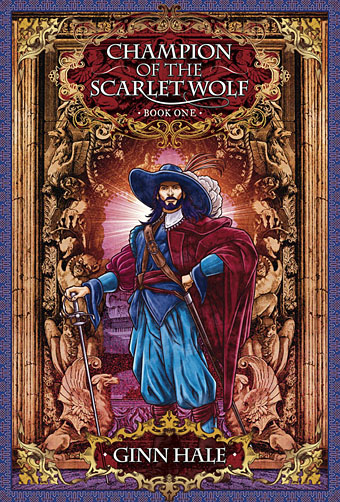
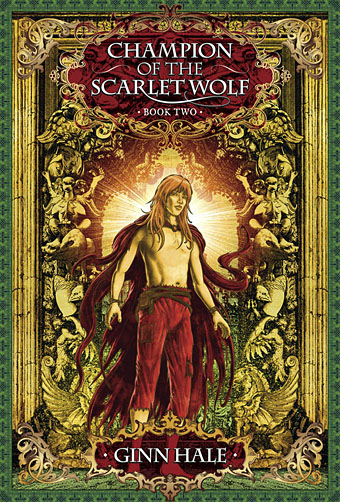
And speaking of extraneous detail… Ginn Hale’s books continue a series featuring swashbuckling, shapeshifting characters, witches and the like. (There’s also a witch in Eric Arvin’s novel but she drives a Buick.) I spent a great deal of time collaging bits of gargoyles and statuary from A. Raguenet’s six-volume Materials and Documents of Architecture and Sculpture (1915) into two elaborate arch designs…then covered them over. This is a bad habit but at least everything ended up in the finished artwork. My other bad habit is spending ages creating something only to place it into the composition and find it doesn’t work at all… Ginn Hale’s novels are published by Blind Eye Books.

hale2.jpg

The Bowmen by Arthur Machen

bowmen.jpg

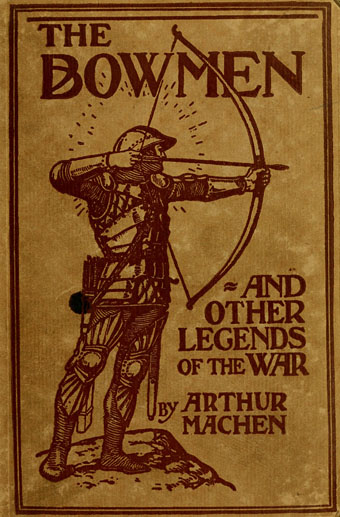
The Bowmen was a short piece of fiction by Arthur Machen published in a London newspaper, The Evening News, on the 29th September, 1914. By Machen’s standards it’s not one of his best pieces, written at a time when he was working at the paper as a journalist. The First World War was in its early days, and the story was conceived as a Kipling-like morale-boost following the retreat of British forces at Mons a few weeks before. The stories for which Machen is remembered today had never provided the success he hoped for so it must have been a surprise when his invention of angelic bowmen appearing during the battle gained him national attention:

On the last Sunday in August, 1914, Machen read in his morning paper of the retreat from Mons.

“I no longer recollect the details, but I have not forgotten the impression that was then made on my mind. I seemed to see a furnace of torment and death and agony and terror seven times heated, and in the midst of the burning was the British army: in the midst of the flame, consumed by it, scattered like ashes and yet triumphant, martyred and for ever glorious.”

That was the way, indeed, in which the English thought about the army at the beginning of the Great War; since then we have come to take a less romantic view of warfare. With this picture in his mind, Machen conceived and wrote a story called The Bowmen, told, as most stories are, as if it were true—that is, he did not begin by saying: “what you are about to read is all my own invention”—in which St. George with an army of English mediaeval bowmen appeared at the critical moment to cover the British retreat. Not, to be sure, a very probable story nor, as Oswald Barron pointed out, was it likely that the Agincourt bowmen, most of whom came from Wales, would use the French expressions Machen evokes from them: and Machen himself felt he had not done justice to his original conception.

“But if I had failed in the art of letters, I had succeeded, unwittingly, in the art of deceit.”

The Bowmen appeared in The Evening News on September 29th, 1914, at a moment when people were looking for a miracle, and many promptly embraced it as an account of one. That such journals as The Occult Review and Light should fasten on it, might have been anticipated; but it was taken up by parish magazines all over the country, and people came forward on every side to say that they had friends and relatives who had seen the “Angels of Mons” with their own eyes. As a result, Machen became, for the first time in his life, a man of nation-wide fame. To thousands of people, the idea, whether true or false, gave consolation or hope, but when Machen protested that his story was entirely the child of his own imagination, the fame threatened to turn to notoriety; he was rebuked for his impudence at claiming originality for the tale. Nevertheless a legend had been born and a shoal of publications appeared to satisfy public demand—On the Side of the Angels (Harold Begbie), Guardian Angels (GP Kerry—a sermon reprinted), Angels, Saints and Bowmen of Mons (IE Taylor, Theosophical Publishing Society).

Aidan Reynolds & William Charlton in Arthur Machen: A Short Account of His Life and Work (John Baker, 1963)

Continue reading “The Bowmen by Arthur Machen”