Cthulhu under glass

bl-exhibition.jpg

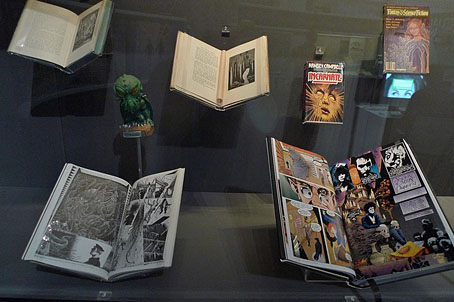
Having had two separate visitors to the British Library’s Out of this World exhibition tell me that some of my work was featured there, it’s been a good to finally discover what was on display. Many thanks to John Keogh for notifying me of his exhibition photo set which includes the above shot of the relevant display case. This is an odd collection for what’s been widely advertised as a science fiction event. Pages from my 1988 adaptation of The Call of Cthulhu are in there along with other fantasy and horror titles including Neil Gaiman’s Sandman, Incarnate by Ramsey Campbell, an edition of Fantasy & Science Fiction with Robert Holdstock’s Mythago Wood on the cover, and a Sidney Sime illustration for Lord Dunsany’s Gods of Pergana. Cthulhu originates out of this world, of course, and that phrase is general enough to encompass other genres.
coulthart-cthulhu.jpg

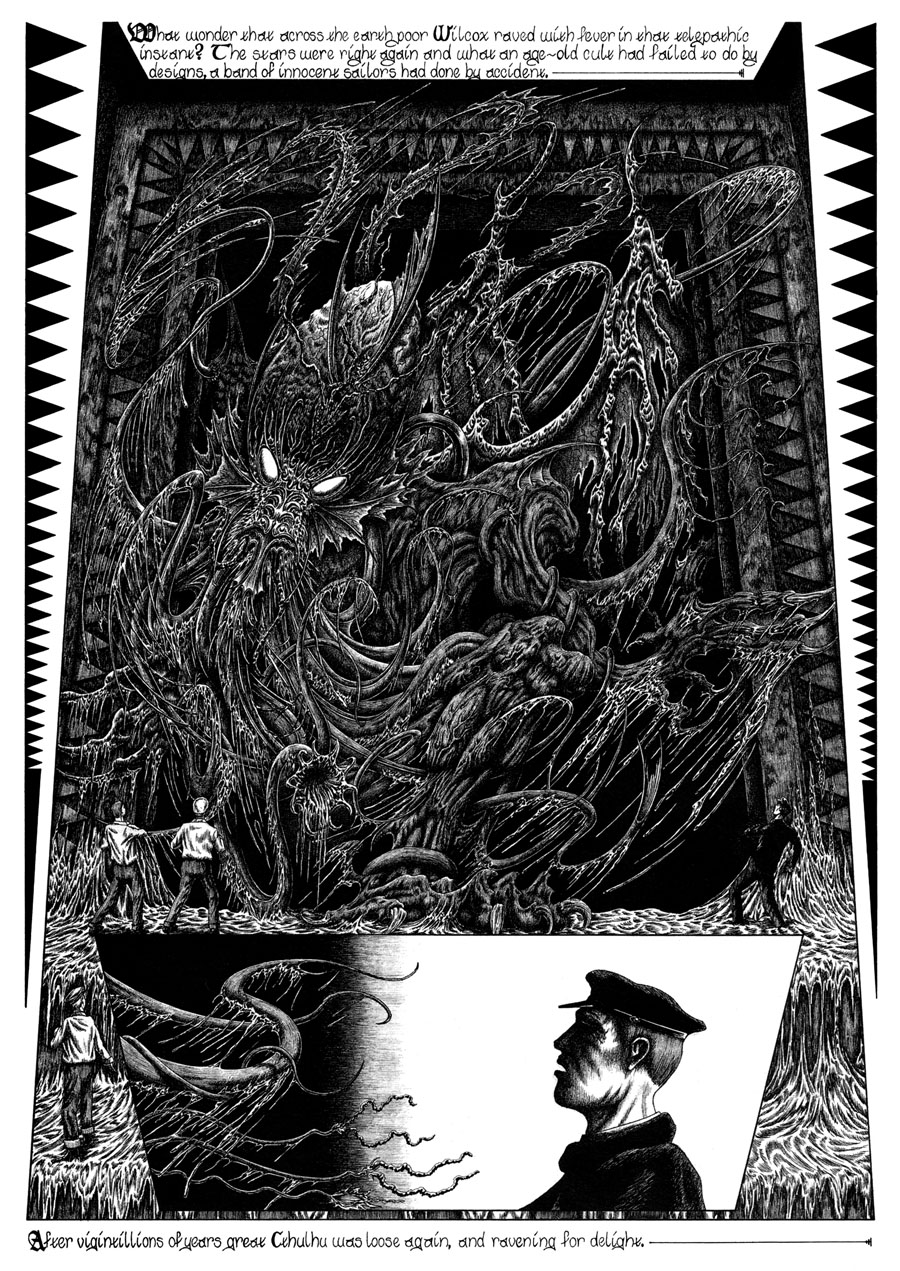
This page from the climax of Lovecraft’s story was the first drawing I made of the living Cthulhu, all earlier representations following Lovecraft’s scheme of the creature manifesting throughout history in different human artworks and religious icons. Since most of those representations are highly stylised I wanted to make the awful reality seem a lot more visceral and even incoherent, hence the mass of flailing tentacles and ropes of slime. This is also the only full view you receive, everything else is fragmentary and allusive so there’s space for the reader’s imagination. I think the book in the library display is the Lovecraft anthology The Starry Wisdom but The Call of Cthulhu is also present in my Haunter of the Dark collection which includes a couple more portraits of “the green, sticky spawn of the stars”.

Out of this World is a free exhibition which will run to September 25th, 2011.

Elsewhere on { feuilleton }
The Lovecraft archive

Lovecraft’s favourite artists revisited

hpl.jpg

HP Lovecraft (1937) by Virgil Finlay.

I was asked recently to join the bloggers at Tor.com writing about art as it relates to fantasy and science fiction, so for today’s post your attention is directed to this piece, an expanded version of a rather half-hearted list I put together a few years back concerning HP Lovecraft’s favourite artists. Half-hearted or not, people kept linking to that list so it seemed a good idea to make more of it. I’ll be writing these posts a couple of times a month, provided I have the time to do something worthwhile. Watch this space.

Previously on { feuilleton }
The monstrous tome

The Vengeance of Nitocris

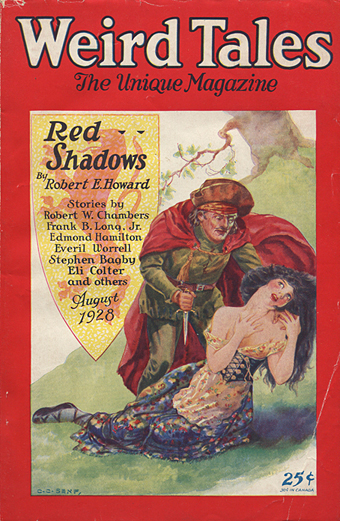
weirdtales.jpg

Cover illustration by CC Senf.

In her mind the queen Nitocris was seeing a ghastly picture. It was the picture of a room of orgy and feasting suddenly converted into a room of terror and horror, human beings one moment drunken and lustful, the next screaming in the seizure of sudden and awful death. If any of those present had been empowered to see also that picture of dire horror, they would have clambered wildly to make their escape. But none was so empowered.

Everyone today will be marking the Tennessee Williams centenary by noting his theatre work, of course, or his subversive celebration of outsiders and, yes, the gays. I’ll confine myself to reminding people that Williams’ first published work was a short story entitled The Vengeance of Nitocris in Weird Tales for August 1928, written when he was only 17. The story reads like the work of a teenager but editor Farnsworth Wright evidently enjoyed an atmosphere of lurid Egyptian melodrama which you can appraise for yourself here. Also in this issue was the debut appearance of Robert E Howard’s Solomon Kane, and The Demoiselle d’Ys by Robert Chambers. Seeing the name Nitocris I have to wonder whether Williams chose it after reading HP Lovecraft who used the name twice in earlier stories published in the same magazine, Imprisoned With the Pharaohs (1924) and The Outsider (1926). That last piece was one of Lovecraft’s most popular tales, and it’s easy to imagine its grotesque parable of alienation making an impression on a would-be writer who, as a gay youth, would have looked upon himself as another kind of outsider.

Previously on { feuilleton }
The King in Yellow

Weekend links 49

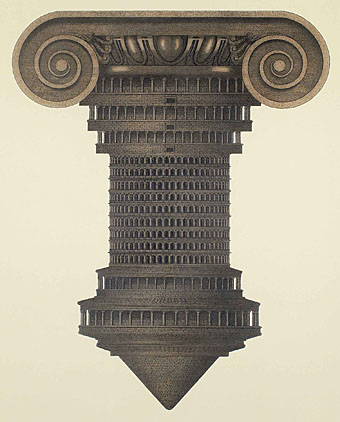
ceranic1.jpg

Star City by Tomislav Ceranic.

• Noted in the blogosphere this week: A Journey Round My Skull underwent a transmutation into 50 Watts; a blog devoted to artist, designer & illustrator Jessie M King; “The arts and musicks of the supranatural” at Secret Lexicon; From the Farm, Railroads, Sewing Machines & Beyond, lengthy reminiscences from a long life in America.

Barney Bubbles in Wonderland, in which the designer and his chums indulge in some Carrollian shenanigans somewhere in the 1960s. The resulting footage is now a promo video for Balloon Race by Bear Driver.

HP Lovecraft’s favourite words, the desert island books of Jorge Luis Borges, a profile of Christopher Isherwood, and Edward Gorey again.

[Arthur] Machen explicitly talks about the strength of London, as opposed to Paris, in that London is more chaotic. Although he doesn’t put it in these words, I think what partly draws him to London is this notion that, in the absence of a kind of unifying vision, like Haussmann’s Boulevards, and in a city that’s become much more syncretic and messy over time, you have more room to insert your own aestheticizing vision.

China Miéville in a great interview at BLDGBLOG.

Matryomin is “the unique, original erectronic [sic] musical instrument invented by Masami Takeuchi in 2000”. Yes, a theremin inside a Russian doll. The Mable ensemble playing Duke Ellington’s Caravan is, well…I’m still speechless. And there’s also this.

Conductor turns the New York subway system into an interactive string instrument.

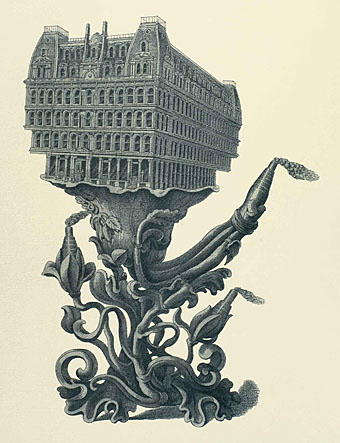
ceranic2.jpg

Discordia by Tomislav Ceranic.

Amazingly enough, prostitution was legal during the Victorian period. There were tons of brothels all over the major cities of England, and of all different kinds. There were lots of flagellation brothels; these were places where primarily men would go to be whipped by women or by men. There were also gay male brothels. You could go to a park in London at night, pick up what were called the “park whores” and give them a very small amount of money to have sex openly in the park. I also write about gay “cruising,” which was quite common. If you knew the right place to go and knew the right signals, you could pick up a man on the street and have sex in an alley.

Deborah Lutz is interviewed about her book Pleasure Bound: Victorian Sex Rebels and the New Eroticism.

Cult-ure: Ideas can be dangerous, a book by Rian Hughes.

Chernobyl: Europe’s strangest wildlife refuge.

The Eadweard Muybridge Online Archive.

Aubrey Beardsley at Tumblr.

Caravan (1959) by Martin Denny | Caravan (1961) by 80 Drums Around The World | Caravan (1962) by Sir Julian | Caravan (1965) by The Ventures | Caravan (1973) by Enoch Light & The Light Brigade | Caravan (1997) by Jimi Tenor (I could go on and on, yes I could…)

Kenneth Grant, 1924–2011

grant.jpg

Kenneth Grant by Austin Spare (c. 1951).

Kenneth Grant, writer and occultist, died last month but the event was only announced this week. He’ll be remembered for the nine fascinating occult treatises he wrote from 1972 to 2002, and for continuing the work of Aleister Crowley as head of the Ordo Templi Orientis, a position which became fraught in later years as various occult factions disputed his authority. Having collected occult books for much of the 1980s I find his name calls out from the shelves more than many other writers; as well as authoring his own works he edited all the major Crowley texts with Crowley’s executor John Symonds, presenting them in authoritative editions for a new readership.

Grant proved a very loyal champion of people he admired, significantly so in the case of Austin Osman Spare whose work he collected, exhibited and republished from the 1950s on. It was Grant’s position as one of the many advisors for Man, Myth & Magic in 1970 which resulted in the part-work encyclopedia using one of Spare’s stunning drawings as the cover picture for its first issue. That effort alone gave Spare an audience far beyond anything he received during his lifetime, and Grant ensured the magazine featured Spare’s work in subsequent issues. Grant’s occult works made liberal use of unique illustrations by his wife, Steffi Grant, Austin Spare and others. The books were singular enough even without their pages of curious artwork, a beguiling and sometimes incoherent blend of western occult tradition, tantric sex magick and hints of cosmic horror which were nevertheless always well-written, annotated and crammed with technical detail. Alan Moore in 2002 examined the experience of an immersion in Grant’s mythos with a wonderful review he called “Beyond our Ken“. He notes there the influence of HP Lovecraft, another of the visionary figures who Grant championed throughout his life.

between.jpg

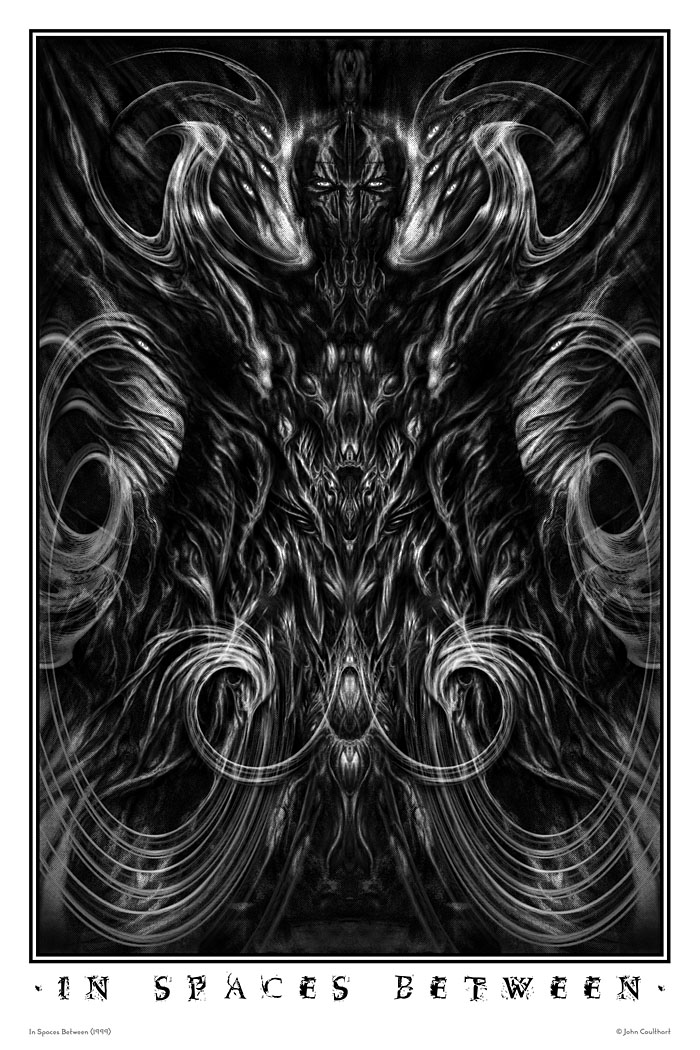
In Spaces Between from The Great Old Ones (1999).

And speaking of Lovecraft, I’ve often wondered whether Kenneth Grant ever saw a copy of my Haunter of the Dark collection. For the opening of the Great Old Ones Kabbalah sequence which Alan Moore and I created for the book I added an extra piece of art entitled In Spaces Between, a reference to Coil via an epigraph from Grant’s Outside the Circles of Time (1980) which I borrowed for the facing page:

For there are Thrones under ground
And the Monarchs upon them
Reign over Space and Beyond

Invoke Them in Darkness, Outside
The Circles of Time

In Silence, in Sleep, in Conjurations
Of Chaos, the Deep will respond…

Coil aficionados will recognise those words as the origin of some lines from Titan Arch (1991):

There are Thrones under ground
And Monarchs upon them
They walk serene
In spaces between

Grant followed his epigraph with another quote, from Lovecraft’s Necronomicon.

In addition to Alan Moore’s Grant review, Fulgur have a detailed Kenneth Grant bibliography on their pages. They were also the publishers in 1998 of Zos Speaks! Encounters with Austin Osman Spare by Kenneth and Steffi Grant, a memoir and celebration of Spare’s work which revealed this trio of remote astral voyagers to be human beings after all. The book is currently out of print but it’s essential for anyone interested in Austin Spare or, for that matter, Mr and Mrs Grant.

Previously on { feuilleton }
New Austin Spare grimoires
Austin Spare absinthe
Aleister Crowley on vinyl
Austin Spare’s Behind the Veil
Austin Osman Spare