The sublimities of John Harris

harris01.jpg

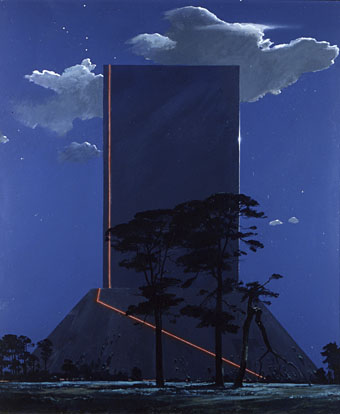
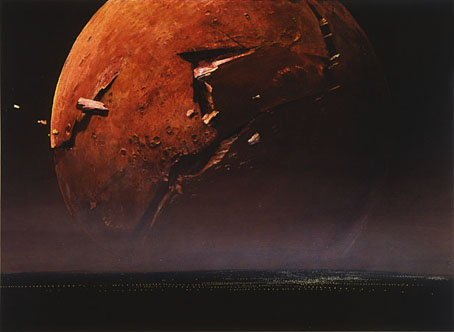
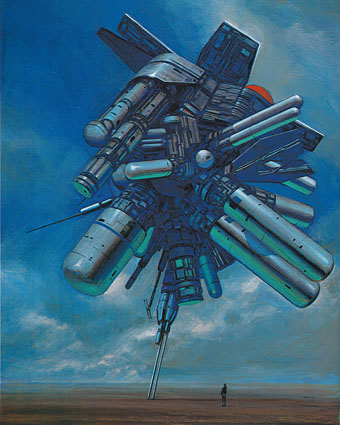
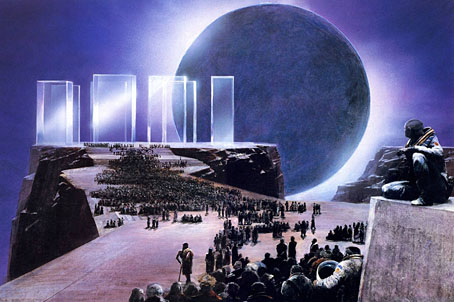
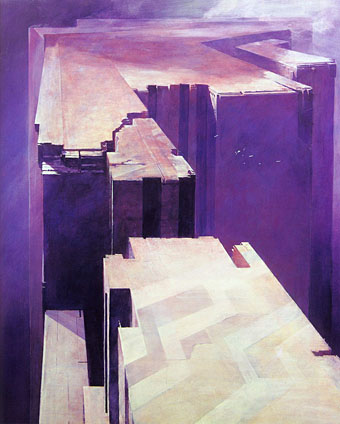
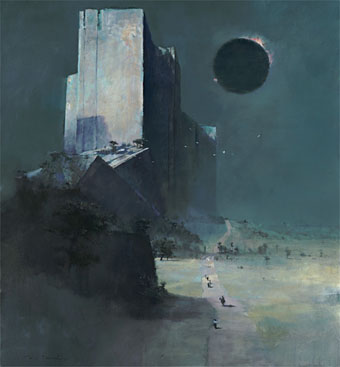
I might never have paid much attention to John Harris’s paintings if they hadn’t appeared so often at Adam Rowe’s 70s Sci-fi Art. Harris is also featured in Rowe’s new book, Worlds Beyond Time, with a few examples that sent me looking for more. I like science-fiction art when it’s dealing with megastructures, especially if those structures aren’t readily interpretable as buildings, spaceships or alien artefacts. This is SF art in the service of the philosophical Sublime, a quality which, since the 1940s, you don’t find very much in painting outside the work of illustrators or artists of the fantastic. Some of these structures, like the one that Harris calls “The Wall” (below), might be relatives of the abandoned concrete edifices in Jean-Pierre Ugarte’s paintings. Another point in Harris’s favour is the way he uses SF-like imagery as outlets for his own visionary experiences: there’s a series entitled Mass which depicts images that came to him following a period of transcendental meditation. The Mass series later gave a title to the first book of Harris’s art which was published by Paper Tiger in 2000.
More John Harris

harris02.jpg

harris13.jpg

harris14.jpg

harris15.jpg

Continue reading “The sublimities of John Harris”

Remedios Varo, 1967

varo1.jpg

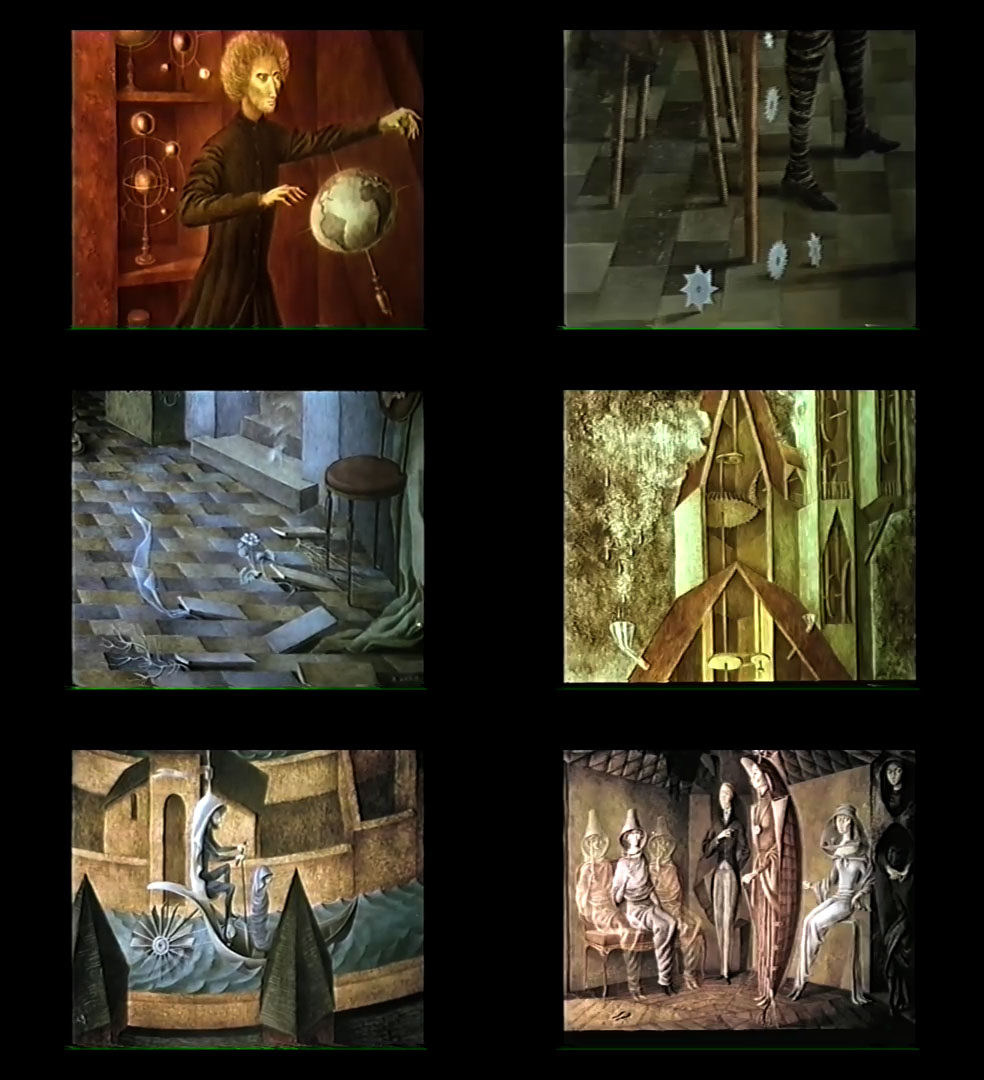
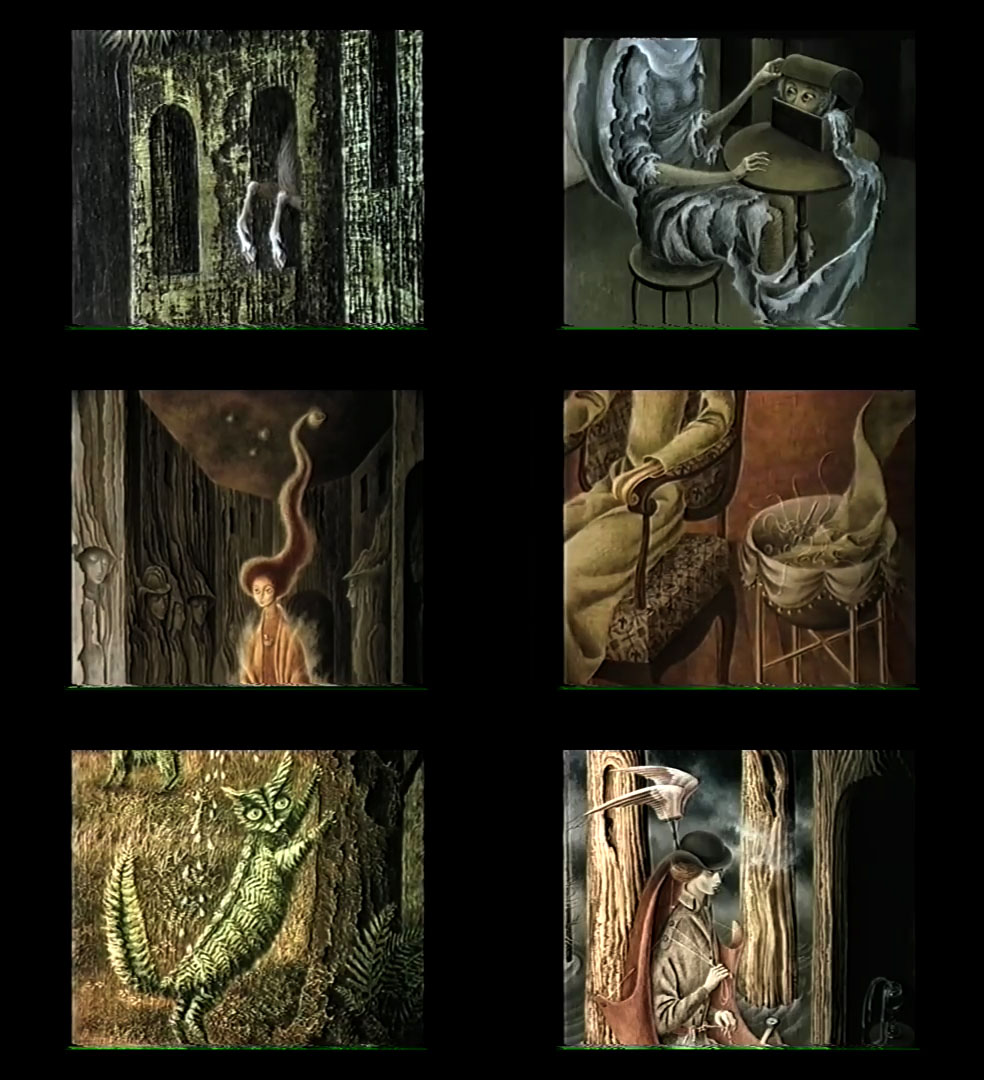
Online galleries have made profiles like this short Mexican film rather redundant, but it’s good to know that someone went to the trouble of presenting Varo’s paintings in this way at a time (1967) when you’d be lucky to see more than one of them in a book on Surrealist art. Jomí García Ascot’s camera roams among the details of Varo’s dreamworlds while Spanish voices read from a variety of Romantic and other texts. I hadn’t noticed before the amount of cats in Varo’s paintings. Look for the felines here.

varo2.jpg

Elsewhere on { feuilleton }
The Surrealism archive

Previously on { feuilleton }
Pynchon and Varo
Remedios Varo’s recipe for erotic dreams

Weekend links 687

crane.jpg

The Peacock Garden (1898) by Walter Crane.

• “The trio [Remedios Varo, Leonora Carrington & Kati Horna] became known as the ‘three witches’ for their exploration of the supernatural and metaphysical—which ranged…’from tarot readings to shamanic psychedelics to attempts to stop or slow time.'” Teresa Nowakowski on Remedios Varo: Science Fictions, an exhibition of Varo’s paintings at the Art Institute of Chicago which includes the one that Thomas Pynchon singled out for description in The Crying of Lot 49.

Philip K. Dick giving a lecture on “orthogonal time” to a small audience at the Festival International de la Science-Fiction, Metz, in 1977. Dick’s talks and interviews aren’t exactly scarce, but this one was of interest for me since I recently designed an edition of John Crowley’s Great Work of Time, a novella which involves a similar concept. If you were at the Metz Festival in 1977 you could also see a live performance by Cluster. Lucky you.

• “Our minds remain open when the LSD wears off.” Steve Paulson on psychedelic drugs and their usefulness as therapeutic tools.

• At Cartoon Brew: Stephen Irwin’s animated films “combine the influences of David Lynch, Struwwelpeter, and the Brothers Grimm.”

• Steven Heller looked at NB3, the third book about Neville Brody’s graphic design. Elsewhere, Heller’s font of the month is Scusi.

The glowing, prismatic nervous system of a sea star wins the Scientific Image of the Year.

• At Unquiet Things: Forgotten worlds and wonderlands from The Art of Fantasy.

• “Don’t waste my time with blood-free monster movies,” says Anne Billson.

• At Aquarium Drunkard: King Tubby And Soul Syndicate — Freedom Sounds In Dub.

• Mix of the week is DreamScenes – August 2023 at Ambientblog.

Time Machine (1970) by Stray | Time Captives (1973) by Kingdom Come | The Existence Of Time (2012) by Monolake

Weekend links 685

katoh.jpg

Art by Naoyuki Katoh, 1982.

• RIP Paul Reubens. Here’s Steven Heller on Pee-wee Herman and his clinically hyperactive playhouse (not forgetting Gary Panter’s involvement); Bruce Handy on Paul Reubens’ preposterous grace; and David Hudson on Paul Reubens before and after Pee-wee.

Three Thousand (2017), a short film by Asinnajaq in which “a riveting collage portrays a century of Inuit history, and envisions a vibrant future”.

• New music: Velocity Of Water by Suki Sou; The Blue Beyond by Jana Winderen; and Jäi mieleen by Aki Yli-Salomäki.

DJ Food posted a handful of psychedelic LP sleeves for non-psychedelic artists. There’s a lot more to be found.

• “We had no rules. Song structure didn’t exist. It was nihilistic.” It’s Bush Tetras again.

• “Infrared light reveals hidden portrait beneath 1943 René Magritte painting.”

• At Dennis Cooper’s: Gakuryu Ishii Day.

Tequila (1958) by The Champs | Tequila (1958) by Perez Prado | Tequila (1972) by Hot Butter

Weekend links 684

okamoto.jpg

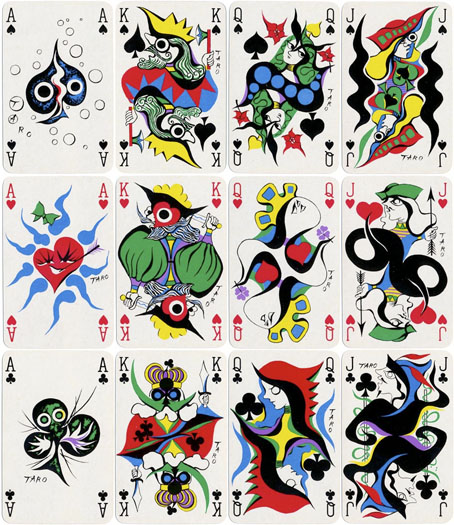
Playing cards designed in 1977 by Taro Okamoto.

• “This practice of looking does not prioritise academic or historical perspectives on art. It is divorced from the artist, the industry and the formal study of the arts. By paying attention to the form, title and other perceptible ‘clues’ in the work, this practice is primarily interested in using the intuitive, sensory, suggestive and aleatory to engage in conversation with a creative work. The point is not to develop an answer, an interpretation that ‘settles’ the ‘question’ of the painting, or to intellectualise the work in terms of form, style, history or the concerns of the artist. Rather, in this practice, a piece of art or writing becomes a test or opportunity for working one’s imagination—an exercise in making associations.” Aparna Chivukula on choosing art over wellness apps.

• “But with the discourse about the limitations of moralizing steadily growing, the question of an alternative naturally arises. The critics of self-righteousness and trauma mongering are for the most part not calling for a return to the amoral ironism that governed the Nineties and early Aughts—the sensibility that surely gave rise, at least in part, to the overgrowth of didacticism that followed. But if not this, then what? Where do we go from here?” Anastasia Berg on “the aesthetic turn”.

• “…by choosing ordinary creatures, the fabulist naturalises the stories in a world that is close to hand, which helps the writer communicate opinions that are often subversive.” Marina Warner on Kalilah wa-Dimnah and the animal fable.

• Coming soon from Strange Attractor: Austin Osman Spare, a revised and expanded edition of Phil Baker’s excellent biography of the artist/occultist.

• At Rarefilmm: The Marat/Sade (1967), Peter Brook’s film (previously) of the 1965 Broadway production of Peter Weiss’s play.

• New music: Hostile Environment by Creation Rebel, and Tone Maps by Field Lines Cartographer.

• Mixes of the week: Isolatedmix 122 by Mary Yalex, and XLR8R Podcast 810 by Zaumne.

• At Dennis Cooper’s: Pierre Clementi Day.

Sade Masoch (1968) by Bobby Callender | On Sadism (1979) by Material | Sadistic (1995) by Stereolab