
The Ambassadors by Hans Holbein the Younger (1533).
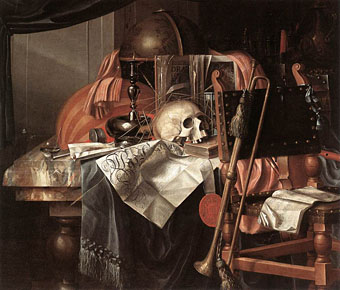
Vanitas by Franciscus Gysbrechts (no date).
A journal by artist and designer John Coulthart.

Painting
The Ambassadors by Hans Holbein the Younger (1533).
Vanitas by Franciscus Gysbrechts (no date).
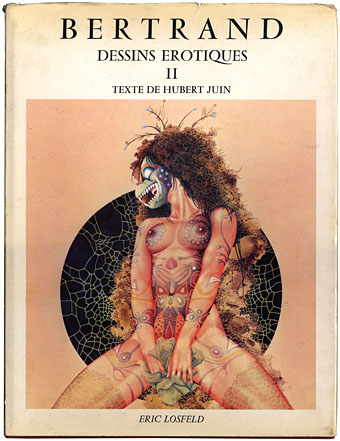
The first question has to be “Bertrand who?” but you won’t receive an answer here since information is scarce (see below). Bertrand’s erotic surrealism first appeared in the late Sixties, going by the dates in collections of his work. Some of his paintings and drawings crept into the underground mags of the period then turned up in odd places throughout the Seventies. The first I saw of any Bertrand art was on the cover of the pre-Savoy publication, Wordworks #6, and a music paper ad for the Chrome 12″, Inworlds.
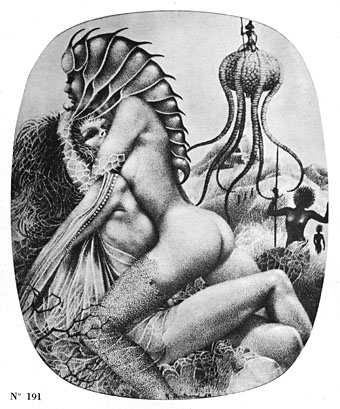
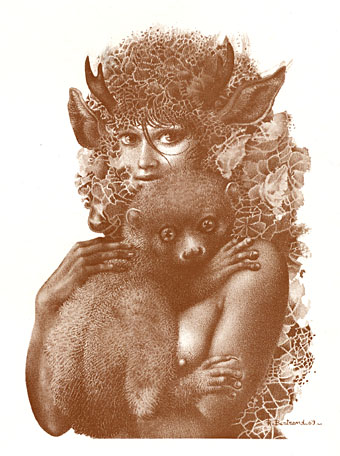
French porn publisher Eric Losfeld produced a couple of large, limited edition collections of Bertrand’s work in the early Seventies. All the drawings reproduced here are from the battered 1971 volume shown above. If it seems surprising that these haven’t been reprinted it may be that Bertrand’s concerns are too weird or simply too unpleasant for contemporary tastes. Many of his ink drawings, and some of his paintings, seem to have begun life as decalcomania splotches, a Surrealist technique invented by Oscar Dominguez as a means of injecting chance into the creative process. Decalcomania produces random patterns which the artist then elaborates upon. Max Ernst’s famous Europe After the Rain, and a number of his other paintings from the 1940s, began life as a field of vaguely organic marks created by pressing thickly applied paint to the canvas with a sheet of glass or paper. Bertrand used ink stains in a similar way, with the result that most of his doe-eyed female figures (and his figures are nearly always women) are fringed by leafy or fungal growths. Many of his scenes are a kind of lesbian equivalent of the human/alien entanglements one finds in William Burroughs’ more elaborate flights of fancy. If his women aren’t being absorbed into some organic mass, they’re often being subject to investigation (even impalement) by spikes or claws, and here we perhaps find the reason his work remains out of print. Feminists then and now would have taken a dim view of Bertrand’s more violent works; even if Taschen did produce a Bertrand collection, it’s unlikely that many of the more grotesque pictures would be included.
All the pictures in the Losfeld books were produced in a short period from 1967–69. What happened to Bertrand afterwards remains a mystery. Did he decide to do pursue a different, more commercial direction? Is he still alive? The books offer no clue but maybe someone out there has the answer.
Update: Nathalie discovers that the artist in question is Raymond Bertrand, and more of his work can be seen here.
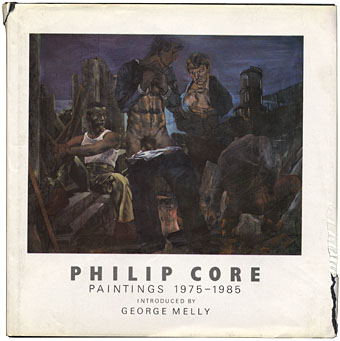
A solidly gay day for secondhand books with the discovery of two relatively scarce items by gay artists. Philip Core is probably more well-known as a writer than a painter, author of The Original Eye: Arbiters of Twentieth Century Taste and the masterful Camp: The Lie that Tells the Truth (both 1984 and both out of print, unfortunately). His paintings predominantly feature unclothed men but present these in a far more painterly style than one usually sees from gay artists, the approach too often being a kind of kitsch photo-realism that tends towards soft (or hard) porn. A shame that this volume is rather battered as it seems to be a rare book. Core died of AIDS in 1989 but his paintings are still being bought and sold, gay art being one genre that never lacks for an audience.
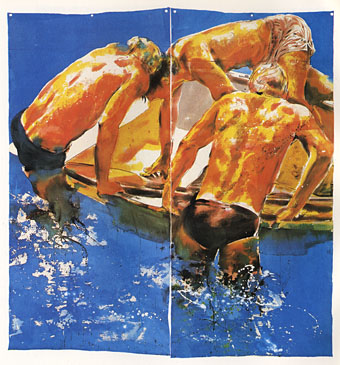
The Bermuda Triangle by Philip Core (1982).
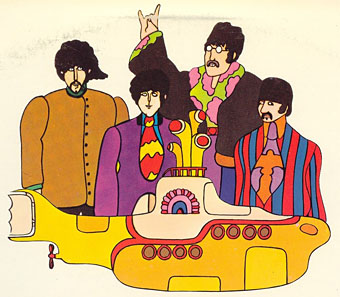
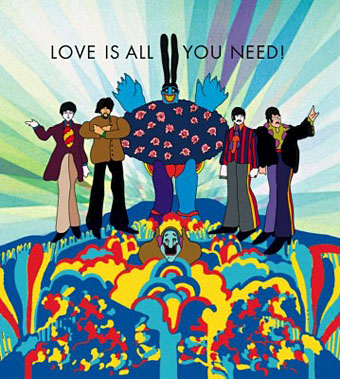
Yellow Submarine art direction and character design by Heinz Edelmann. No dedicated website, unfortunately. XTC (among others) swiped the style for the sleeve of their excellent 1989 album, Oranges & Lemons.
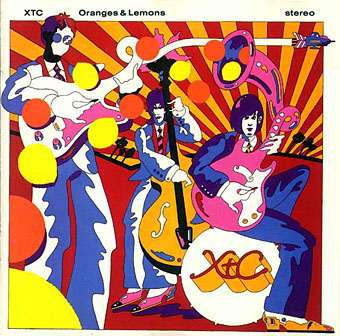
Update: Edelmann is ambivalent about being known as the Yellow Submarine designer but he talked to Baltimore’s 21st Century Radio about working on the film here. And the same site has a look at the film’s production process.
Previously on { feuilleton }
• The L.S. Bumble Bee
• Joe Orton
• Please Mr. Postman
• All you need is…
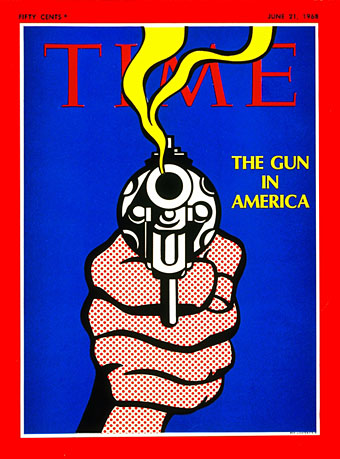
Time, June 21st 1968. Cover by Roy Lichtenstein.