Weekend links 24

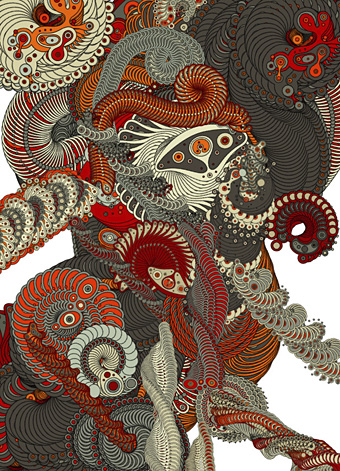
early.jpg

Delta-Wing (2009) by Chloe Early.

• “Feted British authors are limited, arrogant and self-satisfied, says leading academic”. Stating the bleeding obvious but it still needs to be said, apparently, especially when the announcement of the Booker list this year caused the usual confusion when Amis Jr. and McEwan weren’t included, as though the mere existence of their novels makes them prize-worthy. And as someone pointed out, the word “male” is missing from that headline.

Hero of Comic-Book World Gets Real: Alan Moore again, in the NYT this time. Related: a review of Unearthing live.

• Announcing The Hanky Code by Brian Borland & Stephen S Mills, a 40-poem book to be published next year by Lethe Press. For an explanation of the Hanky Code there’s this, and there’s also an iPhone app.

Folk—the ‘music of the people’—is now hip again, says (who else?) Rob Young who can also be heard on the archived podcast here. Related: the folk roots of Bagpuss. Related to the latter: The Mouse Mill.

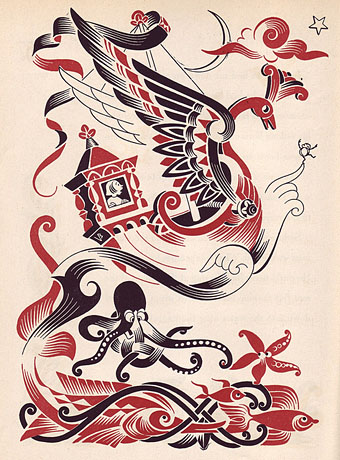
zvorykin.jpg

An endpiece from The Firebird and other Russian Fairy Tales by Boris Zvorykin.

‘Yes’ to Catastrophe: Roger Dean, Prog and SF. A lengthy and thoughtful analysis of Roger Dean’s early work.

Into the Media Web, the enormous Michael Moorcock book which I designed, is officially published this week.

Cassette playa: in praise of tapes. I’ve complained about tapes in the past but people continue to find them useful. Some technologies die harder than others.

Boy BANG Boy: “Quiet moments made suddenly very loud with the attitude and opinion of what it means to be a young male in an impossibly diverse world.” An exhibition opening at Eastgallery, London, on August 5th.

Empty your heart of its mortal dream: Alfred Kubin’s extraordinary novel, The Other Side.

Ghostly and Boym Partners devise a new way to deliver digital music.

Besti-mix #27: a great selection by producer Adrian Sherwood.

Agnostics are troublemakers. Amen to that.

• RIP Harry Beckett.

Acousmata.

Let Us Go In To The House Of The Lord by Pharoah Sanders (live, 1971): Part 1 | Part 2

Schloss Falkenstein

falkenstein.jpg

Proposal for Schloss Falkenstein (c. 1883).

A slight return to Ludwig II. Schloss Falkenstein would have been another beetling edifice in the manner of Schloss Neuschwanstein had it ever been built, and judging by this view it might have been even more grandiose. The painting is one of the proposals by stage designer Christian Jank whose plans had already been used for Neuschwanstein. Philippe Jullian makes some scathing remarks about the Gothic interior of the earlier castle but he may have had more patience for the Byzantine interiors planned for Falkenstein. I’m not sure how these would be reconciled with Jank’s exterior, however, the style being Gothic enough to satisfy Viollet-le-Duc. Ludwig’s untimely death in 1886 drew a line under his architectural schemes but Bavaria’s loss eventually became Walt Disney’s gain as Jank’s fantasias provided the inspiration for the castle in Sleeping Beauty (1959) and all of the Disney theme park castles. What Ludwig would have made of this we can only guess. I suspect he’d be entranced by the fantasy but appalled by the vulgarisation. He was an elitist, after all, and the castles were always for him alone, not hordes of T-shirted proles.

Previously on { feuilleton }
Schloss Linderhof
Schloss Neuschwanstein
Pite’s West End folly
Viollet-le-Duc

The art of Ran Akiyoshi, 1922–1982

akiyoshi1.jpg

In a similar vein to the work of Gilles Rimbault and other erotic fantasists is Ran Akiyoshi, a Japanese artist and illustrator. Akiyoshi’s work manages to be even more obscure than the Europeans, being virtually undocumented outside Japanese websites, hence the absence of titles and dates for these examples. This is surprising given the quasi-Surrealist nature of his paintings which place buxom goddess types in phantasmagoric settings with subtle or not-so-subtle erotic qualities. Akiyoshi follows the pattern of much of this kind of personal fantasy whereby most of the women share similar features. The book cover immediately below is from a recent Japan-only collection of his work. The Illusion cover at the end is another book collection some of whose fascinating pages can be seen here. As always, if anyone turns up a gallery of further pictures, please leave a comment.

akiyoshi2.jpg

Continue reading “The art of Ran Akiyoshi, 1922–1982”

Volcano: Turner to Warhol

wright.jpg

An Eruption of Vesuvius, Seen from Portici (c.1774–6) by Joseph Wright of Derby.

Joseph Wright of Derby captured the eruptions of Vesuvius in several pictures of which this is one of the more spectacular examples. The painter enjoyed spectacle as he also the rendering of chiaroscuro effects so it’s no wonder he was attracted to an apocalyptic night view such as this. Wright is one of the artists featured in a new exhibition at Compton Verney in Warwickshire, Volcano: Turner to Warhol, which presents the depiction of volcanoes in art through the ages.

The exhibition ranges from early engravings, showing imagined cross-sections of the fiery centre of the earth, to an explosive series of paintings by Joseph Wright, JMW Turner and Andy Warhol. It is a chance to examine the presence of volcanoes as geological phenomena and their power and influence, through an exciting range of historic and recent works of art. (More.)

The gallery site doesn’t have a complete list of the featured works but there’s some additional detail in a Telegraph preview from a couple of months ago. Volcano: Turner to Warhol opens on July 24th and runs to October 31st, 2010.

Previously on { feuilleton }
Chiaroscuro II: Joseph Wright of Derby, 1734–1797
Chiaroscuro
Shadows at Compton Verney
Death from above
The apocalyptic art of Francis Danby

Marsi Paribatra: the Royal Surrealist

marsi1.jpg

La Menace (1994).

Two paintings by Princess Marsi Paribatra, a member of the royal family of Thailand who lists Dalí, Arcimboldo and Titian among her artistic influences. If it seems surprising that a princess should not only be an accomplished painter but also be possessed of a distinctly vivid imagination we might ask why this is the case. There’s no reason why a member of a royal family shouldn’t be as good a painter as anyone else although it’s the case that here in Britain our views of royalty are inevitably tainted by the uninspiring members of the current House of Windsor. Prince Charles in particular is a singularly dreary and frequently philistine figure, and also a painter whose daubs would never have received any attention at all were it not for his being born into the right family.

This hasn’t always been the case. It used to be that being an aristocrat gave you the free time and the wealth to indulge no end of manias and eccentricities. The British Isles are littered with architectural follies of various kinds built to appease the whims of rich landowners; William Beckford (1760–1844) is renowned for having written the Gothic melodrama Vathek and also for having built the lavish (and unfortunately short-lived) pile of Fonthill Abbey. In the 20th century we had Edward James (1907–1984), a lifelong champion of Surrealism who spent much of his later life building Las Pozas in the Mexican jungle at Xilitla, a concrete fantasia which looks like something dreamed up by Antonio Gaudí and JG Ballard. James collected the work of Leonora Carrington and Dorothea Tanning and I’d imagine him being equally entranced by some of Marsi Paribatra’s paintings. The recurrence of skeletal figures in her work invokes the Mexican Day of the Dead traditions which always excited the Surrealists.

marsi2.jpg

No title or date available.

Dali House has more about Marsi Paribatra’s life and art while further examples of her paintings can be found here and here. Thanks again to Monsieur Thombeau for pointing the way!

Elsewhere on { feuilleton }
The fantastic art archive

Previously on { feuilleton }
Angels of Anarchy: Women Artists and Surrealism
Return to Las Pozas
The art of Leonor Fini, 1907–1996
Surrealist women
Las Pozas and Edward James