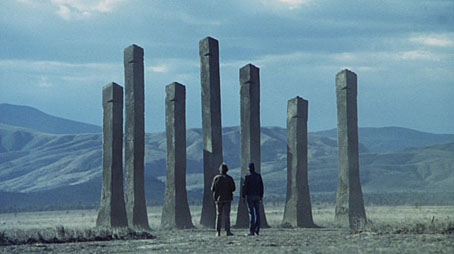
Directed by Saul Bass

bass1.jpg

Phase IV (1974).

It’s been a thrill recently poring over the Saul Bass monograph, Saul Bass: A Life in Film & Design by Jennifer Bass & Pat Kirkham, a large volume that weighs a ton and is as revelatory about the career of a great designer (and his wife and frequent collaborator, Elaine Bass) as you’d hope. One pleasure was getting to read about Bass’s film work from his own viewpoint for once. The curious science-fiction film he made in 1974, Phase IV, is well-known enough to have a cult reputation but too often his long involvement with Hollywood is passed over as a footnote to the careers of the directors for whom he worked. In addition to his celebrated title sequences, Bass was also a visual consultant responsible for the planning and filming of what used to be called “special sequences” within films, the most notorious of which is the endlessly argued-over shower scene in Hitchcock’s Psycho (1960). (See this authoritative post by Pat Kirkham on Bass’s special sequences, and the disputed history of those few seconds of black-and-white film.)
bass3.jpg

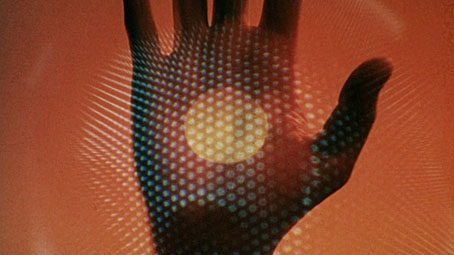
Phase IV (1974).

All of which sent me to YouTube looking for some of the shorter films that Bass directed from the mid-60s on. The monograph explores these and Phase IV in some detail, for the latter showing pages of sketches for unfilmed sequences. I’m not sure these would have improved a film which I find flawed and occasionally ludicrous but it’s good to see what the director had in mind. The film on DVD has no extras at all but a trailer can be found on YouTube that shows off some of the startling imagery, and also includes a few shots that were cut by distributors foolishly eager to try and sell it as a horror film. It’s ironic that a man who gained world recognition for his poster designs wasn’t allowed to design the poster for his own film.
bass2.jpg

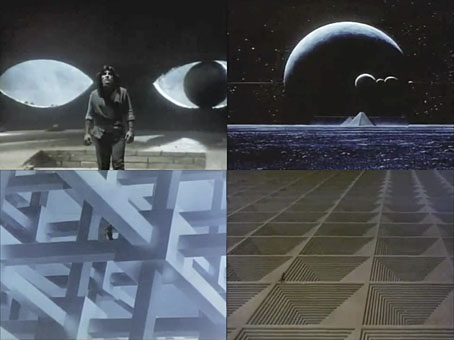
Quest (1984).

Of the short works there’s Why Man Creates (1968) here and here, an examination of the creative impulse that’s been so popular with art teachers over the years that it’s probably been seen by a lot more people than his marauding ants. Both this and The Solar Film (1980), a documentary about solar energy, utilise Bass’s hand-drawn animation. The latter is also of note for its final shot of a baby walking into a sunset, a still of which was turned by Bass into an album cover for Stomu Yamashta in 1984. Also that year, Saul and Elaine produced their strangest work, Quest, a half-hour piece of science fiction based on a Ray Bradbury short story whose quest theme is overly-familiar from a dramatic point-of-view but which typically yields a wealth of memorable visuals. In Phase IV there was a nod to Dalí with the dead man’s hand filled with burrowing ants; in Quest we find imagery borrowed from Magritte (a floating castle-topped mountain) and MC Escher (his Cubic Space Division). The copy on YouTube is rough quality but it’s certainly worth a watch. I’m amused to discover how much Saul & Elaine were prog-rock heads (not that there’s anything wrong with that…): Phase IV has Stomu Yamash’ta and David Vorhaus from White Noise on its soundtrack, The Solar Film features a dubious cover version of Tubular Bells, while the score for Quest is mostly original music (with some borrowings from Holst) that sounds much of the time like Tangerine Dream when they were leaning on their Mellotrons.

Previously on { feuilleton }
Saul Bass album covers
Pablo Ferro on YouTube

Dorothea Tanning, 1910–2012

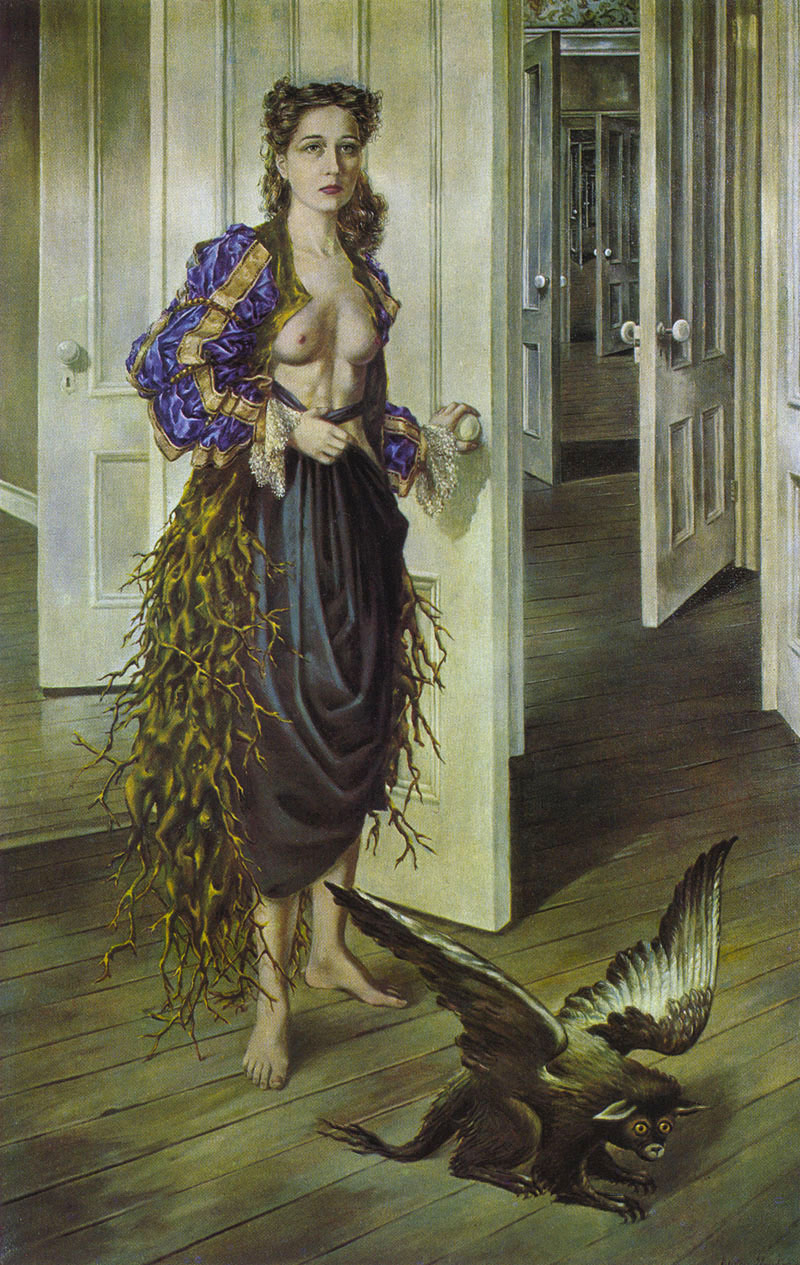
tanning.jpg

Birthday (1942) by Dorothea Tanning.

In pre-internet days it always used to surprise me to read that Dorothea Tanning was still alive when one seldom heard much about her; Leonora Carrington seemed positively hyperactive by comparison. In the end Dorothea outlasted all her Surrealist contemporaries, and the announcement of her death this week sees the passing of that generation of art revolutionaries. Birthday became an immediate favourite when I first encountered it in art books some thirty-odd years ago, and it remains my favourite among her works. John Glassie interviewed her for Salon ten years ago when she had this to say about the painting:

Well, excuse me for this, but “Birthday” is among other dreamlike things, a topless self-portrait. Is it fair to say that at that time, 1942, people thought you were immodest?

Well, I was aware it was pretty daring, but that’s not why I did it. It was a kind of a statement, wanting the utter truth, and bareness was necessary. My breasts didn’t amount to much. Quite unremarkable. And besides, when you are feeling very solemn and painting very intensively, you think only of what you are trying to communicate.

So what have you tried to communicate as an artist? What were your goals, and have you achieved them?

I’d be satisfied with having suggested that there is more than meets the eye.

She also offered a piece of sound advice:

Keep your eye on your inner world and keep away from ads and idiots and movie stars, except when you need amusement.

New York Times: Dorothea Tanning, Surrealist Painter, Dies at 101
• Coilhouse: “My work is about leaving the door open to the imagination.”
New York magazine: Jerry Saltz on Dorothea Tanning
Guardian obituary | From 2004: “I’ve always been perverse!”

Previously on { feuilleton }
Leonora Carrington, 1917–2011
Marsi Paribatra: the Royal Surrealist
Dorothea Tanning: Early Designs for the Stage
Angels of Anarchy: Women Artists and Surrealism
The art of Leonor Fini, 1907–1996
Surrealist women

Las Pozas panoramas

xilitla1.jpg

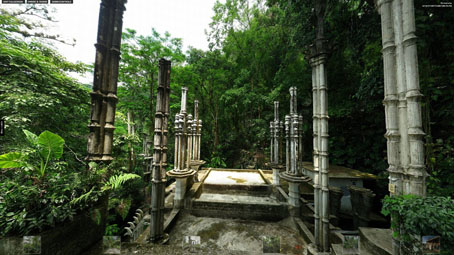
Photo by Carlos Ernesto Guadarrama Muñoz.

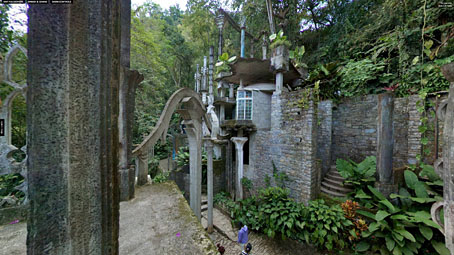
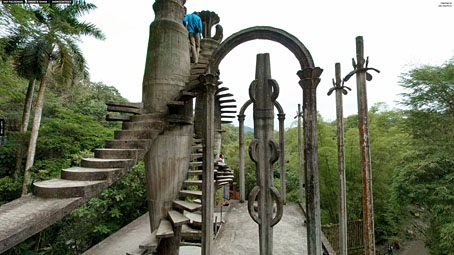
How soon things change. In 2006 when I wrote something about Las Pozas, the unfinished concrete fantasia constructed by Edward James at Xilitla in the Mexican jungle, there was little information about the place on the web. A couple of years later photos had appeared on Flickr and Monty Don had been there with TV cameras for the BBC’s Around the World in 80 Gardens. Now, thanks to 360cities.net, we have a collection of panoramic views inside James’ platforms, plazas and stairways to nowhere. See the complete set of views here.

xilitla2.jpg

Photo by Jose Luis Perez.

Edward James described himself as a poet (and is credited as such on his gravestone), but he’s far better known as one of the primary patrons of Surrealist art and a lifelong proponent of the Surrealist ethos, hence Las Pozas whose construction occupied him up to his death in 1984. In addition to being the model for Magritte’s La reproduction interdite (1937), James also converted Monkton, his home in England, into a Surrealist showcase. It’s a place I’ll be writing about at greater length when I find the time.

xilitla3.jpg

Photo by Jose Luis Perez.

Elsewhere on { feuilleton }
The panoramas archive

Previously on { feuilleton }
Return to Las Pozas
Las Pozas and Edward James

Weekend links 92

bmc1.jpg

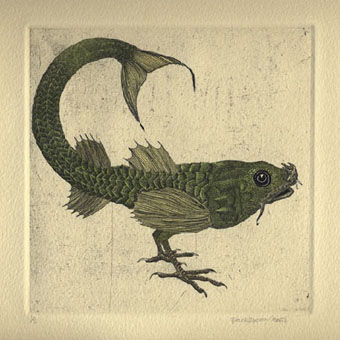
Untitled etching by Briony Morrow-Cribbs.

• An interview with author Paul Russell whose new novel, The Unreal Life of Sergey Nabokov, concerns the gay brother of the celebrated Vladimir.

• Joseph Cornell turns up again in a report at Strange Flowers about Locus Solus, an exhibition in Madrid devoted to the work of Raymond Roussel.

Night of Pan: 42 seconds of occult freakery by Bill Butler featuring Vincent Gallo, Twiggy Ramirez plus (blink and you miss him) Kenneth Anger.

Jan Švankmajer talks (briefly) about his new film Surviving Life. A subtitled trailer is here; the very different Japanese trailer is here.

Cormac McCarthy turns in his first original screenplay. I’d rather he turned in a new novel but any new Cormac is better than none at all.

Barnbrook show off another design for the latest CD from John Foxx & The Maths.

Melanie McDonagh asks “Where have all the book illustrators gone?”

• Congrats to Evan for getting his poetry in the New York Times.

Margaret Atwood on writing The Handmaid’s Tale.

Subliminal Frequencies: An Interview With Pinch.

The (Lucas) Cranach Digital Archive

The M.O.P. Radionic Workshop

• Music promos of the week from the Weird Seventies: All The Years Round (1972) by Amon Düül II, and Supernature (1977) by Cerrone.

René Magritte by David Wheatley

magritte1.jpg

René Magritte as portrayed by Patrick McDonnell.

René Magritte died in 1967, the year Eric Duvivier’s La femme 100 têtes appeared in French cinemas. Magritte is even less visible cinematically than Max Ernst, IMDB lists a couple of documentaries and nothing else. There are trace elements elsewhere, notably the Magritte and de Chirico influence in Bertolucci’s Borges’ adaptation The Spider’s Stratagem (1970), but the artist’s arresting visual imagination has always found more of a welcome on book covers than cinema screens.

magritte2.jpg

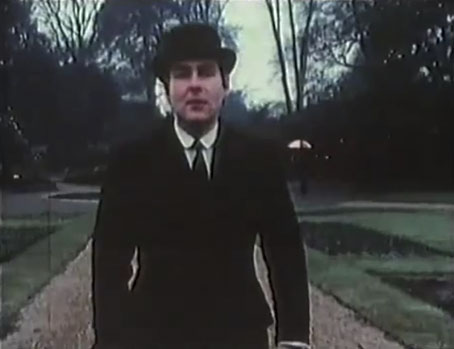
One exception is David Wheatley’s drama documentary René Magritte (1976), yet another work you won’t find listed at IMDB. This was Wheatley’s graduation film which the BBC screened in a 30-minute version (shorn of some apparently clunky dialogue scenes) in 1979, and which secured for Wheatley a place as a regular director for the BBC’s Omnibus and Arena arts programmes. I saw the 1979 broadcast, and caught it again a decade later when one of the channels was having a season of Magritte-related programming, something that’s impossible to imagine in today’s debased television landscape.

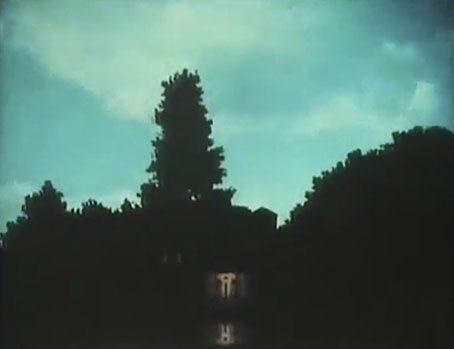
For a student film it’s a stunning piece of work, taking a similar approach to Eric Duvivier in bringing to life many of the artist’s more famous pictures: a window shatters to reveal the scene behind it painted on its panes, a mountain hovers ponderously over the sea, a dove made of clouds flies across a stormy sky. Between the artworks there are short biographical scenes. There’s a sole version of the film on YouTube that remains watchable despite being a low-quality recording from video tape that’s also hacked into three parts and subtitled in Danish.

magritte3.jpg

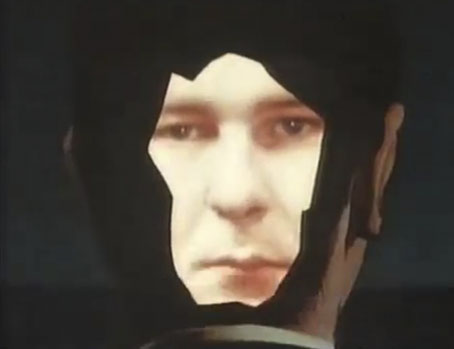
Looking for more information about David Wheatley it was dismaying to find he’d died in 2009, aged 59. Leslie Megahey—a cult TV director of mine—wrote an obituary for the Guardian where he describes some of Wheatley’s other productions including the Arena film Borges and I (1983)—as far as I’m aware the only British TV documentary about Jorge Luis Borges—and Wheatley’s first feature film, an adaptation of Angela Carter’s The Magic Toyshop (1987). I recall enjoying the latter, produced at a time when the success of The Company of Wolves (1984) made it seem there might also be a place in the cinema for Angela Carter’s imagination; we know how that worked out. The Magic Toyshop doesn’t seem to have had a DVD release so good luck to anyone searching for it. As for René Magritte, if anyone runs across a better online copy be sure to leave a comment.

Previously on { feuilleton }
The Public Voice by Lejf Marcussen