Angels 1: The Angel of History and sensual metaphysics

angelus_novus.jpg

Angelus Novus by Paul Klee (1920?).

The Catholic church failed to work its medieval magic on me beyond inspiring a fondness for ecclesiastic architecture and men with wings. But in keeping with the season it’s Angel Week here on { feuilleton } although some of the angels featured may not be quite Vatican-approved.

Above is the Paul Klee painting that prompted Walter Benjamin’s celebrated piece from ‘Theses on the Philosophy of History’ (1940) in Illuminations:

A Klee painting named Angelus Novus shows an angel looking as though he is about to move away from something he is fixedly contemplating. His eyes are staring, his mouth is open, his wings are spread. This is how one perceives the angel of history. His face is towards the past. Where we perceive a chain of events, he sees one catastrophe, which keeps piling wreckage upon wreckage and hurls it in front of his feet. The angel would like to stay, awaken the dead, and make whole what has been smashed. But a storm is blowing from Paradise; it has got caught in his wings with such violence that the angel can no longer close them. This storm irresistibly propels him into the future to which his back is turned, while the pile of debris before him grows skyward. This storm is what we call progress.

A world away from Benjamin’s wreckage, Caravaggio paints a typically luscious boy who just happens to have a pair of wings stuck to his back cradling a swooning saint in St Francis in Ecstasy. Ecstasy as a theme isn’t unknown in religious art, of course, but Renaissance painters usually showed St Theresa doing the fainting. Caravaggio was following a different muse.
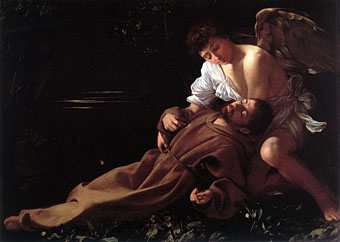
st_francis.jpg

St Francis in Ecstasy by Caravaggio (1595).

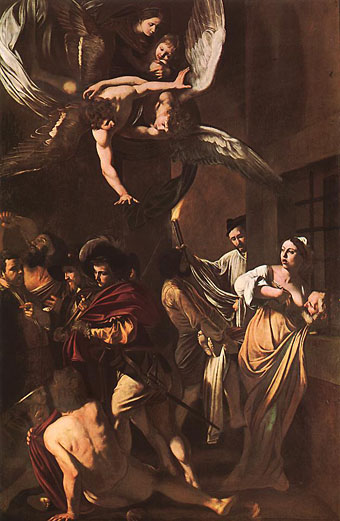
The pair of embracing angels tumbling into the marvellous Seven Acts of Mercy (below) are slightly more robust, a lot more so than the creature posing in Rest on the Flight to Egypt (1597), a picture whose precise religious content seems tenuous at best. And there are still those who believe Caravaggio’s interest in male flesh was solely artistic…
seven_acts.jpg

Seven Acts of Mercy by Caravaggio (1607).

More angels tomorrow.

Elsewhere on { feuilleton }
The gay artists archive

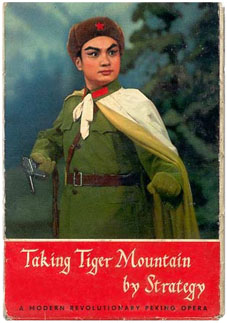
Tiger Mountain Strategies

tiger_mountain.jpgTaking Tiger Mountain (By Strategy) is familiar to those of us in the decadent west as the title of Brian Eno’s second solo album, released in 1974. Eno borrowed the title from a set of Chinese postcards depicting a performance of a Maoist opera, and you can now see a copy of those very postcards here.

“The modern revolutionary Peking opera Taking Tiger Mountain by Strategy, carefully revised, perfected and polished to the last detail with our great leader Chairman Mao’s loving care, now glitters with surpassing splendour.

Taking Tiger Mountain by Strategy is one of the outstanding model theatrical works. It describes an episode in the great Chinese People’s War of Liberation, a battle in which a pursuit detachment of the Chinese People’s Liberation Army wiped out a Kuomintang die-hard gang in northeast China. The opera creates the brilliant images of Yan Tzu-jung and other proletarian heroes by the method of combining revolutionary realism with revolutionary romanticism, and eulogizes Chairman Mao’s great thought on people’s war. The successful creation of the modern revolutionary Peking opera Taking Tiger Mountain by Strategy is a splendid victory for Chairman Mao’s revolutionary line on literature and art.”

Eno produced his own set of strategic cards with artist Peter Schmidt (who painted the cover of Tiger Mountain) a year later, Oblique Strategies, “Over one hundred worthwhile dilemmas.” Originally an expensive limited edition, these are now available in a variety of freeware applications or online versions. Best one if you’re among the 17% of Mac-users visiting this site is probably the Dashboard widget, the latest version of which includes the texts of all three editions. The instant access nature of OS X’s Dashboard is especially suited to small information systems such as this.

Previously on { feuilleton }
Exodus art and Plague Songs
Generative culture
My Life in the Bush of Ghosts

The art of Hubert Stowitts, 1892–1953

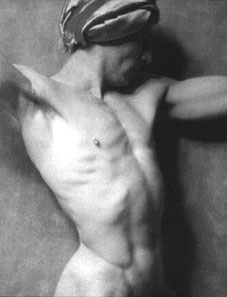
stowitts1.jpg

Left: Stowitts photgraphed by Nickolas Muray, 1922.

Hubert Julian Stowitts had a number of careers, including dancer, film actor, painter, designer and metaphysician. As a dancer he worked with Anna Pavlova, who discovered him in California in 1915 and took him on tour around the world. His statuesque figure was used by Rex Ingram for the infernal scenes in The Magician (1926), an adaptation of Somerset Maugham’s rather limp roman-à-clef based on the exploits of Aleister Crowley. The scene with Stowitts as a satyr owed nothing to the book, however, being more inspired by the director’s fondness for the tales of Arthur Machen. Most photos that turn up from this film show Stowitts rather than Paul Wegener who played the sinister alchemist of the title.

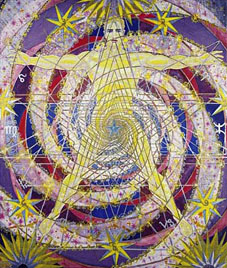
Stowitt’s painting developed in the 1930s and included a series of 55 paintings of nude (male) athletes for the 1936 Olympics (see Ewoud Broeksma’s contemporary equivalents at originalolympics.com). Other paintings depicted dance scenes, costume designs, people encountered during travels in the Far East and, in the 1950s, a series of ten Theosophist pictures entitled The Atomic Age Suite.

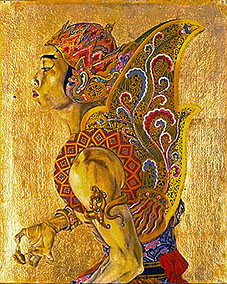
stowitts3.jpg

Prince Suwarno in Mahabarata role (1928).

stowitts2.jpg

Briggs Hunt and William Golden (1936).

stowitts4.jpg

The Crucifixion in Space (1950).

The Stowitts Museum and Library
Stowitts at the Queer Arts Resource

Elsewhere on { feuilleton }
The gay artists archive

Previously on { feuilleton }
The art of Nicholas Kalmakoff, 1873–1955

Death from above

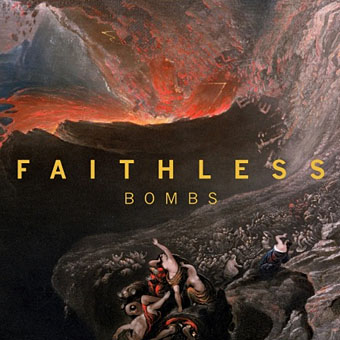
bombs.jpg

The apocalyptic spectacles of Romantic painter John Martin are routinely treated by art critics as kitsch, a dismissal which ignores the considerable power and perennial attraction that many of his best pictures possess. Kitsch is a bad thing, it seems, unless you’re Jeff Koons or Jake and Dinos Chapman.

Martin’s most famous work, The Great Day of His Wrath, has raised its tumultuous head again on the cover of Bombs, a recent single by Faithless. The painting depicts a scene from the Book of Revelations with city-capped mountains being upturned onto terrified sinners while lightning cuts through the sky. The video for the song is an anti-war affair by Howard Greenhalgh, juxtaposing innocuous images of everday life with weapons being fired and soldiers being attacked, often in the same shot. So a happy family skips along a beach while a mushroom cloud grows on the horizon. The moral guardians at MTV have duly banned this in order to spare the delicate sensibilities of America’s teenagers. And they wonder why people like YouTube so much? Or Google Video?

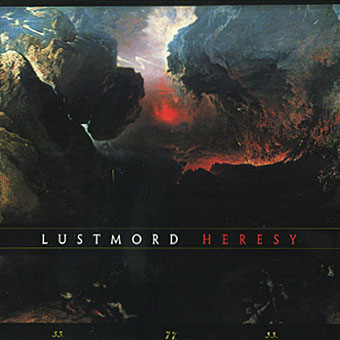
heresy.jpg

Faithless are a bit late to John Martin’s table, Lustmord featured the painting in full on the cover of Heresy in 1990, an album whose doomy rumbles I much prefer to the duo’s lightweight soul. Better late than never, I suppose.

Previously on { feuilleton }
The apocalyptic art of Francis Danby
The Enigma of Desiderio