The art of Bob Pepper

pepper1.jpg

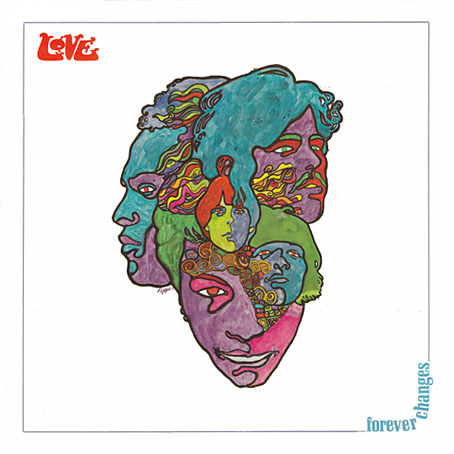
Forever Changes (1967) by Love.
Art by Bob Pepper, design by William S. Harvey.

Following yesterday’s post about Philip K Dick covers (and Erik Davis’s appraisal of the DAW cover), I decided to check out Bob Pepper’s work a bit more and it quickly became obvious I should have joined the dots with this particular artist years ago. Pepper’s work not only decorates one of the recognisable record sleeves of the late Sixties (above), he was working shortly afterwards as an illustrator on the celebrated series of fantasy reprints edited by Lin Carter for Ballantine books. Pepper’s connections with Elektra Records also saw him provide sleeve art for some of the eclectic releases on their Nonesuch label. What’s surprising to me now is the realisation that I’d been seeing his work for years in a variety of places and never noticed it was the same artist. Better late than never, I suppose.
pepper2.jpg

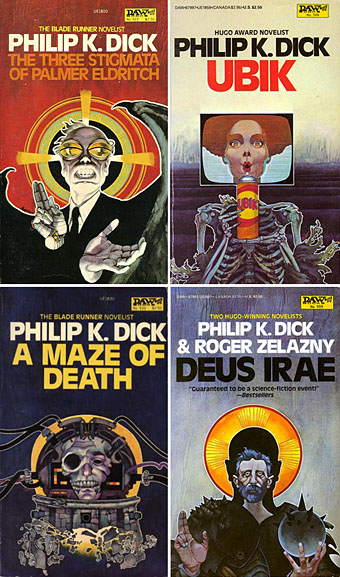
Four more Dick covers for a series of six published in 1982 to coincide with the release of Blade Runner. As with the cover for A Scanner Darkly (in the earlier post) these paintings are all portraits.
pepper3.jpg

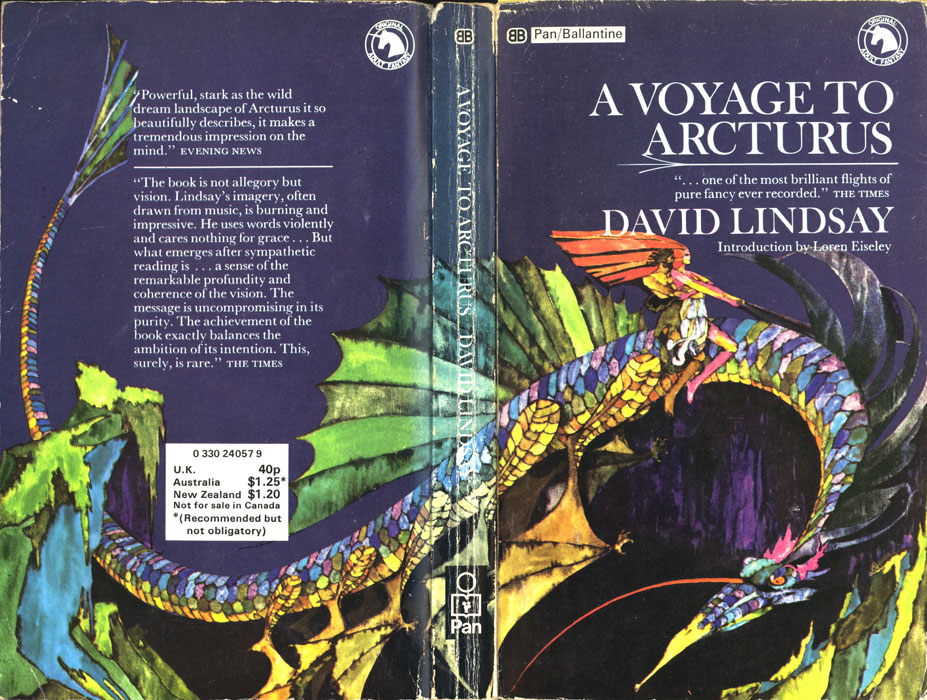
A Voyage to Arcturus (1968) by David Lindsay.

It was the success of the publication of The Lord of the Rings in America which inspired Betty Ballantine to publish a line of fantasy classics in the late Sixties. The series began its run in 1969 and continued until 1974. Lin Carter was commissioned as editor and given free reign to choose any title he thought might be suitable with the result that many of the books in the series—obscurities such as Lud-in-the-mist by Hope Mirrlees—received their first paperback publication. Carter also reprinted personal favourites which frequently shifted from fantasy to outright horror, such as the titles from HP Lovecraft and William Hope Hodgson. The range and scope of this line is what makes the series so notable today and the books have become highly-collectable as a result. Many artists were involved in producing the distinctive cover designs and Pepper’s illustrations were featured on the covers for Mervyn Peake, Lord Dunsany and James Branch Cabell, among others. Unfortunately the various pages devoted to these books aren’t very good at showing the paintings to their best advantage. For a long time Pepper’s cover for A Voyage to Arcturus was one of the few editions available that managed to show a scene from the book, rather than a generic sword-wielding barbarian.
pepper5.jpg

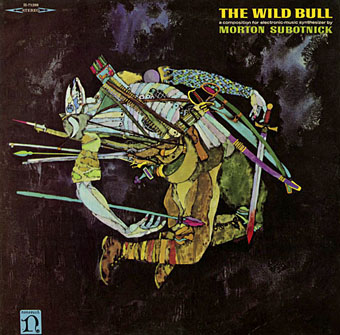
The Wild Bull (1968) by Morton Subotnick.

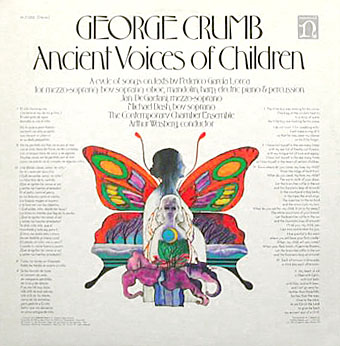
Nonesuch Records was Elektra’s subsidiary classical music label which not only produced classical recordings but also recordings from around the world in their Explorer series, and a range of original works of contemporary electronic music. I’m not positive that the sleeve above is a Pepper painting but it certainly looks like it. This is another surprise since I’ve had Morton Subnotnick‘s album on a reissue CD for years (with different artwork). The George Crumb recording below is Pepper’s work and I’ve had the original vinyl of that one for several years. The similarity between that sleeve and the one for Love is striking.
farmer.jpg

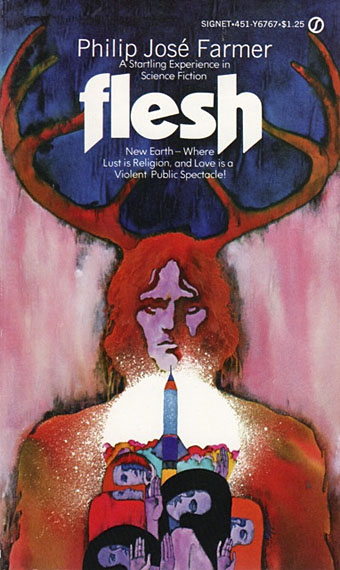
Flesh (1969) by Philip José Farmer.

pepper6.jpg

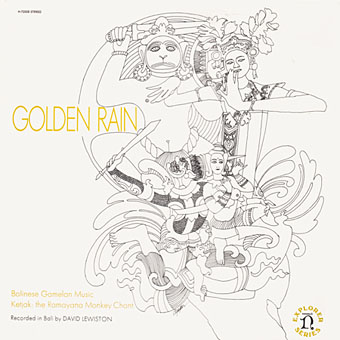
Golden Rain – Balinese Gamelan Music – Ketjak: The Ramayana Monkey Dance (1969) by Various Artists.
Art by Bob Pepper, design by William S. Harvey.
pepper4.jpg

Ancient Voices of Children (1971) by George Crumb.
Art by Bob Pepper, design by Robert W. Zingmark.
delany.jpg

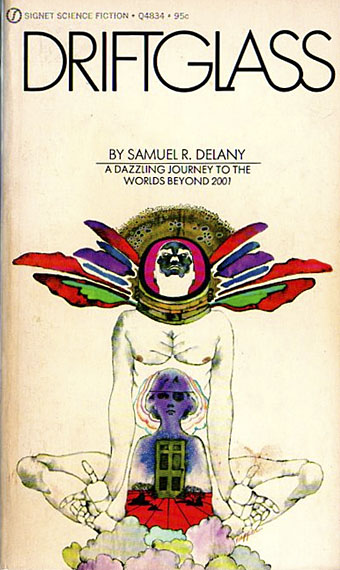
Driftglass (1971) by Samuel R. Delany.

pepper7.jpg

Debussy’s Greatest Hits (1972).

pepper8.jpg

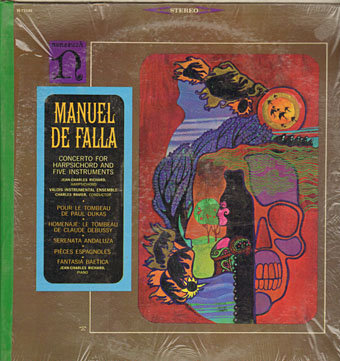
Concerto For Harpsichord And Five Instruments by Manuel De Falla (no date).
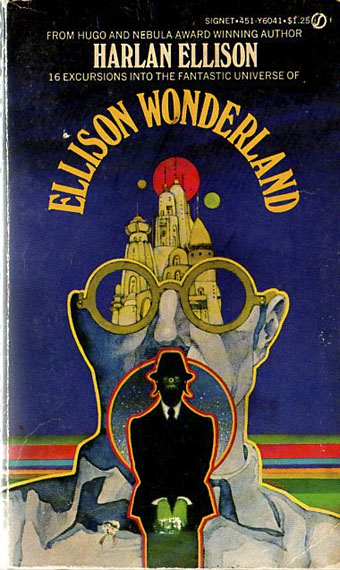
ellison.jpg

Ellison Wonderland (1974) by Harlan Ellison.
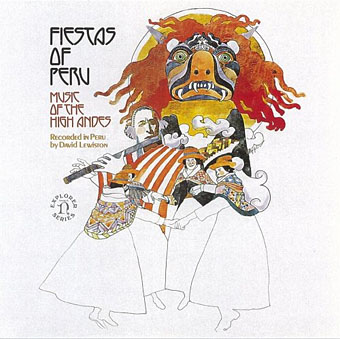
pepper9.jpg

Fiestas of Peru: Music of the High Andes (1975) by Various Artists.
Art by Bob Pepper, design by Jo Ann Gruber.
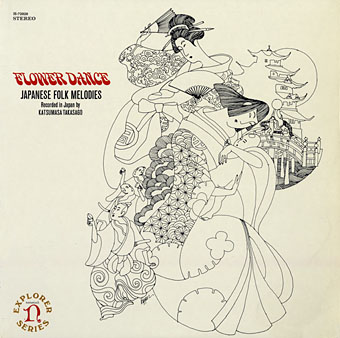
japan.jpg

Flower Dance: Japanese Folk Melodies (no date) by Kofu Kikusui, The Noday Family, Nakagawa & Oishi.
Art by Bob Pepper, direction by William S. Harvey, design by Elaine Gongora.

Pepper is retired now but produced artwork for Dark Tower, a fantasy boardgame, in 1981. The game still has its enthusiasts, and this site features a short interview with the artist.

Update: more about the Ballantine covers.

Update 2: a large scan of the George Crumb cover art.

Update 3: More album and book covers added.

Elsewhere on { feuilleton }
The album covers archive
The book covers archive
The illustrators archive

Previously on { feuilleton}
Philip K Dick book covers
Masonic fonts and the designer’s dark materials

Prince Iskandar’s horoscope

iskandar.jpg

The horoscope of Prince Iskandar, grandson of Tamerlane, the Turkman Mongol conqueror, by Imad al-Din Mahmud al-Kashi, showing the positions of the heavens at the moment of Iskandar’s birth on 25th April 1384.

From the Wellcome Trust image collection. Considering the Wellcome Trust’s medical background, there’s a surprising amount of non-scientific material in its image library, not least a collection devoted to Witchcraft. This perhaps reflects the wide-ranging interests of the Trust’s founder, Henry Wellcome. Jay Babcock and I visited the exhibition of artefacts from Wellcome’s vast collection at the British Museum in 2003 and that proved to be a similarly surprising cabinet of curiosities, including sheets of tattooed human skin and Charles Darwin’s skull-headed walking stick. I was sure I had a photograph of the latter but don’t seem able to find it if it’s still around. Never mind, the BBC has a picture, together with other items from the exhibition. Also on display there was a specially-commissioned film from the Brothers Quay which can now be seen in their DVD collection.

Via Boing Boing.

Previously on { feuilleton }
Calligraphy by Mouneer Al-Shaárani
The Brothers Quay on DVD
The Journal of Ottoman Calligraphy
Word into Art: Artists of the Modern Middle East
The Atlas Coelestis of Johann Gabriel Doppelmayr

Architectural renderings by HW Brewer

brewer1.jpg

Birds-eye view of Birmingham in 1886.

brewer3.jpg

Rome in 1890.

There’s little information online about HW Brewer, a Victorian illustrator who specialised in depictions of cities viewed from the air for magazines such as The Builder. He also imagined how cities might have looked in times past, as with these views of London in the sixteenth century. Always fascinating to see the lack of development south of the river in the days when there was only one bridge available for traffic over the Thames.

Update: bigger copy of the Birmingham picture here.

Elsewhere on { feuilleton }
The etching and engraving archive
The illustrators archive

Masonic fonts and the designer’s dark materials

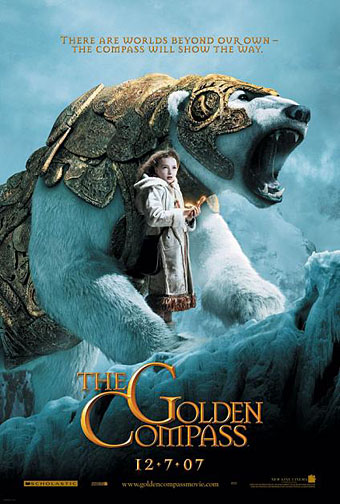
golden_compass.jpg

The trailer for The Golden Compass turned up this week, the first part of Philip Pullman‘s His Dark Materials trilogy, and I can’t help but note that the film’s designers have chosen Jonathan Barnbrook’s Mason font for the titles and the rest of the typography. This isn’t so surprising given that Mason has been used on the covers of several editions of the books already but I wonder if this flush of even greater popularity will spell (as it were) the end of a stylish typeface.

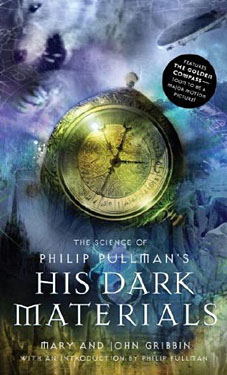
hdm.jpgMason (originally named Manson) was one of Barnbrook’s earliest published type designs, appearing in 1992 via the Emigré foundry, and over the past fifteen years has been widely imitated and become the default font for fantasy works, especially book jackets. The attraction for the genre is obvious in the way the design uses elegant and traditional serif letterforms that have been amended slightly to give them a distinctive quasi-ecclesiastical flavour, with flourishes derived from Greek, Renaissance and Biblical letters. The Gothic arch of the letter A has also helped make the font a popular choice for New Age or occult books. Mason was designed as a set of serif and sans serif variations but it’s Mason Serif Regular which is used the most. (The cover for The Science of His Dark Materials shown here is using both the sans serif variation and Mason Regular Alternate.)

Distinctive fonts take a while to get around and I don’t recall seeing Mason until at least 1994. From 1995 to 2000 it began to appear everywhere, even in newspaper ads for a while, before finding a permanent place in the book world. The trouble with this kind of ubiquity is that the novelty the design once possessed quickly vanishes and it begins to runs the risk of becoming a design cliché. Many typefaces go this way, especially in the publishing world where the choice of typeface is often dictated by genre expectations. So Orbit-B and its variants used to signify “science fiction” or “the future” in the 1970s, Caslon Antique and Rubens have become associated with horror while FF Confidential has been over-used for crime novels.

Continue reading “Masonic fonts and the designer’s dark materials”

Chiaroscuro II: Joseph Wright of Derby, 1734–1797

wright1.jpg

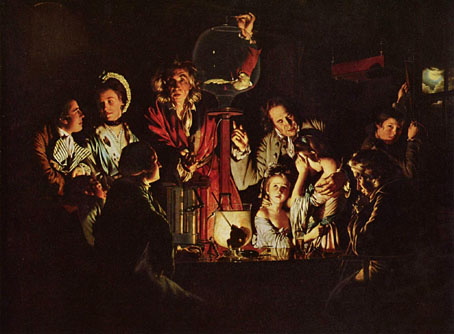
An Experiment on a Bird in the Air Pump (1768).

As promised, one of my favourite chiaroscurists. The impression Joseph Wright’s work made on me at the age of 13 was one of many revelations from my first visit to the Tate Gallery. The paintings which struck me most of the older works there were all of the Romantic or late-Romantic era: Turner, Francis Danby, John Martin, Philippe de Loutherbourg and Joseph Wright’s enormous An Experiment on a Bird in the Air Pump, which is now housed in the National Gallery. The National Gallery site has this to say about the picture:

A travelling scientist is shown demonstrating the formation of a vacuum by withdrawing air from a flask containing a white cockatoo, though common birds like sparrows would normally have been used. Air pumps were developed in the 17th century and were relatively familiar by Wright’s day. The artist’s subject is not scientific invention, but a human drama in a night-time setting.

The bird will die if the demonstrator continues to deprive it of oxygen, and Wright leaves us in doubt as to whether or not the cockatoo will be reprieved. The painting reveals a wide range of individual reactions, from the frightened children, through the reflective philosopher, the excited interest of the youth on the left, to the indifferent young lovers concerned only with each other.

The figures are dramatically lit by a single candle, while in the window the moon appears. On the table in front of the candle is a glass containing a skull.

As with many paintings, the online reproductions do little justice to the subtlety of Wright’s rendering of light and shade. This remains his most famous picture although he made another on a similar theme, A Philosopher Giving a Lecture on the Orrery (below) and, like Godfried Schalcken, he has at least two studies of people viewing statues by candlelight, a common practice at that time for the way the light gave classical sculpture a spurious life. Wright’s painting of The Alchymist is another popular work, turning up frequently in occult encyclopedias. Being a native of Derby he also became (along with de Loutherbourg) one of the first painters to depict the beginnings of the Industrial Revolution whose flaring furnaces provided an ideal subject for dramatists of flame and shadow.

Before leaving the tenebral world, I’ll note that Claire left a message to say that issue 24 of Cabinet Magazine has a feature on shadows in art, symbolism and philosophy.

Continue reading “Chiaroscuro II: Joseph Wright of Derby, 1734–1797”