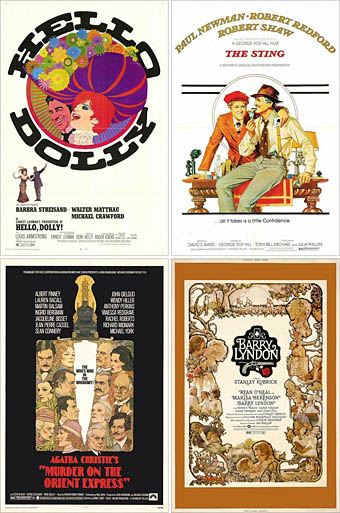
Hello Dolly (1969); The Sting (1973).
Murder on the Orient Express (1974); Barry Lyndon (1975).
Thanks are due for today’s post to Sebastiane who reminded me of the poster art that Richard Amsel produced through the Seventies up to the mid-Eighties. Together with Bob Peak, Amsel was a major exponent of the illustrated poster, a form that’s now completely vanished from cinema promotion in a sea of floating Photoshop heads and persistently lazy design. Amsel’s most famous piece in terms of success and visibility is probably his Raiders of the Lost Ark poster (and its variants) but I tend to prefer his work from the previous decade.
I collected film posters for a while and have one of Amsel’s Chinatown designs packed away somewhere. The Hello Dolly poster above was his first commission and must count as the first and only time a Spirograph was used (for the flowers) to create a design for a major Hollywood production. The Amsel page at American Art Archives notes that the poster for The Sting is a pastiche of the very popular (and gay) JC Leyendecker whose magazine and advertising art was contemporary with the film’s setting. This is exactly the kind of thing that can’t be done with ease today when the art is predominantly a product of digital techniques.
Amsel died in 1985, an early victim of the AIDS pandemic which possibly explains why there isn’t a site dedicated to his work as there is for Bob Peak. This page features a few examples of Amsel’s other work, however, including his instantly recognisable Divine Miss M album cover for Bette Midler. And there’s a small gallery of his posters at IMP.
Update: A retrospective article and marvellous gallery of Amsel’s work by Adam McDaniel
Elsewhere on { feuilleton }
• The illustrators archive
Previously on { feuilleton }
• Bollywood posters
• Lussuria, Invidia, Superbia
• The poster art of Bob Peak
• A premonition of Premonition
• Perfume: the art of scent
• Metropolis posters
• Film noir posters