Lucien Gaillard

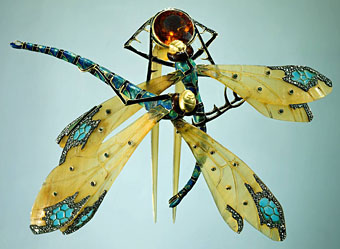
gaillard1.jpg

Two dragonflies (1904).

Art Nouveau insect jewellery by Lucien Gaillard (1861–1933).

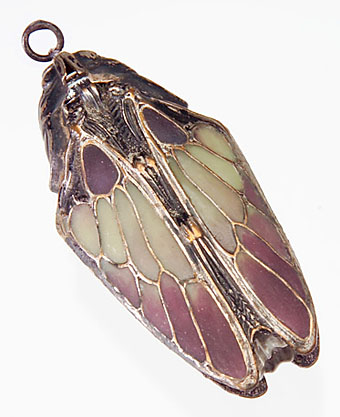
gaillard2.jpg

Perfume bottle (?) (c. 1923).

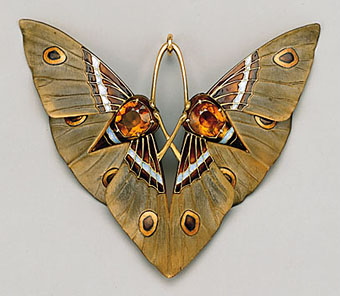
gaillard3.jpg

Moth pendant (1900).

And while we’re on the subject, a display of precious stones and metals has opened at London’s Natural History Museum in a new gallery they’re calling The Vault.

Previously on { feuilleton }
Wesley Fleming’s glass insects
The art of Sergei Aparin
Insect Lab
The glass menagerie
The Museum of Fantastic Specimens

The Age of Enchantment: Beardsley, Dulac and their Contemporaries

dulac.jpg

“Everything about her was white.” Illustration by Edmund Dulac for
The Dreamer of Dreams by Queen Marie of Roumania (1915).

A major exhibition of British fantasy illustration opens at the Dulwich Picture Gallery this Wednesday, running to February 17th, 2008. Considering the huge resurgence of popularity in fantasy for children I’m surprised none of the UK galleries have done this before now. The Dulwich organisers have chosen a suitably wintry picture by the wonderful Edmund Dulac to promote the exhibition which—intentionally or not—happens to look like a precursor of the poster art for The Golden Compass.

With the death of Aubrey Beardsley in 1898, the world of the illustrated book underwent a dramatic change. Gone were the degenerate images of scandal and deviance. The age of decadence was softened to delight rather than to shock. Whimsy and a pastel toned world of childish delights and an innocent exoticism unfolded in the pages of familiar fables, classic tales and those children’s stories like The Arabian Nights and Hans Andersens’ Stories. These were published with lavish colour plates and fine bindings: these were the coffee table books of a new age.

As a result a new generation of illustrators emerged. This new group of artists was intent upon borrowing from the past, especially the fantasies of the rococo, the rich decorative elements of the Orient, the Near East, and fairy worlds of the Victorians. The masters of this new art form were artists like Edmund Dulac and Kay Nielson, whose inventive book productions, with those of Arthur Rackham, became legendary. Disciples gathered, like Jessie King and Annie French, the Scottish masters of the ethereal and the poetic, the Detmold Brothers, masters of natural fantasy, as well as those who remained in Beardsley’s shadow: the warped yet fascinating works of Sidney Sime, a joyously eccentric coal-miner turned artist, Laurence Housman, master of the fairy tale, the precious inventions from the classics by Charles Ricketts, the Irish fantasies of Harry Clarke, himself a master of stained glass as well as the gift book, and the rich and exotic world of Alaistair. Children’s stories were transformed by the imaginations of a group still bowing to the Victorians Walter Crane, Randolph Caldecott and Kate Greenaway and the fairies of Richard Doyle but these were now given a more colourful intensity by Charles Robinson, Patten Wilson, Anning Bell, Bernard Sleigh and Maxwell Armfield.

The exhibition of British fantasy illustration will be the first such exhibition in Britain and the first worldwide for over 20 years (the last being in New York in 1979). All works, of which over 100 are planned, will come largely from British museums and private collections, many of these will never have been seen publicly before in Britain.

The exhibition is curated by Rodney Engen.

AS Byatt reviewed the exhibition for The Guardian and also looked at the sinister perversity underlying many of the Edwardian fairy tales.

Edmund Dulac at Art Passions

Books by Queen Marie of Roumania:
The Dreamer of Dreams (1915; illus: Edmund Dulac)
The Stealers of Light (1916; illus: Edmund Dulac)
Vom Wunder der Tränen (1938; illus: Sulamith Wülfing)

Elsewhere on { feuilleton }
The illustrators archive

Previously on { feuilleton }
Masonic fonts and the designer’s dark materials

New things for November II

newthings_0711.jpg

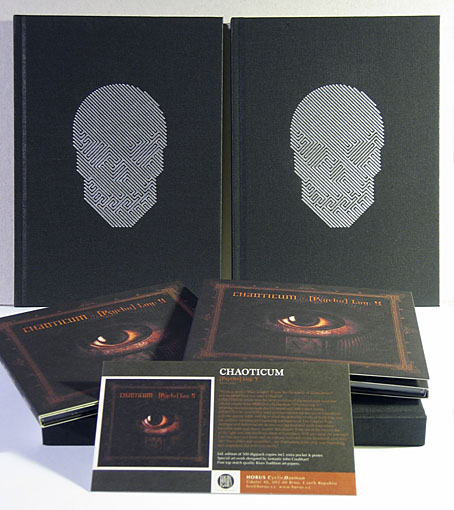
It’s always nice when something you’ve worked on turns up in the post and there’s been a double helping of that this week with the arrival of the Chaoticum CD and the catalogue for the Maison D’Ailleurs exhibition. Since both of these are either partly or wholly connected to HP Lovecraft, their simultaneous arrival is fitting.

The CD is a digipak on textured art paper and another quality production from Horus CyclicDaemon. The exhibition catalogue manifested as a small hardback book which was a pleasant surprise, with the skull maze design blocked in silver on the cover. Each artist is allotted a single page and the book also includes some original fiction based on Lovecraft’s story notes by a number of well-known writers. My picture is rather shrunken the way it’s positioned across the centre of a page (would have been better running vertically) but then it was my decision to make it so wide in the first place.

The Chaoticum CD is limited to 500 copies and can be ordered here. The catalogue is available from Maison D’Ailleurs or the Payot Libraire bookstore for CHF 37.00 + p&p (or 38, depending on which page you look at).

bishop.jpg

Also arriving this week is my illustration of ex-Sun City Girls guitarist Sir Richard Bishop for an Arthur Magazine interview by Erik Davis. Arthur #27 will be hitting the stands in the US and Canada shortly but for now you can download it in PDF form here.

Previously on { feuilleton }
Lovecraftian horror at Maison d’Ailleurs
New things for October

Visions and the art of Nick Hyde

visions.jpg

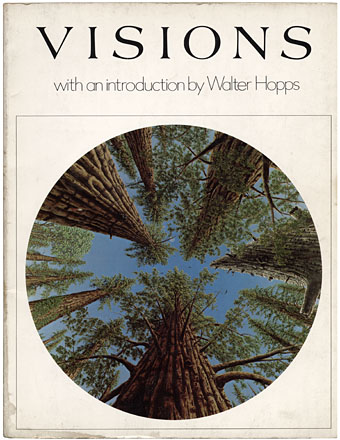
Cover painting: Holy Grove by Gage Taylor (1975).

Book purchase of the week was this American collection of what we have to call “hippy art” (or “California Visionary Art”, as its creators preferred) published by Pomegranate Publications in 1977. I’d seen this circa 1979 and many of the pictures inside were used by Omni Magazine to decorate the science fiction stories in their early issues. After that it vanished from view completely which leads me to believe that UK distributors Big O didn’t sell as many as they would have liked. The white cover design made me remember it for a long time as being part of the David Larkin series which I discussed in May but it isn’t, although the Larkin books were quite probably the model for the book’s presentation.

Finally acquiring a copy was something of a disappointment since it transpires I remembered the decent painters and forgot the terrible ones who comprise at least half the book. Cliff McReynolds is one of the better artists (Omni thought so too) and by coincidence I posted one of his Visions paintings, Landscape with Grenade, almost a year ago to the day.

hyde.jpg

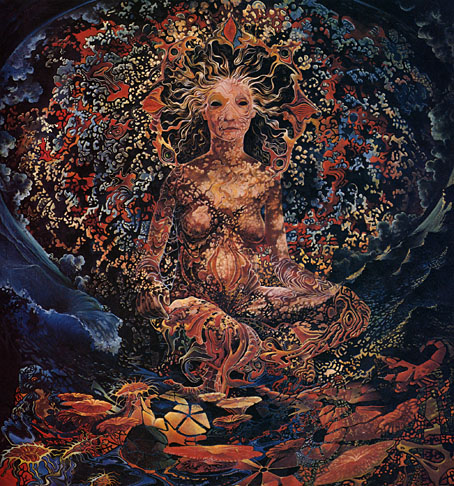
BethAnn (1970).

Best of the bunch for me is Nick Hyde whose fantastically detailed works blend the fractal filigree of psychedelic art with the kind of dreamscapes and tableaux one sees in Surrealism. The print reproductions do little justice to his detail and the web degrades his work even further (see Abraxas for a good example). Happily there are posters available.

Elsewhere on { feuilleton }
The fantastic art archive

The poster art of Richard Amsel

amsel.jpg

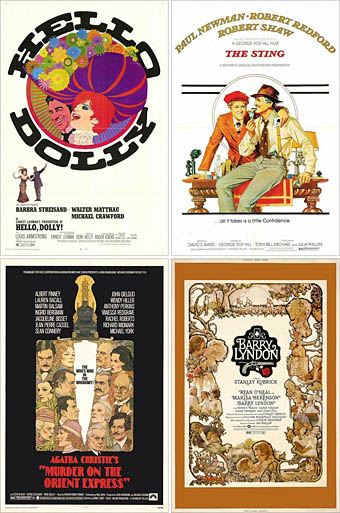
Hello Dolly (1969); The Sting (1973).
Murder on the Orient Express (1974); Barry Lyndon (1975).

Thanks are due for today’s post to Sebastiane who reminded me of the poster art that Richard Amsel produced through the Seventies up to the mid-Eighties. Together with Bob Peak, Amsel was a major exponent of the illustrated poster, a form that’s now completely vanished from cinema promotion in a sea of floating Photoshop heads and persistently lazy design. Amsel’s most famous piece in terms of success and visibility is probably his Raiders of the Lost Ark poster (and its variants) but I tend to prefer his work from the previous decade.

I collected film posters for a while and have one of Amsel’s Chinatown designs packed away somewhere. The Hello Dolly poster above was his first commission and must count as the first and only time a Spirograph was used (for the flowers) to create a design for a major Hollywood production. The Amsel page at American Art Archives notes that the poster for The Sting is a pastiche of the very popular (and gay) JC Leyendecker whose magazine and advertising art was contemporary with the film’s setting. This is exactly the kind of thing that can’t be done with ease today when the art is predominantly a product of digital techniques.

Amsel died in 1985, an early victim of the AIDS pandemic which possibly explains why there isn’t a site dedicated to his work as there is for Bob Peak. This page features a few examples of Amsel’s other work, however, including his instantly recognisable Divine Miss M album cover for Bette Midler. And there’s a small gallery of his posters at IMP.

Update: A retrospective article and marvellous gallery of Amsel’s work by Adam McDaniel

Elsewhere on { feuilleton }
The illustrators archive

Previously on { feuilleton }
Bollywood posters
Lussuria, Invidia, Superbia
The poster art of Bob Peak
A premonition of Premonition
Perfume: the art of scent
Metropolis posters
Film noir posters