Is Goya masterpiece just a colossal mistake?
| Panic over El Coloso.
Category: {art}
Art
Vintage/Vantage
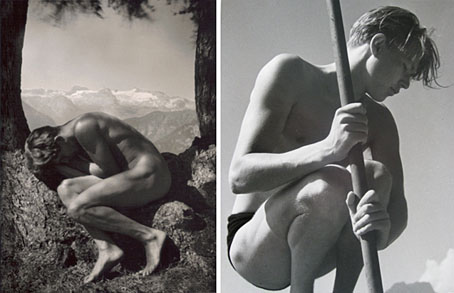
left: In The Belly of Nature (self-portrait) by Rudolph Koppitz (1923).
right: Ritti with Rod, North Sea, Germany by Herbert List (1933).
Vintage/Vantage is an exhibition of classic homoerotic photography of the 19th and 20th century at Wessel + O’Connor Fine Art, NYC. Examples range from Muybridge’s human locomotion experiments, through von Gloeden‘s Mediterranean boys to Herbert List, George Hoyningen-Huene and co. The exhibition runs to May 3, 2008.
The art of Boris Artzybasheff, 1899–1965
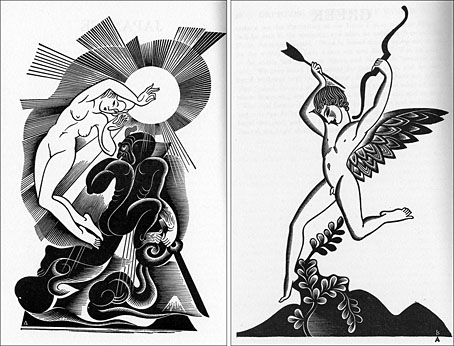
Myths of the World (1930).
Boris Artzybasheff’s humorous illustrations of anthropomorphic machines have received a lot of attention from Boing Boing recently. But Artzybasheff was a very versatile artist, not a one-trick pony, and his book and other magazine illustration is worth a look as well. These examples are from the indispensable VTS. Some of his early magazine covers brought to light here have a distinct Hannes Bok flavour.
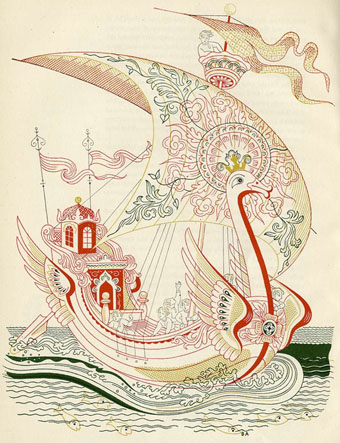
Seven Simeons (1937).
See also:
• Artzybasheff’s Neurotica
• Artzybasheff’s Machinalia
• Another page of illustrations
Elsewhere on { feuilleton }
• The illustrators archive
The skull beneath the skin
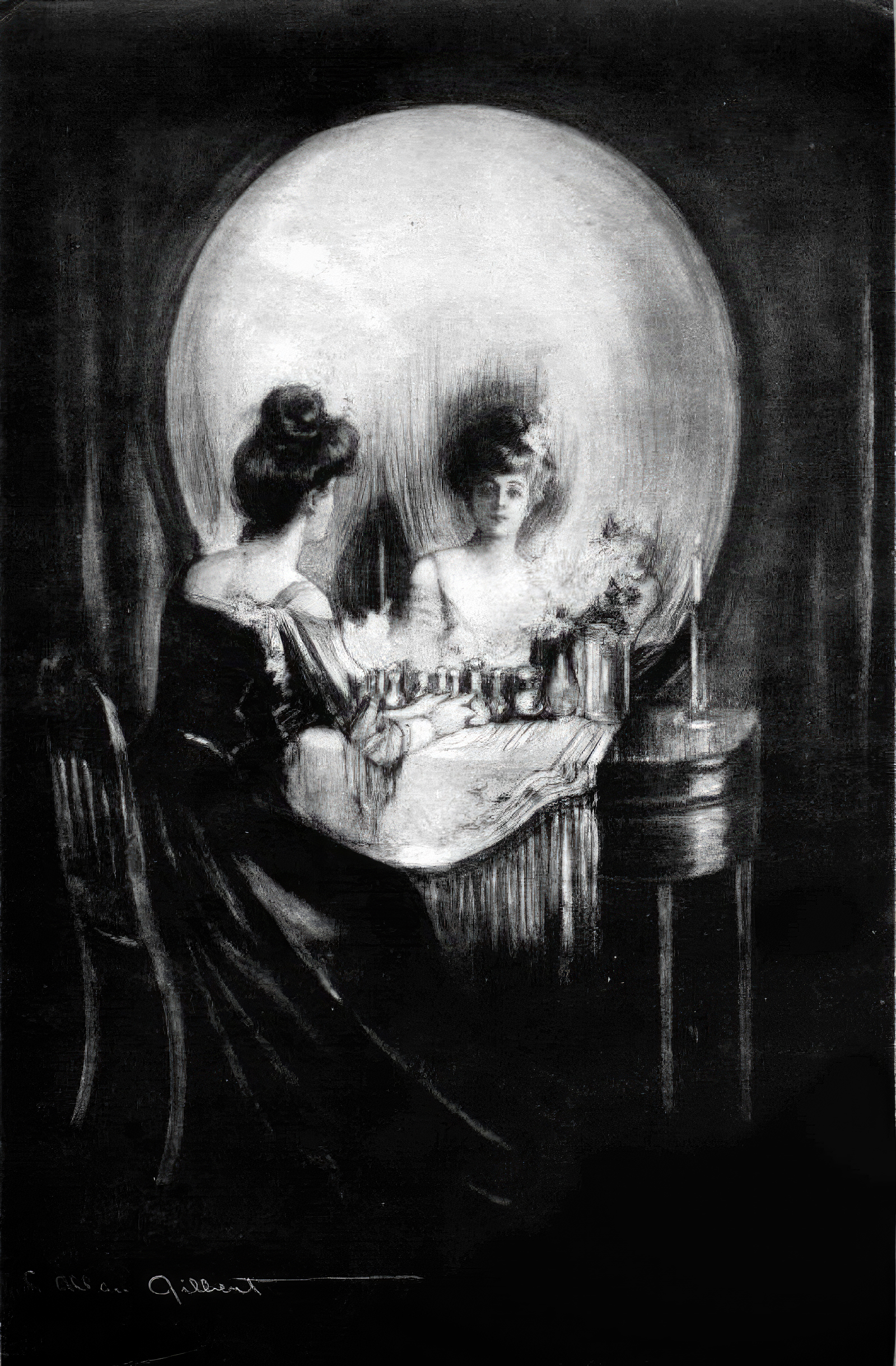
All Is Vanity by Charles Allan Gilbert (1892).
The subliminal skull is another of those perennial motifs that recur in art from time to time, and one which has become especially prevalent since the late 19th century. There seem to be a number of reasons for this, the most obvious being that if you’re going to show how clever you are by hiding one image inside another you may as well make the hidden thing something that everyone recognises. A secondary reason would seem to be the waning power of the vanitas theme. As painting became more pictorially sophisticated it wasn’t enough to simply show a skull and expect people to accept this with a stern moral as the principal content. Hence the development of death as a non-skeletal character in Symbolism and the reduction of skulls in pictures to a kind of playful game.
Holbein’s anamorphic skull in The Ambassadors is probably the grandfather of all the later versions but the more recent popularity of the hidden motif can be traced back to Charles Allan Gilbert whose 1892 picture, All is Vanity, drawn when he was just 18, was sold to Life Publishing in 1902, and subsequently spread all over the world in postcard form. Despite giving birth to a host of imitators, Gilbert’s picture is the one that still inspires artists and photographers up to the present day.
The art of Heidi Taillefer
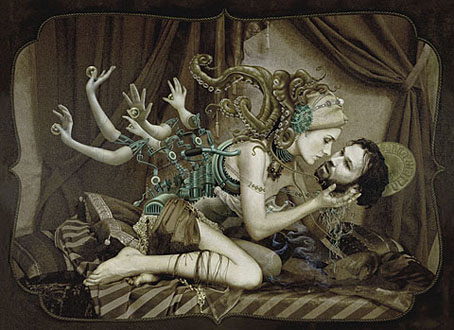
Frustration Attraction (2006).
A Canadian artist works a marvellous variation on Salomé using oils and photo-printed canvas. Lots of other fine, inventive work at her site, all of it shown far too small to see the considerable detail. A tip to artists with websites: let us see the pictures properly; people appreciate it and will spread the word if they like your work. Via Fabulon.
Update: Her site has been relaunched and you can now see a lot more of the detail in her incredible paintings.
Elsewhere on { feuilleton }
• The fantastic art archive
Previously on { feuilleton }
• Beardsley’s Salomé
• Peter Reed and Salomé After Dark
• Alla Nazimova’s Salomé