The King in Yellow

king_ace.jpg

Along the shore the cloud waves break,
The twin suns sink beneath the lake,
The shadows lengthen
In Carcosa.

Strange is the night where black stars rise,
And strange moons circle through the skies
But stranger still is
Lost Carcosa.

The King in Yellow, Act i, Scene 2.

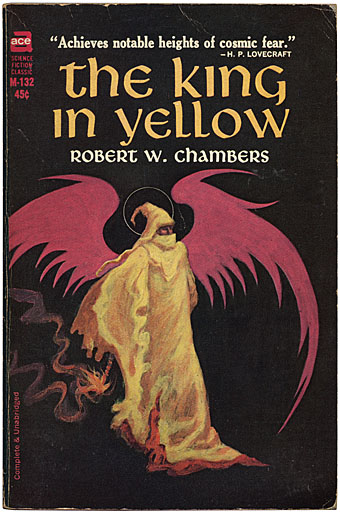
Rearranging the bookshelves this week had me looking again at this old Ace paperback of Robert Chambers’ weird classic, one of that select handful of books which can bear a blurb from HP Lovecraft. Any Lovecraft aficionados yet to read the first four stories in Chambers’ collection (the others pieces are of lesser interest) are missing out. These are as good as anything that Weird Tales published and together they achieve that unique blend of science fiction, fantasy and horror which Lovecraft and others also managed in the days when writers, and readers for that matter, were far less concerned with the definition and boundaries of genre.

king2.jpg

My Ace edition was the first paperback printing from 1965 and the cover painting is by Jack Gaughan, credited inside as being based on Chambers’ own first edition design. I’d often wondered what the original cover looked like and now, of course, it’s easy to find. Whether Chambers himself drew this is unclear but whoever the artist was, the design is rather more finessed than Gaughan’s sketchy painting.
king.jpg

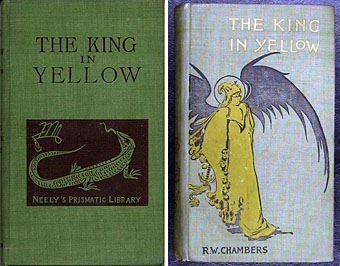
Searching around reveals two further variations, one of which—the green cover—is described on a bookselling site as the actual first edition of the book from 1895. Yours for a mere $1,750. The other cover is probably a later reprint which gives a clearer view of the mysterious King. What’s notable here is the curious sigil on both the Neely editions. I was hoping this might be the dreaded Yellow Sign which is the subject of Chambers’ fourth (and Lovecraft’s favourite) story; it’s certainly more suitable than the squiggle which seems so unaccountably popular among certain quarters of Lovecraft fandom. It isn’t the Yellow Sign, however, it turns out to be the monogram for publisher F. Tennyson Neely. Perhaps this is just as well. “The solution to the mystery is always inferior to the mystery itself,” as Borges said, and some things, like the malevolent play which gives its name to this collection, are best kept out of reach.

The King in Yellow at the Internet Archive

Elsewhere on { feuilleton }
The book covers archive
The Lovecraft archive

Previously on { feuilleton }
Arthur Machen book covers
Clark Ashton Smith book covers

Melancholy Lucifers

feuchere.jpg

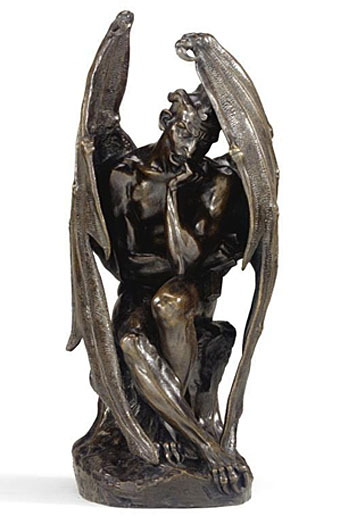
Satan (1833).

I always enjoy it when a search for a piece of information about an artist leads to works you hadn’t come across before. Today it was a quest for the identity of the Satan statue above, created, as it turns out, by French sculptor Jean-Jacques Feuchère (1807–1852). The Louvre site has another view of what seems to have been a popular work, produced in a range of bronzes.

lawh.jpg

I did actually know the artist’s name a few years ago since I’d used the statue as a starting point for the Satan figure on the cover of Cradle of Filth’s Lovecraft & Witch Hearts in 2002. One function of postings such as this is that it allows me to make a note of details which otherwise might flee the memory. Here Feuchère’s statue was combined with some squid tentacles and seated on an elaborate Gothic throne which is mostly obscured by the band’s name. (See a larger version sans lettering here.)

Continue reading “Melancholy Lucifers”

Henry Keen’s Dorian Gray

keen1.jpg

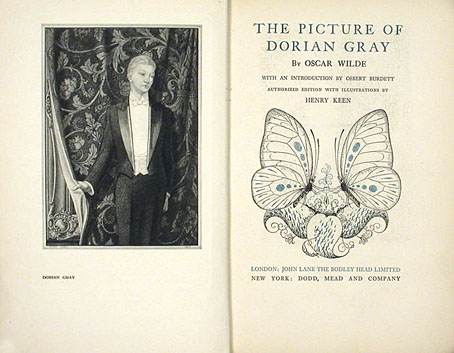
Returning to the golden boy again this week with an illustrated edition of Wilde’s novel from 1925. The publisher was Aubrey Beardsley’s old employer, John Lane, and the illustrator was Henry Keen, an artist of singular and dismaying obscurity. Perhaps some of my knowledgeable commenters can provide more information. Keen’s 12 plates look like lithographs but the book also featured ink embellishments and a splendid sunflower/butterfly design on the boards and slipcase.

Continue reading “Henry Keen’s Dorian Gray”

The real Basil Hallwards

dorian.jpg

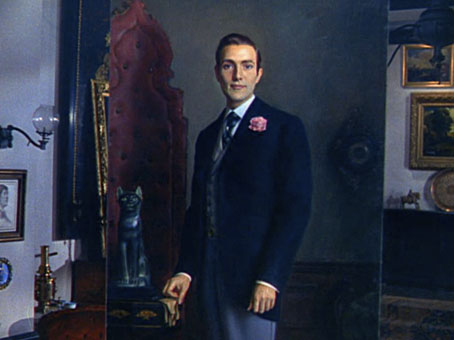
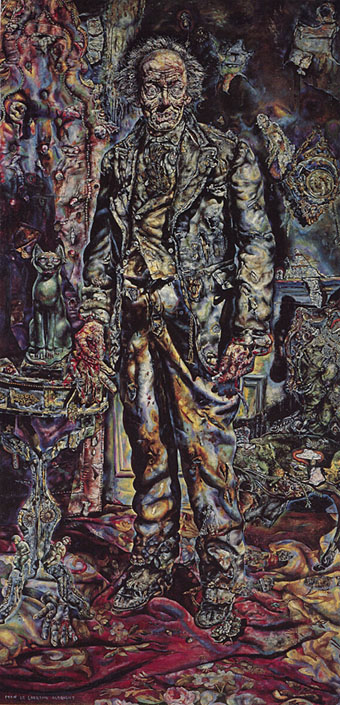
Well, two of them anyway… Discussion with commenter Noel in one of my old (and rather scant) posts about Albert Lewin’s 1945 film of The Picture of Dorian Gray touched on the fate of the original version of Dorian’s portrait (above). For some reason I’d always assumed this to have been produced by MGM’s art department despite a clear credit at the opening of the film for artist Henrique Medina (1901–1988). I no doubt miss this since my eyes always go to the credit for Ivan Albright (1897–1983), the artist responsible for the famous deteriorated final state of the picture (below). That painting is so splendidly grotesque its presence almost overpowers the entire film but its power would be lessened without the contrast of Medina’s elegant original. Examples of Medina’s other portrait works show a distinct similarity.

albrights.jpg

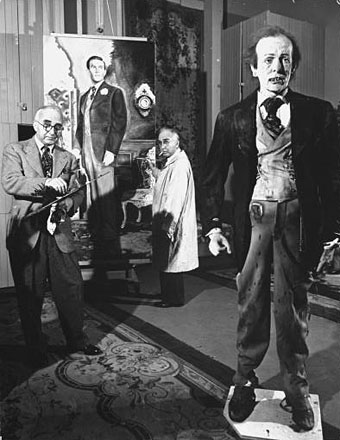
Noel pointed the way to photos from the LIFE magazine archives which show Ivan Albright and his identical twin brother, Malvin, at work on the portrait. (Another here.) Fascinating not only to see an early stage of the painting but also a dummy of the decayed Dorian they were using as a model.

albright.jpg

Albright’s dissolute masterpiece can be seen at the Art Institute of Chicago, together with a number of his other works. Noel notes that Medina’s picture was bought at auction for $25,000 but its current whereabouts and ownership remain a mystery. If anyone knows more about this, please leave a comment.

Elsewhere on { feuilleton }
The Oscar Wilde archive