Weekend links 31

bock.jpg

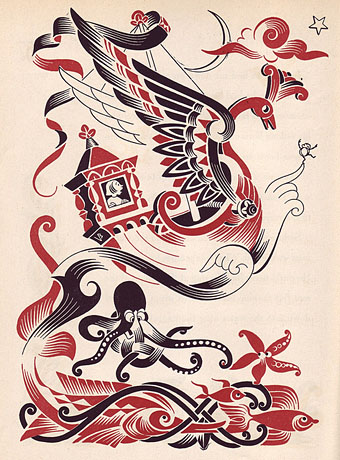
One of a series of illustrations by Vera Bock for A Ring and a Riddle (1944) by M.Ilin and E. Segal. Via A Journey Round My Skull.

The Creator of Devotion: Photos from a Vogue Hommes Japan feature by Matthew Stone. And also here.

Dressing For Pleasure: Jonny Trunk gets out the rubber gear. Related: King of Kinky.

Salvator Rosa (1615–1673) is having a show at the Dulwich Picture Gallery, London.

Hackney Dissenting Academy #1: Throbbing Gristle, Iain Sinclair & Alan Moore.

Out Of The Flesh (1984) by Chakk. A great single never reissued on CD.

• Photographer Charles Gatewood remembers William Burroughs.

mural.jpg

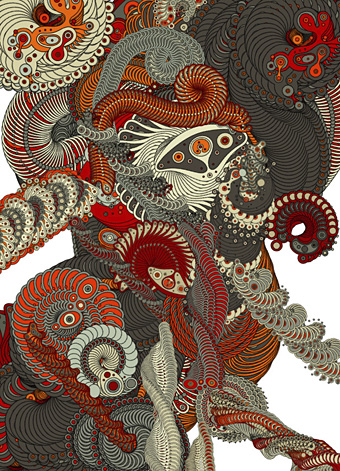
The Endless Mural. Follow links here to have a play around.

Vinyl record sales are at the top of a four-year sales trend.

Can explosions move faster than the speed of light?

• Buckminster Fuller’s Dymaxion Car is reborn.

• Maximus Clarke talks with William Gibson.

Why Stephen Fry loves Wagner.

Kafka’s Last Trial.

• Alice Coltrane in concert, Warsaw, 1987: Harp solo | Impressions | Lonnie’s Lament | A Love Supreme.

The art of Karel de Nerée tot Babberich, 1880–1909

babberich1.jpg

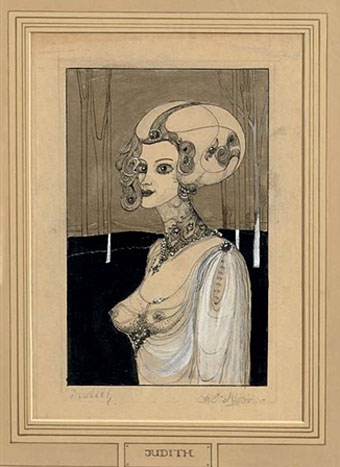
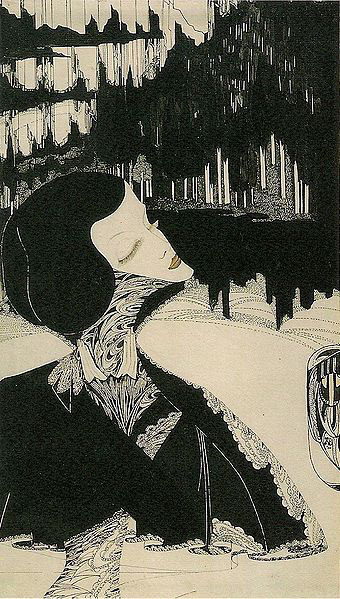
Judith (no date).

Another Decadent type who died young, de Nerée was a Dutch artist and illustrator whose work in these pictures owes a great deal to Aubrey Beardsley. As Beardsley-influenced pieces go they’re rather crude, although it’s unfair to be too judgemental since there’s so little of his work available to see online. Following yesterday’s post, it’s inevitable that he produced a Salomé picture of his own but there’s no sign of that, the curiously space-age (or alien) Judith above is the closest you’ll get.

babberich2.jpg

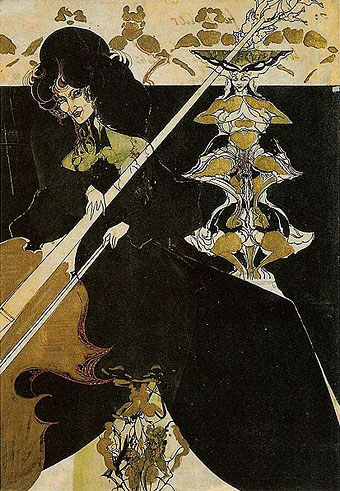
Introduction to Extaze (1900-01).

On the strength of these drawings I’d probably have de Nerée down as a post-Beardsley pasticheur similar to Alastair (aka Hans Henning Voigt) but there’s another side to his output evident in his painted works which show a far more assured Symbolist style, with a figurative approach closer to another Dutch artist of the period, Jan Toorop. It’s a shame the photos there are little more than snapshots, I’d like to see more of these. The Wikipedia article has a couple more drawings, and there’s another Beardsley-esque piece here.

babberich3.jpg

La musique (1904).

Elsewhere on { feuilleton }
The illustrator’s archive

Previously on { feuilleton }
More decorated books from the Netherlands

Several Salomés

fowler.jpg

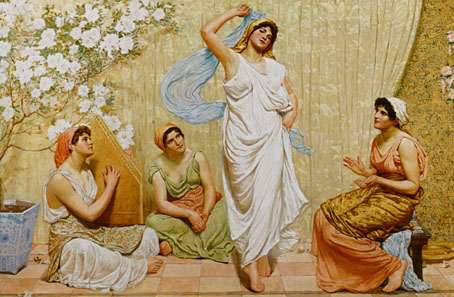
The Dance of Salomé (1885) by Robert Fowler.

There’s always more to find… Unfortunately, Robert Fowler’s academic tableaux is a prime example of bad Victorian art: carefully modelled but overlit, dull and lifeless. And worst of all for the subject at hand: deeply unerotic. We’re supposed to believe that this woman wrapped in a bedsheet would exude enough eros to drive her father to lustful recklessness. This was the bloodless “good taste” against which Oscar Wilde and the Aesthetes set themselves.

moreau.jpg

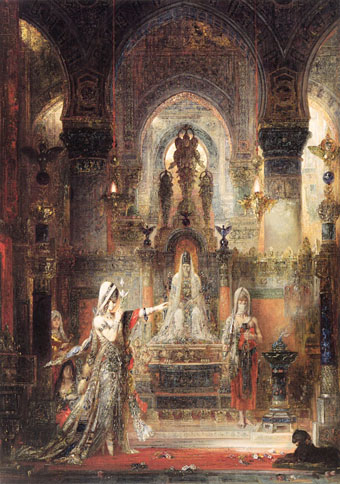
Salomé Dancing before Herod (1876) by Gustave Moreau.

Wilde’s idea of Salomé can be seen here in one of Gustave Moreau‘s many paintings on the theme. Wilde would have preferred Moreau’s paintings, or something similar, to adorn his published play but he ended up with Aubrey Beardsley instead. You only have to compare Beardsley’s Stomach Dance with Fowler’s painting to see why Aubrey’s art made such a dramatic impression in the 1890s.

pell.jpg

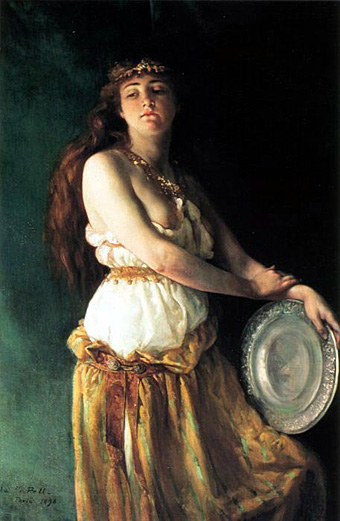
Salomé (1890) by Ella Ferris Pell.

Ella Ferris Pell’s painting isn’t the only portrait of Salomé by a female artist of this period but it’s the one which Bram Dijkstra chose as the cover image for his excellent study Idols of Perversity: Fantasies of Feminine Evil in Fin-de-Siècle Culture (1986). Of this work Dijkstra writes:

In Pell’s painting a number of the most characteristic turn-of-the-century attributes of the biblical temptress are absent. She does not glare at us with a look of crazed sexual hunger; she does not have the wan, vampire features of the serpentine dancer; nor does she show herself to be a tubercular adolescent … Pell’s Salomé, a real life-woman, independent, confident, and assertive, was far more threatening, far more a visual declaration of defiance against the canons of male dominance than any of the celebrated viragoes and vampires created by turn-of-the-century intellectuals could ever have been. Such a woman could not be disposed of in as cavalier a fashion as the evil women in man’s mind. Her indomitable reality was this feminist Salomé’s most formidable weapon, far more dangerous than any imaginary decapitating sword.

henri.jpg

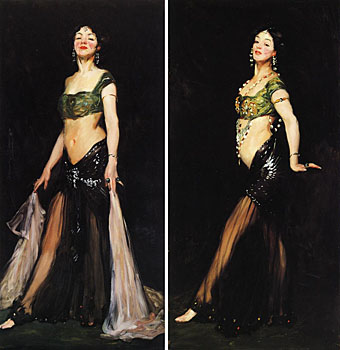
Salomé (1909), two paintings by Robert Henri.

Finally, there’s this pair of paintings by American artist Robert Henri whose work resembles John Singer Sargent’s in its shadowed backgrounds and light brushstrokes. Salomé was no longer a perennial theme by this point but Maud Allan’s improvised dance performance, Vision of Salomé, was proving enormously popular at the time Henri painted these pictures which may explain his choice of subject. There’s little in the rest of his oeuvre along similar lines.

Elsewhere on { feuilleton }
The Salomé archive

Steampunk overloaded!

infernal.jpg

Yes, it’s the “S” word again, and if there was any doubt that this has been the Year of Steampunk here at Coulthart Towers, look at these recent works. And this is by no means everything I’ve been doing in this area, there’ll be further announcements later on.

The covers for KW Jeter’s novels are a pair of reprintings from UK publisher Angry Robot whose books will shortly be available in the US and Canada. Jeter is now famous—infamous, perhaps—for having given the word “steampunk” to the world in the early 1980s. This was intended as a jest after he and a couple of other writers (including a favourite of mine, Tim Powers) had written a number of science fiction novels set in the 19th century; like many light-hearted neologisms, it gained a life of its own. Angry Robot are reissuing two of these early works as a result of the ongoing steampunk explosion.
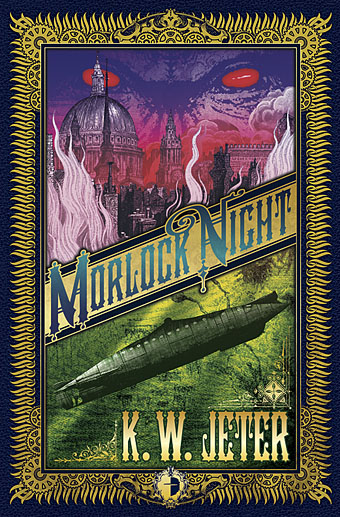
morlock.jpg

Morlock Night (1979) is a pulpy affair which sees the Morlocks from HG Wells’ The Time Machine using the Time Traveller’s vehicle to return to Victorian London and wreak no end of havoc. Infernal Devices (1987) is a rather more substantial confection involving a great deal of clockwork mechanisms (for once the clock parts are justified!), automata, fish people, and a device capable of destroying the earth. I’ve been producing a lot of engraving collage à la Ernst and Sätty recently but the technique seemed especially appropriate here as a means of illustrating works which themselves are collages of Victorian motifs.
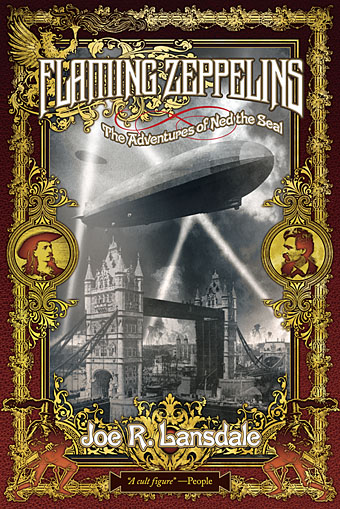
zeppelins.jpg

Meanwhile, over at Tachyon Publications, there’s this cover for another Victorian adventure, two in fact, from master beserker Joe R Lansdale. Flaming Zeppelins combines a pair of comic adventures, Zeppelins West (2001) and Flaming London (2006), which feature a host of notable figures including Mark Twain, Annie Oakley, Buffalo Bill Cody…and a talking seal. Publication date is November 1st.

steampunk.jpg

Then from Tachyon in mid-November there’ll be Steampunk II: Steampunk Reloaded, a 430-page anthology edited by Ann & Jeff VanderMeer which includes fiction and non-fiction from William Gibson, Caitlín R Kiernan, Jeffrey Ford, Cherie Priest, and many others. Also a comic strip, copious illustrations and a very full-on interior design from yours truly of which I’ll only show you the above page for the time being. Yes, that’s a mechanical ostrich but if you want to know what it’s doing there you’ll have to read the book. More about this later. And more later about The Steampunk Bible to which I’m also a contributor, a glossy, full-colour guide to the entire sub-culture which will be published next year by Abrams. By the time that appears I’ll probably be sick of the sight of clockwork parts, dirigibles, florid typefaces and Victorian decoration; I’ll be needing a good dose of Helvetica and Josef Müller-Brockmann minimalism to calm down.

Previously on { feuilleton }
Skeleton clocks
Vickers Airship Catalogue
The Air Ship
Dirigibles
More Steampunk and the Crawling Chaos
La route d’Armilia by Schuiten & Peeters
The art of François Schuiten
Steampunk Redux
Steampunk framed
Steampunk Horror Shortcuts
The Airship Destroyer
Zeppelin vs. Pterodactyls

Beardsley’s Rape of the Lock

pope1.jpg

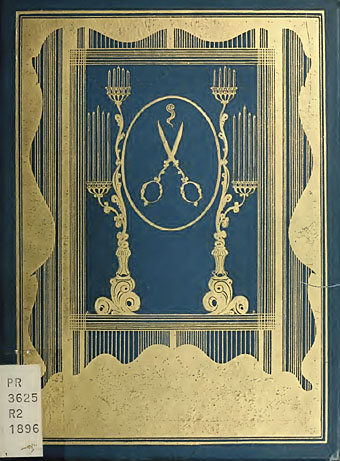
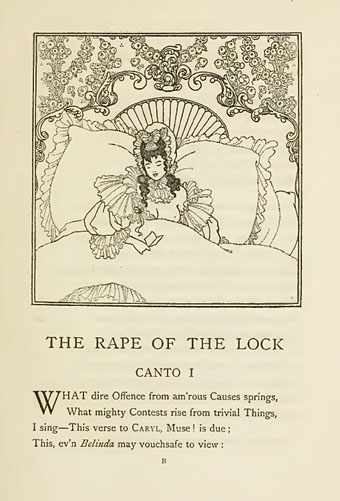
This week’s reading has been Virginia Woolf’s Orlando, a capricious novel which features in its 18th century scenes encounters with some of the great poets of the era, including Alexander Pope. A number of references are made to Pope’s satiric The Rape of the Lock (1717), one of his most notable works which received an equally notable set of illustrations in 1896 from Aubrey Beardsley. The pictures here are from a copy of the first edition published by Leonard Smithers which can be seen at the Internet Archive where the collection features a large number of books created by or written about the artist. Even though Beardsley’s illustrations are endlessly reprinted I do like to see how they were first presented to the world, how the pages were typeset and so on. One detail from this first edition is that we see the credit on the title page: “Embroidered with nine drawings by Aubrey Beardsley.” The cover design is often reproduced in its original black-and-white state which fails to convey the intended effect of those great slabs of gold, while the illustrations within are some of the finest and most detailed of the artist’s career. If the PDF doesn’t really do them justice there are better copies to be found, here and here, for example.

pope2.jpg

Leonard Smithers was notorious in Victorian London for his publishing of pornography but he tried to use the proceeds to occasionally produce works with a better reputation such as this. Beardsley had also been tarred as a pornographer, of course, but here he restrained himself in order to do justice to a book he admired. There is one possible exception in the cover design; I’m afraid I couldn’t find the reference but one of Beardsley’s critics asserts that the open scissors and fatal lock of hair shown in the mirror create a surreptitious image of the female pudenda. With many other artists this interpretation might be dismissed as fanciful but Aubrey filled his early drawings with phalluses and breast shapes, and his unfinished novel, the erotic fantasy Under the Hill, has a title referring to the mons pubis. No other artist of the time would be so daring even with a pornographer for a publisher; it was just this sort of impudence which infuriated his more staid contemporaries. Under the Hill is far more overt in its sexuality and its writing style owes something to Pope’s era which Aubrey adored. The posthumous edition of that book, containing other Beardsley ephemera, can be found here.

Elsewhere on { feuilleton }
The Aubrey Beardsley archive
The illustrators archive
The book covers archive