Deutsche Kunst und Dekoration #4

dkd04-01.jpg

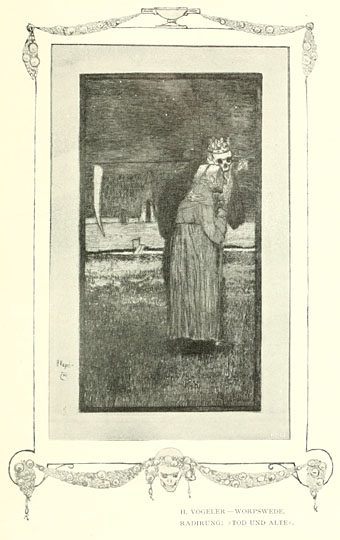
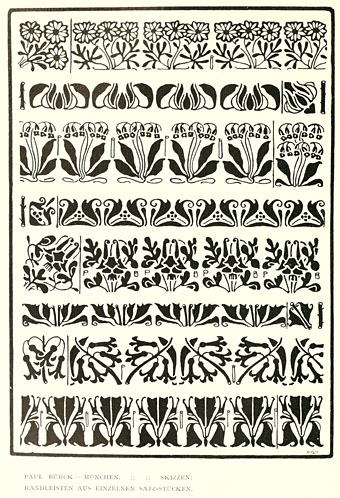
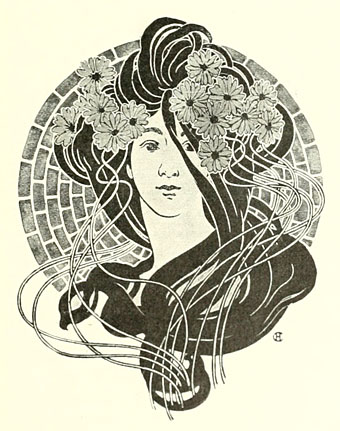
Continuing the delve into back numbers of Deutsche Kunst und Dekoration, the German periodical of art and decoration. There isn’t a volume 3 in the Internet Archive collection, hence the jump in the series to volume 4 which covers the period from April–September 1899. This edition features a few more familiar names beginning with artist and illustrator Heinrich Vogeler whose illustrated edition of Oscar Wilde stories was featured here last year. Vogeler’s work isn’t always to my taste although I liked his Wilde drawings; the Tod und Alte piece above is an exception to his usual work of this period rather than the rule. Elsewhere there’s a feature on the graphic designs of Paul Bürck, a profile of Dutch Symbolist Jan Toorop and a report on the Dresden art exhibition of 1899 which includes an array of beautiful Art Nouveau interiors. As with all such idealised exhibition displays, they point the way to a future that was never to be.

More DK&D next week.

dkd04-02.jpg

dkd04-03.jpg

Continue reading “Deutsche Kunst und Dekoration #4”

Passage 14

passage14.jpg

It’s that time of year again when my good friend Ed Jansen unveils the latest edition of Passage, his Dutch-language webzine:

The 14th issue of Passage contains articles about language, the dreamachine of Brion Gysin, the collaboration of Gysin with William Burroughs and Ian Sommerville (The Third Mind), a recently discovered photograph of Arthur Rimbaud’s presence in Aden, lots of photos of exhibitions and performances of artists in and around The Hague, about the experiences of Louis-Ferdinand Céline in the First World War and the latest novel of Michel Houellebecq. The purpose behind everything we write and make is to give the reader a sense of direction towards the unknown, towards the North-West Passage that leads to a new world.

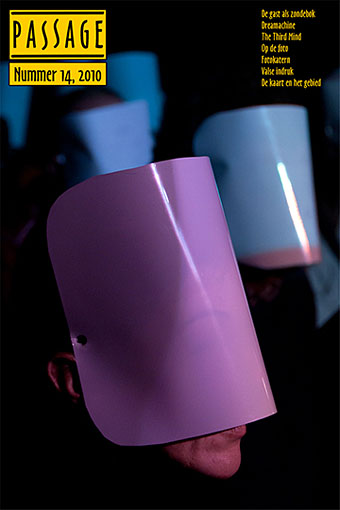
The cover picture is a photo of the audience at a Dreamachine-inspired presentation by Matthijs Munnik about which we’re told:

In my performance I also make use of the flicker effect, but I have more control over it. In my performance, the audience wears white plastic masks, this way they look into a ganzfeld, a totally white field during the performance. In my set up, I use beamers, projecting light on the audience’s masks, completely immersing them in the light and colors of the projection.

I play an 8 minute live composition, based on the varying effects of different frequencies of flicker, colour, binaural beats and sound. During the performance every spectator will see something different, varying patterns and colours, created within their own brains.

And speaking of the Dreamachine, Nick Hydra left a comment in an earlier post with the news that visitors to the Wellcome Collection’s High Society exhibition in London have the opportunity to trip out with one of Brion Gysin’s flicker machines until the end of February.

Previously on { feuilleton }
Brion Gysin let the mice in
Passage 13
Passage 12
Passage 11
Passage 10

Weekend links 43

broadcast.jpg

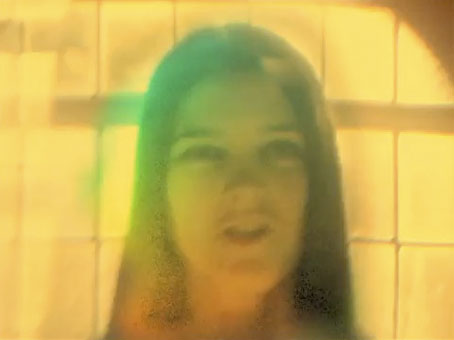
From the video for I See, So I See So by Broadcast.

RIP Trish Keenan of Broadcast. Tributes here and here. The Broadcast/Focus Group collaboration …investigate Witch Cults of the Radio Age was The Wire‘s album of the year for 2009. Joseph Stannard interviewed Trish Keenan and James Cargill in October of that year.

Who Knows What Tomorrow Might Bring, a new pay-what-you-please Arthur mixtape. Also at Arthur, Sunday Lectures by Freeman House here, here, here and here.

• Cormac McCarthy’s description of American pioneers in Suttree (1979) kept coming to mind during the past week:

Where hunters and woodcutters once slept in their boots by the dying light of their thousand fires and went on, old teutonic forebears with eyes incandesced by the visionary light of a massive rapacity, wave on wave of the violent and the insane, their brains stoked with spoorless analogues of all that was, lean aryans with their abrogate semitic chapbook reenacting the dramas and parables therein and mindless and pale with a longing that nothing save dark’s total restitution could appease.

Born This Way: “A photo/essay project for gay viewers (male and female) to submit pictures from their childhood (roughly ages 4 to 14), with snapshots that capture them, innocently, showing the beginnings of their innate LGBT selves. It’s nature, not nurture!”

Mischievous street art characters. Chris Marker wouldn’t want us to forget Monsieur Chat. Speaking of Chris Marker, there’s Plato’s Cave as Kino: Owl’s Legacy Excerpt & Becoming Imperceptible.

With the point of a knife Dr. LeBaron took from the little round box a small quantity of a dark, greenish-colored gum, which, as it was passed from one to another for inspection, gave off an agreeable, aromatic odor. Then, as he was engaged in filling two capsules from the box, he explained:

“As le docteur read from ze book of Monsieur Richet, ze favoreet méthode in ze Orient ees to take ze Haschisch by ze smoke in ze Persian pipe—ze hookah, ze nargileh. But zey also take eet in ze great varieté. Ze principal kind zat come to ze market of Europe, ees zat I show you—ze Haschisch, an’ ve take eet like ze dose of quinine,” said he, as he handed a well-filled capsule to both Smith and Arnold.

Throwing back his head, Smith bolted his dose without ceremony, and Arnold immediately followed his example.

Haschisch: A Novel (1886) by Thorold King. Related: Haschisch Hallucinations (1905) by HE Gowers.

• Dan Hill’s personal report from the drowned world of Brisbane. Related: Hayley Campbell recalls swimming in the city’s hazardous floodwaters when she was a wild child. Also: Canoeing in McDonald’s.

Cabinet Card Backmarks, florid advertisements from Victorian cabinet photos. Callum James made a post on the subject in 2008 and has a Flickr set showing his discoveries.

• The Brothers Quay made a public information film about AIDS in 1996. (Now deleted from YouTube…boo!)

The secret stories of book inscriptions. Related: The Book Inscriptions Project.

• Ani, Turkey: City of 1001 Churches, all of them abandoned and ruined.

Vulgar Army: Octopus in Propaganda and Political Cartoons.

• Designer John Gall makes collages in his spare time.

Phantasmaphile at Tumblr.

Witch Cults and I See, So I See So, both by Broadcast & The Focus Group.
Deutsche Kunst und Dekoration #2

dkd02-01.jpg

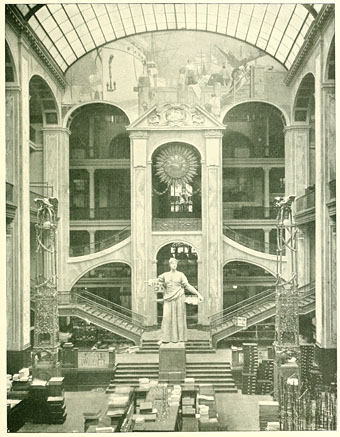
Continuing the delve into back numbers of Deutsche Kunst und Dekoration, the German periodical of art and decoration. Volume 2 covers the period April–September 1898 and, as before, this issue can be downloaded in a variety of formats at the Internet Archive. This edition opens with a feature on the Wertheim department store, Berlin, design by Alfred Messel. Like many examples of Art Nouveau architecture, the store suffered damage during the Second World War and was eventually demolished.

dkd02-02.jpg

This number also has a lengthy feature devoted to artist Hans Christiansen whose work was appearing regularly in issues of Jugend magazine at this time. The colour panels below are Christiansen’s work.

Continue reading “Deutsche Kunst und Dekoration #2”

The art of Carel Willink, 1900–1983

willink1.jpg

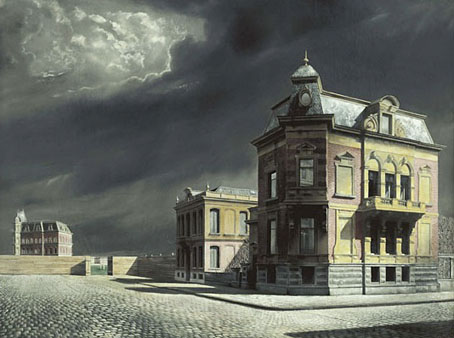
Townscape (1934).

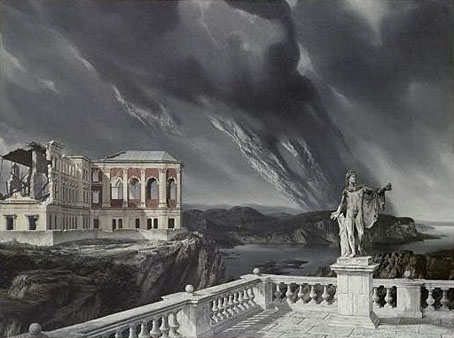
Carel Willink was a Dutch painter whose self-described brand of “imaginary realism” conjured in its early years a collection of views of desolate plazas, empty lanes and abandoned ruins over which smoke or cloud hangs like an ominous portent. The works of Giorgio de Chirico and Paul Delvaux come to mind when looking at these pictures although Willink’s work has enough unique qualities to stand apart from his more famous contemporaries. I’m also reminded a little of Spanish artist Arnau Alemany who has a similar predilection for isolated architecture.

willink2.jpg

Chateau in Spain (1939).

There’s an official Willink website here, while further paintings can be seen at this Flickr set and also at Ten Dreams.

Elsewhere on { feuilleton }
The fantastic art archive

Previously on { feuilleton }
Bruges-la-Morte
Taxandria, or Raoul Servais meets Paul Delvaux
The art of Arnau Alemany