Weekend links 737

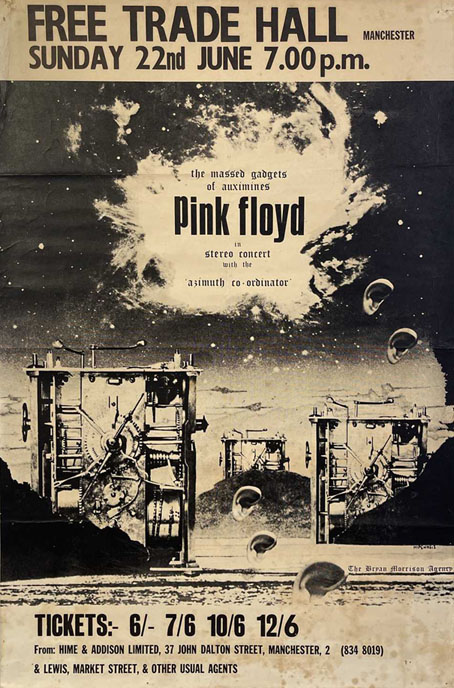
pinkfloyd.jpg

The Massed Gadgets of Auximines – Pink Floyd – in stereo concert with the “Azimuth Co-ordinator”. Design by Hipgnosis, 1969.

• At Rond1900: Sander Bink explores the life of another obscure Dutch Symbolist, Léonard Sarluis (1874–1949): artist, friend of Oscar Wilde and lover of Alfred Jarry.

• At Spoon & Tamago: Manga artist Hirohiko Araki pays tribute to Osaka station’s history and culture with new public art sculpture.

• At Public Domain Review: Scenes of reading on the early portrait postcard by Melina Moe and Victoria Nebolsin.

• At Dennis Cooper’s: 33 films that either faked ingesting LSD or did.

• At Bandcamp: Blissful Noise, Bad Vibes: A Doomgaze Primer.

• Mix of the week: Azimuth Coordinator by Tarotplane.

• New music: Global Transport by Monolake.

• The Strange World of…Gay Disco.

Speak & Glitch

Postcard From Jamaica (1967) by Sopwith Camel | Postcards Of Scarborough (1970) by Michael Chapman | An Unsigned Postcard (1991) by Tuxedomoon

Weekend links 736

jupiter.jpg

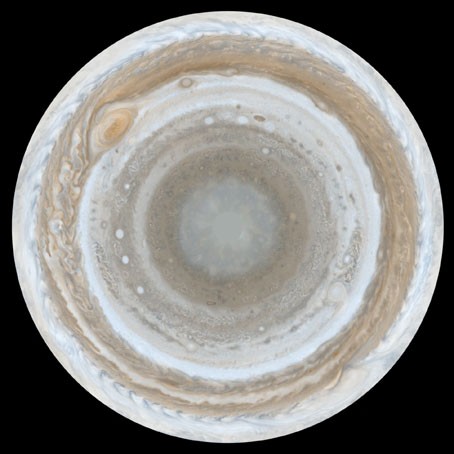
South Polar Map of Jupiter by the Cassini spacecraft, 2000.

• “A ghostly train journey on a forgotten branch line transports a son, Jozef, visiting his dying Father in a remote Galician Sanatorium. Upon arrival Jozef finds the Sanatorium entirely moribund and run by a dubious Doctor Gotard who tells him that his father’s death, the death that has struck him in his country has not yet occurred, and that here they are always late by a certain interval of time of which the length cannot be defined. Jozef will come to realise that the Sanatorium is a floating world halfway between sleep and wakefulness and that time and events cannot be measured in any tangible form.” The Quay Brothers have finished their third feature film, Sanatorium Under the Sign of the Hourglass, a combination of live action and animation which is being premiered next month at the Venice film festival. No sign of a trailer as yet but the curious can prime themselves by watching (or rewatching) the Quays’ Street of Crocodiles—their first adaptation of Bruno Schulz—or Hourglass Sanatorium, the first screen adaptation of Schulz’s stories by Wojciech Has.

• “No one is sure when the tremendous whirl—the largest and longest-lived storm in our current solar system, with a diameter wider than planet Earth and wind speeds of more than 260 miles per hour—began. Or why it’s red. Or even who first observed it…” Katherine Harmon Courage on Jupiter’s Great Red Spot.

• New music: Bórdice by Nestor, and Nightfall by Trentemøller, the latter with a video swiping shots from Maya Deren’s Meshes of the Afternoon. Nice song but musicians really need to stop plundering independent film-makers when they want some visual embellishment.

• At The Daily Heller: Steven Heller talks to Drew Friedman about Friedman’s new book of caricatures, Schtick Figures.

• Mixes of the week: A mix for The Wire by Miaux, and Isolatedmix 127 by David Douglas & Applescal.

• DJ Food’s latest psychedelic trawl is a collection of book covers, puzzles, etc, designed by Peter Max.

• At Unquiet Things: Vic Prezio’s Gothic book covers.

• At Dennis Cooper’s: Morgan Fisher Day.

Jupiter (1990) by NASA Voyager Space Sounds | Jupiter! (Feed Your Head Mix) (1994) by System 7 | Jupiter Collision (2002) by Redshift
Frank C. Papé’s The Well of Saint Clare

pape01.jpg

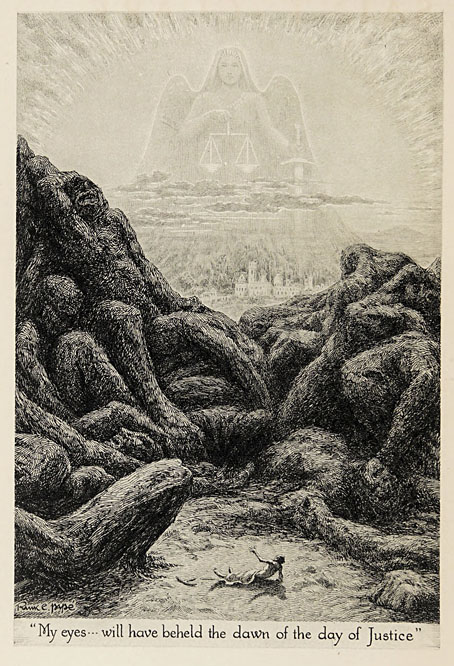
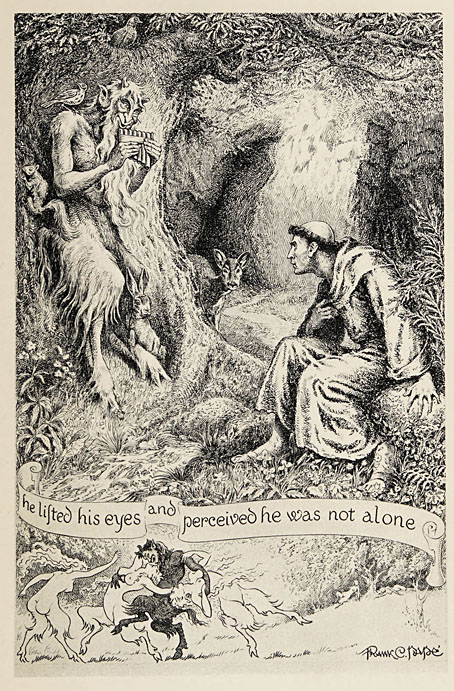
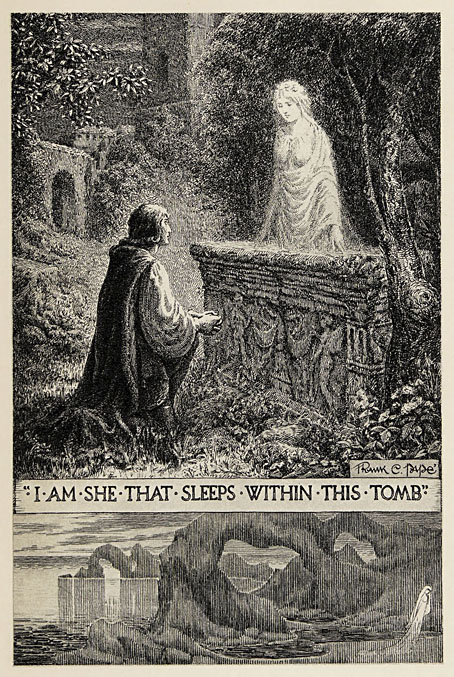
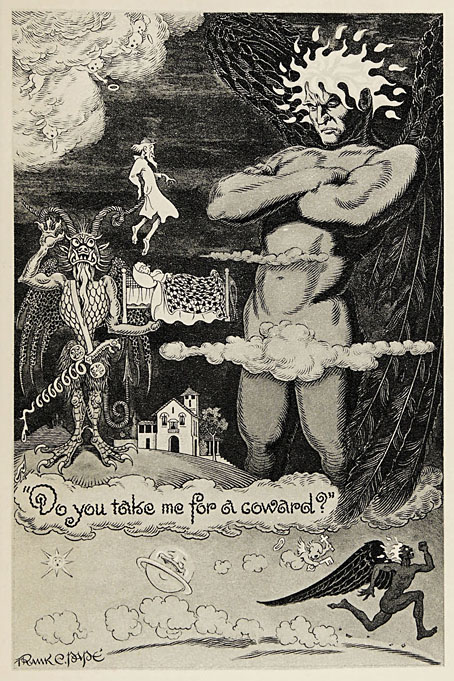
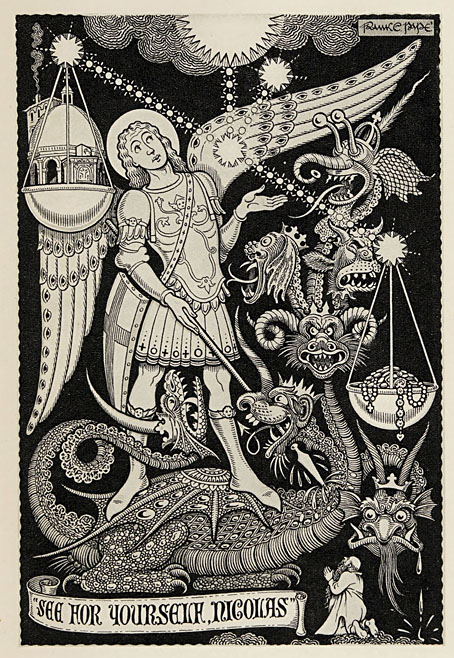
I was asked recently if I’d ever written anything about British illustrator Frank C. Papé (1878–1972). The answer was no for two reasons, the first being that where book illustration is concerned I like to be able to point to whole books, and until recently there hasn’t been much of Papé’s work available in complete editions. The second reason is that Papé’s illustration is often broadly comic, to a degree that had he been born a generation or two later he might have been drawing humorous comic strips or editorial cartoons. Papé was very adept on a technical level but his drawings aren’t always to my taste so I’ve never spent much time looking for his books.

pape02.jpg

The first of those caveats has been ameliorated by recent uploads at the Internet Archive which include this volume, one of several Anatole France editions with Papé illustrations. The Well of Saint Clare (1928) is a collection of religious stories set in the medieval era. The book appeared a few years after Papé had illustrated James Branch Cabell’s Jurgen: A Comedy of Justice, a quasi-medieval fantasy which was the subject of a celebrated obscenity case in the USA. Anatole France’s satires were almost as contentious for a time—the Vatican put his books on their prohibited list—which leaves me wondering whether Papé had a natural inclination for risqué material or whether his publishers pushed him in this direction. Probably a little of both.

pape03.jpg

pape04.jpg

pape05.jpg

Continue reading “Frank C. Papé’s The Well of Saint Clare”

Weekend links 735

wyeth.jpg

The Adventure of the Giant Squid (c.1939) by NC Wyeth.

• Mix of the week is a superb XLR8R Podcast 860 by Kenneth James Gibson. Elsewhere there’s DreamScenes – July 2024 at Ambientblog, and Deep Breakfast Mix 267 at A Strangely Isolated Place.

• A trailer for a restored print of Time Masters (1982), the second animated feature by René Laloux, with character designs/decor by Moebius. Now do Gandahar.

• Coming soon from Strange Attractor: Music From Elsewhere: Haunting Tunes From Mythical Beings, Hidden Worlds, and Other Curious Sources by Doug Skinner.

Not only a prolific lyricist, Lovecraft considered his main vocation to be poetry. And at its best, his verse can be judged an apt expression of his philosophical vision, in which cosmic horror embodies the predicament of all sentient beings in a meaningless universe. That Lovecraft’s poetry never reaches the heights attained by such Modernists as T.S. Eliot or Ezra Pound should not diminish the fact that his is verse that, in the most archaic of ways, advances a startlingly modern metaphysic, a poetic encapsulation of what Thomas Ligotti in The Conspiracy Against the Human Race describes as an affirmation that the universe is a “place without sense, meaning, or value.” Lovecraft, with his antiquated prosody and his anti-human ethics, presented readers with a type of counter-modernist poetry. Ironically, he is the radical culmination of William Carlos Williams’s injunction of “No ideas but in things;” he is an author for whom there are only things. Graham Harman in Lovecraft and Philosophy describes Lovecraft as a “violently anti-idealist” who “laments the inability of mere language to depict the deep horrors his narrators confront.” Unpleasant stuff, for sure. It is verse that at best exemplifies something that controversial poet Frederik Seidel called for in the Paris Review: “Write beautifully what people don’t want to hear.”

Ed Simon on The Unlikely Verse of HP Lovecraft

• Among the new titles at Standard Ebooks, the home of free, high-quality, public-domain texts: The Case of Charles Dexter Ward, by HP Lovecraft.

• At Spoon & Tamago: An ethereal bubble emerges from a Japanese townhouse.

• New music: The Head As Form’d In The Crier’s Choir by Sarah Davachi.

Mabe Fratti’s favourite albums.

Bubble Rap (1972) by Can | Bubbles (1975) by Herbie Hancock | Reverse Bubble (2014) by Air

Thomas Mackenzie’s Crock of Gold

mackenzie13.jpg

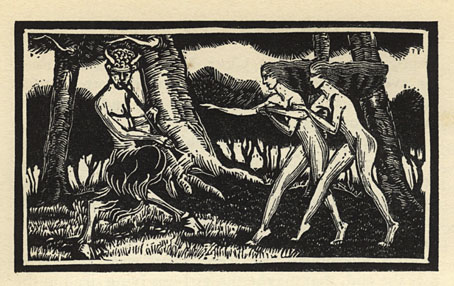
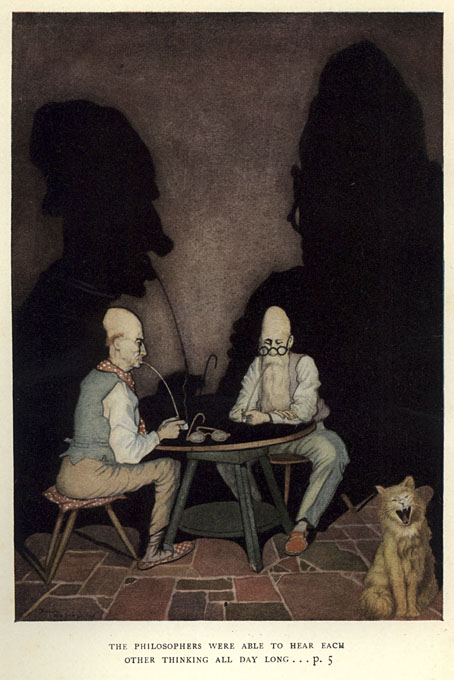
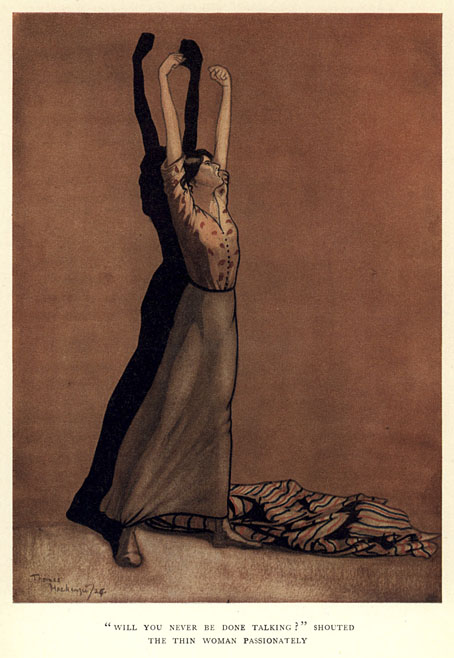
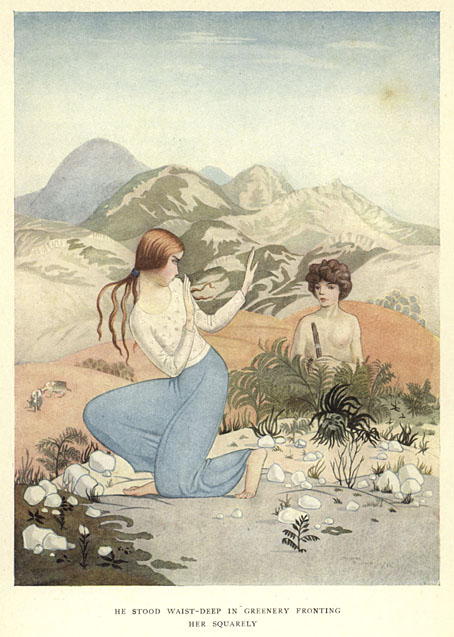
Thomas Mackenzie (1887–1944) was an English illustrator whose work has appeared here before via his illustrations for a verse rendering of the Aladdin story by Arthur Ransome, a typical product of the 1920s’ boom in illustrated children’s books. James Stephens’ The Crock of Gold (1912) is a vessel of a different kind, too sophisticated for children yet suffused with a fairy-tale quality, this is more like a fable for adults:

A mixture of philosophy, Irish folklore and the “battle of the sexes”, it consists of six books, Book 1 – The Coming of Pan, Book 2 – The Philosopher’s Journey, Book 3 – The Two Gods, Book 4 – The Philosopher’s Return, Book 5 – The Policemen, Book 6 – The Thin Woman’s Journey, that rotate around a philosopher and his quest to find the most beautiful woman in the world, Cáitilin Ni Murrachu, daughter of a remote mountain farm, and deliver her from the gods Pan and Aengus Óg, while himself going through a catharsis. (more)

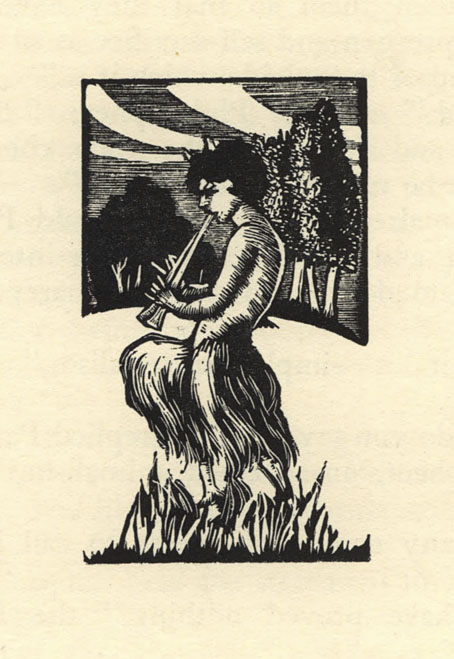
The illustrations, which Mackenzie created for a 1926 edition, are a little different to his earlier work, tending in places towards that Hellenic stylisation that became increasingly popular in the graphic art of the 1920s and 30s. The depictions of Pan remind me that I once tried to catalogue all the appearances of the god in prose and poetry from the 1890s on. The years from 1890 to 1930 saw Pan become a persistent presence in English literature, while also giving a title to one of the leading Jugendstil journals. The idea of trying to document all this activity is an attractive one until you set to work and find that there are many more examples than you imagined, not all of them indicated in the titles of the works.

mackenzie14.jpg

mackenzie01.jpg

mackenzie02.jpg

mackenzie03.jpg

Continue reading “Thomas Mackenzie’s Crock of Gold”