Eustace details

durer01.jpg

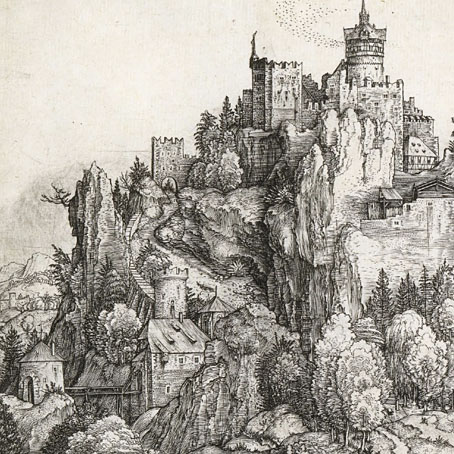
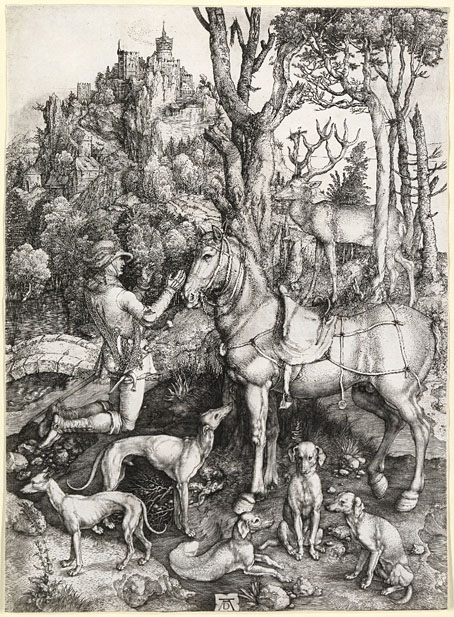
St Eustace (c. 1501) by Albrecht Dürer.

As is often the case with his engraving on religious themes, Dürer is less concerned with the Biblical story—in this case St Eustace’s vision of Christ appearing between the horns of a stag—than with the opportunity to render with great fidelity a wealth of natural detail. Everything here is observed with the utmost precision, down to the binding of the spurs on Eustace’s boots. A superb composition which leads the eye past the mystical deer, through the trees and up the hill.

durer09.jpg

Continue reading “Eustace details”

Rackham silhouettes

rackham01.jpg

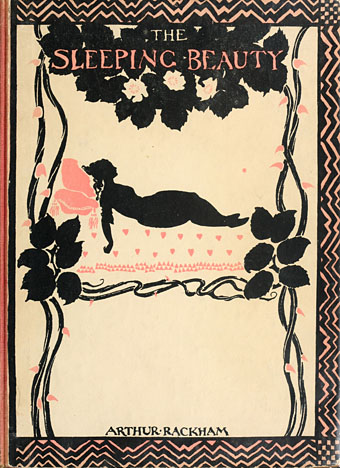
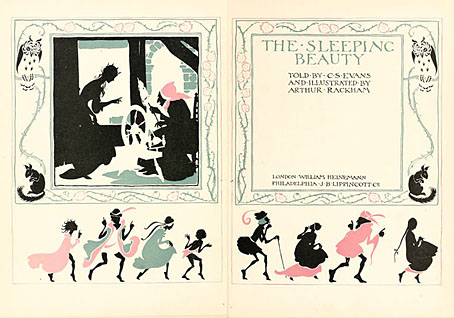
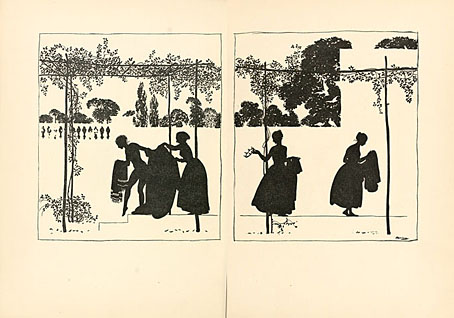
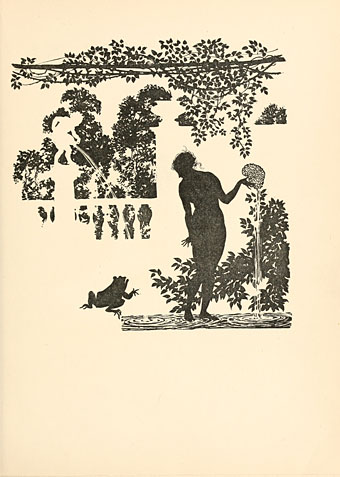
Another recent work-related discovery, this edition of the tale of Sleeping Beauty was published in 1920. The text is by CS Evans, and the book is illustrated throughout by Arthur Rackham who forgoes his usual ink-and-wash style in favour of silhouettes. Many of Rackham’s other books employ silhouettes, usually as vignettes at the ends of chapters, but this is the first book I’ve seen of his where the technique is applied to the book as a whole. The effect is stunning, with careful application of colour, and some very clever use of negative space. The combination of silhouettes with a fairy tale immediately brings to mind the animated films of Lotte Reiniger so it’s no surprise to find Rackham’s book being cited as an influence on both Reiniger and Fritz Lang. Browse the rest of the pages here or download the book here.

rackham02.jpg

rackham03.jpg

rackham04.jpg

Continue reading “Rackham silhouettes”

The art of Mark Reep

reep1.jpg

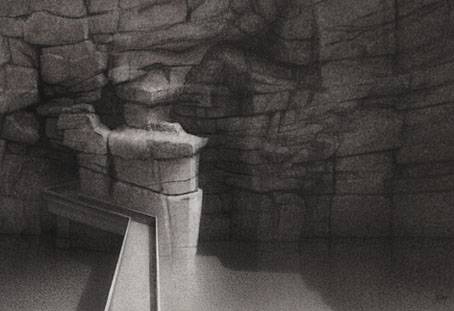
Crossing.

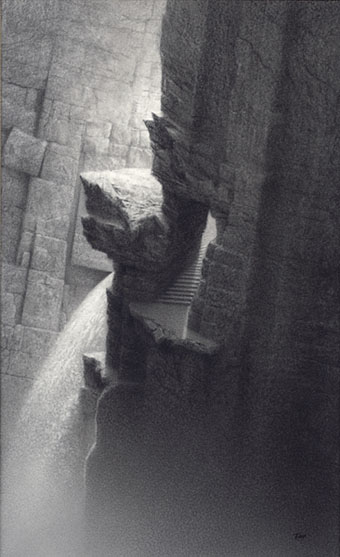
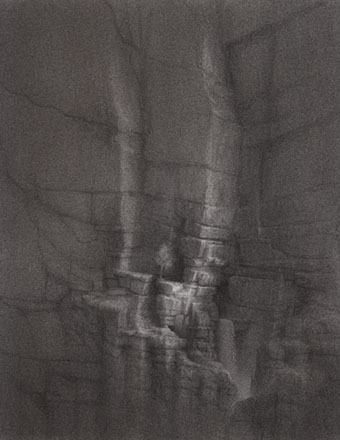
Artist Mark Reep sent me a link recently to his gallery of meticulous pencil and charcoal drawings which he calls “dreams in black and white”. The combination in many of these of isolated settings with minor architectural features is something I always enjoy seeing but don’t find often enough. Offhand I can think of Gérard Trignac‘s equally meticulous etchings, and Jean-Pierre Ugarte‘s paintings. Mark Reep has cards and prints of his drawings and photographs available for purchase at Bluecanvas and Redbubble.

reep2.jpg

Abandoned Waterworks.

reep3.jpg

Not All The Old Doors.

Previously on { feuilleton }
The art of Gérard Trignac

Weekend links 152

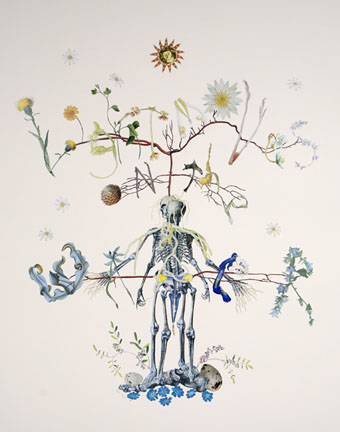
mackenzie.jpg

Light Moves on the Water (2010), a collage by Alexis Anne Mackenzie.

“[She] stated, emphatically and more than once, that pornography cannot and should not be linked to LGBT rights…When a gay man lives somewhere where his identity is threatened, it’s clear how sex – including pornography – and sexuality are intertwined. His sexual imagination, which is criminalized, matches the sexual images of gay pornography (which are also criminalized). Since acting out his imagination through sex would be to risk his life, the access to the images is safer. The images, created by gay men wherever it’s legal to create them, provide empowerment and diminish alienation.” An important piece by Conner Habib who asks “Why are we afraid to talk about gay porn?”

• Florida’s Parallel Universe: “The abandoned Nike Missile Site, surrounded by the Everglades, is a reminder of when humans almost destroyed the world and a warning that we could still lose everything today.” By Stefany Anne Golberg.

• In Search of Divine: A Retrospective by Katherine McLaughlin. Related: Jeffrey Schwarz, director of a new documentary, I Am Divine, talks about Divine’s career, and his film to Polari Magazine.

When Brendan Behan’s Borstal Boy was banned in 1958, it was said that a man in a pub asked him how much the book weighed, then offered to bring two thousand copies across the border instead of his usual smuggled butter. We might have called it the Black North, for being dark with Protestants, but when I was a child in the 1960s, Ulster was the place British sweets came from: Spangles, Buttons and, most notably, Opal Fruits. It was across this border that the feminists of “the condom train” staged a mass importation of illegal contraceptives in May 1971. When they arrived from Belfast into Connolly Station, the customs men “were mortified”, Mary Kenny, one of the participants, remembered, “and quickly conceded they could not arrest all of us, and let us through”.

Anne Enright on censorship in Ireland.

• Open Culture posts a copy of Nigel Finch’s 1988 Arena documentary about Robert Mapplethorpe.

The Fall of Communism Through Gay Pornography: A video by William E. Jones.

• Surrealism Made Fresh: Sanford Schwartz on the drawings of the Surrealists.

• Cult Classic: Defining Katherine Mansfield by Kirsten O’Regan.

Jonathan Barnbrook (again!) on David Bowie (again!).

Sydney Stanley illustrates Algernon Blackwood

20 Haunting Ghost Towns of the World

• At Pinterest: The Male Form

The Life Divine (1973) by Santana and McLaughlin | The Rhythm Divine (1987) by Yello feat. Shirley Bassey | Divine (2000) by Antony and the Johnsons

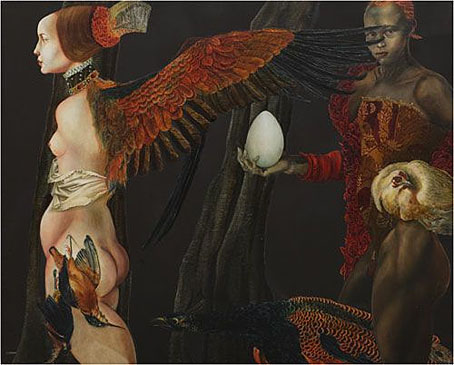
The art of Joanna Chrobak

chrobak1.jpg

Pageant III (2005–2006).

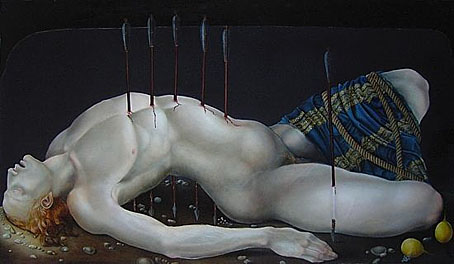
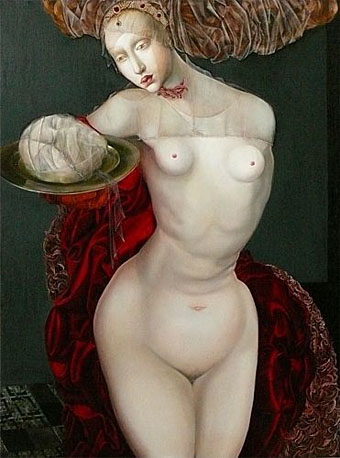
A Polish artist whose paintings have that combination of technical virtuosity and strange imagination I always like to see. She also explores traditional themes such as those below. Her website is in Polish but can be translated easily enough via Google.

chrobak2.jpg

Saint Sebastian (2007–2008).

chrobak3.jpg

Salomé (2007–2008).

Elsewhere on { feuilleton }
The fantastic art archive
The Salomé archive