Weekend links 821

tevis.jpg

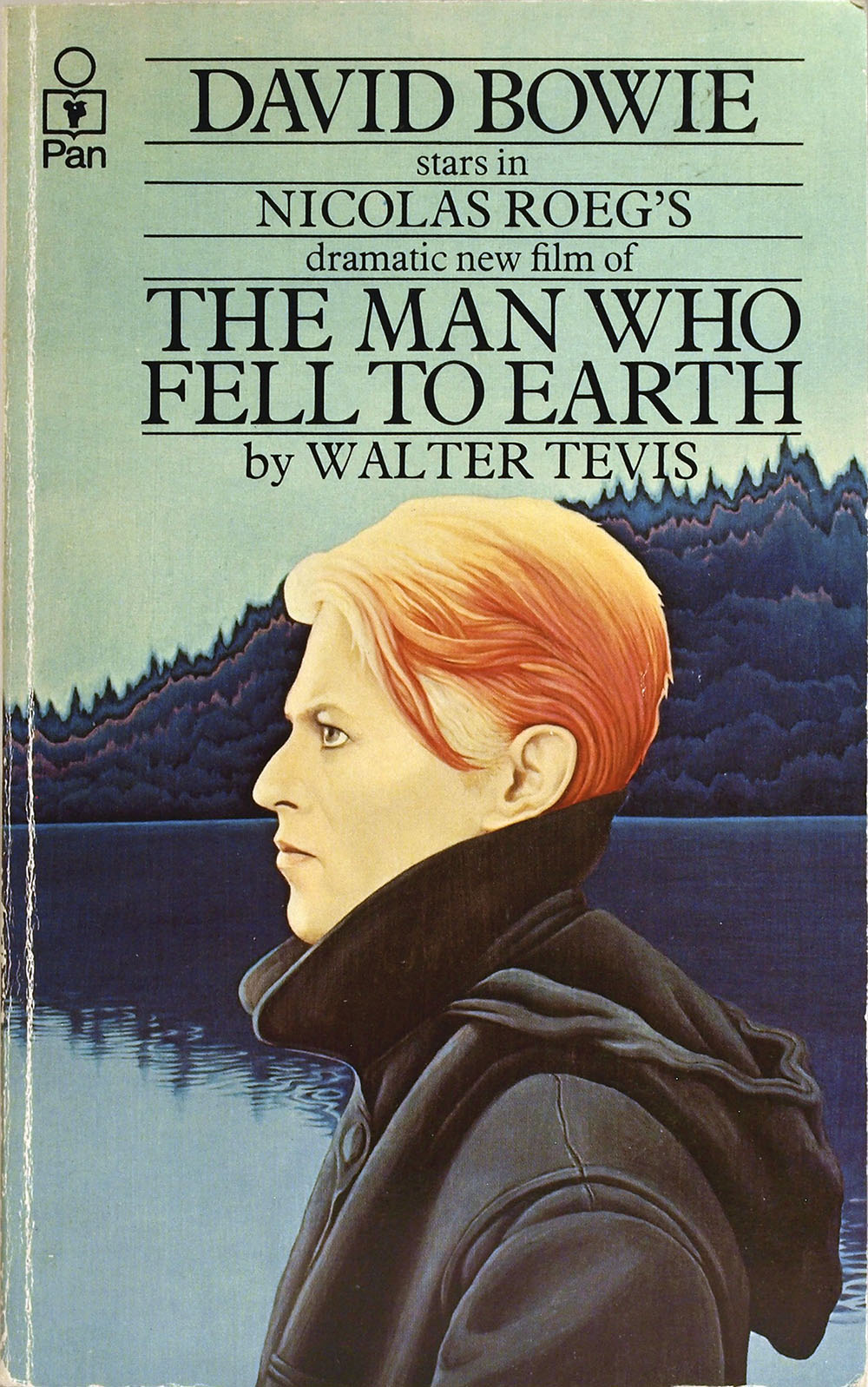
The first UK paperback edition, 1976. Cover art by David Bowie’s illustrator friend George Underwood.

• At the BFI: “Humanity, lost and found”. The original Sight and Sound review by Tom Milne of The Man Who Fell to Earth which was released 50 years ago this month. The film is another Nicolas Roeg project whose lofty reputation today has made everyone forget the bewildered or even hostile reaction it generated at the time, including from the US distributor, Paramount, who hated it. Milne, by contrast, had read the novel it was based on, and paid close attention to what the film’s writer, Paul Mayersberg, described as its “minefield of images”.

• Among the new titles at Standard Ebooks, the home of free, high-quality, public-domain texts: The Varieties of Religious Experience by William James.

• Issue 13 of Verbal magazine features an interview with Michael Moorcock, Iain Sinclair in the “Talking Books” section, and more.

• New music: 4 Hours (DVATION 2026 Version) by Clock DVA; -Music For Oriental Hotel Okinawa Resort & Spa- by Harikuyamaku.

• The Shaw Brothers Cinema YouTube channel has whole feature films from the studio’s huge archive free to view.

• At Colossal: “Historic architecture emerges from stone in Matthew Simmonds‘ ethereal sculptures”.

• “Music with Balls”: Terry Riley performing live with an arrangement of shiny silver spheres on KQED TV in 1969.

• Mixes of the week: DreamScenes – March 2026 at Ambientblog, and Motorik by Jon Savage.

• “What is electronic music?” Daphne Oram explains.

• RIP Country Joe MacDonald.

Stardust (1941) by Artie Shaw And His Orchestra | Stardust (1959) by Martin Denny | Stardust (1985) by Yasuaki Shimizu & Saxofonettes

Chess players

chess10.jpg

Chess Problem 25 (13th century), from El Libro de los Juegos.

Chess-playing in art. Some of it, anyway. I hadn’t realised until I went searching for examples how many paintings there are of people playing chess. The prompt for this was my current reading, The Flanders Panel, a novel from 1990 by the Spanish author Arturo Pérez-Reverte. Arturo likes his art mysteries, as you’ll know if you’ve read The Club Dumas, an excellent novel that was reworked for cinema as The Ninth Gate. The chess game in The Flanders Panel is the subject of a painting by a fictional Flemish artist, Pieter Van Huys. Pérez-Reverte presents a biography of the artist and the three people depicted in the painting, with special attention given to the game of chess which gives the painting its title, a game which may or may not provide clues to a 15th-century murder mystery. Pérez-Reverte describes the painting itself in detail; Julia, the main character is a picture restorer so the descriptions extend to physical materials. Some of the novel’s cover designs have attempted to depict Van Huys’s picture, with unsuccessful results. There’s also a 1994 film adaptation, Uncovered, which I haven’t yet seen.

chess06.jpg

The Chess Player (no date) by Isidor Kaufmann.

I’ll admit to not having thought very much about chess-playing in art until the conversation in the novel turned to the subject of the painted game, and the question of whether or not the position of the pieces had anything to say about the people in the picture. (Pérez-Reverte helpfully includes a diagram that shows the layout of the board.) There’s no reason why a game of chess shouldn’t be used for semiotic reasons even if this is only to indicate the power relationship within a picture by making one party the dominant player. Given the ease with which this can be done I’d guess there are many such examples that use the game to communicate something about the players beyond the fact that they enjoy playing chess. If you’re painting a chess game you’re always going to be faced with the question of how you position the pieces, a problem that leads in turn to decisions about who should be shown to be winning or losing via the number of pieces and their placement on the board. Western art is replete with pictorial symbolism involving animals, plants, birds, colours, and so on; if the very old and very familiar game of chess is added to the symbolic repertoire then we’re left to decide which paintings are using the game for incidental reasons, and which have something more to communicate.

chess09.jpg

An Interesting Problem (no date) by Adolphe-Alexandre Lesrel.

In making a picture selection I’ve looked for paintings that clearly show the position of the pieces on the board, as well as those which depict the game with some accuracy. It becomes apparent when you examine many paintings on this subject that some artists don’t seem too familiar with the details of the game, a common error being the mispositioned board. This could also have a symbolic meaning, of course, but I’ll leave that question for others to explore. As a final note, Marcel Duchamp had a thing for chess.

chess05.jpg

Ein schwieriger Zug Öl auf Holz (no date) by Albert Joseph Franke.

chess11.jpg

Die Schachspieler (Faust und Mephisto) (1834) by Moritz Retzsch.

Continue reading “Chess players”

Weekend links 820

davent.jpg

Lust, from the Seven Deadly Sins (circa 1550–55) by Léon Davent, after Luca Penni.

• At Dennis Cooper’s: Bill Hsu presents…High Anxiety: tense, dark films from 2010–2019 (for fans of Robert Aickman and Brian Evenson) (restored).

• New music: Ever No Way by Seefeel; In A Few Places Along The River by Abul Mogard; Displaces by Francesco Fabris.

• At Inconspicuous Consumption: Paul Lukas investigates a Frank Lloyd Wright typographic mystery.

In the late 19th century, Rops created a vast oeuvre of drawings, etchings, prints and paintings of such breathtaking fruitiness—often laced with satanic elements—that even Picasso responded to him in awe (in homage, the Spaniard drew a cartoon of a man in the form of a pig performing cunnilingus on a woman). Rops’ works depicted naked witches riding brooms, voyeurs in top hats and courtesans riding penis-shaped bicycles. The French art critic Félix Fénéon called him an artist “who paints phalluses the way others paint landscapes”.

Christian House on a new exhibition, Laboratory of Lust, showcasing the erotic art of Félicien Rops

• At Public Domain Review: Wayang Kulit: Raden Soelardi’s Illustrations of Javanese Puppets (1919).

• At Criterion Current: David Hudson explores the fantastic realism of Georges Franju.

• At Unquiet Things: The Nocturnal Visions of Nona Limmen.

• Steven Heller’s font of the month is Curve Display.

• RIP TV producer Kenith Trodd.

Exploratorium

Lust (1954) by Les Baxter Featuring Bas Sheva | Monster Lust (1989) by Helios Creed | Keine Lust (2004) by Rammstein

Zones on wheels

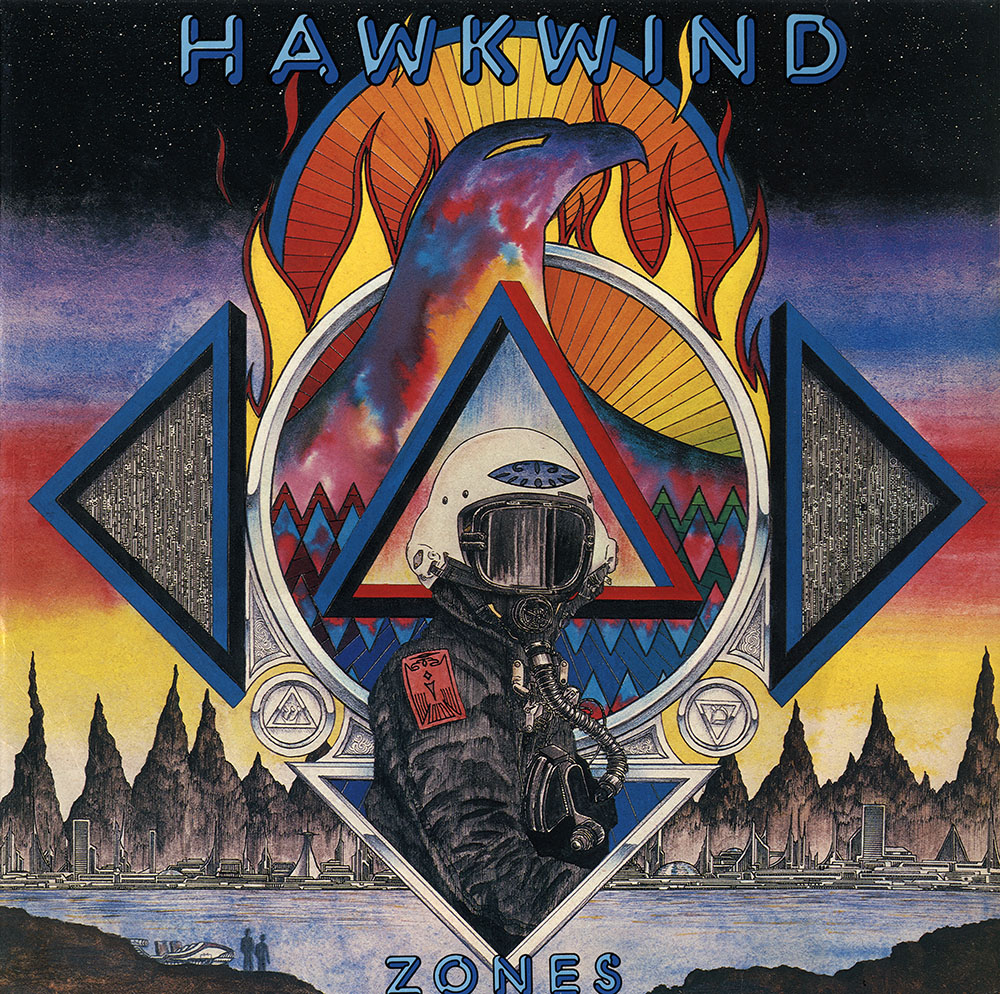
zones.jpg

Zones (1983).

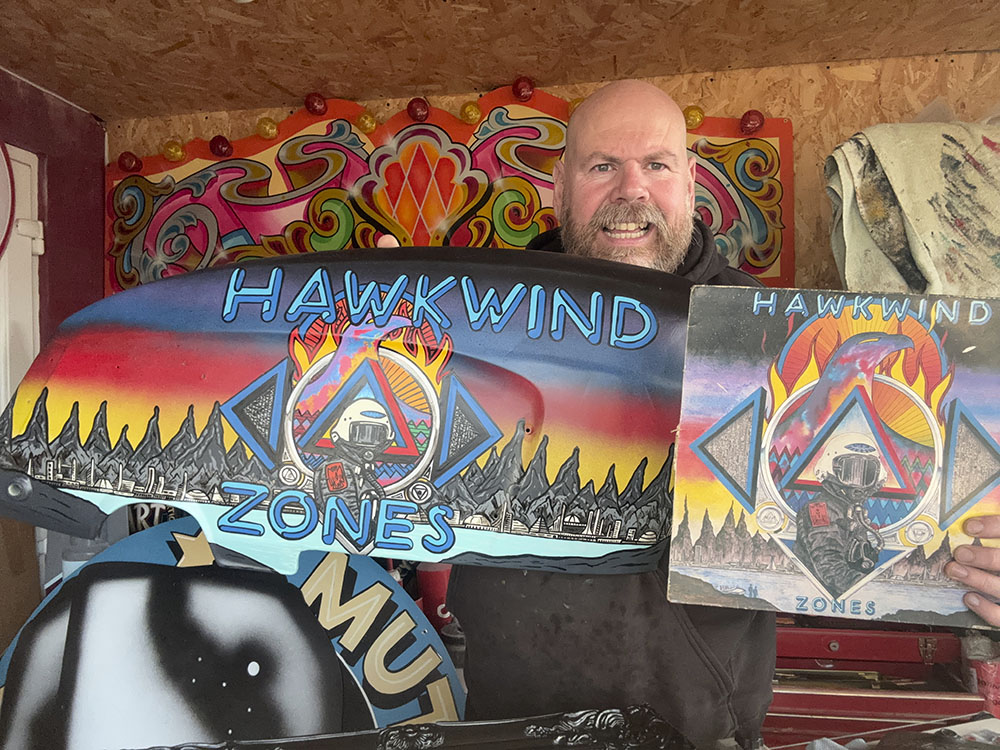
My thanks to Nigel Day for sending me the following photos of the rear end of a Lambretta scooter that he was recently asked to decorate with art based on my cover for Zones by Hawkwind. He’s done a marvellous job, and even improved a little on the colour gradations behind the hawk’s head which in my painting don’t evolve as smoothly as they should. Nigel trades under the name Harry’s Hotrod Shop; there’s a website here as well as pages under the same name at Facebook, Instagram and TikTok.

lambretta1.jpg

lambretta2.jpg

As I’ve no doubt said before, the Zones sleeve is one of the few Hawkwind covers I don’t feel abjectly embarrassed by. The album was released in October 1983, and was my second cover for Hawkwind, following an album released the month before whose terrible artwork was something I sent to Dave Brock that I never intended to have used anywhere. The Zones art was something I’d created on spec the year before, shortly after what would have been my cover for the Church Of Hawkwind album was forced onto the album’s lyric book by an art director at RCA who hated the material he’d been given to work with. This wasn’t the only unpleasant incident from the group’s short tenure at RCA. Zones was released on Flicknife Records, an independent label that proved to be a much better home for the band.

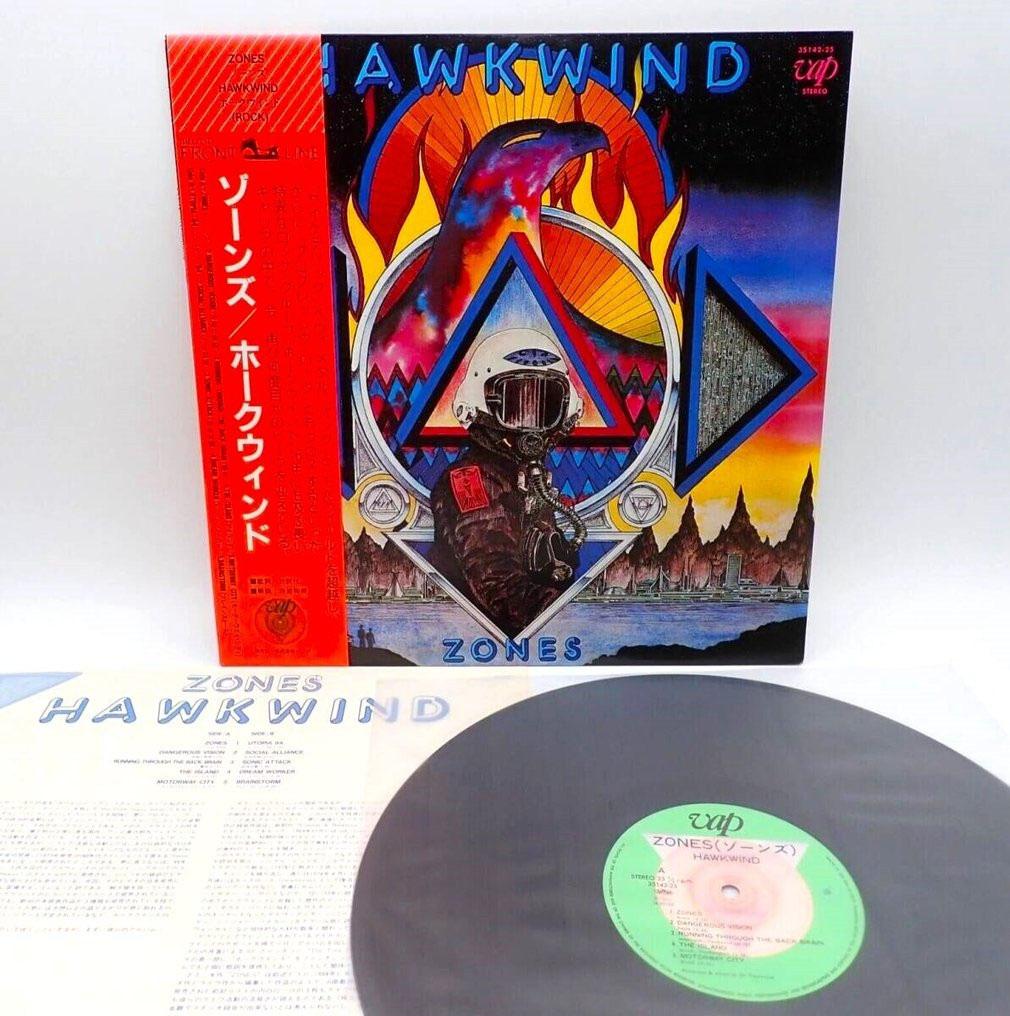
zones-japan.jpg

A rare Japanese vinyl release.

The album itself is a pretty good collection of live recordings from 1980 to 1982, with highlights that include a Michael Moorcock song, Running Through The Backbrain, with Moorcock himself on vocal. This was an exclusive piece until the entire concert (Lewisham, 1980) was released as part of the Levitation box set in 2009. Zones also contains several songs featuring Nik Turner, from the brief period when he returned to the group he’d been expelled from in 1976. And there’s also another live version of Motorway City, a song that first appeared on the Live Seventy Nine album. Having always liked Motorway City I was pleased when the Zones version was released as a single that used another spec piece of mine as the cover art (see this post).

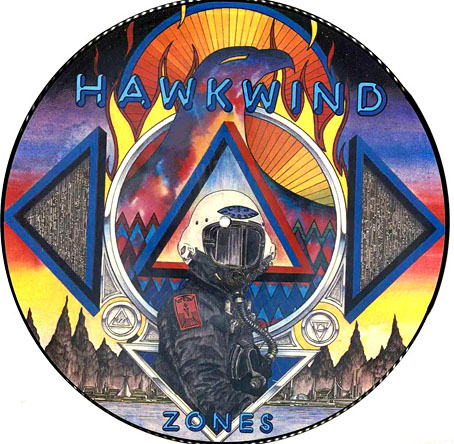
zones-pic-disc.jpg

And a picture-disc.

As I said in the post about the single artwork, I was 18 when I did that drawing. I was only 20 when I painted the Zones cover. Imagine something you’d created when you were 20 years old continually turning up again decades later. It’s gratifying, of course, but it can also be disconcerting. People seem to like it anyway, which is more than can be said for some of my other album covers. The weather here is finally getting warmer; prepare for the summer with a Zones T-shirt!

Previously on { feuilleton }
Space is one trip: the Hawkwind takes off
New Wave Strangeness: Hawkwind’s Calvert years
Twinkle, twinkle little stars
Motorway cities
Reality you can rely on
Silver machines
Notes from the Underground
Hawkwind: Days of the Underground
The Chronicle of the Cursed Sleeve
Rock shirts
The Cosmic Grill
Void City
Hawk things
The Sonic Assassins
Barney Bubbles: artist and designer

Weekend links 819

ohrai.jpg

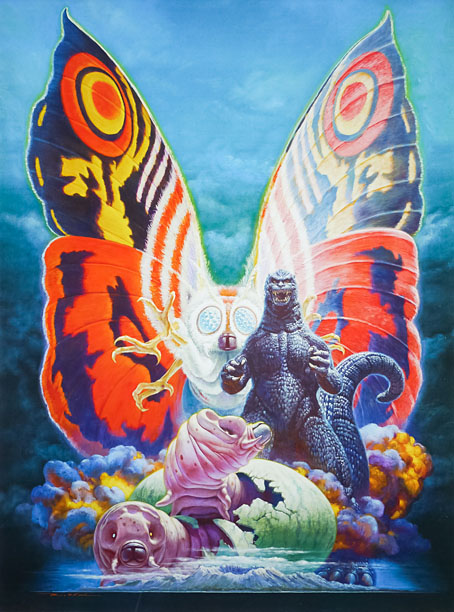
Godzilla vs. Mothra (1992), poster art by Noriyoshi Ohrai.

• At Wormwoodiana: Douglas A. Anderson on the first English translation of The Luminous Fairies and Mothra, a multi-author serial that formed the basis for Ishirō Honda’s film about the giant moth.

• At the Library of Congress: “Lost 19th century film by Méliès discovered at the Library“. 45 seconds of Gugusse and the Automaton (1897).

• At Public Domain Review: The Blinkered Flâneur: Walking with Franz Hessel in 1920s Berlin by Paul Sullivan.

• At Juno Daily: Kevin Richard Martin lists ten albums that shaped his Sub Zero album.

• New music: And All The Clocks Ran Dry by Andreas Voelk & Scott Monteith.

• “Behold Belgium’s beauty in these 15 scenic photographs.”

A Spoon and Tamago Guide to Tohoku.

• The Strange World of…Shane Parish.

• At Dennis Cooper’s: Occults.

• RIP Éliane Radigue.

Mothra’s Song (1961) by Yuji Koseki | Mothra (1984) by Frank Chickens | Mothra (2014) by The 5.6.7.8’s