Illustrating Lovecraft again

dunwich.jpg

The Dunwich Horror (1972). Art by Victor Valla.

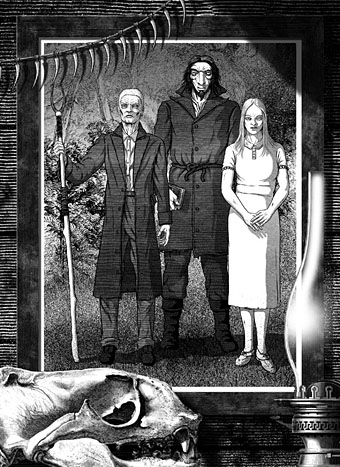
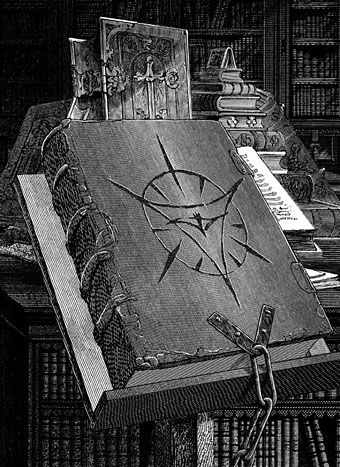
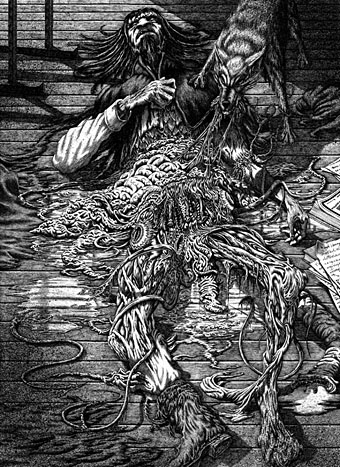
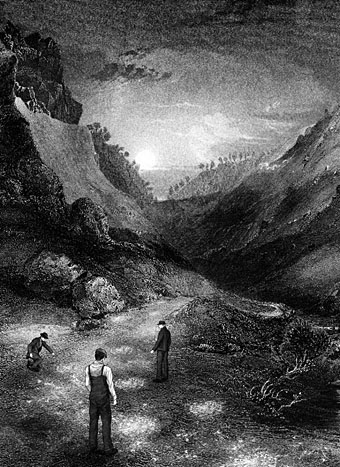
El horror de Dunwich y otros relatos is the last of the books I was working on earlier this year for Spanish publisher Editorial Alma. This was a more stimulating Lovecraft collection to work on than the previous two-story volume since three of the stories were ones I hadn’t dealt with before. The fourth story, The Dunwich Horror, I partly illustrated back in 1988/89, and I took the liberty of reusing the best of that set of pages showing Wilbur Whateley’s messy demise. This picture has been reprinted a few times elsewhere so I was reluctant to recycle it again, but the collision of deadlines earlier this year meant that once again I was pressed for time on this book, and having an illustration already done was a great help. It’s taken me 30 years to finally get round to depicting Wilbur’s monstrous brother.

hpl11.jpg

The Dunwich Horror 1.

hpl12.jpg

The Dunwich Horror 2.

hpl13.jpg

The Dunwich Horror 3.

hpl14.jpg

The Dunwich Horror 4.

Continue reading “Illustrating Lovecraft again”

Weekend links 431

eckman-lawn.jpg

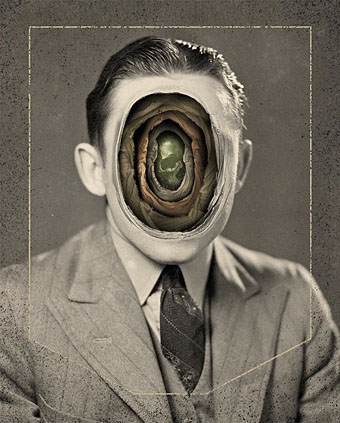
Postcard collage by Alex Eckman-Lawn.

• “He deserves to be a major figure not only in the history of Japanese music, but in popular music writ large.” Geeta Dayal on Haruomi Hosono, a musician whose solo albums from the 1970s are reissued this month by Light In The Attic.

Erica X Eisen reviews Black Light: Secret Traditions in Art since the 1950s, an exhibition of occult art at the Barcelona Contemporary Culture Centre. Related: Gary Lachman‘s talk from the same exhibition.

• Mixes of the week: Jesús Bacalão’s Light Entertainment Programme 2, Secret Thirteen Mix 265 by Alexander Tucker, and FACT Mix 672 by Rian Treanor.

Whenever horror is criticised, it is criticised for staging a dark carnival of physicality. Perhaps the only sort of media we moralise more than we do horror is that other mainliner of bodily response, pornography.

Horror’s historical ghettoisation has meant that weightier, smarter horror reliably gets labelled as something else. The finest films of our current golden age have been dubbed “elevated horror” and “post-horror”. In literary circles, works of horror seen as sufficiently cerebral get relabelled “Gothic”. It’s certainly true that great horror is always about more than gore. But we should be careful not to gentrify the genre by cleansing it of everything but the philosophy.

MM Owen on the perennial attractions of a perennially despised genre

• “Netflix is a woeful service,” says Jeremy Allen who prefers DVD/Blu-ray to streaming video (as do I). Related: The problem with film aspect ratio on Netflix.

• The Thought Gang album, a Twin Peaks-related collaboration between David Lynch & Angelo Badalamenti from 1993, will be released next month.

Tangerine Dream: Sound From Another World: a TV documentary from 2016. In German but with auto-translated subtitles.

The Thing’s Incredible! The Secret Origins of Weird Tales by John Locke.

Haute Macabre Staff Favorites: Tarot Decks

First Light (1980) by Harold Budd & Brian Eno | Blue Light (1993) by Mazzy Star | Black Light (1994) by Material

Weekend links 430

fiochi.jpg

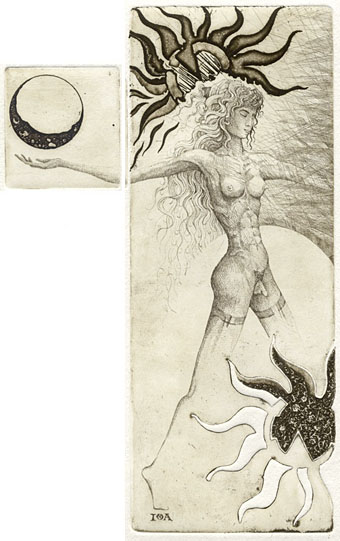
Il Mago from the IONA Tarot by Giona Fiochi.

• “Russia’s answer to James Bond: did he trigger Putin’s rise to power?” Andrew Male on Max Otto von Stierlitz and Seventeen Moments of Spring. The whole series is on YouTube (with subtitles).

Geeta Dayal reviews High Static, Dead Lines: Sonic Spectres and the Object Hereafter by Kristen Gallerneaux, a new book about the eeriness of sound technology.

• Published next month: Strange Frequencies: The Extraordinary Story of the Technological Quest for the Supernatural by Peter Bebergal.

Let me first introduce an aside: I hate the word “queer” and all its new iterations. “Gay” was awful enough. “‘Gays’ makes us sound like bliss ninnies,” Christopher Isherwood said once. “Queer” will always be for men of my generation a word of violence and hatred, and it separates generations. And while I’m digressing, let me commit blasphemy: the over-emphasis on the Stonewall riots depletes and distorts our history of resistance and the art produced, which is determinedly referred to as “pre-Stonewall.” Resistance occurred years before Stonewall (but there were lots of writers in New York at the time to write about those riots), in San Francisco, Los Angeles, other cities, powerful confrontations with the police, powerful demonstrations. “Pre-Stonewall” writers include William Burroughs, Allen Ginsberg, strong radical voices confronting the grave dangers of the time, violence, prison.

John Rechy talking to Eric Newman about his latest novel, Pablo!, written in 1948 but only now seeing publication

Tangerine Dream performing Identity Proven Matrix, one of the standout pieces from recent album Quantum Gate, live in the studio.

Beloved is the debut solo album by Randall Dunn, record producer and member of the masterful Master Musicians of Bukkake.

• “How will police solve murders on Mars?” Geoff Manaugh on the new frontier of interplanetary law enforcement.

Milly Burroughs on how Verner Panton changed the way the world sees furniture design.

Tim Martin on the new science of psychedelics.

Werner’s Nomenclature of Colours

Next Stop Mars (1966) by Sun Ra & His Arkestra | Mars, The Bringer Of War (1976) by Isao Tomita | Mars Garden (2013) by Juan Atkins & Moritz Von Oswald

Weekend links 429

holter.jpg

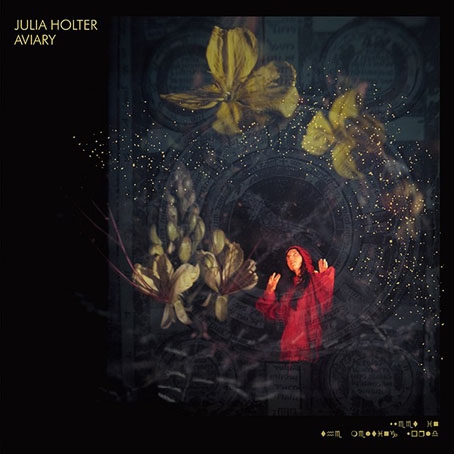
• Julia Holter’s next album, Aviary, will arrive next month with a cover design bearing astrological symbols (a cryptic message?) and what looks like a grimoire page in the background, although I may be reading too much into this. Whatever the esoterics signify, the album is a double, and going by the sound of new song I Shall Love 2 it’s going to be a good one. Aviary will be released on 26th October just in time for the witch season.

Donna Ferguson talks to Oscar Wilde’s grandson, Merlin Holland, about the manuscript for The Picture of Dorian Gray which includes more openly homoerotic sentences than were included in the printed versions. A facsimile of the manuscript is now available in a limited, numbered edition from SP Books.

• The final single in the excellent Other Voices series from the Ghost Box label is released later this month. Something Out Of Nothing is by Sharron Kraus and Belbury Poly.

…we’re still trying to operate this new, paranoid society on what amounts to a psychedelic substrate—with little or no awareness of how our sets and settings are determining our results. The set and setting of the advertiser yield addictive behavioral design and persuasive technologies. The set and setting of the investor lead to algorithmic trading and winner-takes-all, extractive businesses. The set and setting of the military lead to drone warfare. The set and setting of the politician lead to targeted propaganda and digital fascism.

America is unconsciously living in a psychedelic landscape and having a bad trip. We don’t realize that we are living in a media environment that offers us an unprecedented capacity over reality. The world may have always been a consensual hallucination to some extent, but never before have we built our world so completely.

The internet is acid, and America is having a bad trip, says Douglas Rushkoff

Photographia Erotica Historica is a tiny leatherbound collection of antique pornography from Goliath Books.

Why is the Federal Government threatening an indie book publisher with $100,000 in fines?

• Undead, undead: my illustrations for Dracula are featured at Dangerous Minds. Thanks!

• The Vinyl Factory meets Japanese composer and musician Midori Takada.

• Exploring HP Lovecraft’s Gothic roots by Dr Xavier Aldana Reyes.

• From 2013: Dario Argento discussing his films with Alan Jones.

• Aurora Mitchell on Electro pioneer Doris Norton.

• Mix of the week: XLR8R Podcast 558 by DJ T.

Aviator (1970) by Michael Chapman | Aviation (2000) by Fluxion | Aviation (2001) by Monolake

The eyes have it

oeil01.jpg

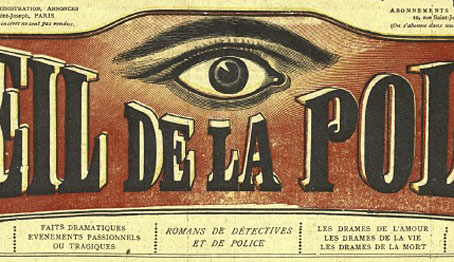
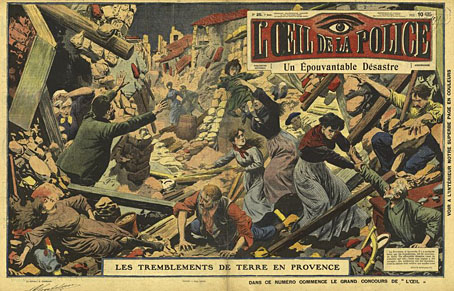
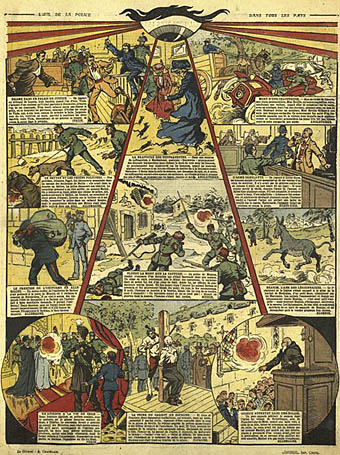
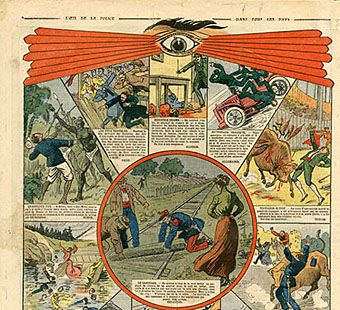
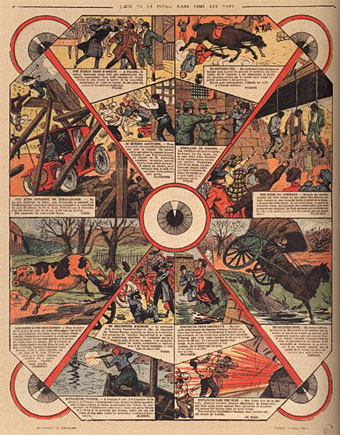
Recent picture research turned up issues of L’Oeil de la Police, a lurid French crime magazine that I hadn’t encountered before. It shouldn’t be too surprising when the nation that gave the world the guillotine and Grand Guignol theatre produces magazines filled with gore, but the amount of red ink in these pages (also applied to gun shots and explosions) is certainly unusual for the time. The covers of Le Petit Journal—which ran concurrently with L’Oeil de la Police—also tended to the lurid and gory but the quality of illustration was better there. L’Oeil de la Police is positively cartoon-like, especially on the back covers of each issue which present their disasters in comic-like pages overseen by the spectral Eye of the Law. This is rather disingenuous when many of the scenes don’t involve law-breaking at all, but are reports of natural disasters and fatal accidents. The samples below show the most bizarre feature of the back pages which is the titular Eye in places becoming anthropomorphised, like an atrocity-viewing precursor of the eyeball heads worn by The Residents.

oeil02.jpg

The L’Oeil de la Police archive at Gallica runs from 1908 to 1914 should you require an antique disaster fix. The archive site has improved in recent years but it can still be awkward (and slow) to use so perseverance is required.

oeil03.jpg

oeil04.jpg

oeil05.jpg

Continue reading “The eyes have it”