Colleen Corradi Brannigan’s Invisible Cities

ccb1.jpg

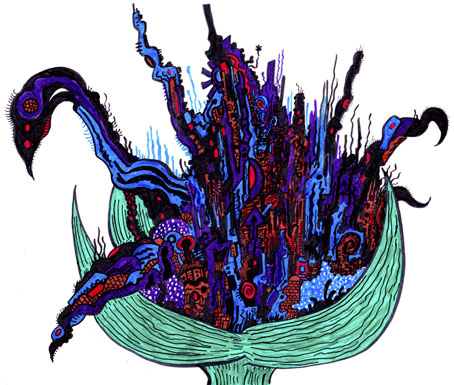
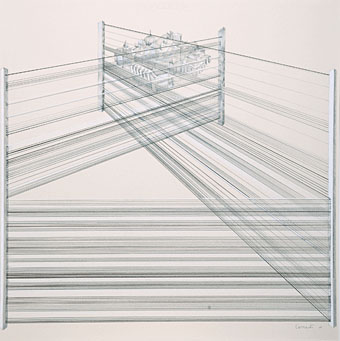
Cities and Memory 5: Maurilia.

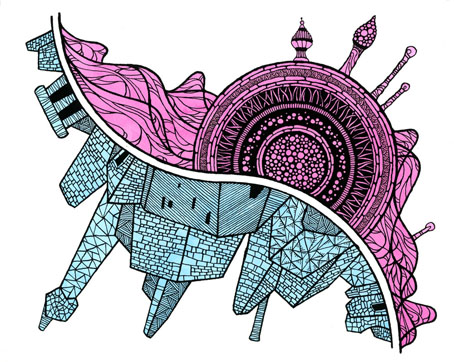
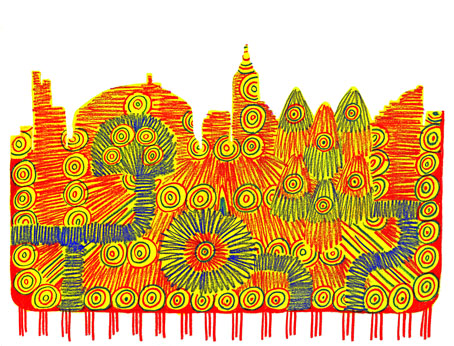
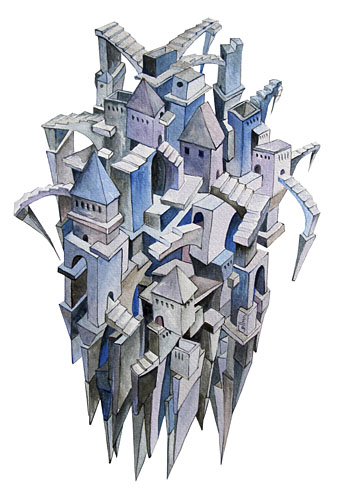
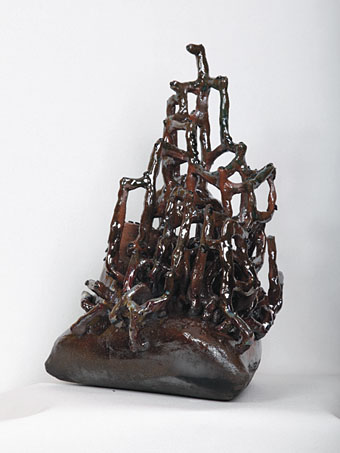
Colleen Corradi Brannigan’s multimedia project was linked here back in 2011 when news of her endeavours reached a number of high-profile websites. These artworks are another attempt to depict all of Italo Calvino’s cities, this time using a range of media that includes sculpture. I like the variety of this series; some of the depictions approach the more rigorous perspectives of MC Escher while others are as loose as Expressionist paintings. The website also includes extracts from Calvino’s descriptions.

ccb2.jpg

Trading Cities 4: Ersilia.

ccb3.jpg

Thin Cities 3: Armilla.

Continue reading “Colleen Corradi Brannigan’s Invisible Cities”

Le Città In/visibili

sbe06.jpg

Thin Cities 3: Armilla by Luca Enoch.

Sergio Bonelli Editore, an Italian comics publisher, staged an exhibition of art based on Italo Calvino’s Invisible Cities at the Triennale Milano in 2002. The drawings for Le Città In/visibili head in the opposite direction from Mikhail Viesel’s depictions, and in several pictures push the cities towards generic fantasy and science fiction. These images are from an extinct page on the publisher’s website although they may also be seen on the current site with a little searching. The publisher doesn’t offer much information, however, so while the artists are identified it’s less clear which cities are being depicted. I’ve noted the more obvious ones; Calvino obsessives can have fun guessing which the others might be.

sbe02.jpg

Laura Zuccheri.

sbe05.jpg

Thin Cities 2: Zenobia by Maurizio Dotti.

Continue reading “Le Città In/visibili”

Mikhail Viesel’s Invisible Cities

viesel3.jpg

Thin Cities 2: Zenobia.

I’ve a lot of work to get through this week so the theme will be illustrated Calvino, and that means looking at various renderings of the Invisible Cities. Calvino’s novel has many attractions for illustrators, at least superficially: all those descriptions, the endless variety and invention. Whether the book should be illustrated at all is another matter. The conversations between Marco Polo and Kublai Khan that bracket each chapter return continually to the veracity of the Venetian’s descriptions; this in turn places each city in a nebulous zone where the reader may see the places described as being simultaneously an actual place and a fabrication. And then there’s the question of Calvino’s anachronisms, with mentions of railway stations and the like… Visual adaptations of elusive fictions have a tendency to literalise the subject in a manner that isn’t always to the benefit of the book.

With that proviso in mind, this first selection of drawings are by a Russian artist, Mikhail Viesel, who illustrates each of the cities. All may be seen at this page with section titles in English although the text for each picture is in Russian.

viesel1.jpg

Cities and Eyes 3: Baucis.

viesel4.jpg

Thin Cities 5: Octavia.

viesel2.jpg

Hidden Cities 4: Theodora.

Elsewhere on { feuilleton }
The illustrators archive

Previously on { feuilleton }
Bookmark: Italo Calvino
Crossed destinies revisted
Crossed destinies: when the Quays met Calvino
Tressants: the Calvino Hotel

After Beardsley by Ryan Cho

cho.jpg

One of the posts last week concerned a swipe from Harry Clarke by an unknown illustrator. This Beardsley pastiche came to my attention shortly after the Clarke discovery, not a swipe but a deliberate exercise by American illustrator Ryan Cho in adopting the Beardsley style. It took some effort to trace the origin of Cho’s drawing since this is one of many similar works proliferating via Tumblr and Pinterest in which the credit goes to Beardsley himself. Cho’s exercise was one of a series following the styles of different artists and illustrators. In addition to another Beardsley drawing there’s also a couple of less successful attempts to pastiche Harry Clarke; having attempted a Clarke pastiche myself I can testify to the scale of the challenge. More of Ryan Cho’s work may be seen here.

Elsewhere on { feuilleton }
The Aubrey Beardsley archive
The illustrators archive

Copying Clarke

clarke.jpg

“On to the brocken the witches are flocking.” From Faust (1925) by Harry Clarke.

Spotted earlier this week, a rather blatant swipe from Harry Clarke’s Faust by an unknown cover artist for the Avon Fantasy Reader. Such borrowings weren’t uncommon in the pulp magazines—the pressure of deadlines no doubt encouraged them—and I’ve logged a couple of other examples in the past, here and here. Clarke’s scene shows a crowd of his mutated witches flaunting themselves in a manner that was too strong for a fantasy magazine. The Avon cover is probably illustrating The Day of the Dragon (1934), a novelette by Guy Endore. Everything in this edition was a reprint, and among the contents there’s also The Yellow Sign by Robert Chambers.

avon.jpg

Avon Fantasy Reader, No. 2, 1947.

Previously on { feuilleton }
Harry Clarke’s Fairy Tales of Charles Perrault
Harry Clarke in colour
The Tinderbox
Harry Clarke and the Elixir of Life
Cardwell Higgins versus Harry Clarke
Modern book illustrators, 1914
Illustrating Poe #3: Harry Clarke
Strangest Genius: The Stained Glass of Harry Clarke
Harry Clarke’s stained glass
Harry Clarke’s The Year’s at the Spring
The art of Harry Clarke, 1889–1931