De Plancy’s Dictionnaire Infernal

deplancy01.jpg

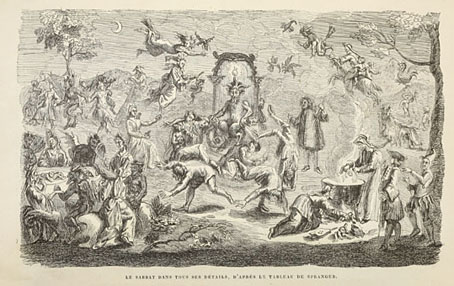
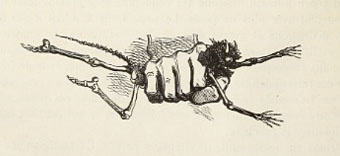
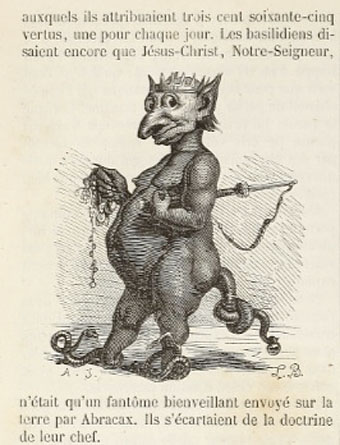
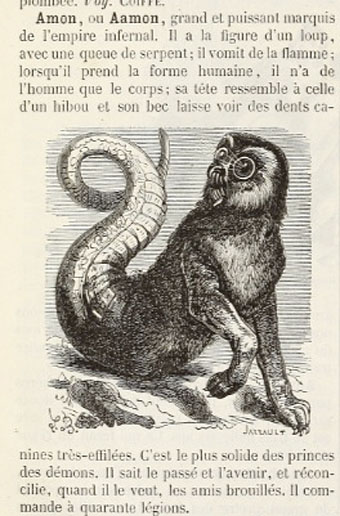
This would have been an ideal post for last week but better late than never, especially when I’ve been hoping for several years that a decent copy of Collin de Plancy’s dictionary would turn up at the Internet Archive. The Dictionnaire Infernal (1818–1863) has become famous mainly for the curious and often fanciful illustrations of demons which fill out the 1863 edition, pictures which have been plundered endlessly by occult histories, art directors, and illustrators such as myself. The demon portraits were the work of Louis Le Breton but the 1863 edition contains hundreds of other small illustrations and embellishments of varying quality. De Plancy was an author of many popular accounts of history, religion and mythology (also a book on “the food of the reptiles and the batrachians of France”) but his name is permanently wedded to this volume which the 1826 edition self-described as:

Infernal Dictionary, or, a Universal Library on the beings, characters, books, deeds, and causes which pertain to the manifestations and magic of trafficking with Hell; divinations, occult sciences, grimoires, marvels, errors, prejudices, traditions, folktales, the various superstitions, and generally all manner of marvellous, surprising, mysterious, and supernatural beliefs.

If you can read French then there’s 750 pages of this. The rest of us can enjoy the pictures.

deplancy02.jpg

deplancy03.jpg

deplancy04.jpg

Continue reading “De Plancy’s Dictionnaire Infernal”

Hugo Steiner-Prag’s The Ancestress

steinerprag08.jpg

Another handful of macabre illustrations by Hugo Steiner-Prag. As before, these are minor works compared to the Golem illustrations and his illustrated Poe but it’s good to find something new. The Ancestress (1816) was a tragedy by Austrian dramatist Franz Grillparzer in which a woman killed by her husband for infidelity returns to haunt future generations. Steiner-Prag’s illustrations date from 1919, and may be seen at the Google Cultural Institute.

steinerprag09.jpg

steinerprag10.jpg

Continue reading “Hugo Steiner-Prag’s The Ancestress”

Weekend links 281

fini.jpg

Chimère du soir (1961) by Leonor Fini. Réalisme irréel is an exhibition of Fini’s work currently running at the Weinstein Gallery, San Francisco.

• ” ‘Paris invented the flâneur,’ he notes, ‘and continues to press all leisurely and attentive walkers into exercising that pursuit, which is an active and engaged form of interaction with the city, one that sharpens concentration and enlarges imaginative empathy and overrides mere tourism.’ ” David L. Ulin reviewing The Other Paris by Luc Sante.

• “A lot of posters promise so much that how can they ever deliver?” Nicolas Winding Refn talking to Mat Colegate about his book, The Act Of Seeing, a collection of posters for exploitation films.

• “Sexuality is present throughout and often subverts a narrative we might read entirely differently from a straight poet.” Callum James reviews Physical by Andrew McMillan.

This movie will lose a lot of people along the way, but then again, as far back as 1962, Ballard wrote a manifesto for a new form of science fiction, Which Way to Inner Space?, in which he insisted that “from now on, most of the hard work will fall, not on the writer, but on the readers. The onus is on them to accept a more oblique narrative style, understated themes, private symbols and vocabularies.” This is exactly what Wheatley wants from his audience.

Mike Holliday comparing Ben Wheatley’s forthcoming film of High-Rise with JG Ballard’s novel. Ballard’s suggestion for a new SF now seems increasingly like a road not taken. But that’s another discussion entirely…

The Lost Library of John Dee, an exhibition of books owned by the Elizabethan magus, opens at the Royal College of Physicians museum, London, in January.

Clive Hicks-Jenkins has been writing about his illustration heroes including Alexander Alexeieff.

Cameron: Cinderella of the Wastelands. The exhibition has just finished but the art is still online.

• Mixes of the week: FACT Mix 518 by Fis, and Secret Thirteen Mix 165 by Damien Dubrovnik.

• At Dirge Magazine: Tenebrous Kate on Fantômas, the French King of Crime.

• Suitably seasonal: Polish Night Music by David Lynch & Marek Zebrowski.

Kickin’ In, a previously unreleased EP of music by Patrick Cowley.

Jean-Michel Jarre‘s favourite albums.

Seeing It As You Really Are (1970) by Hawkwind | Seeing Out The Angel (1981) by Simple Minds | Seeing Red (1998) by Red Snapper

Metzengerstein

satty.jpg

Metzengerstein by Wilfried Sätty.

One of the horses in yesterday’s post seemed familiar until I realised it had been used by Wilfried Sätty for his final Metzengerstein illustration in The Illustrated Edgar Allan Poe (1976). This has been happening a lot since I started delving into the book scans at the Internet Archive, Sätty’s collage sources leaping abruptly from old engravings. The horse is a good example of Sätty’s evolved approach to collage which often reversed the printing of assembled artwork, or used a printing press (or PMT process) to duplicate and mirror his collage elements.

Not all Poe illustrators bother with this Gothic pastiche, and those that do don’t always provide an effective rendering of the climax when the clouds of smoke above a smouldering castle assume the form of a colossal horse. Byam Shaw’s illustration is typical, with the horse standing inertly above the flames. Sätty’s picture only occupies half a page but is much more successful, as are many of the other illustrations in a volume that remains one of the very best Poe collections, and the finest of Sätty’s books.

horses3.jpg

Previously on { feuilleton }
The original Gandharva
The Occult Explosion
Wilfried Sätty album covers
Nature Boy: Jesper Ryom and Wilfried Sätty
Wilfried Sätty: Artist of the occult
Illustrating Poe #4: Wilfried Sätty
Gandharva by Beaver & Krause

John Batten’s Indian Fairy Tales

batten01.jpg

I keep intending to write some longer pieces, including a review of Aleksei German’s unforgettable Hard To Be A God, but the workload has been heavy again so here’s another illustrated book.

Illustrations by John Dickson Batten (1860–1932) have appeared here before, all of them for collections of fairy tales compiled and adapted by Joseph Jacobs. Indian Fairy Tales (1892) is another Batten/Jacobs collaboration, and is as fine as their other books, with Batten enclosing many of his full-page drawings in elaborate frames. Most of the figures look nothing like Indian people but that’s standard for books of this period. The Internet Archive has several copies of this title, including a limited, numbered copy with hand-coloured illustrations. I prefer the illustrations in black-and-white, however, so that’s what you see here.

batten02.jpg

batten03.jpg

Continue reading “John Batten’s Indian Fairy Tales”