Delville, Scriabin and Prometheus

delville1.jpg

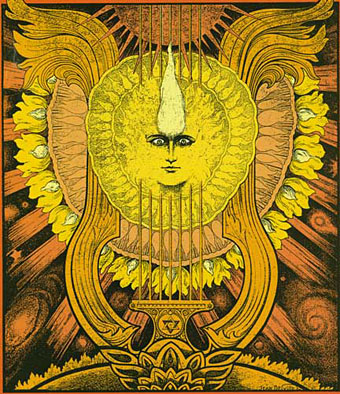
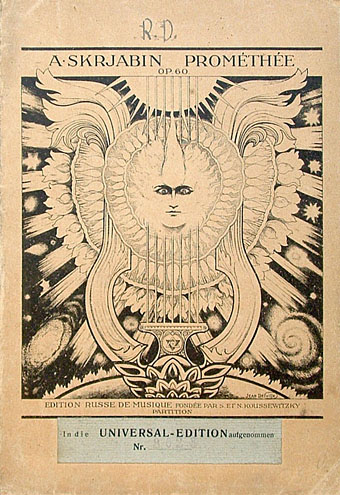
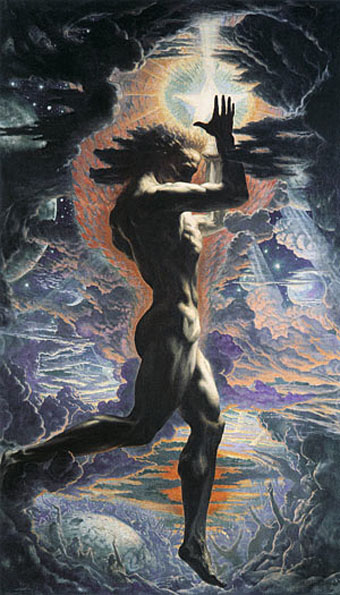
Another striking design found by chance. Symbolist artist Jean Delville (1867–1953) created this sheet music title page for Promethée by Scriabin in 1912, and the pair are well-matched given their shared predilection for mysticism (Theosophy in Delville’s case). Delville had also dealt with Prometheus in a typically dramatic, if sexless, picture a few years earlier (below). Once again it’s unfortunate that one of the really great artists of the Symbolist period is so poorly-served by the web that one has to discover his work by accident. There’s a dedicated site here but the gallery pages are only harvesting what’s already scattered around. Delville had a long and consistently high-quality career; he deserves better.

delville2.jpg

delville3.jpg

Prometheus (1907).

Update: Dave C reminds us of another Delville site with a better selection of pictures including a photo of the artist at work.

Previously on { feuilleton }
The faces of Parsifal
Masonic fonts and the designer’s dark materials
Angels 4: Fallen angels

Steinlen’s cats

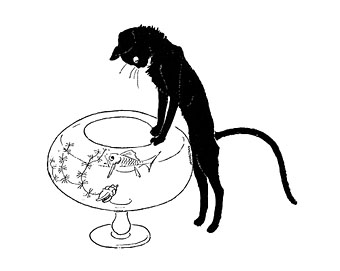
steinlen1.jpg

Chat Noir poster (1896).

We had Louis Wain yesterday so it only seems right to follow with the other notable cat artist of the period, and also the one whose work I prefer, Théophile Alexandre Steinlen (1859–1923).

Steinlen’s designs for the Montmartre cabaret, Le Chat Noir, of which there are many variations, are dismayingly ubiquitous in contemporary Paris, so much so that you quickly tire of his haloed feline when wandering the streets. Parisians regard Steinlen’s posters the way Londoners regard pictures of Beefeaters; they’re part of the background noise of the capital city, intended solely for tourists. A shame because it really is a splendid cat.

steinlen2.jpg

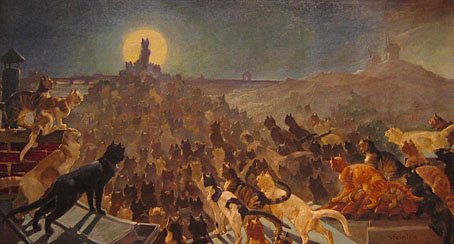
The Apotheosis of the Cats (c. 1890).

Steinlen’s cat pieces run the gamut of styles and variations, from delicate life studies and bronze sculptures to works such as the three-metres wide mural above depicting the advent of some ultimate feline deity. Among his many drawings he produced a number of marvellous cartoon sequences like the one below featuring cats fighting, playing and generally getting into trouble. Some of these can be found on Flickr here and here.

For more Steinlen, including his non-feline works, there’s Steinlen.net.

steinlen3.jpg

The End of a Goldfish.

Elsewhere on { feuilleton }
The illustrators archive

Previously on { feuilleton }
Louis Wain at Nunnington Hall
The Boy Who Drew Cats
8 out of 10 cats prefer absinthe
Monsieur Chat

Louis Wain at Nunnington Hall

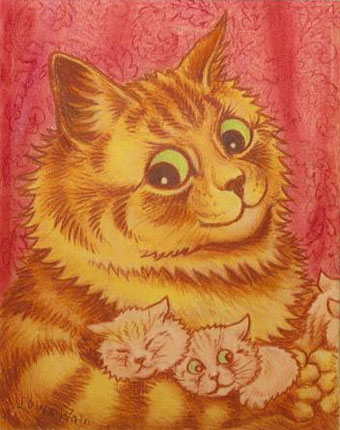
wain.jpg

The Mother of Triplets.

Anyone in the vicinity of Nunnington Hall in North Yorkshire over the next month has the opportunity to view and—if you’re wealthy enough—buy some pictures by Victorian cat artist Louis Wain (1860–1939). Wain is famously “The Cat Artist Who Went Mad” (as Chris Beetles’ gallery site puts it) and that piece of knowledge always comes to the fore when looking at his anthropomorphised felines with their huge eyes and often scowling expressions. The excellent Beetles gallery has an overview of the works on display at Nunnington. For the really eccentric stuff, however, you’ll have to go here.

Louis Wain at Nunnington Hall runs until September 13, 2009.

Catland: The art of Louis Wain

Previously on { feuilleton }
Marbled papers
A Madmen’s Museum
The art of Franz Xaver Messerschmidt, 1736–1783

Harry Lachman’s Inferno

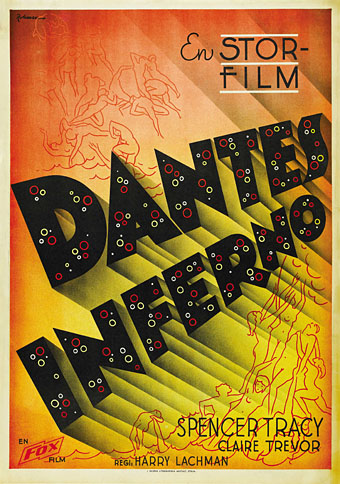
inferno1.jpg

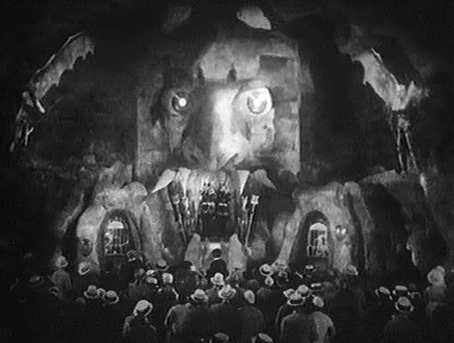
Looking at Willy Pogány’s work last week I was reminded that as well as illustrating books he worked in Hollywood for a while as an art director and set designer. Among those jobs was a credit for “Technical staff” on the only film for which director Harry Lachman is remembered today, a curious 1935 melodrama, Dante’s Inferno. This stars Spencer Tracy as a fairground barker whose talent for drawing an audience helps an old showman boost the attendance at his moralising “Dante’s Inferno” attraction.
inferno2.jpg

Entrance to the fairground attraction.

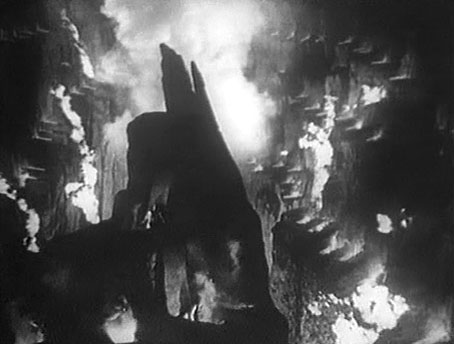
A hubristic rise and fall follows for Tracy, and the film spends much of its running time in routine business and family scenes. What sets it apart is some striking fairground designs (no doubt Pogány’s involvement) and a truly startling self-contained sequence when the old showman describes for Tracy the true nature of the Inferno. This sequence takes Gustave Doré’s celebrated illustrations and brings them to life in a series of atmospheric tableaux which even manage to contain brief glimpses of nudity. Hell, it seems, is the one place you can get away with not wearing any clothes. I’ve read many times that this sequence was borrowed from an earlier silent film, also called Dante’s Inferno, but have yet to come across any definite confirmation. It’s certainly possible since studios at that time treated other films in a very cavalier fashion; when a film was remade the studio would try to buy up and destroy prints of the earlier film. If anyone can point to more information about the origin of the Hell sequence, please leave a comment.
inferno3.jpg

Stone tombs from the Inferno sequence.

If the Inferno sequence wasn’t already stolen in 1935, it works so well that it’s been plundered many times since; Kenneth Anger borrowed shots which he mixed into Inauguration of the Pleasure Dome (1954), Derek Jarman did the same for TG: Psychick Rally in Heaven (1981), and Ken Russell slipped some tinted scenes into Altered States (1980). I tinted the entire sequence red and dumped it into the one-off video accompaniment I made for Alan Moore and Tim Perkins’ stage performance of Angel Passage in 2001; it wouldn’t surprise me if it’s been used elsewhere. As with many of Hollywood’s products, Lachman’s film pretends to condemn prurience—Tracy’s character exploits Hell’s lurid attractions for gain—while revelling in the opportunity to show as much bare flesh as the censors would allow. As with Doré, Lachman’s Inferno seems populated solely by men and women in the peak of physical fitness.

Inevitably, you can see the Inferno sequence on YouTube here and here. The film doesn’t seem to be available on DVD but it’s worth seeking out to watch in full. In addition to the infernal delights, you also get to see 16-year-old Rita Hayworth’s screen debut as a dancer on a cruise ship.

Previously on { feuilleton }
Willy Pogány’s Lohengrin
Willy Pogány’s Parsifal
Maps of the Inferno
A TV Dante by Tom Phillips and Peter Greenaway
The art of Lucio Bubacco
The last circle of the Inferno
Angels 4: Fallen angels

The Whale again

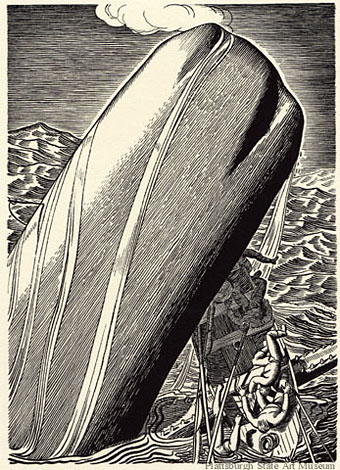
kent.jpg

Reading Moby Dick at the moment, and thoroughly enjoying it, so I felt the need to look again at Rockwell Kent’s tremendous illustrations. The Rockwell Kent Gallery at the Plattsburgh State Art Museum doesn’t have a complete set of these, unfortunately, but there’s more of them than in the Flickr set I pointed to earlier. The thing to do, of course, is to order an illustrated edition of the book…

Meanwhile, Philip Hoare’s non-fiction account of his whale obsession, Leviathan, or The Whale, is receiving renewed attention now it’s out in paperback. I love this description of a humpback whale “breaching”:

For a split second the animal appeared like some vast and improbable whale-angel against the sky, its huge, gnarled flippers outstretched like wings. Every detail was visible. I saw its great ribbed belly, the rorqual pleats that expand when feeding. I saw the barnacles on its skin, the parasites that hold fast to the animal, making it a travelling colony of its own. Then, as if someone had taken their finger off the pause button, the animal bowed to gravity and fell back into the sea, creating a splash that resounded for miles.

Forgetting that I was surrounded by schoolchildren, I blurted out an inadvertent, “Fuck!” Hardly an erudite response, but I challenge anyone to be indifferent to a close encounter with a whale. I have seen grown men cry at their first sight of a cetacean. They simply exist in another universe; aliens occupying vast oceans of which we have less knowledge than we do of the surface of the moon. To see a whale is a privilege. But it can also become an obsession. This spring, I succeeded in a long-held ambition: to watch right whales from the shore.

Read more of that here.

More whale art by Ivan Chermayeff and another whale feature at the NYT

Elsewhere on { feuilleton }
The illustrators archive

Previously on { feuilleton }
Rockwell Kent’s Moby Dick