Weekend links 65

plakhova.jpg

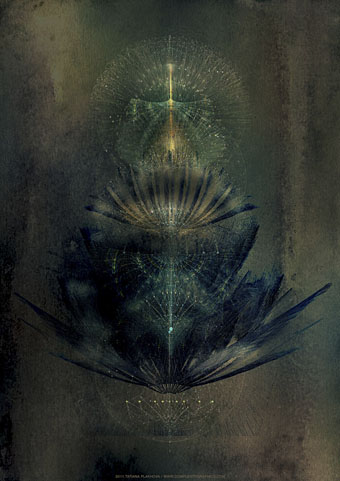
From Light Beyond Sound, a new series of works by Tatiana Plakhova.

“The invasion philosophy of the Olympic Park strikes me as just like the invasion philosophy behind going into Iraq,” he says, “or anywhere else that you blast into, put up the fence, establish the Green Zone, explain everything, put it all into this lovely eco-terminology…” Iain Sinclair

• Iain Sinclair has a new book out, Ghost Milk: Calling Time on the Grand Project, a critique of the tendency of British governments to waste money on white elephant projects. He’s visited this territory before in Sorry Meniscus, the small book/essay about the Millennium Dome. That book grew out of a piece for the London Review of Books which can be read here. Among the current round of interviews there’s this piece in which the title of the book is explained, and a talk with John Walsh at The Independent where he describes how the site for the 2012 Olympics has destroyed his patch of London.

A celebration of the writing and art of Mervyn Peake: “Mervyn Peake, creator of Gormenghast, is now recognised as a brilliant novelist and artist. Michael Moorcock, China Miéville, Hilary Spurling and AL Kennedy celebrate his achievements.”

• Looking like a children’s book invaded by the inhabitants of alchemical engravings, Die Geburtstagsreise (The Birthday Trip, 1976) by Monika Beisner.

• At AnOther mag this week: The ear in Blue Velvet and publisher Peter Owen on Salvador Dalí’s novel Hidden Faces.

Four Days, Four Recordings by Jon Brooks aka The Advisory Circle. Related: The Hauntological Society.

Leaving it to Chance: maverick director Nicolas Roeg on Don’t Look Now.

Brian Eno: “This is my problem with Tracey Emin; who fucking cares?”

• Scans of Max Ernst’s masterwork Une Semaine de Bonté.

Susie Bright: Mapping the Erotic and the Revolutionary.

How to Become a Sensuous Witch, 1971.

The View From Her Room (1982) by Weekend | Weekend live on the OGWT (October, 1982) • Gormenghast Drift (1992) by Irmin Schmidt.
Rossetti and His Circle by Max Beerbohm

beerbohm1.jpg

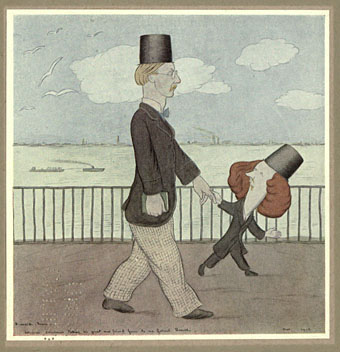
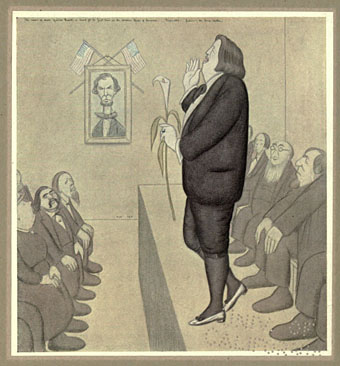
Rossetti’s name is heard in America (Oscar Wilde).

The Happy Hypocrite was Max Beerbohm’s words illustrated by George Sheringham; here we have Beerbohm’s caricatures from a 1922 collection depicting notable figures among the Aesthetes and Pre-Raphaelites from the 1860s on. Beerbohm wasn’t born until 1872 so there’s something of a younger generation’s mockery in these drawings. That said, he was just as happy to mock his London friends of the 1890s, Oscar Wilde included, and often poked fun at himself in his cartoons and his writings.

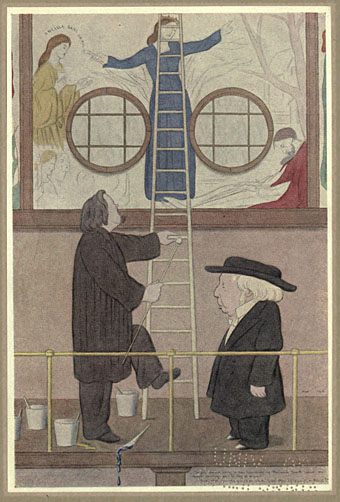
Some of the pictures in Rossetti and His Circle are familiar from books about the period, the Wilde picture in particular is often reprinted. You don’t always see them in colour, however, so once again the scans at the Internet Archive give us a fuller view provided you ignore the security perforations on each print.

beerbohm2.jpg

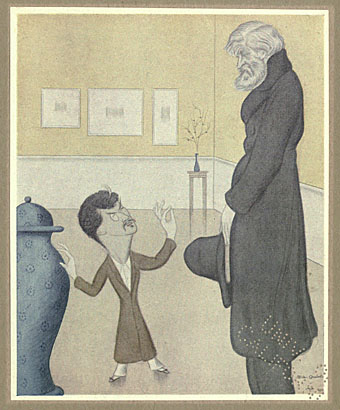
Blue China (JM Whistler and Thomas Carlyle).

A drawing which complements Wilde’s description of Whistler as a “miniature Mephistopheles”. Beerbohm was more succinct in one of his verbal portraits: “Tiny”.

beerbohm3.jpg

Algernon Swinburne taking his great new friend Gosse to see Gabriel Rossetti.

Swinburne, it seems, was another diminutive figure.

beerbohm4.jpg

The sole remark likely to have been made by Benjamin Jowett about the mural paintings at the Oxford Union: “And what were they going to do with the Grail when they found it, Mr. Rossetti?”

Previously on { feuilleton }
The Happy Hypocrite by Max Beerbohm

Morlocks, airships and curious cabinets

morlock.jpg

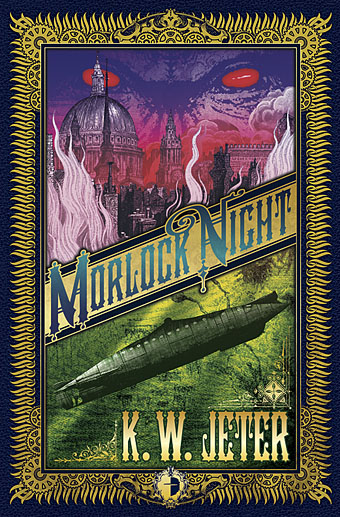
Things I was working on late last year continue to percolate or, if you prefer, build a head of steam. My cover for KW Jeter’s Morlock Night appears in a short piece by Rick Poynor in July’s Creative Review. That feature is prompted by the British Library’s Out of the World exhibition. Nice to see something of mine with Hannes Bok’s illustration for Who Goes There? by John W Campbell, the story which was filmed as The Thing from Another World, and later, John Carpenter’s The Thing.

Morlock Night is also one of my contributions to the lavish Steampunk Bible which editors SJ Chambers and Jeff VanderMeer have been promoting for the past couple of months. USA Today ran a feature on the book which included my piscine airship among the selected illustrations.

Next up will be the Thackery T Lambshead Cabinet of Curiosities for which I’ve provided a number of illustrations and decorative title pages. Jeff V has a preview shot of the cover. That will be out next month. More later.

Previously on { feuilleton }
The Steampunk Bible
Steampunk Reloaded
Steampunk overloaded!
Vickers Airship Catalogue
The Air Ship
Dirigibles
More Steampunk and the Crawling Chaos
The art of François Schuiten
Steampunk Redux
Steampunk framed
Steampunk Horror Shortcuts
The Airship Destroyer
Zeppelin vs. Pterodactyls
The Hetzel editions of Jules Verne

The Happy Hypocrite by Max Beerbohm

beerbohm01.jpg

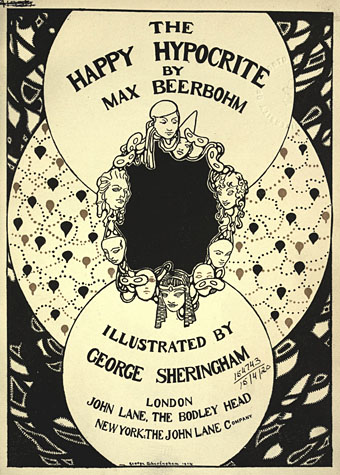
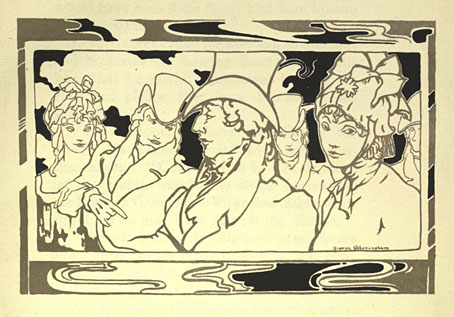
The spirit of the 1890s persists in this 1915 edition of a story the splendid Max wrote originally for The Yellow Book in 1896. Originally subtitled “A Fairy Tale for Tired Men”, The Happy Hypocrite is a typically light-hearted affair concerning the misadventures of one Lord George Hell. The setting is the Regency era so beloved of many of the London Decadents, Aubrey Beardsley included, and the rather fine illustrations are by George Sheringham whose style was distinctive enough to avoid any Beardsley pastiche. The copy preserved at the Internet Archive includes a number of full-colour plates but time and the vicissitudes of reproduction haven’t done them any favours, hence the concentration here on the monochrome drawings.

beerbohm02.jpg

beerbohm03.jpg

Continue reading “The Happy Hypocrite by Max Beerbohm”

Weekend links 62

pavlishin.jpg

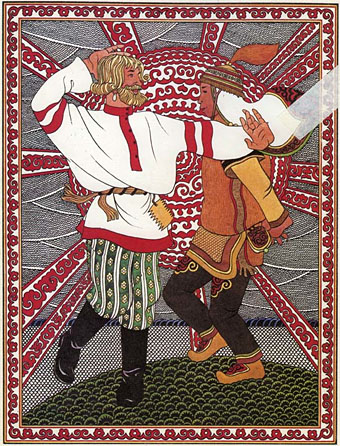
A plate from Tales of the Amur by Dmitry Nagishkin, a 1975 edition illustrated by Gennady Pavlishin.

• The week in Surrealism: Opera of the surreal gives Dalí an encore: Yo, Dalí, a previously unperformed work by Xavier Benguerel, receives its premier in Madrid. Meanwhile Tate Liverpool’s summer exhibition, René Magritte: The Pleasure Principle, is profiled here. “René Magritte has inspired more book covers than any other visual artist,” says James Hall.

If Rimbaud anticipated the Surrealists by decades, Ashbery is said to have gone beyond them and defied even their rules and logic. Yet though nearly 150 years have intervened since Rimbaud’s first declaration of independence, many readers in our own age, too, still prefer a coherence of imagery, a sameness of tone, a readable sequential message, even, ultimately, what amounts to a prose narrative broken into lines.

Lydia Davis on Rimbaud’s Wise Music.

Umberto Eco’s glimpse into the art of the novel | Return to Wonderland: an essay on Lewis Carroll’s world by Alberto Manguel | Heavy sentences by Joseph Epstein: On How to Write a Sentence and How to Read One, by Stanley Fish.

And then there’s the mystery of what happened to him for those four months in London when we have no trace of him. Rimbaud mentions Scarborough in “Promontory” and talks about “Hotels, the circular façades of the Royal and the Grand in Scarborough or Brooklyn.” Since there’s that missing period in England, people say he must have gone to Scarborough, and have even checked hotel registers for that period, but as far as I know nobody has ever found anything. Someone even checked railway and train schedules in order to pin him to this real place. I seem to remember a French writer admitting that Rimbaud was never in Brooklyn, but kind of wishfully thinking that he might have been. Which is very funny. “Rimbaud in Brooklyn”: there’s a project for someone.

A Refutation of Common Sense, John Ashberry on translating Rimbaud.

Robert Jeffrey posts a video of his nine-year-old self giving Madge a run for her money in 1991. As Boy Culture puts it: “Anyone who feebly clings to the belief that gay can be prayed away should take a look at this and give up already…” Amen.

• The mathematics of Yog-Sothoth: Richard Elwes on Exotic spheres, or why 4-dimensional space is a crazy place.

For I Will Consider My Cat Jeoffry by Christopher Smart (1722–1771).

Lesbian pulp fiction, 1935–1978 and Faber 20th century classics.

As The Crow Flies, a new album from The Advisory Circle.

New World Transparent Specimens by Iori Tomita.

79 versions of Gershon Kingley’s Popcorn.

Minor Man (1981) by The League of Gentlemen.