La Morphine by Victorien du Saussay

morphine1.jpg

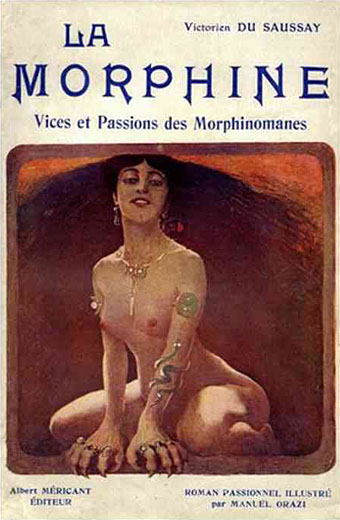
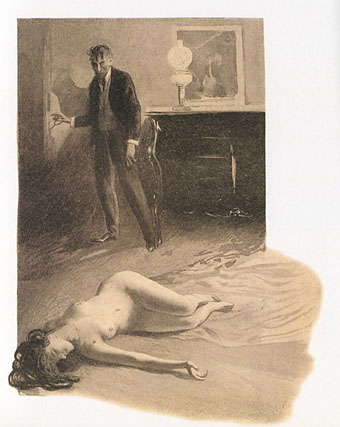
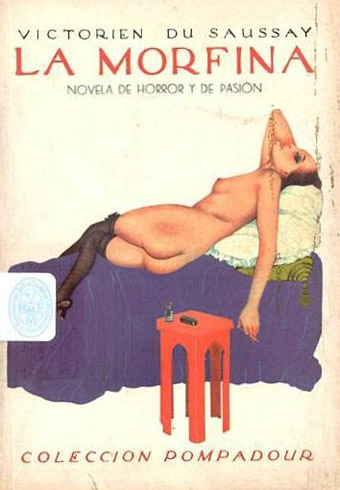
Manuel Orazi’s illustrations (above and below) have been travelling the recursive paths of the Tumblr labyrinth recently. I was hoping to find covers for other editions but the third image here (from 1930) is the only one that’s turned up. La Morphine, Vices et passions des morphinomanes by Victorien du Saussay was published in 1906, and is described by Barbara Hodgson as “a stark novel of addiction, failed cures, incest, indecent exposure and adultery” (In the Arms of Morpheus: The Tragic History of Laudanum, Morphine, and Patent Medicines (2001)). Orazi apparently produced 22 interior illustrations but (again) they don’t appear to be available for the moment.

morphine2.jpg

morphine3.jpg

Elsewhere on { feuilleton }
The book covers archive

Previously on { feuilleton }
Haschisch Hallucinations by HE Gowers
Manuel Orazi’s Salomé
Demon rum leads to heroin
La belle sans nom
German opium smokers, 1900

The Piper at the Gates of Dawn

witw1.jpg

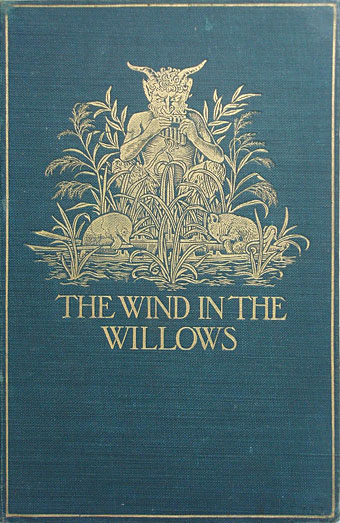
Illustration by W. Graham Robertson (19o8).

(No, this doesn’t concern Pink Floyd.)

The chapter – The Piper at the Gates of Dawn – is normally dropped because it jars, seems so strange compared to all the others and, to some, is vaguely homoerotic. [Kenneth] Grahame thought it essential.

Thus Mark Brown discussing the curious seventh chapter of The Wind in the Willows (1908) wherein Mole and Rat have a mystical encounter with the Greek god of nature in the British countryside:

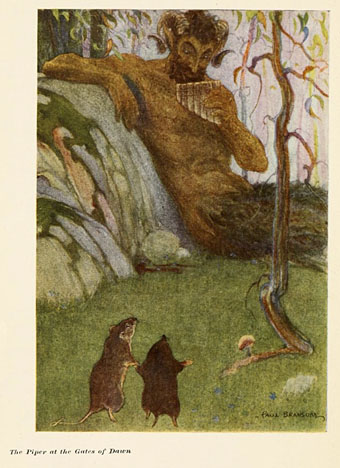
Perhaps he would never have dared to raise his eyes, but that, though the piping was now hushed, the call and the summons seemed still dominant and imperious. He might not refuse, were Death himself waiting to strike him instantly, once he had looked with mortal eye on things rightly kept hidden. Trembling he obeyed, and raised his humble head; and then, in that utter clearness of the imminent dawn, while Nature, flushed with fullness of incredible colour, seemed to hold her breath for the event, he looked in the very eyes of the Friend and Helper; saw the backward sweep of the curved horns, gleaming in the growing daylight; saw the stern, hooked nose between the kindly eyes that were looking down on them humorously, while the bearded mouth broke into a half-smile at the corners; saw the rippling muscles on the arm that lay across the broad chest, the long supple hand still holding the pan-pipes only just fallen away from the parted lips; saw the splendid curves of the shaggy limbs disposed in majestic ease on the sward; saw, last of all, nestling between his very hooves, sleeping soundly in entire peace and contentment, the little, round, podgy, childish form of the baby otter. All this he saw, for one moment breathless and intense, vivid on the morning sky; and still, as he looked, he lived; and still, as he lived, he wondered.

Brown’s article concerns a forthcoming exhibition, Writing Britain: Wastelands to Wonderlands, at the British Library, part of the summer’s Olympic celebrations. Kenneth Grahame’s hand-written text of chapter seven will be on display together with a later Arthur Rackham illustration of the goat god. The Library makes a point of noting that the Pan chapter is sometimes excised from the book although I’m not sure how often this occurs, it’s been present in all the editions I’ve seen including the cheap paperback edition I have somewhere. W. Graham Robertson’s rather fine drawing above (showing Mole and Rat bowing to their presiding deity) embellishes the first UK edition. Paul Bransom’s illustration below is the frontispiece to a 1913 US edition.

witw2.jpg

Illustration by Paul Bransom (1913).

One benefit of this bit of news has been finding Robertson’s illustration which gives Brown’s use of “homoerotic” a slight twist. Robertson was a children’s illustrator and playwright who Neil McKenna in The Secret Life of Oscar Wilde (2003) describes as being a member of the surreptitiously gay art world in London during the 1890s. (If there’s to be any dissent about this let’s note that one of his plays was entitled Pinkie and the Fairies…) Robertson knew Oscar Wilde but fell in with the contra-Wilde fraternity, notably Robert de Montesquiou, so gets left out of many accounts of Wilde’s circle. He was however immortalised by John Singer Sargent in this well-known portrait. I’ll be writing a little more about Robertson and Sargent’s painting at a later date. For more about the surprising recurrence of Pan in Victorian and Edwardian literature, see this earlier post.

Writing Britain: Wastelands to Wonderlands at the British Library opens on May 11th and runs throughout the summer.

Elsewhere on { feuilleton }
The illustrator’s archive

Previously on { feuilleton }
The Great God Pan
Peake’s Pan

Amy Sacker, book designer

sacker1.jpg

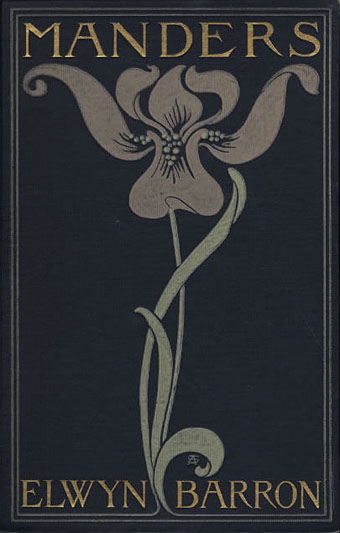
Manders: A Tale of Paris (1899) by Elwyn Barron.

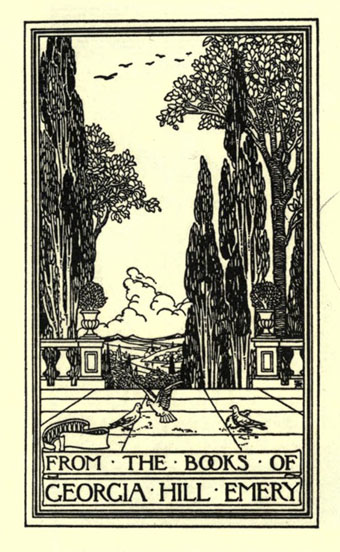
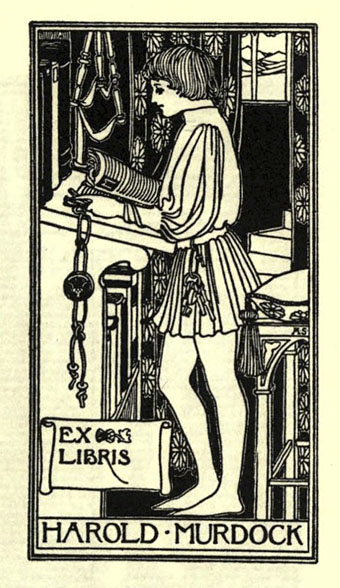
Amy Sacker (1872–1965) was an American book designer, illustrator and bookplate artist, one of a number of female designers and illustrators whose careers began in the last years of the 19th century. I’ve mentioned before how women struggled at this time for acceptance in the male-dominated spheres of painting and sculpture. Those who insisted on pursuing an artistic career were encouraged to concentrate their impulses in the decorative arts with the result that women are a lot more visible in the illustration and design of this period. (See this earlier post about Margaret Armstrong, and these pages at Princeton University Library about women printers, binders and book designers.)

sacker2.jpg

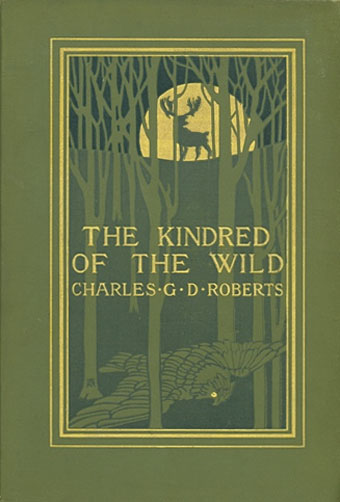
The Kindred of the Wild (1902) by Charles G. D. Roberts.

The cover above is from the Amy Sacker website which features information about Ms Sacker’s bookbindings, illustrations and bookplate designs. A recent post here mentioned the Troutsdale Press collection of Amy Sacker bookplates from which the two examples below are taken. These often show people in Renaissance or medieval garb drawn in a style reminiscent of Walter Crane. More of them can be seen at the Internet Archive while the University of North Carolina archive has 120 examples of her cover designs.

sacker3.jpg

sacker4.jpg

Elsewhere on { feuilleton }
The book covers archive

Previously on { feuilleton }
Troutsdale Press bookplates
Margaret Armstrong book designs

Weekend links 96

nunez.jpg

Sin título (monstruas) (2008) by Marina Núñez.   

• Salon asks Christopher Bram “Is gay literature over?” Bram’s new book, Eminent Outlaws: The Gay Writers Who Changed America, is reviewed here.

Robert Montgomery is profiled at the Independent as “The artist vandalising advertising with poetry.”

In addition to aesthetics, McCarthy noted a deeper link between great science and great writing. “Both involve curiosity, taking risks, thinking in an adventurous manner, and being willing to say something 9/10ths of people will say is wrong.” Profound insights in both domains also tend arise from a source beyond the limits of analytic reason. “Major insights in science come from the subconscious, from staring at your shoes. They’re not just analytical.”

Nick Romeo meets Cormac McCarthy at the Santa Fe Institute.

• For FACT mix 316 Julia Holter mixes radio broadcasts, street recordings and music.

• This week in the Tumblr labyrinth: fin de siècle art and graphics from Nocnitsa.

“There’s a widespread cultural barrenness across art and political culture. But there are some pockets of resistance on the extreme margins, like the techno-savvy protest movements, small press, the creator-owned comics, that seem to be getting some signs of hope for the future,” he says. “All of the genuinely interesting work is being done on the margins, with independent companies, self-producing, and alternative distribution networks.”

Alan Moore on Watchmen’s “toxic cloud” and creativity v. big business.

Stone Tape Shuffle, a 12” LP of readings by Iain Sinclair. Limited to 400 copies.

Monolake on how we cope with death: mythologies, rituals, drugs and Ghosts.

Kraftwerk perform at New York’s Museum of Modern Art in April.

Kathy Acker (in 1988?) interviewing William Burroughs.

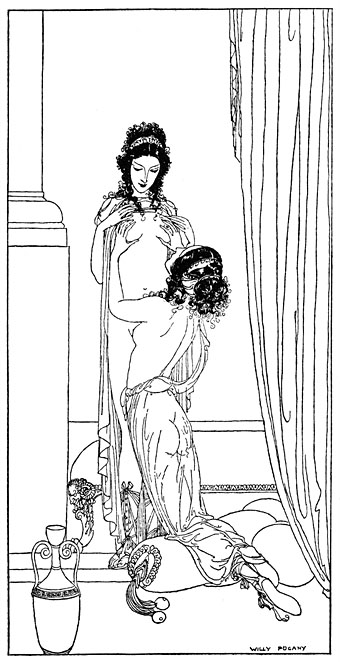
pogany.jpg

Willy Pogány’s erotica: illustrations for a 1926 edition of The Songs of Bilitis by Pierre Louÿs.

• Nicholas Lezard on David Lynch: director of dreams.

Did otherworldly music inspire Stonehenge?

Coilhouse has an Eyepatch Party.

Tanzmusik (1973) by Kraftwerk | The Model (1992) by the Balanescu Quartet | Trans Europe Express (2003) by the Wiener Sinfonie Orchestra & Arnold Schönberg Choir.

Vathek illustrated

vathek1.jpg

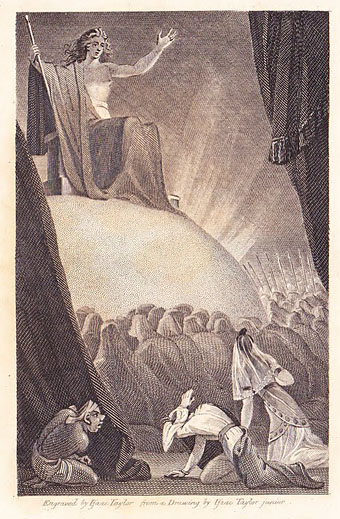
Frontispiece, 1815. Engraved by Isaac Taylor after a drawing by Isaac Taylor Jr.

After some time Vathek and Nouronihar perceived a gleam brightening through the drapery, and entered a vast tabernacle carpeted with the skins of leopards; an infinity of elders with streaming beards, and Afrits in complete armour, had prostrated themselves before the ascent of a lofty eminence, on the top of which, upon a globe of fire, sat the formidable Eblis. His person was that of a young man, whose noble and regular features seemed to have been tarnished by malignant vapours; in his large eyes appeared both pride and despair; his flowing hair retained some resemblance to that of an angel of light; in his hand, which thunder had blasted, he swayed the iron sceptre that causes the monster Ouranabad, the Afrits, and all the powers of the abyss to tremble; at his presence the heart of the Caliph sank within him, and for the first time he fell prostrate on his face.

Vathek by William Beckford

The inevitable follow-up to yesterday’s post. Vathek was, we’re told, written in three days and two nights in the winter of 1782 when William Beckford was only 21. The novel is an Orientalist fantasy that’s grotesque and arabesque in the original sense of those terms, very much influenced by The Arabian Nights and similar tales. Here’s HP Lovecraft with a description:

Vathek is a tale of the grandson of the Caliph Haroun, who, tormented by that ambition for super-terrestrial power, pleasure, and learning which animates the average Gothic villain or Byronic hero (essentially cognate types), is lured by an evil genius to seek the subterranean throne of the mighty and fabulous pre-Adamite sultans in the fiery halls of Eblis, the Mahometan Devil. The descriptions of Vathek’s palaces and diversions, of his scheming sorceress-mother Carathis and her witch-tower with the fifty one-eyed negresses, of his pilgrimage to the haunted ruins of Istakhar (Persepolis) and of the impish bride Nouronihar whom he treacherously acquired on the way, of Istakhar’s primordial towers and terraces in the burning moonlight of the waste, and of the terrible Cyclopean halls of Eblis, where, lured by glittering promises, each victim is compelled to wander in anguish forever, his right hand upon his blazingly ignited and eternally burning heart, are triumphs of weird colouring which raise the book to a permanent place in English letters. No less notable are the three Episodes of Vathek, intended for insertion in the tale as narratives of Vathek’s fellow-victims in Eblis’ infernal halls, which remained unpublished throughout the author’s lifetime and were discovered as recently as 1909 by the scholar Lewis Melville whilst collecting material for his Life and Letters of William Beckford. Beckford, however, lacks the essential mysticism which marks the acutest form of the weird; so that his tales have a certain knowing latin hardness and clearness preclusive of sheer panic fright.

Jorge Luis Borges noted some of the influences in his 1943 essay On William Beckford’s Vathek:

…I believe that Vathek foretells, in however rudimentary a way, the satanic splendors of Thomas De Quincey and Poe, of Charles Baudelaire and Huysmans. There is an untranslatable English epithet, “uncanny,” to denote supernatural horror; that epithet (unheimlich in German) is applicable to certain pages of Vathek, but not, as far as I recall, to any other book before it.

[Guy] Chapman notes some of the books that influenced Beckford: the Bibliothéque orientale of Barthélemy d’Herbelot; Hamilton’s Quatre Facardins; Voltaire’s La Princesse de Babylone; the always reviled and admirable Mille et une nuits of Galland. To that list I would add Piranesi’s Carceri d’invenzione: etchings, praised by Beckford, that depict mighty palaces which are also impenetrable labyrinths. Beckford, in the first chapter of Vathek, enumerates five palaces dedicated to the five senses; Marino, in the Adone, had already described five similar gardens.

Byron admired the novel enough to take the name “Giaour” for one of his poems, and it’s no surprise to read that Clark Ashton Smith penned additions to The Third Episode of Vathek. Beckford’s fantasy is very much a precursor of Smith’s equally lurid and sinister stories.
vathek2.jpg

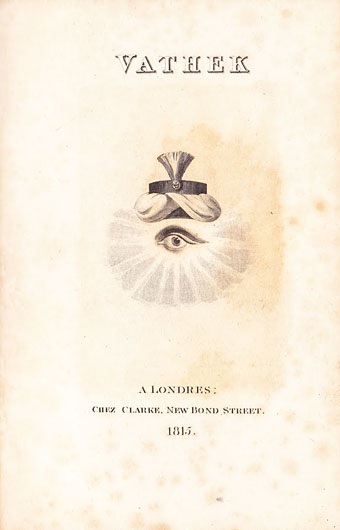
Given all this, it’s a surprise that more illustrators haven’t been attracted to the book. This may in part be a hangover of Victorian prudery: some of the novels of the Gothic period remained shocking to later sensibilities while Beckford’s scandalous reputation (Byron called him “the great Apostle of Paederasty”; to Hilaire Belloc he was “one of the vilest men of his time”) wouldn’t have made his name popular among the collectors of costly illustrated editions. Of the pictures here, the 1815 volume has a frontispiece showing Eblis perched on a hemispherical throne like the one John Martin later gave to Milton’s Satan. More of the uncredited edition from 1923 can be found at the Internet Archive while VTS has plates from the Marion Dorn edition. Mahlon Blaine not only put more effort into his illustrations but the content is also far more suited to his temperament; a shame there aren’t more of the drawings online. And it’s a shame too that Harry Clarke never tackled Beckford’s novel. Many of his contemporaries produced illustrated fairy tale books, as Clarke himself did with Charles Perrault’s stories. But none would have been able to match Clarke if he’d adapted Vathek with the same vigour he brought to Faust.
vathek6.jpg

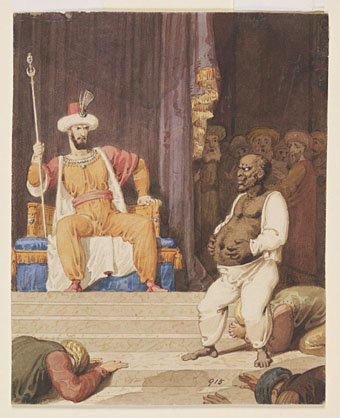
The Caliph and the Giaour (c. 1800) by Richard Westall.

Continue reading “Vathek illustrated”