The Metropolis of Tomorrow by Hugh Ferriss

ferriss01.jpg

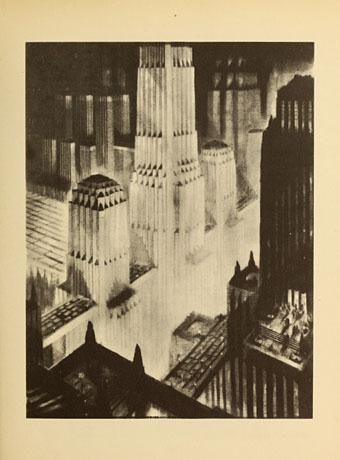
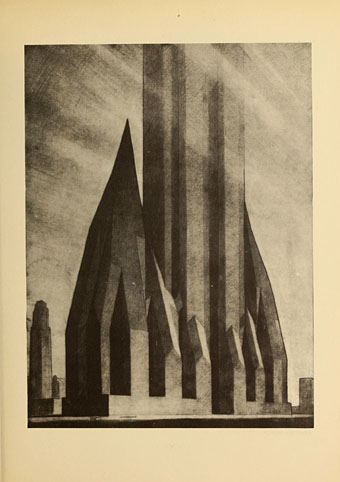
Crowding Towers.

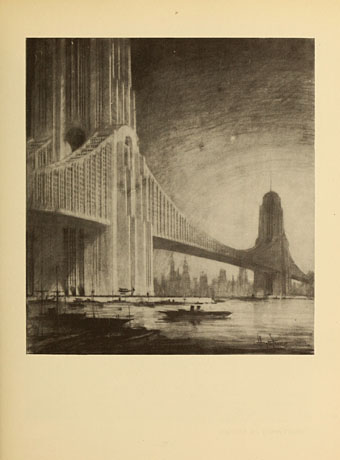
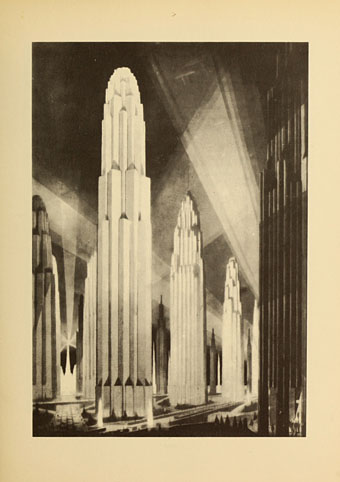
The work of architectural renderer Hugh Ferriss (1889–1962) has appeared here before. The Metropolis of Tomorrow (1929) was a major influence on the architectural style I deployed in the Reverbstorm series, together with Berenice Abbott’s photographs of New York City in the 1930s. Ferriss’s hazy proposals for cities of the future are more visible today than they used to be thanks to the popularity of those sites that enjoy outmoded visions of the future.

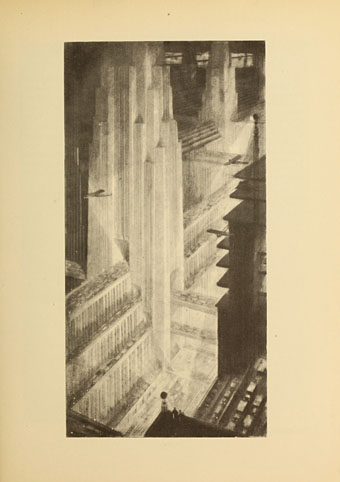
Flickr has been a good source of Ferriss’s drawings in the past but the Internet Archive recently posted the entirety of The Metropolis of Tomorrow, pages as well as pictures. The book appeared a couple of years after Fritz Lang’s Metropolis, and shares that film’s idea of the future city as a kind of superannuated New York. Skyscrapers were still a relatively new idea so this seemed a natural development at the time, as did the concept of super-highways and rooftop aerodromes. Human beings in Ferriss’s future are either ant-like specks or they’ve vanished altogether among the massed ranks of towers which often look more like less like buildings and more like Art Deco spacecraft. Lang’s vision was dystopian only in the way it relegated its workers to the underworld, while Ferriss’s proposals were wholly optimistic. Looking back we’re more aware of the shortcomings of such ideas, and from my perspective it wasn’t so difficult to bring out the latent menace inherent in these megastructures. Ferriss’s metropolis, like that of Fritz Lang, is a fun place to visit but you wouldn’t necessarily want to live there.

Browse the rest of the book here or download it here.

ferriss02.jpg

Overhead traffic-ways.

ferriss03.jpg

Apartments on bridges.

ferriss04.jpg

Evolution of the set-back building: second stage.

ferriss05.jpg

Verticals on wide avenues.

Continue reading “The Metropolis of Tomorrow by Hugh Ferriss”

Weekend links 178

bantjes.jpg

Pretty Pictures, a new book by designer Marian Bantjes, is out on October 1st.

• A writer admired by Angela Carter, Michael Moorcock, Harlan Ellison, Anthony Burgess, Jonathan Meades and Iain Sinclair; a “writer’s writer…[whose] best stories bear comparison with the Ficciones of Jorge Luis Borges”; a writer with an “unsettling quality to his writing, a whiff of brimstone that links him to fin-de-siècle occult figures such as HP Lovecraft—and even, at a further remove, Aleister Crowley”. David Collard explains why you may want to read something by Gerald Kersh (1911–1968), four of whose books are being republished.

• The Eccentronic Research Council and Maxine Peake pay homage to Delia Derbyshire’s The Dreams project with a new single out at the end of the month (Pye Corner Audio and Carol Morley appear on the flip). Ms Peake’s barm-cake reverie may be heard here.

• “Applying for grants, writing artist statements, showing up to openings—artists have to do far more than just make art if they want to find an audience for it.” Jen Graves on lies and deception in the art world.

The material does not make the work. The life does not make the art. Exactly the opposite. The work creates the material. The art creates the life. Did Trinidad exist before Naipaul? Did cargo ships exist before Joseph Conrad? Did Newark and the New Jersey suburbs exist before Philip Roth? Did women in playgrounds in New York City exist before Grace Paley? See how the writer invents the material? These places did not exist as literary subjects. They were invisible to literature. The magic of a great book is that it makes its own subject seem inevitable. The danger is, it makes the subject seem like the source of power in the work.

Phyllis Rose on life and literature.

• Mix of the week: Secret Thirteen Mix 087, 40 minutes of original electronic music by Geistform (Rafael Martinez Espinosa).

• “You’ve Got This“, an It Gets Better-style video support campaign for people recently diagnosed with HIV.

• At Dangerous Minds: Babalon Working: Brian Butler’s trippy occult odyssey with Paz de la Huerta.

Manfred Mohr‘s computer-created artwork, from the 1960s to the present.

Robert Macfarlane on the strange world of urban exploration.

Rick Poynor on Bohumil Stepan’s Family Album of Oddities.

• Oli Warwick talks to Martin Jenkins, aka Pye Corner Audio.

• The 384-page BUTT calendar for 2014 is now on sale.

• Pye Corner Audio: We Have Visitors (2010) | Toward Light (2011) | The Mirror Ball Cracked (2012)

Digital Grotesque

3d1.jpg

These organic forms are details of an architectural environment produced in sandstone using a 3D printer. The project is a collaboration between Michael Hansmeyer and Benjamin Dillenburger who use a series of algorithms to create the shapes the printer produces:

In the Digital Grotesque project, we use these algorithms to create a form that appears at once synthetic and organic. The design process thus strikes a delicate balance between the expected and the unexpected, between control and relinquishment. The algorithms are deterministic as they do not incorporate randomness, but the results are not necessarily entirely foreseeable. Instead, they have the power to surprise.

The resulting architecture does not lend itself to a visual reductionism. Rather, the processes can devise truly surprising topographies and topologies that go far beyond what one could have traditionally conceived.

3d2.jpg

The diagram below shows the scale of the completed structure. Regular readers won’t be surprised to hear that the first thing that came to my mind when looking at these photos was “Lovecraft!” This unpredictable rendering process immediately solves the problem of how to depict or construct a non-human architecture without resort to anything Earth-bound. Those ridged and fluted columns could be R’lyeh or they could equally be the vast and ancient buildings that Dyer and Danforth discover in At the Mountains of Madness. I’ve been waiting for a while for 3D printing to start moving beyond the mere replication of existing objects; this is a very promising development. There’s more detail about the process and construction at the Digital Grotesque site.

3d3.jpg

Previously on { feuilleton }
At the Mountains of Madness

A Trip to the Moon, 1901

expo1.jpg

On the Airship Luna, visiting the Queer City of the Moon, and the wonderful Palace of the Man in the Moon.

An artist’s rendering of Frederic Thompson’s amusement ride created for the Pan-American Exposition of 1901 which is no doubt more impressive than was the earthbound reality. Thompson’s ride pre-dates Georges Méliès’ Le Voyage dans la Lune by a year, and while both lunar excursions owe something to HG Wells, whose The First Men in the Moon was published in 1901, the Wikipedia description of Thompson’s ride sounds very similar to the Méliès film:

The first version of the ride involved a simulated trip for thirty passengers from the fairgrounds to the Moon aboard the airship-ornithopter Luna, with visions displayed of Niagara Falls, the North American continent and the Earth’s disc. The passengers then left the craft to walk around a cavernous papier-mâché lunar surface peopled by costumed characters playing Selenites, and there visiting the palace of the Man in the Moon with its dancing “moon maidens”, before finally leaving the attraction through a Mooncalf’s mouth.

Thompson’s attraction was later relocated to Coney Island where it gave its name to the Luna Park created there, a name subsequently passed on to all the other Luna Parks worldwide. The illustration is from One Hundred Views of the Pan-American Exposition, Buffalo and Niagara Falls (1901) which includes some views of the other attractions and exhibits. This exposition was on a smaller scale than some of those that came before and after, and includes a couple of features that appear plagiarised from earlier shows, notably “Roltair’s House Upside Down” which might have been inspired by the Upside-Down Manor at the Exposition Universelle in Paris the year before. I appear to have exhausted the Paris exposition as a subject but the fascination with these events persists, especially when they turn up oddities such as these. Browse the rest of the book here or download it here.

expo2.jpg

expo3.jpg

expo4.jpg

expo5.jpg

expo6.jpg

Previously on { feuilleton }
Le Voyage dans la Lune
A Trip to Mars
Lunation: Art on the Moon
Somnium by Steve Moore
Mushrooms on the Moon
Filippo Morghen’s Voyage to the Moon

Tokyo details

tokyo01.jpg

Another enormous gigapixel panorama appeared this week, this one being a view from the Tokyo Tower by Jeffrey Martin. Some cities suit this detailed bird’s-eye view more than others. A similar panorama of Prague wasn’t as interesting for me as the view over London which appeared at the beginning of this year. Tokyo from this vantage may be an endless clutter of concrete and tarmac but it still yields some interesting details.

tokyo02.jpg

Tokyo’s Ginza district, and Chuo-dori Avenue, are locatable by these signs.

tokyo03.jpg

Further away there’s this cat-and-kitten sign.

tokyo04.jpg

While elsewhere Colonel Sanders proves inescapable. The Colonel’s Wikipedia entry contains this, er…nugget:

The Japanese Nippon Professional Baseball league has developed an urban legend of the “Curse of the Colonel”. A statue of Colonel Sanders was thrown into a river and lost during a 1985 fan celebration, and (according to the legend) the “curse” has caused Japan’s Hanshin Tigers to perform poorly since the incident.

Continue reading “Tokyo details”