Graft by Matt Hill

graft1.jpg

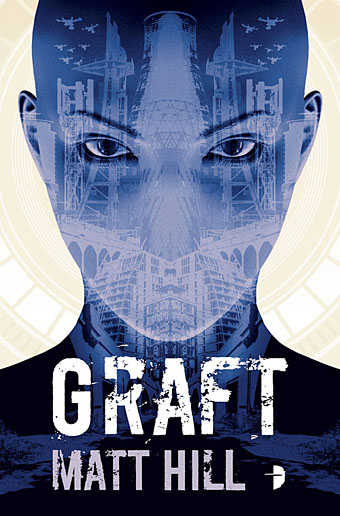
UK edition.

This latest cover design has been made public much sooner than some of the other things I’ve been working on this year. Graft is another cover for Angry Robot, a novel set in near-future Manchester by local author Matt Hill. The title plays on the multiple meanings of the word “graft”, not only the colloquial term for work (honest or otherwise) but also the sense of a medical graft. Once again, Barnes & Noble have provided a convenient précis:

Manchester, 2025. Local mechanic Sol steals old vehicles to meet the demand for spares. But when Sol’s partner impulsively jacks a luxury model, Sol finds himself caught up in a nightmarish trans-dimensional human trafficking conspiracy.

Hidden in the stolen car is a voiceless, three-armed woman called Y. She’s had her memory removed and undertaken a harrowing journey into a world she only vaguely recognises. And someone waiting in the UK expects her delivery at all costs.

Now Sol and Y are on the run from both Y’s traffickers and the organization’s faithful products. With the help of a dangerous triggerman and Sol’s ex, they must uncover the true, terrifying extent of the trafficking operation, or it’s all over.

Not that there was much hope to start with.

A novel about the horror of exploitation and the weight of love, Graft imagines a country in which too many people are only worth what’s on their price tag.

graft2.jpg

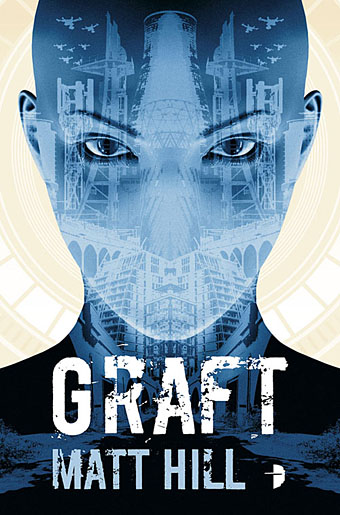
US edition.

The challenge with this one was to create something that might be read as futuristic yet also included elements of the real Manchester. All the buildings are worked up from photos of my own, many of them taken during a long day out spent wandering around the Cornbrook area and Salford Quays. The latter has been extensively redeveloped in recent years so there’s a lot of new architecture out there, including the new BBC headquarters. The elegant pylons are the supports of the Lowry Bridge which can be raised to allow ships into the docks.

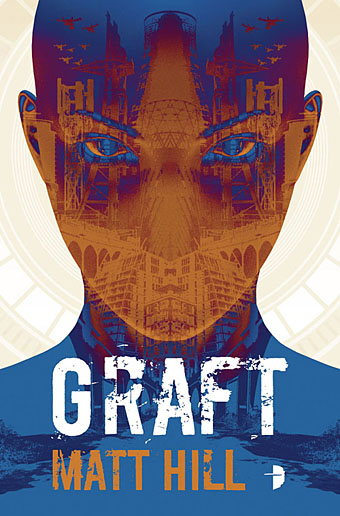
I couldn’t settle on a final colour scheme for this one so I made a number of variations then let author and publisher decide. This resulted in three covers: the UK edition, US edition and e-book. It took a while but I think I’m happiest now with the blue-and-purple version. Matt Hill talks about Graft here.

graft3.jpg

E-book.

Urbatecture

urbicande1.jpg

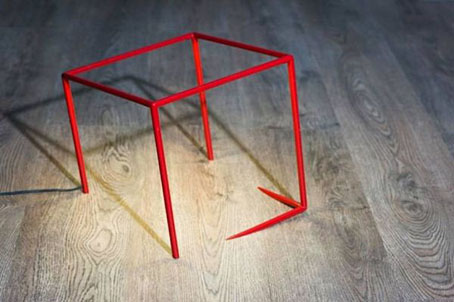
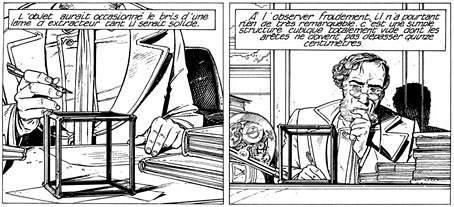
Spotted at Neatorama this week, Cédric Dequidt‘s Urbicande lamp, a cubic design which appears to be sinking into the table. The Neatorama people don’t seem aware that the name of the lamp refers to Fever in Urbicande (1985), a comic book by François Schuiten and Benoît Peeters, and the second volume in the masterful Cités Obscures series.

urbicande1.jpg

Fever in Urbicand: Urbatect Eugen Robick ponders the properties of the strange cube which is invulnerable yet able to grow through solid materials.

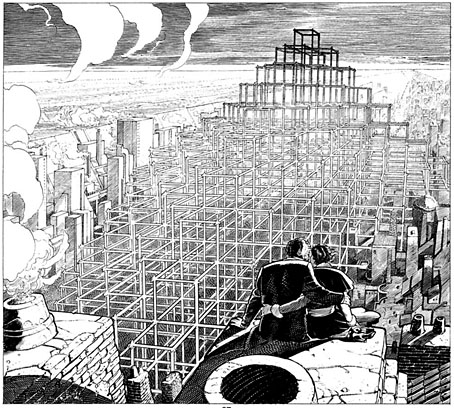
The mysterious para-dimensional cube and its effects on the divided city of Urbicande have been described here already. Fever in Urbicande is my favourite of the core stories by Schuiten and Peeters, and it seems to be one of the more popular of Schuiten’s creations to judge by the lamp and some of the spin-off works that follow.

urbicande4.jpg

Fever in Urbicand: Several months later, and the cube has burgeoned into a city-spanning “Network”.

Continue reading “Urbatecture”

Cabaret des Truands

truands1.jpg

Up until 1950 Montmartre retained an aura of evil for provincials and foreign visitors, and did its best to satisfy them with a tawdry kind of satanism. The most famous of these places, in the Boulevard de Clichy, was called L’Enfer.

Philippe Jullian, Montmartre (1977)

L’Enfer is still the most famous of these vanished Parisian establishments thanks to photos by Eugène Atget and others of its hell-mouth entrance. Among the other novelty cabarets on the Boulevard de Clichy there was Le Ciel (Heaven) next door to L’Enfer, and the death-themed Cabaret du Néant (Cabaret of Nothingness, or Limbo as Jullian has it). The exterior of the latter was suitably funereal but otherwise mundane, although once inside you were in crypt-like surroundings.

truands2.jpg

Another cabaret with a striking exterior that I hadn’t come across before was at no. 100 Boulevard de Clichy. The Cabaret des Truands (Cabaret of Truants) had a generally medieval interior with staff dressed like serving wenches and troubadours, but the exterior could almost be that of a fairground haunted house, replete with spider webs and plaster grotesques. Descriptions in English are unclear but the spiders seem to relate to a shared establishment, L’Araignée. It’s surprising to think of all these extravagant façades standing in a single (long) street in the heart of Paris, but then Montmartre in the late 19th century was the wild nighttown. Searching for photos of the Cabaret des Truands reveals an exterior changing by degrees with the passing years.

truands3.jpg

Previously on { feuilleton }
Infernal entrances

Weekend links 281

fini.jpg

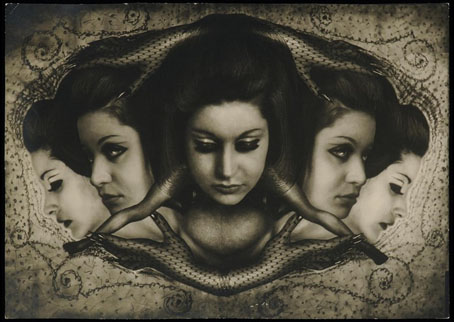
Chimère du soir (1961) by Leonor Fini. Réalisme irréel is an exhibition of Fini’s work currently running at the Weinstein Gallery, San Francisco.

• ” ‘Paris invented the flâneur,’ he notes, ‘and continues to press all leisurely and attentive walkers into exercising that pursuit, which is an active and engaged form of interaction with the city, one that sharpens concentration and enlarges imaginative empathy and overrides mere tourism.’ ” David L. Ulin reviewing The Other Paris by Luc Sante.

• “A lot of posters promise so much that how can they ever deliver?” Nicolas Winding Refn talking to Mat Colegate about his book, The Act Of Seeing, a collection of posters for exploitation films.

• “Sexuality is present throughout and often subverts a narrative we might read entirely differently from a straight poet.” Callum James reviews Physical by Andrew McMillan.

This movie will lose a lot of people along the way, but then again, as far back as 1962, Ballard wrote a manifesto for a new form of science fiction, Which Way to Inner Space?, in which he insisted that “from now on, most of the hard work will fall, not on the writer, but on the readers. The onus is on them to accept a more oblique narrative style, understated themes, private symbols and vocabularies.” This is exactly what Wheatley wants from his audience.

Mike Holliday comparing Ben Wheatley’s forthcoming film of High-Rise with JG Ballard’s novel. Ballard’s suggestion for a new SF now seems increasingly like a road not taken. But that’s another discussion entirely…

The Lost Library of John Dee, an exhibition of books owned by the Elizabethan magus, opens at the Royal College of Physicians museum, London, in January.

Clive Hicks-Jenkins has been writing about his illustration heroes including Alexander Alexeieff.

Cameron: Cinderella of the Wastelands. The exhibition has just finished but the art is still online.

• Mixes of the week: FACT Mix 518 by Fis, and Secret Thirteen Mix 165 by Damien Dubrovnik.

• At Dirge Magazine: Tenebrous Kate on Fantômas, the French King of Crime.

• Suitably seasonal: Polish Night Music by David Lynch & Marek Zebrowski.

Kickin’ In, a previously unreleased EP of music by Patrick Cowley.

Jean-Michel Jarre‘s favourite albums.

Seeing It As You Really Are (1970) by Hawkwind | Seeing Out The Angel (1981) by Simple Minds | Seeing Red (1998) by Red Snapper

Weekend links 279

ray.jpg

Untitled painting by Jen Ray.

• Lots of architecture links this week so it’s fitting that one of them is director Ben Wheatley talking to David Fear about his forthcoming film of JG Ballard’s High-Rise: “I was just thinking about this the other day, how hard it was to get a hold of stuff before the Internet. You really had to hunt down stuff or have someone who knew what was up to say, ‘You gotta read Naked Lunch, mate. You gotta read Crash.’ […] They were secretive things you had to ferret out, those books. It was the same with music and certain movies. And drugs.” Related: Souvenir d’un Futur, photographs by Laurent Kronental of the high-rise banlieues of Paris.

• “In Ancient Egypt, if a lowly official received the glyph of an owl from the Pharaoh, it was understood that the recipient should take his own life.” Carey McHugh in a brief history of the owl.

• I’d always thought the red buildings seen briefly in Blow-Up (1966) had been painted to Antonioni’s orders. Not so, says Another Nickel In The Machine.

He belongs right up there with Poe and Kafka. The best writer of weird fiction in the past half century. And the reason he belongs there is Ligotti’s both visceral and intellectual, formally experimental and able to tell a traditional horror story with equal ease. He’s also modernized the weird tale, from his early work on. The later workplace stories complete that process. The other thing he brings is a very dark sense of humor and a sense of the absurdity of the world—and a critique of that world that serves as subtext. All of these elements in harmony—symbiosis and contamination—equal genius. I read his work in a continuum that includes Kafka, Poe, Angela Carter, Bruno Schulz, Rikki Ducornet, and the great Caitlin R. Kiernan, but also absurdists and realists and flat-out surrealists. I appreciate that Ligotti stories can be revisited and reveal new dimensions.

Jeff VanderMeer on Thomas Ligotti

David Ferry talks to the people trying to excavate the remains of sets from Cecil B. DeMille’s first film of The Ten Commandments.

• As part of the ongoing vinyl reissue deluge, Crammed Discs are releasing a 10-disc box of albums by the great Tuxedomoon.

• At Strange Flowers: I see for it is night, remembering Marie Cermínová, better known as Surrealist artist Toyen.

Blue Sun Chiming, an animated video by Elisa Ambrogio for the song of that name by Six Organs of Admittance.

• At BLDGBLOG: Occult Infrastructure and the “Funerary Teleportation Grid” of Greater London.

• Enigmatic music makers Watch Repair are now selling their works at Bandcamp.

• Video by Harald Albrigtsen of whales basking under the Northern Lights.

• The urban explorations of Russian photographer Ralph Mirebs.

• Mix of the week: Secret Thirteen Mix 164 by Discipula.

The lost rivers that lie beneath London

Egypt (1985) by Tuxedomoon | Whales Tails (1986) by Cocteau Twins | London’s Lost Rivers (1996) by Coil