Alexander Hammid

prague_castle.jpg

Two short films by Maya Deren’s husband are now available for viewing at Ubuweb. I’ve known about Hammid’s work for years but this is the first time I’ve seen any of it so these additions are very welcome. In a reversal of the usual state of affairs, the works of the wife overshadowed those of the husband even though they collaborated on Deren’s most famous film, Meshes of the Afternoon (which is also at Ubuweb).

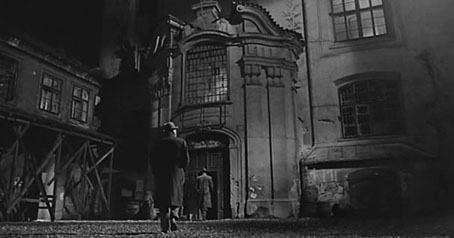
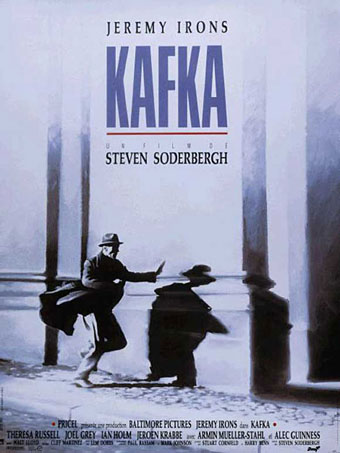
Of the pair of films, Na Prazskem Hrade (At Prague Castle) (1931) is the most interesting for this Prague fetishist, a disjointed study of the architecture of the city’s castle which turns the building into an expressionist collage. Two obvious associations arise while watching this; one is Franz Kafka who lived for a time in the castle’s Hradčany district at 22 Golden Lane and whose novel, The Castle (1926), is inspired by the dominating presence of the building. The other is the Nazi invasion which took place a few years after the film was made and caused its maker and his wife to flee to America. The Nazi high command controlled the country from Prague Castle so the brief glimpse of marching soldiers in one shot can be seen as an ominous presentiment of the future. The castle has featured in bigger budget productions more recently, including one of my cult films, Steven Soderbergh’s Kafka (1991), and the underrated The Illusionist (2006) where Prague masqueraded as turn-of-the-century Vienna.

Previously on { feuilleton }
Jan Švankmajer: The Complete Short Films
Meshes of the Afternoon by Maya Deren
How to disappear completely
Karel Plicka’s views of Prague
Giant mantis invades Prague
Barta’s Golem

Danger Diabolik

diabolik.jpg

More pulp madness as Mario Bava’s 1968 crime caper finally appears on DVD in the UK this week; a camp confection from an already very camp decade, although it pales beside the lurid excesses of Barbarella which was released in the same year. Both films were based on popular European comic strips, and both are connected by the presence of John Phillip Law, the sexiest (male) screen angel in Barbarella, and the star of Danger Diabolik. Barbarella’s adventures on page and screen managed to be equally frivolous whereas master thief Diabolik in the original fumetti (which is still running) was rather more serious, at least in serial adventure terms. Bava forgoes any attempt to treat his subject with a straight face, opting instead for the knowing action-comedy style that was popular during the Sixties, whether in post-Bond fare such as Our Man Flint or superior TV series like The Avengers.

diabolik1.jpg

Diabolik stands apart from his contemporaries, and from other campy comic spin-offs such as Adam West’s Batman, by being an anti-hero in a field over-stuffed with costumed vigilantes and sexist super-spies. Most characters of this type are descendants of deathless arch-criminal Fantômas, and Diabolik can perhaps be seen as a trendy updating of the Fantômas type, with his black leather bondage outfit and ultra-cool E-type Jaguar, probably the only car ever made in Britain that would impress style-conscious Italians. The comic strip was created in 1962 by two sisters, Angela and Luciana Giussani, a feat one imagines would be impossible in the male-dominated world of American comics at that time.

diabolik2.jpg

The fumetti Diabolik shuns firearms in favour of knife-throwing expertise, something that Bava ignores by giving him a mundane machine-gun. Bava had directed a very silly James Bond spoof, Doctor Goldfoot and the Girl Bombs, two years earlier, and always had a great eye for aesthetics even when lacking an adequate budget. His horror films frequently outdid Hammer for Gothic atmosphere, and his strange science fiction/horror, Planet of the Vampires (1965), features a cast similarly sheathed in shiny black spacesuits. The clouds of coloured fog those astronauts encounter reappear as the coloured smoke Diabolik uses to evade his pursuers, while his underground super-pad is one of the more spectacular villainous residences, like something Norman Foster might design for Dr. No. It certainly makes the Batcave look shabby, although, as with all these underground complexes, you can’t help wondering who the hell built them and how they managed to escape detection while doing so. The plot of the film, such as it is, is some forgettable nonsense concerning Diabolik’s cat-and-mouse game with his chief adversary, Inspector Ginko. Michel Piccoli plays the inspector, and it’s surprising seeing the splendid Terry-Thomas as a government official who Diabolik embarrasses with “exhilarating gas” at a press conference. The film is embellished with a tremendously groovy score by Ennio Morricone.

diabolik3.jpg

One of my favourite comic strip heroes when I was a kid was Billy the Cat in the Beano, the adventures of a super-agile boy in a black leather catsuit (no eyebrow-raising, please). I always had a fondness for these kind of characters, and I’m sure I would have loved Danger Diabolik for the cat burglary and the Sixties’ zaniness had I seen it on TV. My only gripe now is I can’t quite believe that Diabolik is all that interested in his female companion, Eva, despite the scene where they have sex on a revolving bed covered in dollar bills. If he’d rescued Alain Delon’s taciturn assassin from death at the end of Le Samouraï he could find Eva a nice young man in Monte Carlo, after which Jef Costello (as Delon is named in Melville’s film) could whack the pesky Inspector Ginko, and the pair could live together in subterranean peace, at least until the next heist. We can but dream.

A tip of the hat to Mark Pilkington for alerting me to this one. Bava’s Diabolikal influence lives on via Roman Coppola’s 2001 homage to Sixties’ camp, CQ, and the Beastie Boys’ video for Body Movin’.

Previously on { feuilleton }
Fantômas
The persistence of memory

The art of Agostino Arrivabene

arrivabene1.jpg

Lo psiconauta (2006).

arrivabene2.jpg

Capriccio con ruderi di città ideale (2003).

arrivabene3.jpg

Vanitas su zolla di viole (2006).

I’ve tagged this as “gay” since the first painting is featured in the controversial Arte E Omosessualita’. Da von Gloeden a Pierre et Gilles at the Palazzo della Ragione, Milan. That exhibition has caused as stir with Catholics who demanded that Paolo Schmidlin’s Miss Kitty, which shows the current Pope in drag, be removed.

Whatever Agostino Arrivabene‘s sexuality he’s no slouch with a paintbrush, and all the sections on his site are worth looking at. The “Paesaggi” section features some architectural caprices, there’s a section of vanitas works and a fair amount of artistic quotation; I spotted references to Piranesi, Boulée and George Minne, among others.

Elsewhere on { feuilleton }
The fantastic art archive

Previously on { feuilleton }
Vanitas paintings
Giant Skeleton and the Chocolate Jesus

Architectural renderings by HW Brewer

brewer1.jpg

Birds-eye view of Birmingham in 1886.

brewer3.jpg

Rome in 1890.

There’s little information online about HW Brewer, a Victorian illustrator who specialised in depictions of cities viewed from the air for magazines such as The Builder. He also imagined how cities might have looked in times past, as with these views of London in the sixteenth century. Always fascinating to see the lack of development south of the river in the days when there was only one bridge available for traffic over the Thames.

Update: bigger copy of the Birmingham picture here.

Elsewhere on { feuilleton }
The etching and engraving archive
The illustrators archive