The art of Ludwig von Hofmann, 1861–1945

dkd24-01.jpg

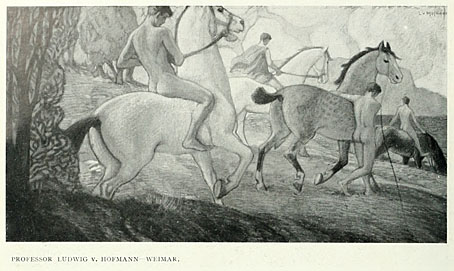
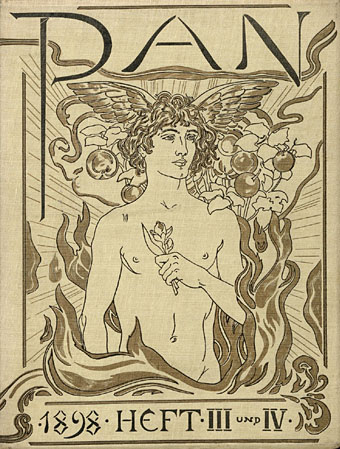
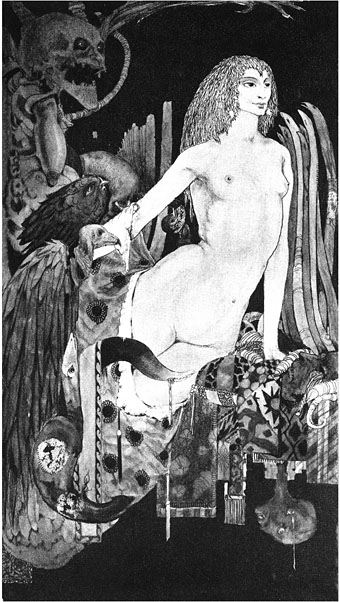
Ludwig von Hofmann was a German artist whose work has already appeared via the above example from Deutsche Kunst und Dekoration. Many of Hofmann’s drawings and paintings appeared in that magazine’s rival publication, Pan magazine, for which the artist also provided a cover design for the collected editions, and vignettes for the interiors.

hofmann01.jpg

Hofmann is also of note for those of us who search art history for potentially gay art or artists. A handful of his works turn up continually on forums where homoerotic artwork is posted even though I’ve yet to see any evidence that his desires ran in this direction. It’s true that many of Hofmann’s pictures focus exclusively on the naked male form, but it’s equally true that he painted and drew a large number of naked women. Males and females often appear together in Adam and Eve pictures, a theme which was so common in German art at this time it’s easy to assume that most artists were using the subject as the merest excuse to represent the unclothed figure.

hofmann02.jpg

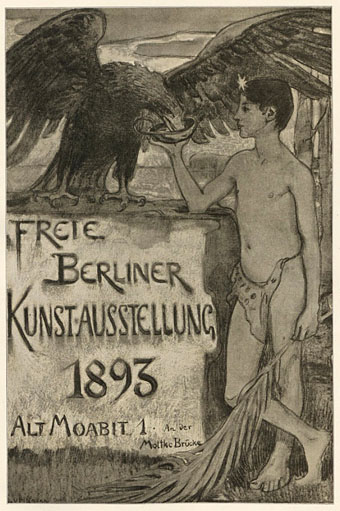
Ganymede poster design from Pan (1895).

Biographical details state that Hofmann married his cousin in 1899 although he still may have been  bisexual, of course. If I was making a case for a Uranian inclination in his art I’d point to his poster design on the Ganymede theme (a favourite among gay artists with its story of Zeus falling for a beautiful boy), his many drawings of bathing boys and naked riders on horseback (the latter seems an obsession), Thomas Mann’s admiration for his work, and at least one sketch of a boy from Capri, an island with a long history as a favourite holiday resort for the rich and famous homosexuals of Europe. Whatever the truth, many of Hofmann’s pictures remain homoerotic, intentionally or not, and a few further examples are posted here. I should note that two of the pictures have been cropped to focus on the male figures, and that many of them lack verifiable dates.

Continue reading “The art of Ludwig von Hofmann, 1861–1945”

Weekend links 70

swinburne1.jpg

Faustine (1928) by Harry Clarke.

• This week’s Harry Clarke fix: 50 Watts reposts the Faust illustrations while Golden Age Comic Book Stories has the illustrated Swinburne.

What Goes Steam in the Night is an evening with contributors to The Steampunk Bible hosted in London by The Last Tuesday Society on September 6th:

Co-author S. J. Chambers invites you to the official U.K. celebration of her book The Steampunk Bible (Abrams Image). Part lecture, part signing, and part entertainment, S. J. will be accompanied by contributors Jema Hewitt (author of Steampunk Emporium ) and Sydney Padua (Lovelace & Babbage) for a discussion of the movement, a special performance by Victorian monster hunter, Major Jack Union, and inevitable hi-jinks and shenanigans to later be announced.

• RIP Conrad Schnitzler, an incredibly prolific electronic musician, and founder member of Tangerine Dream and Kluster/Cluster.

Golden Pavilion Records reissues fully-licensed late 60’s and 70’s psychedelic, progressive, acid-folk & art-rock music.

Dressing the Air is “an exclusive consulting and online resource for the creative industries”.

Luke Haines explains how to cook rabbit stew whilst listening to Hawkwind.

Wood pyrography by Ernst Haeckel from his home, the Villa Medusa.
swinburne2.jpg

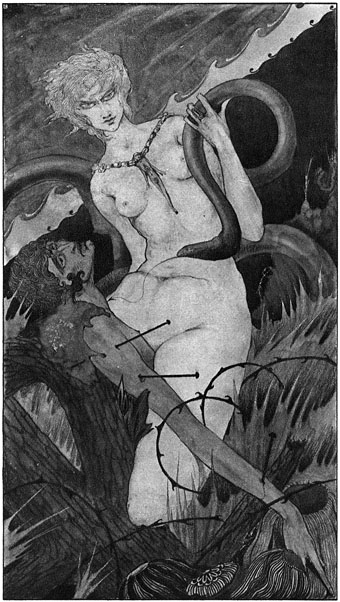
Satia Te Sanguine (1928) by Harry Clarke.

The truth is, the best novels will always defy category. Is Great Expectations a mystery or The Brothers Karamazov a whodunnit or The Scarlet Letter science fiction? Does Kafka’s Metamorphosis belong to the genre of fantasy? In reality men don’t turn into giant insects. And it’s funny. Does that mean it’s a comic novel? […] At a time when reading is in trouble, those readers left should define themselves less rigidly.

Howard Jacobson: The best fiction doesn’t need a label.

Pace the redoubtable Jacobson, Alan Jacobs believes We Can’t Teach Students to Love Reading.

How Ken Kesey’s LSD-fuelled bus trip created the psychedelic 60s.

Salvador Dalí creates something for Playboy magazine in 1973.

JG Ballard: Relics of a red-hot mind.

Electric Garden (1978) by Conrad Schnitzler | Auf Dem Schwarzen Kanal (1980) by Conrad Schnitzler.
The City of the Singing Flame

cas1.jpg

Wonder Stories, July 1931. Illustration by Frank R. Paul.

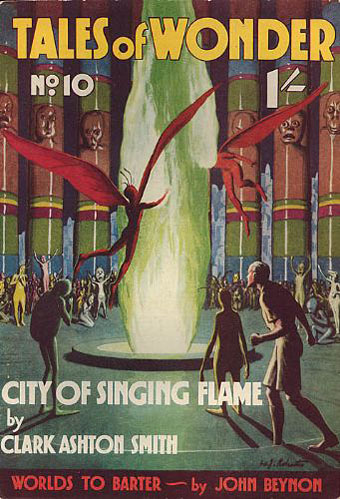
Looking over Bruce Pennington’s artwork this week sent me back to some of my Clark Ashton Smith paperbacks, many of which sport Pennington covers. One of my favourite Smith stories, The City of the Singing Flame, is also one of his finest pieces, and a story that Harlan Ellison has often referred to as his favourite work of imaginative fiction.

cas2.jpg

Tales of Wonder, Spring 1940. Illustration by WJ Roberts.

The story as it’s known today was originally a shorter piece, The City of the Singing Flame, followed by a sequel, Beyond the Singing Flame; both stories were published in Wonder Stories magazine in July and November of 1931, then as one in Arkham House’s CAS collection Out of Space and Time in 1942. The two-in-one story is now the definitive version.

Smith’s tale concerns the discovery of a dimensional portal somewhere in the Sierras. Beyond this there lies a path leading through an otherworldly landscape to a colossal city peopled by a race of mute giants. A temple at the heart of the city protects the prodigious green flame of the title, an eerie and alluring presence whose siren call draws creatures from adjacent worlds who prostrate themselves before the flame before immolating themselves in its fire. A narrator, Philip Hastane, give us details of diary entries from a friend who discovered the portal, and who subsequently has to decide whether to resist the lure of the mysterious flame or follow the other creatures into the fire. More than this would be unfair to divulge if you’ve never read Smith’s remarkable piece of fiction.

Continue reading “The City of the Singing Flame”