Magritte’s Maldoror

maldoror2.jpg

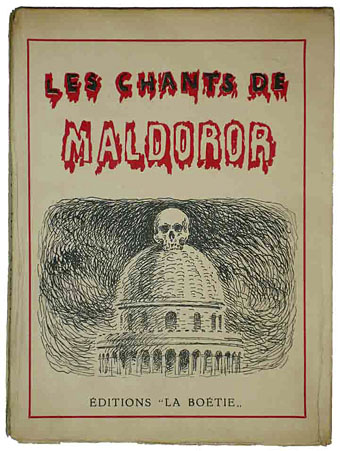
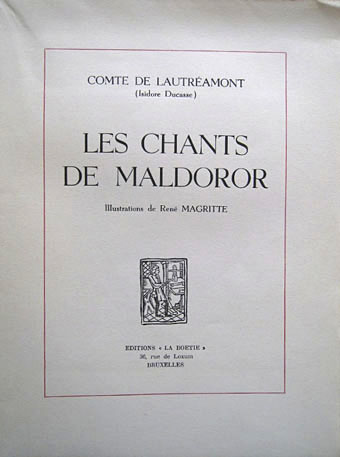
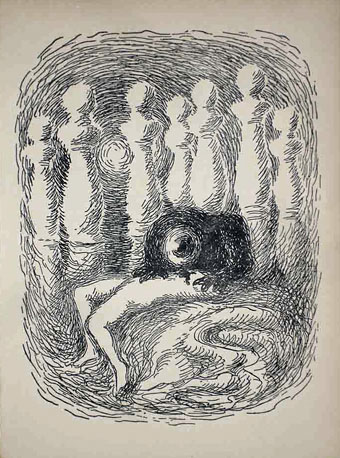
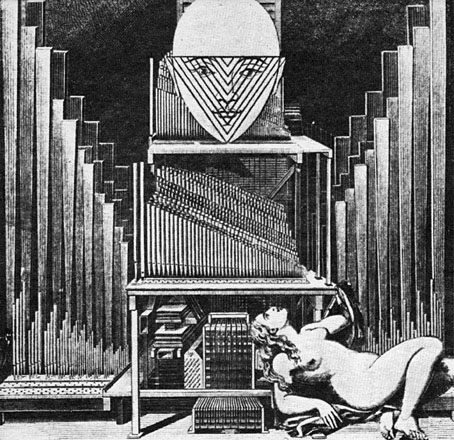
Seen briefly in yesterday’s film about René Magritte were some of the artist’s 77 illustrations created for a 1948 edition of Lautréamont’s Les Chants de Maldoror published by Éditions “La Boetie”, Brussels. The examples here are from various auction sites, and they can’t be counted among Magritte’s best work which probably explains why they’re not reproduced very often. Salvador Dalí’s set of engravings for a 1934 edition were appended last year to a new English translation by RJ Dent for Solar Books. And from French publisher La Baconniere there’s this recent edition with a set of fresh illustrations by TagliaMani (also here).

maldoror4.jpg

maldoror1.jpg

Continue reading “Magritte’s Maldoror”

René Magritte by David Wheatley

magritte1.jpg

René Magritte as portrayed by Patrick McDonnell.

René Magritte died in 1967, the year Eric Duvivier’s La femme 100 têtes appeared in French cinemas. Magritte is even less visible cinematically than Max Ernst, IMDB lists a couple of documentaries and nothing else. There are trace elements elsewhere, notably the Magritte and de Chirico influence in Bertolucci’s Borges’ adaptation The Spider’s Stratagem (1970), but the artist’s arresting visual imagination has always found more of a welcome on book covers than cinema screens.

magritte2.jpg

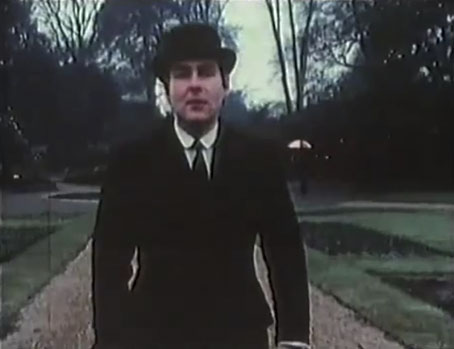
One exception is David Wheatley’s drama documentary René Magritte (1976), yet another work you won’t find listed at IMDB. This was Wheatley’s graduation film which the BBC screened in a 30-minute version (shorn of some apparently clunky dialogue scenes) in 1979, and which secured for Wheatley a place as a regular director for the BBC’s Omnibus and Arena arts programmes. I saw the 1979 broadcast, and caught it again a decade later when one of the channels was having a season of Magritte-related programming, something that’s impossible to imagine in today’s debased television landscape.

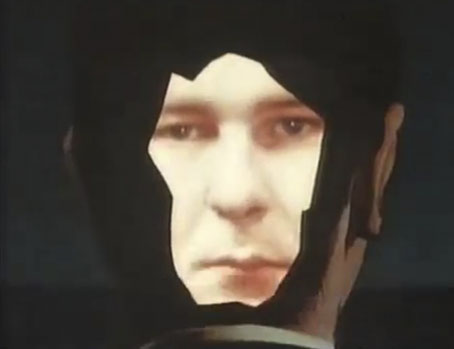
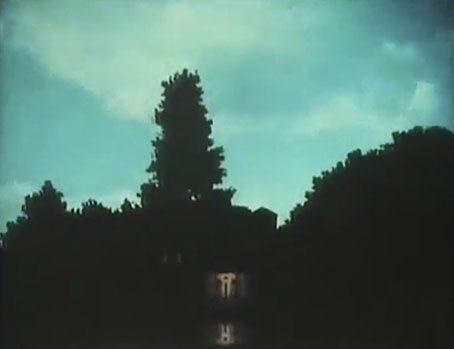
For a student film it’s a stunning piece of work, taking a similar approach to Eric Duvivier in bringing to life many of the artist’s more famous pictures: a window shatters to reveal the scene behind it painted on its panes, a mountain hovers ponderously over the sea, a dove made of clouds flies across a stormy sky. Between the artworks there are short biographical scenes. There’s a sole version of the film on YouTube that remains watchable despite being a low-quality recording from video tape that’s also hacked into three parts and subtitled in Danish.

magritte3.jpg

Looking for more information about David Wheatley it was dismaying to find he’d died in 2009, aged 59. Leslie Megahey—a cult TV director of mine—wrote an obituary for the Guardian where he describes some of Wheatley’s other productions including the Arena film Borges and I (1983)—as far as I’m aware the only British TV documentary about Jorge Luis Borges—and Wheatley’s first feature film, an adaptation of Angela Carter’s The Magic Toyshop (1987). I recall enjoying the latter, produced at a time when the success of The Company of Wolves (1984) made it seem there might also be a place in the cinema for Angela Carter’s imagination; we know how that worked out. The Magic Toyshop doesn’t seem to have had a DVD release so good luck to anyone searching for it. As for René Magritte, if anyone runs across a better online copy be sure to leave a comment.

Previously on { feuilleton }
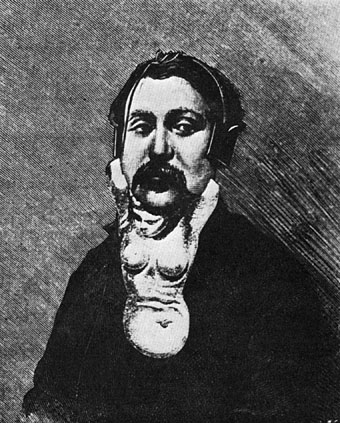
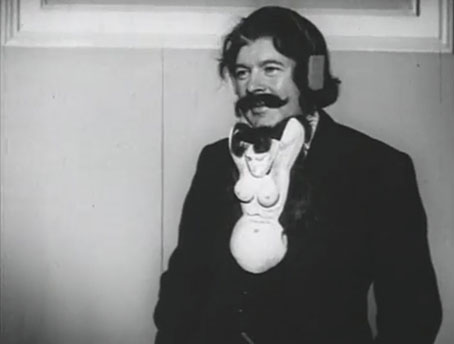
The Public Voice by Lejf Marcussen

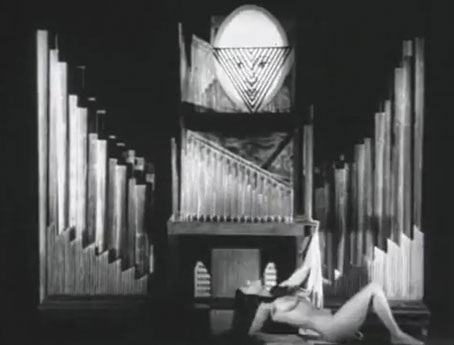
La femme 100 têtes by Eric Duvivier

femme1.jpg

La femme 100 têtes: L’immaculée conception (1929).

Salvador Dalí never lacked for attention from filmmakers, as has been noted here on several occasions. Max Ernst, on the other hand, received far less attention despite being an actor and collaborator in two of the most significant Surrealist films, L’Age D’Or (1930) and Dreams That Money Can Buy (1947).

femme2.jpg

La femme 100 têtes: Alors je vous présenterai l’oncle (1929).

One of the key works in the Ernst filmography is La femme 100 têtes, a 19-minute film from 1967 based on the series of collages Ernst created under that title in 1929, precursors to his collage masterwork Une semaine de bonté (1934). Eric Duvivier was the director, nephew of the celebrated French director Julien Duvivier, and a director of many educational films, none of which seem to be listed on IMDB. Duvivier’s film may be short but he had the resources to go to some extraordinary lengths in replicating cinematically so many of Ernst’s collages. Some of the scenes merely require a room or a street, in others bizarre or elaborate sets have had to be built then populated with actors for shots that last less than half a minute.

femme3.jpg

La femme 100 têtes (1967).

Why go to all this effort in 1967? The clue is in the name and logo of the producer—Sandoz—the pharmaceutical company that invented and manufactured LSD. Sandoz had a film division which they used to create promotional films for their products. Among the ones related to LSD are Images du monde visionnaire (1964), directed by Henri Michaux and Eric Duvivier, and (possibly) La femme 100 têtes. I say “possibly” only because I haven’t seen this confirmed but why else would a pharmaceutical company that just happened to make the world’s most famous hallucinogenic drug make a Surrealist film? Whatever the reason it’s a remarkable piece of work. See it on YouTube here.

femme4.jpg

La femme 100 têtes (1967).

Previously on { feuilleton }
Scenes from a carriage
Surrealist echoes
Max (The Birdman) Ernst
The Robing of the Birds

Weekend links 91

santosh.jpg

Untitled (1978) by GR Santosh at 50 Watts.

Evertype Publishing produces a range of Lewis Carroll special editions including Ailice’s Àventurs in Wunnerland (a translation in Scots), Alicia in Terra Mirabili (a Latin version), and an edition printed in the Nyctographic Square Alphabet devised by Carroll.

• This week’s bookshop animations: Type Books, Toronto presents The Joy of Books while at Shakespeare and Company, Paris, Spike Jonze and Simon Cahn explore the erotic life of book covers in Mourir Auprès de Toi.

• Invisible Girls and Phantom Ladies, a 1982 article on sexism in (US superhero) comics by Alan Moore. Thirty years on, things haven’t improved much at all.

I reread it now, 35 years later, and I am struck by its capacity to change like a magic mirror. Where I had originally seen it as a book about writing, about becoming a writer, I now see it as a book about reading, about taking one’s place in the chain. Where I once assumed it was a book about eternal youth, I now see it as a book about growing up, about learning to live.

Tilda Swinton on Virginia Woolf’s Orlando

Dark Water, Lovecraftian carpet designs (yes, carpets) by Kirill Rozhkov. Danish carpet manufacturer Ege has a catalogue showing the finished products.

Neil Gaiman ventures into the treacherous labyrinth of M. John Harrison’s Viriconium.

Nicholas Lezard reviews The White People and Other Weird Stories by Arthur Machen.
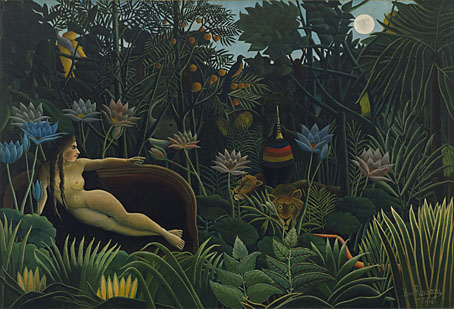
rousseau.jpg

The Dream (1910) by Henri Rousseau at the Google Art Project.

• Reassessing the Saul Bass and Alfred Hitchcock Collaboration by Pat Kirkham.

• Getting There Too Quickly: Peter Bebergal on Aldous Huxley and Mescaline.

Hidden in the Open: A Photographic Essay of Afro-American Male Couples.

Filles En Aiguilles, a new musical work by Schütze+Hopkins.

RubiCANE’s Erotic Illustrations.

Laurie Anderson has a Godplex.

Alan Bennett on Smut.

The Jungle Line (1975) by Joni Mitchell | The Jungle Line (1981) by Low Noise (Kevin Armstrong, Thomas Dolby, JJ Johnson & Matthew Seligman) | The Jungle Line (2007) by Herbie Hancock with Leonard Cohen.