Be prepared

sherer2.jpg

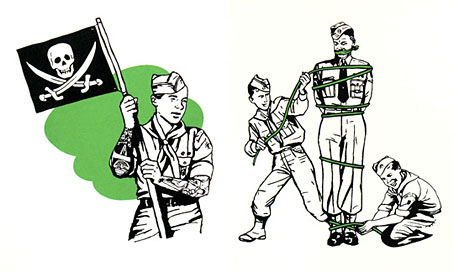
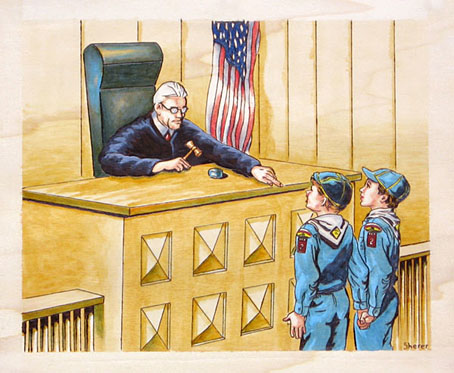
Sodomites (no date) by Robert Sherer.

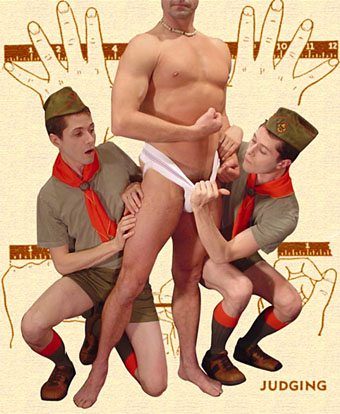
The Boy Scouts of America yet again proved itself a retrograde organisation by deciding this week after a two-year review to maintain its policy of exclusion for gay scouts and gay scout leaders. The Girl Scouts of America don’t have this kind of policy, nor do UK Scouting organisations. In honour, then, of the Boy Scouts of America’s decision here’s some work by a trio of North American artists all of whom have used scouting iconography for subversive or satirical purposes. Robert Sherer and Jason Driskill are both American while Daryl Vocat is Canadian. Vocat’s portfolio of prints is particularly funny, showing scouts tattooing each other and making bombs; William Burroughs would love it. Poor old Chuck Norris, meanwhile, would no doubt collapse with a fit of the vapours at the sight of Sherer’s scouts holding hands.

vocat.jpg

Prints from A Boy’s Will (no date) by Daryl Vocat.

driskill.jpg

Judging (2004) by Jason Driskill.

Elsewhere on { feuilleton }
The gay artists archive

The Royal Natural History by Richard Lydekker

nathist01.jpg

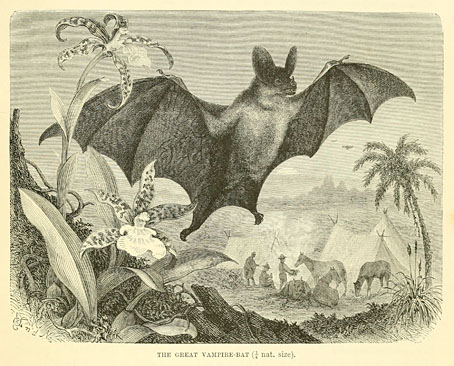
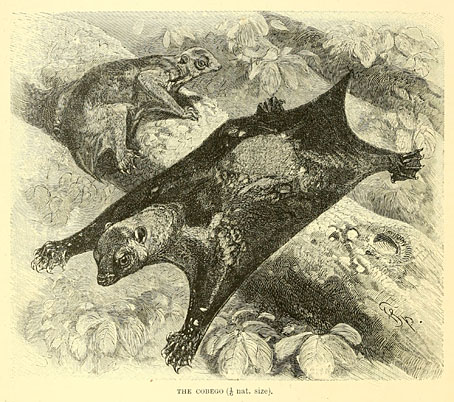
The second surprise of the weekend came, as in the best Lovecraftian tradition, with the chance discovery of a small sheet of paper, a reminder from the librarian when I was at sixth form college to return three overdue books. This was an odd survival from my schooldays since I kept hardly anything from that period. One of the books was this volume, The Royal Natural History (1894), vol. 1, sec. 2, written by Richard Lydekker with engraved illustrations by a variety of artists. I said goodbye to higher education when I quit sixth form after a year; the interval there was miserable but the place did have a very good library in which I spent a lot of time reading instead of attending classes. Many of the books there were better than those in the town library—my first sight of James Joyce’s Ulysses was on those shelves—and included a small number of older titles which were in surprisingly good condition for school books.

nathist02.jpg

What’s nice about tracing this book is finding the title of one of those volumes whose engravings I found so fascinating and whose identity I’ve wondered about for years. The pictures are all excellent renderings, far better than the illustrations in a set of similar books I own which are forty years older and where the animals tend to be goggle-eyed comical things. Although this was the one I borrowed I suspect the library may have had more in Lydekker’s series since I recall one depicting fish and other marine creatures. The copies here are from the Internet Archive, of course, where they have a complete set that I’ve yet to look through. (There are twelve books in the set.) I wondered at first why I’d borrowed a book about the larger mammals until I saw the picture of a lynx below which I remember using as reference for a drawing. The Lydekker and the purchase a year later of Wilfried Sätty’s illustrated Edgar Allan Poe is where my engraving obsession really took off.

nathist03.jpg

Continue reading “The Royal Natural History by Richard Lydekker”

Haçienda ephemera

hac01.jpg

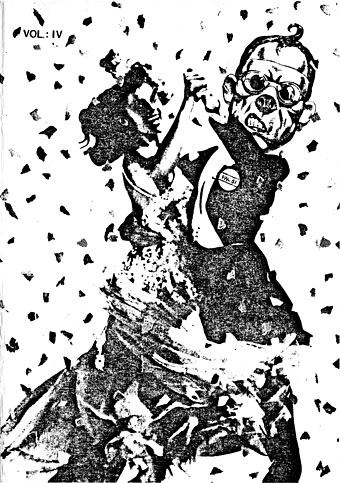
Haçienda Members’ Newsletter IV, 1982. (The head collaged onto the male figure is from RanXerox by Tanino Liberatore.)

Searching through some papers at the weekend turned up something I’d completely forgotten about: a members’ newsletter for Manchester’s Haçienda club. When the place first opened you needed to be a member to get in, unless you already knew a member in which case you could be signed in as a guest. One reason the place was so empty in its first couple of years was the restricted access, a policy they later dropped.

haccard.jpg

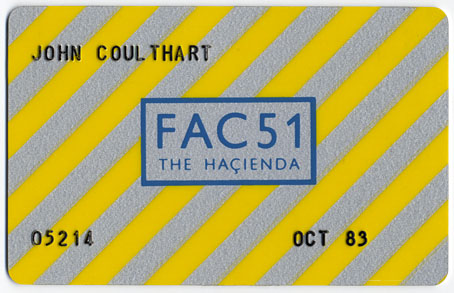
I paid for my membership in September 1982 since I was eager to see William Burroughs appearing in the Final Academy event on October 4th. I think the newsletter must have arrived with the nice Peter Saville-designed card. If there were any other newsletters after this I never received any but then I was never a conscientious club-goer and only went there if there was a decent band playing.

hacflyer.jpg

And speaking of decent bands, I also found this flyer, the only one I have from that period. Einstürzende Neubauten played the Haçienda twice, in August 1983 and February 1985, and I saw them on both occasions. The flyer is for the second event and is a lot more typical of Haçienda products than the fanzine-style newsletter. Neubauten’s first appearance there was sparsely attended but remains one of the best events I’ve witnessed. This was at the tail end of their metal-bashing period, and the performance that night involved a lot of hammering, flames, showers of sparks and broken glass flying into the audience. The climax came when one of them picked up the pneumatic road-drill they used for their noise-making and drilled straight into the concrete wall at the side of the stage. The machine was left hanging there to the consternation of the club staff. A few months later they staged their notorious performance at the ICA in London which was cut short when they started dismantling the stage. The second Haçienda gig drew a larger crowd but was a more subdued affair which would have disappointed those who were yelling for destruction between the songs.

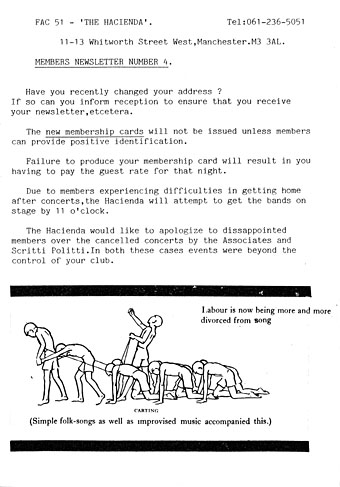
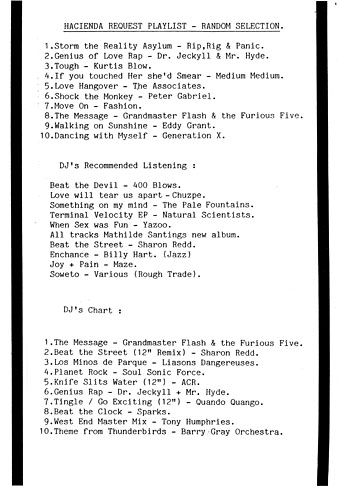
The Haçienda is demolished now so that drilling incident may be seen as a precursor of the inevitable. But the history persists in exhibitions like the recent one at the V&A in London which recreated some of the decor. The typewritten and photocopied members’ newsletter shows a more humble origin than the usual “design classic” label that gets endlessly recycled. Further page scans follow, or you can download a PDF I made. The last two scans in this post are a sheet of guest passes for members to fill, and that ultimate low-tech item: a handwritten and photocopied events list for late 1982. I don’t remember Jah Wobble playing the day after the Burroughs event; I would have liked to have seen that one as well.

hac02.jpg

hac03.jpg

Continue reading “Haçienda ephemera”

Weekend links 117

lux1.jpg

Illustration and design by Karlheinz Dobsky.

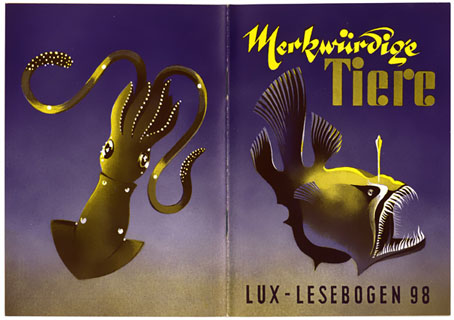
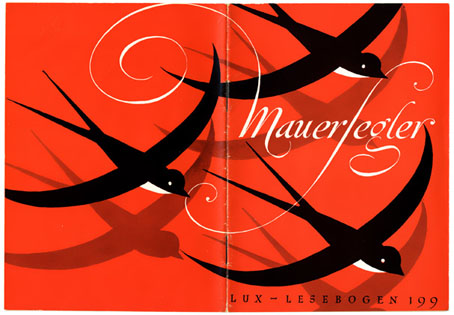
Above and below: samples from Die Lux-Lesebogen-Sammlung, an exhibition of booklets for young people published by Sebastian Lux from 1946–1964. All were designed and illustrated by Karlheinz Dobsky.

• At The American Scholar: “Vladimir Nabokov’s understanding of human nature anticipated the advances in psychology since his day,” says Nabokov biographer Brian Boyd, and An Unquenchable Gaiety of Mind: “On visits to Cambridge University late in life, Jorge Luis Borges offered revealing last thoughts about his reading and writing,” says George Watson.

• The British Library releases The Spoken Word: “A rare collection of recordings featuring the American writer William S Burroughs and the British-born artist Brion Gysin.” Related: Interzone – A William Burroughs Mix by Timewriter.

• Charting the Outlaws: Christopher Bram (again) talking to Frank Pizzoli about his recent study Eminent Outlaws: The Gay Writers Who Changed America.

• The BBC asks “Where are you on the global fat scale?” I’ve always been thin but was still surprised to find my BMI at the very bottom of the scale.

The “otherness” of Ballard, his mesmeric glazedness, is always attributed to the two years he spent in a Japanese internment camp in Shanghai (1943–45). That experience, I think, should be seen in combination, or in synergy, with the two years he spent dissecting cadavers as a medical student in Cambridge (1949–51). Again the dichotomy: as a man he was ebulliently social (and humorous), but as an artist he is fiercely solitary (and humourless). The outcome, in any event, is a genius for the perverse and the obsessional, realised in a prose style of hypnotically varied vowel sounds (its diction enriched by a wide range of technical vocabularies). In the end, the tensile strength of The Drowned World derives not from its action but from its poetry.

Martin Amis on The Drowned World by JG Ballard.

The Chickens and the Bulls: “The rise and incredible fall of a vicious extortion ring that preyed on prominent gay men in the 1960s.”

• It’s that Zone again: Jacob Mikanowski on Andrei Tarkovsky’s Stalker and Geoff Dyer’s Zona.

• Scans of the rare film programme for London screenings of Fritz Lang’s Metropolis.
lux2.jpg

Illustration and design by Karlheinz Dobsky.

• “The web is a Library of Babel that could go the way of the Library of Alexandria.

Fila Arcana: alchemy- and occult-themed embroidery by Mina Sewell Mancuso.

A Very Edgy Alice In A Very Weird Wonderland: illustrations by Pat Andrea.

Malka Spigel reveals a new track from her third solo album.

John Martin and the Theatre of Subversion.

Olafur Eliasson: Little Sun at Tate Modern.

• Meanwhile, back in 1972: Mahavishnu Orchestra live at the BBC (30 mins), and the complete performance of the MC5 on Beat Club (29 mins).
Zeppelinology

zeppelin1.jpg

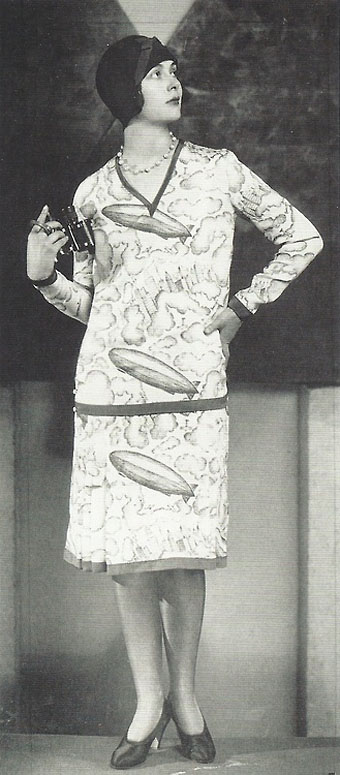
Robe dans le style Zeppelin, Berlin, vers 1930.

So after you’ve donned your very best Zeppelin dress (and grabbed a pair of binoculars)…

zeppelin2.jpg

…you can head on over to the Zep Diner for lunch.

zeppelin3.jpg

Try some of the Zeppelin Bread: it’s light as air!

zeppelin4.jpg

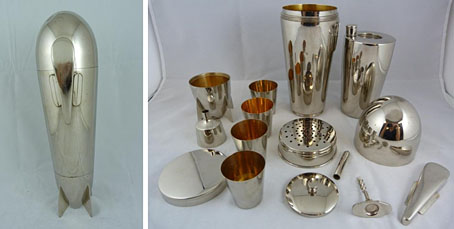
Afterwards (if it’s not too early) you can relax with a martini prepared in a Hindenburg shaker

zeppelin5.jpg

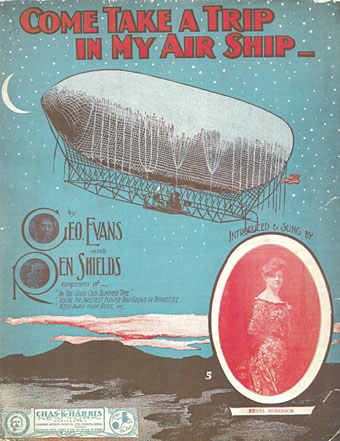
…whilst listening to Billy Murray singing a song about his (male) sweetheart, Come Take A Trip In My Airship, and browsing colour photographs of the Hindenberg interior.

(Thanks to Thom for starting the ball rolling with his new Paris/Berlin tumblr!)

Previously on { feuilleton }
Vickers Airship Catalogue
The Air Ship
Dirigibles
The Airship Destroyer
Zeppelin vs. Pterodactyls