Zimbu Xolotl Time

wb1.jpg

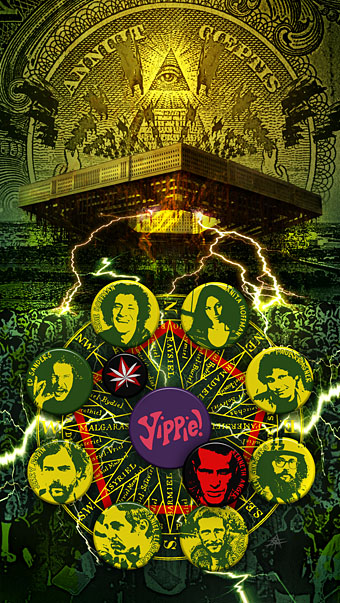
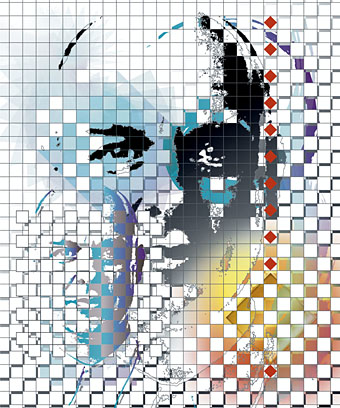
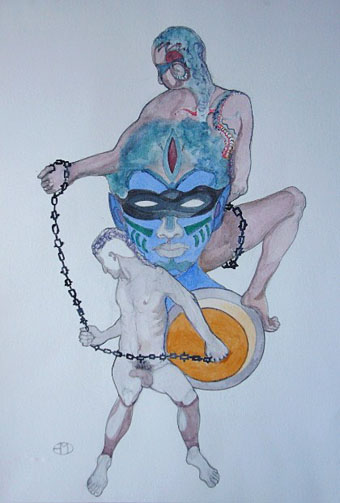
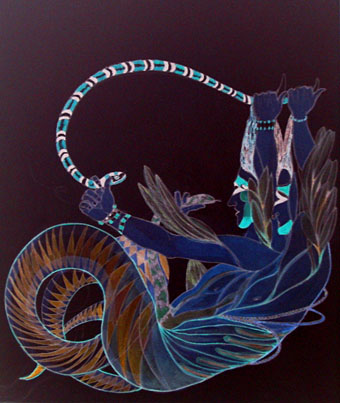
Or The Wild Boys revisited. These are two of Emma Doeve’s Wild Boys paintings from the Academy 23 book which was published in October by WhollyBooks to coincide with the recent London event remembering and celebrating The Final Academy, a William Burroughs-themed series of events held in London and Manchester in 1982. I’ve mentioned before that the book contains an edited version of my post about the event at Manchester’s Haçienda club. The book is now sold out but I expect some copies will find their way into the secondhand market eventually. Had Emma’s pictures been around a year ago I would have included them in my post about The Wild Boys and the various music and art inspired by Burroughs’s novel. They’re also a reminder that I ought to finish my own Wild Boys portfolio which has languished this year while I’ve been engaged with other things, not least finishing the Reverbstorm book. Something for the future, then. As for Zimbu Xolotl Time, Phil Hine can explain.
wb2.jpg

Elsewhere on { feuilleton }
The William Burroughs archive

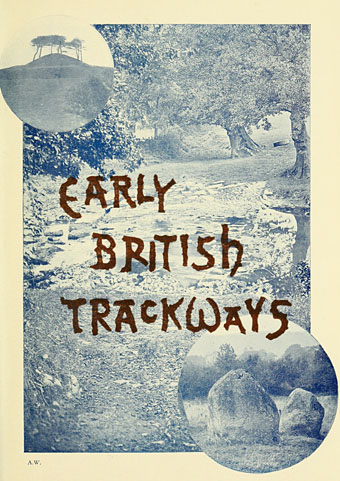
Early British Trackways

watkins01.jpg

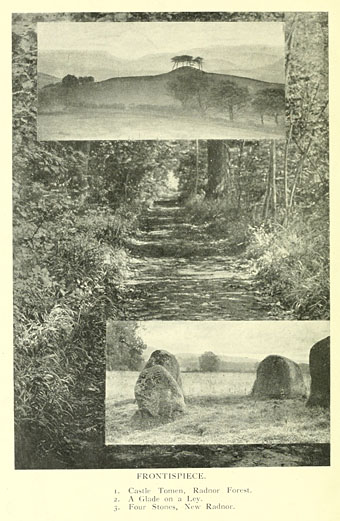
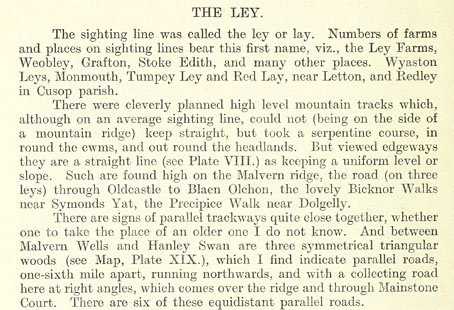
Continuing the Earth mysteries/megaliths theme, Early British Trackways: Moats, Mounds, Camps, and Sites (1922) by Alfred Watkins (1855–1935) was the first book in which the ley lines theory was proposed. Watkins was an amateur archaeologist (more a kind of early psychogeographer), photographer and writer who theorised that ancient Britons had marked the land with pathways connected by a variety of natural and man-made features: hills, mounds, trees, ponds, hillside notches and (of course) standing stones. Watkins coined the term “ley” after noticing that many of the lines connecting these features ran through villages or areas of land whose names ended in “-ley”, “-lay” or similar. The thesis was developed more fully in The Old Straight Track (1925), a book which became the ur-text for subsequent ley hunters. I’ve never seen any of Watkins’ books so it was interesting finding this short volume at the Internet Archive, not least because several of the photos appear in Mysterious Britain (1972) by Janet & Colin Bord, a classic guide to Britain’s sacred sites and folk rituals.

watkins02.jpg

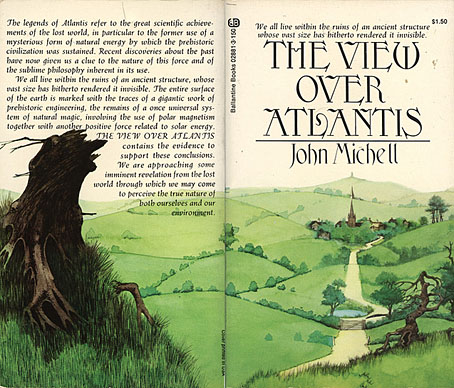
Watkins never regarded ley lines as having any mystic significance, he thought they were probably old trade routes. Archaeologists have never agreed with his suppositions, however, and Watkins himself might have disapproved of the conjectures added to his theories by John Michell in The View Over Atlantis (1969) which wedded ley line theory to feng shui to create the whole “lines of energy” idea. Whatever one thinks of Michell’s theories, that book and subsequent volumes put ley lines firmly into popular culture, and without them we wouldn’t have the references in Children of the Stones, Steve Hillage’s Green (1978) (pretty much a Michell-inspired concept album), Nigel Kneale’s Quatermass (1979) and so on. But this slim book is where it all begins.

tvoa.jpg

Illustration by Roger Dean (1972).

watkins03.jpg

Continue reading “Early British Trackways”

Milbury souvenirs

milbury.jpg

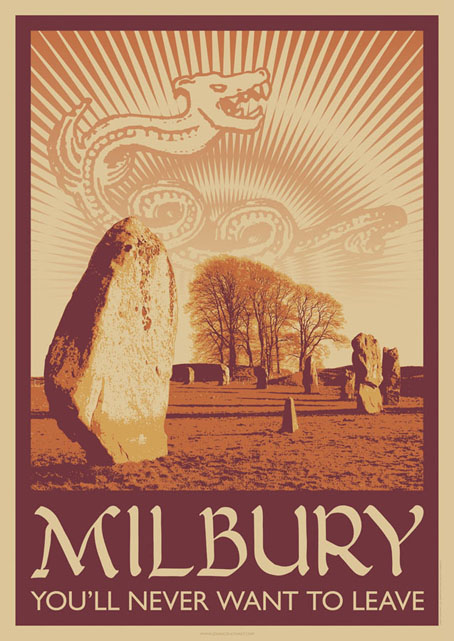
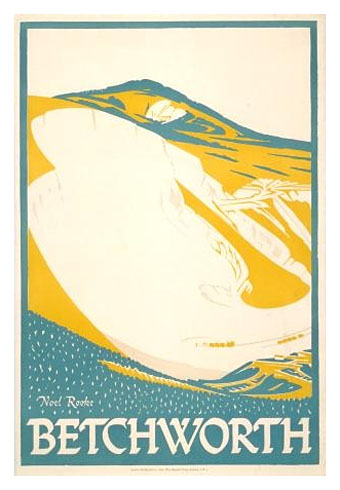
A little something I ran up this weekend inspired by a certain TV serial which has been the subject of discussion recently. This is now a new design at CafePress. The idea was to do a travel poster in the style of those produced by London Transport in the 1920s promoting their destinations outside the city. I’ve always liked the colours and bold design of those prints so this piece is based on posters by artist Noel Rooke (1881–1953).

rooke.jpg

Betchworth by Noel Rooke.

The picture of the stones was adapted from a photo by Jim Champion which is made available under the Creative Commons licence. I took the liberty of enlarging the stone on the left to give it more presence. I couldn’t find a font that was a good match for Noel Rooke’s pen lettering so I scanned an alphabet from a lettering book my mother used to use when she was at art school (thanks, Mum!). The snake design is based on a postcard seen in the TV serial; nothing else looked as effective, and the combination of the snake with the slogan adds the requisite sinister touch.

Previously on { feuilleton }
A Journey to Avebury by Derek Jarman
Children of the Stones
Avebury panoramas

Weekend links 135

kuhlman.jpg

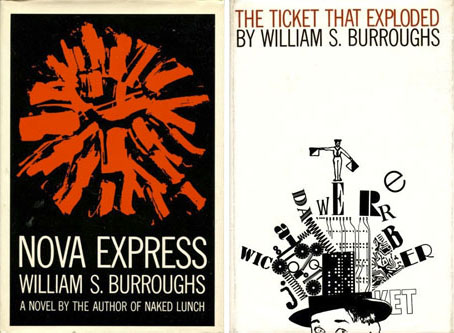
Two Grove Press covers by Roy Kuhlman. From Arden Kuhlman Riordan’s Pinterest page collecting her father’s cover designs.

• “When people asked me what boylesque was, I’d say I’m doing burlesque and I have a penis,” said Mr. Ferguson.

Sequence5: 42 tracks of new, atmospheric/ambient music. A free download in a variety of formats.

The trailer for Jimmy’s End, the forthcoming film by Alan Moore and Mitch Jenkins.

As a porn performer, I can say from experience and with confidence that I’ve never been objectified by other performers. Nor have I been objectified by viewers. At least not in a way that seemed to confuse them into thinking I was an object. What happens instead is that I shift in and out of object-hood. Athletes do this too—they engage with their bodies for a specific task. At the end of the game or the shoot, the context changes.

Conner Habib on The Virtues of Being an Object

Secret Weapons (1972), David Cronenberg’s lost TV movie resurfaces.

Joseph Burnett reviews Nude, the new album by The Irrepressibles.

Over a third of e-readers are used just once before being set aside.

The guarded, the cautious, the small-scale, the modest, the well-crafted—such books may be rewarded (in our own time, at the national level), but they are rarely preserved. They are not preserved because guardedness, caution, smallness, modesty, and craft can be replaced in any given generation. What is irreplaceable is excess: Of verbal kinesis, religious intensity, intellectual voracity.

Amit Majmudar on Entertainment and Excess: The Great Literary Audiences

Miniature Book Interviews with Louis Wain Bound by Hand.

A Tour Inside Salvador Dalí’s Labyrinthine Spanish Home.

• Horror fiction should be deep, not cheap, says Nina Allan.

• RIP Peter Kuhlmann aka Pete Namlook

More is More by Alex Trochut

The Useless Web

Lost In The Sea (1992) by Sequential (Pete Namlook & DJ Criss) | Angel Tech (1994) by Bill Laswell & Pete Namlook | Yenlik (Part II) (1996) by Burhan Öçal & Pete Namlook

Arthur Rising

arthurrising.jpg

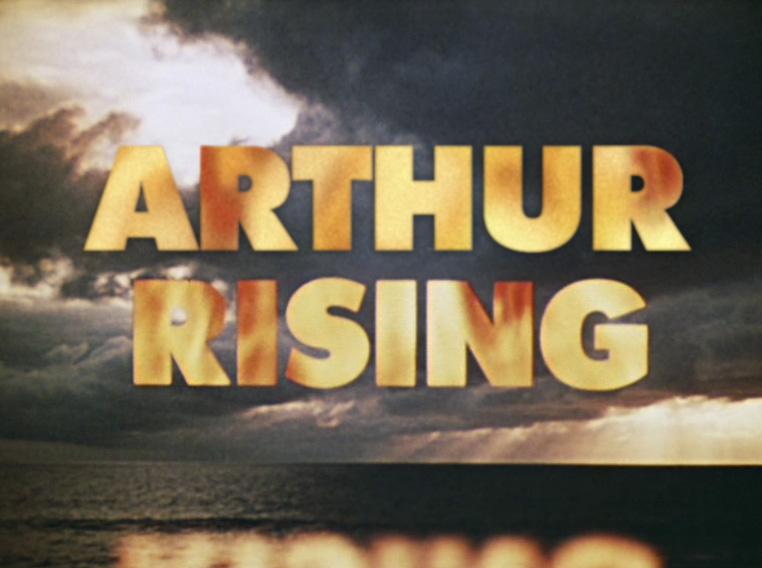
In which the sorely missed Arthur magazine returns to the world of print after a four-year slumber in Avalon. I was involved with the magazine from the outset so regular readers may recall many earlier posts about America’s most vital cultural bulletin:

After a four-year sabbatical (faked death?), your beloved revolutionary sweetheart Arthur returns to print, renewed, refreshed, reinvigorated and in a bold new format: pages as tall and wide as a daily newspaper, printed in color and black and white on compostable newsprint, with ads only on the back cover(s). Amazing!

In partnership with Portland, Oregon’s Floating World Comics, Arthur’s gang of goofs, know-it-alls and village explainers are back, from Bull Tonguers Byron Coley and Thurston Moore to radical ecologist Nance Klehm to trickster activists Center for Tactical Magic to Defend Brooklyn‘s socio-political commentator Dave Reeves to a host of new, fresh-faced troublemakers, edited by ol’ fool Jay Babcock and art directed by Yasmin Khan. You want a peek at the contents? Sorry, compadre. That would be saying too much, too soon. Wait ’til Dec. 22, 2012: that’s right—THE DAY AFTER THE NON-END OF THE WORLD!

Please keep in mind… Arthur is no longer distributed for free anywhere. Those days are (sadly) long gone. Now you gotta buy Arthur or you won’t see it. Our price: Five bucks cheeeeeep!

Arthur No. 33
Broadsheet newspaper, 15″ x 22.75″
Available Dec. 22, 2012
NOW YOU MAY PRE-ORDER ARTHUR NO. 33 HERE.

The NYT picked up on the news on Thursday. Is re-launching a paper magazine in 2012 a crazy idea? We’re about to find out. A selection of my illustrations for previous issues follows.

mbvarkestra.jpg

MBV Arkestra (2003).

crowley.jpg

The Aeon of Horus (2004).

pentagon.jpg

Out, Demons, Out! (2004).

eno.jpg

Brian Eno (2005).

richardbishop.jpg

Sir Richard Bishop (2007).