Firebirds

bilibin.jpg

Ivan Tsarevich Catching the Firebird’s Feather (1899) by Ivan Bilibin.

The firebirds are those that you find on the covers of recordings of Stravinsky’s Firebird ballet score, or on its popular distillation, The Firebird Suite. The latter has long been one of my favourite pieces of classical music, in fact it was one of the first I owned, via a cheap vinyl pairing with The Rite Of Spring that was mainly of interest for being conducted by Stravinsky himself. The cover photo showed a ballerina as the Firebird in a ballet performance, a common choice for the covers of Firebird recordings.
firebird-1955.jpg

No artist/designer credited, 1955.

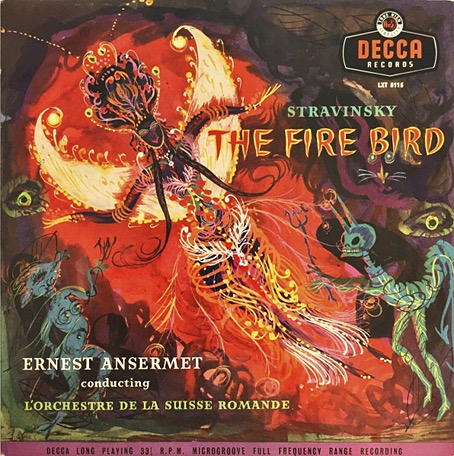
Much better was the cover of Tomita’s Firebird album (see below) which I bought around the same time, an uncredited tapestry design which is also a better album cover than the painting used on the earlier Japanese release. Depicting the Firebird itself is the other obvious choice when designing Stravinsky albums, and the dazzling, magical bird has helped this particular opus fare better in the world of classical album design than many other recordings.
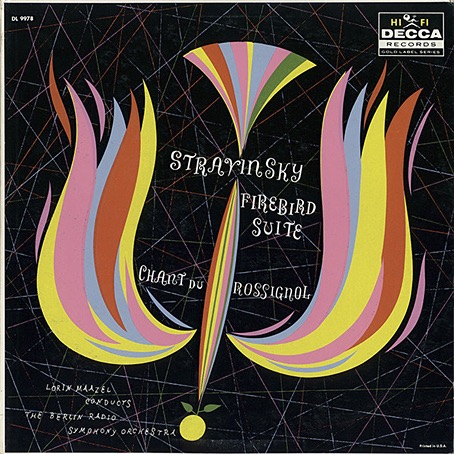
firebird-1958.jpg

No artist/designer credited, 1958.

It’s easy to cast aspersions at the designers or art directors of classical records when you see an uninspired cover design, but the format presents a number of difficulties. There’s no such thing as a fixed design for a classical album because classical albums have no fixed form. With the exception of albums devoted to a single long composition most classical albums are compilations, pairing longer works with shorter ones, often by two or more composers. This confusion of identity creates problems for the designer, as does the huge quantity of classical releases. Then there’s the problems posed by the music itself which is so often abstract; you can’t “illustrate” The Goldberg Variations. The default choice is to use a painting or a drawing or a photograph of the composer as a cover image, or a photo of the conductor or performer. The easiest assigments, as these Firebird covers demonstrate, are albums based around a composition with a well-defined theme that can be depicted visually. Nobody has ever had a problem designing a cover for recordings of Debussy’s La Mer, for example, the only difficulty is deciding what picture of the sea you want to use.
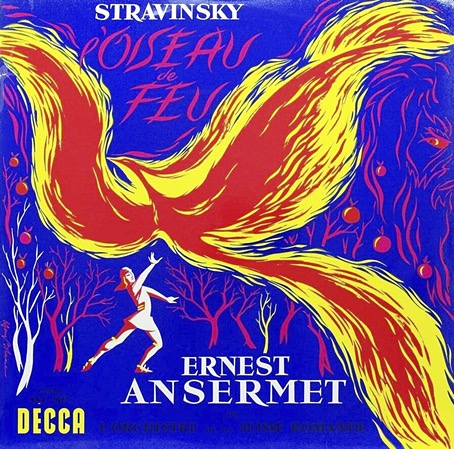
firebird-1960-1.jpg

No artist/designer credited, 1960.

I’ve never had the impression that classical devotees care very much about these issues, it’s the music and the performance they’re interested in. Record labels (or their marketing departments) do seem to pay attention to visual matters now and then, and you’ll find occasional attempts to create a new line of themed covers. (The Orphic Egg series was one of the more bizarre examples from the 1970s.) Deutsche Grammophon have a history of decent cover design but even they resort to using photos of the artist or conductor far too often. I’ve never been asked to design a classical release, and I’m not sure I’d relish the task, but the problems raised by the form fascinate me. This is a subject I’ll no doubt keep returning to.
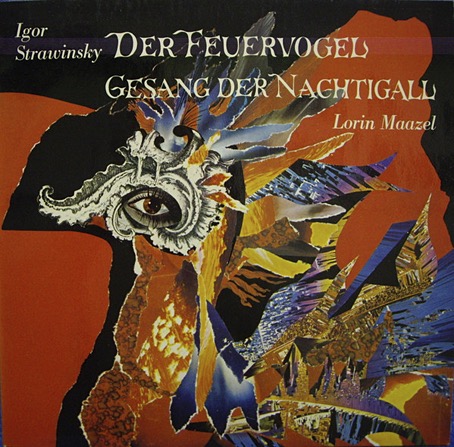
firebird-nd2.jpg

Irma Seidat, no date.

Continue reading “Firebirds”

Engulfed Cathedrals

debussy.jpg

La cathédrale engloutie by Claude Debussy. From Préludes pour Piano (1910).

La cathédrale engloutie performed by Daniel Barenboim.


escher.jpg

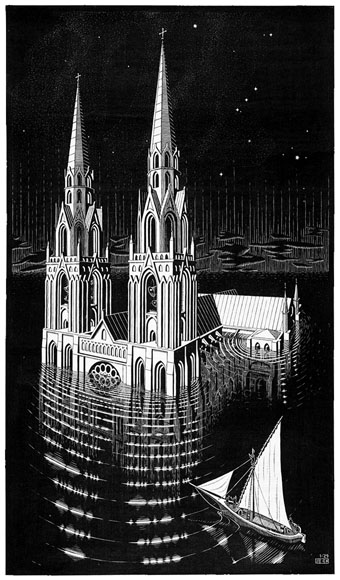
The Submerged Cathedral (1929) by MC Escher.


colquhoun.jpg

La cathédrale engloutie (1950) by Ithell Colquhoun.


richards.jpg

La cathédrale engloutie III (1960) by Ceri Giraldus Richards.


simon.jpg

La cathédrale engloutie (1968) by Luc Simon.


tomita.jpg

Snowflakes Are Dancing (aka Clair De Lune) (1974) by Tomita.

• Track 6: The Engulfed Cathedral (Preludes, Book 1, No. 10).


escape.jpg

Escape From New York (Original Motion Picture Soundtrack) (1981) by John Carpenter In Association With Alan Howarth.

• Track 4: Engulfed Cathedral.


sora.jpg

Re:Sort (2003) by Sora.

• Track 4: La Cathédrale Engloutie.


Previously on { feuilleton }
L’après-midi d’un faune
Hokusai record covers
Tomita album covers

Weekend links 668

escher.jpg

The Drowned Cathedral (1929) by MC Escher.

• “All Saints’ was the last of the seven parish churches to fall headlong into the waves. The drowned church was doomed to lie in a gulley not far out to sea, a habitat for sponges and crabs, and yet it lives on, unvanquishable; for—as the story of Britain’s lost cities, ghost towns, and vanished villages tells us—what has disappeared beneath the sea can rebuild itself in the mind.” Matthew Green explores the history of Dunwich, Suffolk.

• “Why do certain artists endure and become (dread word) ‘iconic’, while some are forgotten or sidelined or only grudgingly acknowledged?” Ian Penman talking to Jeremy Allen about his new book, Fassbinder Thousands of Mirrors.

• Coming soon from Strange Attractor: A new edition of England’s Hidden Reverse, David Keenan’s study of the lives and music of Coil, Nurse With Wound and Current 93.

• “What is electronic music?” Daphne Oram, Desmond Briscoe and David Cain of the BBC Radiophonic Workshop are here to explain.

• “Direct evidence of the use of multiple drugs in Bronze Age Menorca (Western Mediterranean) from human hair analysis.”

• New music: Timespan by Majeure, and Microdosing by African Head Charge.

• “Future of Borges estate in limbo as widow doesn’t leave will.”

Arooj Aftab’s favourite albums.

Paperback Covers on Tumblr.

The Engulfed Cathedral (1974) by Tomita | Engulfed Cathedral (1981) by John Carpenter | La Cathédrale Engloutie (2003) by Sora

Weekend links 650

phillips.jpg

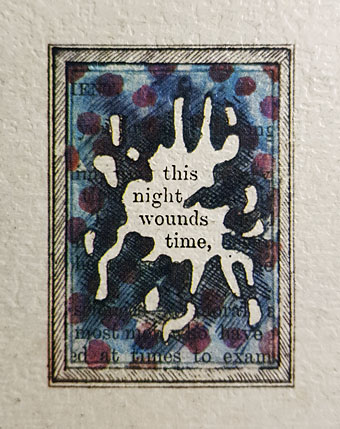
A detail from Tom Phillips’ cover design for Starless And Bible Black (1974) by King Crimson.

• RIP Tom Phillips. The term “polymath” is often used by monomaths to describe people who are proficient in two areas instead of just one. Tom Phillips was a model polymath, an artist whose work ranged wherever his curiosity took him, from conventionally realist portraiture to abstract painting and computer art, from collage, sculpture and stage design to 20 Sites n Years, a long-term photographic work. When Phillips decided to illustrate Dante’s Inferno he first translated the book himself; the Dante project subsequently evolved into a TV/film production made in collaboration with Peter Greenaway and Raúl Ruiz. As for A Humument, this is the artist’s book by which all others should be judged, a unique reworking of a Victorian novel which now exists in multiple editions and sub-works. Humument extracts became a kind of Phillips signature (you can see one at the top of this post), a series of often cryptic fragments and pronouncements that appeared in prints and paintings while also supplying the libretto for Phillips’ first opera, Irma, one of his many musical compositions. Some years ago I posted a quote by Brian Eno about his former art teacher; those words (from A Year With Swollen Appendices) are worth repeating:

It’s a sign of the awfulness of the English art world that he isn’t better known. Tom has committed the worst of all crimes in England. He’s risen above his station. You can sell chemical weapons to doubtful regimes and still get a knighthood, but don’t be too clever, don’t go rising above your station.

The smart thing in the art world is to have one good idea and never have another. It’s the same in pop—once you’ve got your brand identity, carry on doing that for the rest of your days and you’ll make a lot of money. Because Tom’s lifetime project ranges over books, music and painting, it looks diffuse, but he is a most coherent artist. I like his work more and more.

• “The most radical thing about Ever So Lonely is the instrumental when it breaks down and for eight glorious bars you’re dancing to a classical raga and loving it, whoever you are.” Sheila Chandra again on the fleeting pop career of Monsoon.

• Something to look forward to for next summer: Worlds Beyond Time: Sci-Fi Art of the 1970s, a book by Adam Rowe, curator of 70s Sci-fi Art at Tumblr.

• Mix of the week: Groove Orient: South Asian Elements in Psychedelic Jazz at Aquarium Drunkard.

• “Physicists create a wormhole using a quantum computer.” Natalie Wolchover explains.

Pattern Collider is a tool for generating and exploring quasiperiodic tiling patterns.

• “Infernal Affairs is still Hong Kong’s greatest crime saga,” says James Balmont.

Secret Satan, 2022, the essential end-of-year book list from Strange Flowers.

• Also no longer with us as of this week, comic artist Aline Kominsky–Crumb.

• New music: Violet Echoes by Subtle Energy.

Il Trio Infernale (1974) by Ennio Morricone | Firebird Suite: Infernal Dance Of King Kastchei (Stravinsky) (1975) by Tomita | Infernal Devices (2011) by Moon Wiring Club

Switched-On… hits and misses

so01.jpg

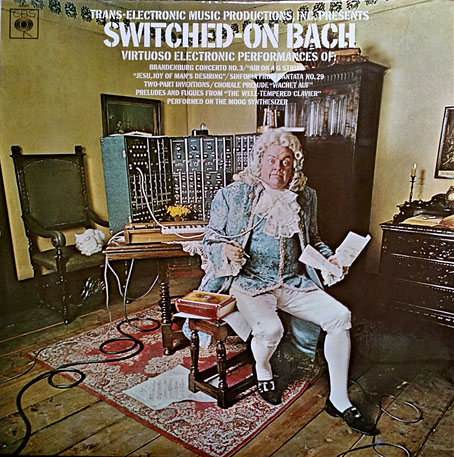
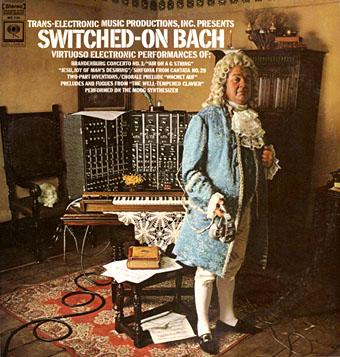
The first pressing of Switched-On Bach with a cover showing a Bach-alike confounded/dismayed by the sounds issuing from the machine behind him. The cover was soon swapped for the one below.

After mentioning the proliferation of Switched-On… synthesizer albums in the previous post, curiosity impelled me to see how many of these things were out there. A lot more than I expected is the answer, almost enough to make this cul-de-sac of novelty exploitation into a sub-genre of its own. As mentioned earlier, it was the huge success of Switched-On Bach (1968) by Wendy Carlos that began the trend. The album had a rare crossover appeal so that it could be sold to classical listeners as well as to a younger audience interested in electronic sounds, those for whom the words “switched on” echoed the druggy/erotic intersection of “turned on”. Carlos had an advantage over other musicians thanks to a long association with Robert Moog which meant she had a head start in exploring the recording potential of the new Moog synthesizer and innovations like Moog’s touch-sensitive keyboard. In 1968 few people could afford a Moog system; those who could usually needed to hire technicians like Paul Beaver and Bernie Krause to help them operate the thing. For a brief while it was enough to simply use the instrument to make strange noises, hence Mick Jagger’s droning score for Kenneth Anger’s Invocation of my Demon Brother (1969), and George Harrison’s preposterous Electronic Sound (1969), 44 minutes of very amateurish Moog-doodling. Switched-On Bach sounds a little primitive today—it sounds primitive next to its follow-up albums, The Well-Tempered Synthesizer (1969) and Switched-On Bach II (1973)—but Carlos and collaborators Rachel Elkind and Benjamin Folkman spent much more time refining their recording techniques than the knob-twiddling horde who rushed to capitalise on their success.

so02.jpg

The rules of the Switched-On… idiom are as follows: a title that begins with the words “Switched-On”, obviously, although there’s a subset of the form in which an album may have a different title while a subtitle mentions something about “switched-on recordings”; the music must be cover versions of familiar songs or compositions, originality here is surplus to requirements; and it’s not essential but the cover art often alludes in some way to synthesizer technology and/or “the future”, with the latter represented by Space Age typefaces such as Amelia, Computer, Countdown or Data 70. I’ve not heard many of these albums, and I’m fairly certain that I don’t want to hear most of them, but I’ve heard enough Carlos cash-ins to know that the cover designs are often the best thing about them. The remastered CDs that Wendy Carlos released in the 1990s feature additional tracks that give some idea of the amount of work involved in the creation of each album. The early cash-ins, by contrast, tend to avoid time-consuming multi-track composition in favour of using a synthesizer as though it’s merely an expensive keyboard. The success of these albums musically may be gauged by the lack of reissues. They may be of interest to the so-bad-it’s-good “Incredibly Strange Music” crowd but I prefer to spend my time listening to other things. Beware.

so03.jpg

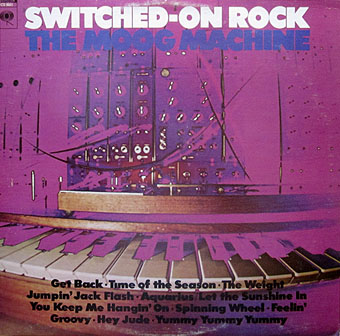
Switched-On Rock (1969) by The Moog Machine.

so04.jpg

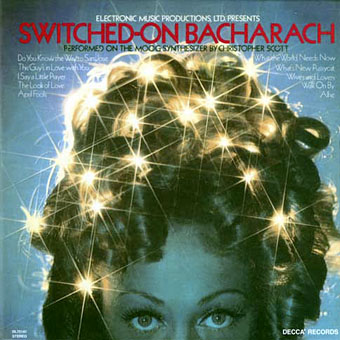
Switched-On Bacharach (1969) by Christopher Scott.

so05.jpg

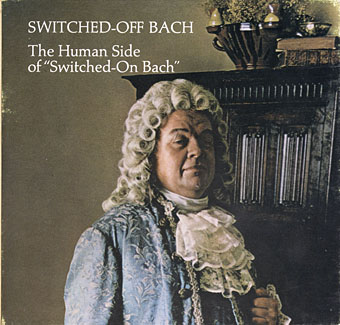
Switched-Off Bach (1969) by Various Artists.

CBS exploits the success of the electronic album by packaging a collection of earlier non-electronic recordings.

Continue reading “Switched-On… hits and misses”