Thomas Pynchon – A Journey into the Mind of [P.]

pynchon_film.jpg

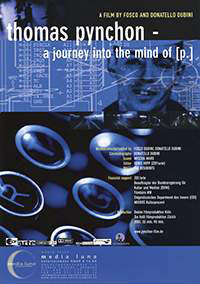
Thomas Pynchon – A Journey into the Mind of [P.] (2001)
Written and directed by Fosco Dubini
and Donatello Dubini
Music by The Residents
Language: English
Runtime: 96mins

“Things are not as they seem.” In US writer Thomas Pynchon’s case, this is a mantra, cornerstone to a life and labyrinthine oeuvre freighted with ceaseless speculation. In books like V. and Gravity’s Rainbow, the covert arenas of the contemporary order (the military-industrial complex, governmental conspiracy, the sinister reaches of science) mesh with counter-cultural values, permeating paranoia, arcane knowledge-systems and profoundly ironic humour in an encyclopaedic investigation of modernity. Central to this is a (doomed) quest for some singular explanation of things, a motif taken up by the Dubini duo in their intriguing derive that takes in his biography, times and obsessive supporters.

On the surface it’s a tall order: Pynchon is one of the great cultural recluses, unphotographed for 40 years, his absence from the flashgun glare now an inseparable part of his “project.” So the film offers an atmospheric collage, chaptered around varying recollections and his synchronicity with resonant aspects of post-war US society. Apposite newsreel and found-footage of missile experiments and Agency psychedelics tests mix with talking heads, spoken extracts and Pynchon’s articulate fans. Stand-ins, doubles, lookalike contestants populate a shifting reality, scored to a trippy, fragmented soundscape care of The Residents, that builds towards a compelling final act, searching for the grail of a new image of the writer. Reflecting the hall of mirrors in which the novels, history, the novelist and his “researchers” move, this documentary, while uneven and occasionally over-extended, provides required viewing for devotees, and should reward those keen to explore the mysterious dynamics of the age via one of their definitive surveillants.

Gareth Evans, Time Out.

The Grey Lodge is torrenting a 632MB avi version. Buy the DVD here.

Previously on { feuilleton }
A literary event: new Thomas Pynchon

A literary event: new Thomas Pynchon

MutedPosthorn.jpgNew Thomas Pynchon novel to be released
Mysterious author’s first novel in almost a decade comes out in December

NEW YORK—Thomas Pynchon fans, the long wait is apparently over: His first novel in nearly a decade is coming out in December.

But details, as with so much else about the mysterious author of such postmodern classics as “V.” and “Gravity’s Rainbow,” have proved a puzzle.

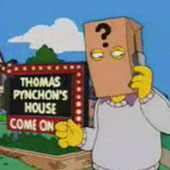
Since the 1997 release of “Mason & Dixon,” a characteristically broad novel about the 18th-century British explorers, new writings by Pynchon have been limited to the occasional review or essay, such as his introduction for a reissue of George Orwell’s “1984.” He has, of course, made no media appearances or allowed himself to be photographed, not counting a pair of cameos in “The Simpsons,” for which he is sketched in one episode with a bag over his head.

This much is known about the new book: It’s called “Against the Day” and will be published by Penguin Press. It will run at least 900 pages and the author will not be going on a promotional tour.

“That will not be happening, no,” Penguin publicist Tracy Locke told The Associated Press on Thursday.

Like J.D. Salinger (who at one point Pynchon was rumored to be), the 69-year-old Pynchon is the rare author who inspires fascination by not talking to the press. Alleged Pynchon sightings, like so many UFOs, have been common over the years, and his new book has inspired another round of Pynchon-ology on Slate and other Internet sites.

Late last week, the book’s description—allegedly written by Pynchon—was posted on Amazon.com. It reads in part:

“Spanning the period between the Chicago World’s Fair of 1893 and the years just after World War I, this novel moves from the labor troubles in Colorado to turn-of-the-century New York, to London and Gottingen, Venice and Vienna, the Balkans, Central Asia, Siberia at the time of the mysterious Tunguska Event, Mexico during the Revolution, postwar Paris, silent-era Hollywood, and one or two places not strictly speaking on the map at all.

“With a worldwide disaster looming just a few years ahead, it is a time of unrestrained corporate greed, false religiosity, moronic fecklessness, and evil intent in high places. No reference to the present day is intended or should be inferred.”

The description was soon pulled from the site, with Penguin denying any knowledge of its appearance. According to Amazon.com spokesman Sean Sundwall, Penguin requested the posting’s removal “due to a late change in scheduling on their part. We expect the description to be reposted to the book’s detail page in the next day or two.”

Locke declined comment on why the description was taken down, but did reluctantly confirm two details provided by Sundwall, that the book is called “Against the Day” (no title is listed on Amazon.com) and that Pynchon indeed wrote the blurb, which warns of more confusion to come.

“Contrary-to-the-fact occurrences occur,” Pynchon writes. “If it is not the world, it is what the world might be with a minor adjustment or two. According to some, this is one of the main purposes of fiction. Let the reader decide, let the reader beware. Good luck.”