Poe at 200

poe.jpg

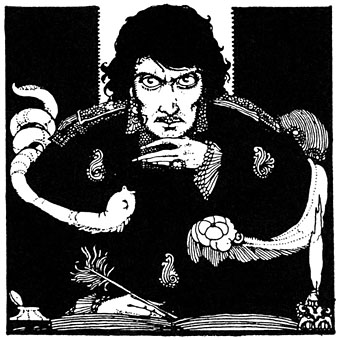
Poe by Harry Clarke.

Happy birthday Edgar Allan Poe, born two hundred years ago today. I nearly missed this anniversary after a busy weekend. Rather than add to the mountain of praise for the writer, I thought I’d list some favourites among the numerous Poe-derived works in different media.

Illustrated books
For me the Harry Clarke edition of 1919 (later reworked with colour plates) has always been definitive. Many first-class artists have tried their hand at depicting Poe’s stories and poems, among them Aubrey Beardsley, Gustave Doré, Arthur Rackham, W. Heath Robinson and Edmund Dulac; none complements the morbid atmosphere and florid prose as well as Clarke does. And if it’s horror you need, Clarke’s depiction of The Premature Burial could scarcely be improved upon.

Honourable mention should be made of two less well-known works, Wilfried Sätty’s The Illustrated Edgar Allan Poe (1976) and Visions of Poe (1988) by Simon Marsden. I wrote about Sätty’s collage engravings in Strange Attractor 2, and Sätty’s style was eminently suited to Poe’s work. Marsden’s photographs of old castles and decaying mansions are justly celebrated but in book form often seem in search of a subject beyond a general Gothic spookiness or a recounting of spectral anecdotes. His selection of Poe stories and poems is a great match for the photos, one of which, a view of Monument Valley for The Colloquy of Monos and Una, was also used on a Picador cover for Blood Meridian by Cormac McCarthy.

Recordings
These are legion but among the outstanding one-off tracks I’d note two poems set to music, Dream Within a Dream from Propaganda‘s 1985 album, A Secret Wish, and The Lake by Antony & The Johnsons. The latter appeared on the landmark Golden Apples of the Sun compilation and also on Antony’s own The Lake EP.

Among the full-length works, Hal Willner’s 1997 2-CD collection Closed on Account of Rabies features lengthy readings set to music from a typically eclectic Willner line-up: Marianne Faithfull, Christopher Walken, Iggy Pop, Diamanda Galás, Gavin Friday, Dr John, Deborah Harry, Jeff Buckley (one of the last recordings before his untimely death) and Gabriel Byrne. Byrne’s reading of The Masque of the Red Death is tremendous and the whole package is decked out in Ralph Steadman graphics.

Antony Hegarty appears again on another double-disc set, Lou Reed’s The Raven (2003), a very eccentric approach to Poe which I suspect I’m in the minority in enjoying as much as I do. An uneven mix of songs and reading/performances, Reed updates some Poe poems while others are presented straight and to often stunning effect by (among others) Willem Defoe, Steve Buscemi, Laurie Anderson, David Bowie, Amanda Plummer and Elizabeth Ashley.

Films
Once again, there’s too many films but The Masque of the Red Death (1964) has always been my favourite of the Roger Corman adaptations, not least for the presence of Jane Asher, Patrick Magee and (behind the camera) Nicolas Roeg. I wrote last May about the animated version of The Tell-Tale Heart from UPA. That adaptation, with narration by James Mason, is still on YouTube so if you haven’t seen it yet you can celebrate Poe’s anniversary by watching it right now.

Elsewhere on { feuilleton }
The illustrators archive

Previously on { feuilleton }
The Tell-Tale Heart from UPA
William Heath Robinson’s illustrated Poe
The art of Harry Clarke, 1889–1931
Welcome to Mars

welcometomars.jpg

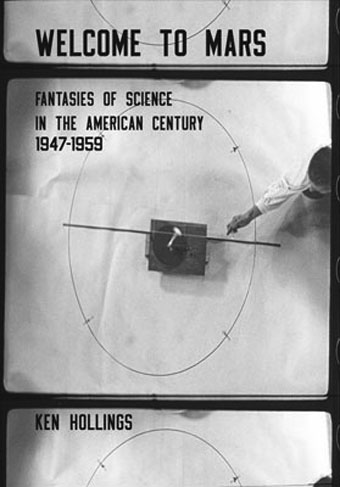
Arriving today—and barely surviving the postman’s attempts to cram it through the letterbox—is the latest volume from Strange Attractor, Welcome to Mars by Ken Hollings. I’m really looking forward to reading this since it touches on areas of interest which span the development of Cold War technologies to pulp science fiction, examining the interconnections between these disparate zones; most histories of the period prefer to stay in one area or the other. A glance at the chapter titles immediately pushes my buttons: “1947 Rebuilding Lemuria”, “1951 Absolute Elsewhere”. If all that wasn’t enough there’s an intro by Erik Davis and the first 250 copies come with a CD of “classy analogue Outer Space exotica” by Simon James. Order from the SA Shoppe and get a free postcard!

Welcome to Mars is a map of the post-war Zone, a non-fiction Gravity’s Rainbow that follows the arc of Germany’s V2 rocket to the end of the rainbow – to America.’ Erik Davis

Welcome to Mars is an iconoclastic, penetrating and darkly humorous history of America from 1947-1959, the decade in which the nation defined its image and created the blueprint for the world we live in today.

Welcome To Mars draws upon newspaper accounts, advertising campaigns, declassified government archives, old movies and newsreels from this unique period when the future first took on a tangible presence. Ken Hollings depicts an unsettled time in which the layout of Suburbia reflected atomic bombing strategies, bankers and movie stars experimented with hallucinogens, brainwashing was just another form of interior decoration and strange lights in the sky were taken very seriously indeed.

Seamlessly interweaving developments in technology, popular culture, politics, changes in home life, the development of the self, collective fantasy and overwhelming paranoia, Hollings has produced an alarming and often hysterically funny vision of the past that would ultimately govern all of our futures.

“Ken Hollings shows brilliantly how the extraordinary web of technologies that drove the Cold War have shaped not just our culture but the very way we think of ourselves as human beings. Welcome to Mars offers a rare and fascinating glimpse of the roots of the strange humanoid culture we live in today.” Adam Curtis

‘Ken Hollings has placed his critical focus at the precise point where the high technologies of information control and social manipulation intersect the passionate search for scientific ways to probe the human mind. Welcome to Mars is a searingly accurate and deeply disturbing exposé of the fantasies of American modernism that have inspired the many nightmares and the few hopeful visions of our new Millennium.’ Dr Jacques Vallée

Previously on { feuilleton }
SAJ again
Strange Attractor Journal Three
How to make crop circles

Dead on the Dancefloor

suspiria.jpg

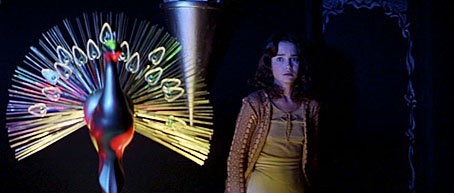
Suspiria: Jessica Harper and a bird with crystal plumage.

For this year’s Halloween playlist I’ve let Mark Pilkington from Strange Attractor make the selection. The following is from a CD-R collection of Italian horror soundtracks that Mark sent me some time ago. Not everything here is easy to find but the superbly nerve-jangling racket created by Goblin to accompany Dario Argento’s equally superb Suspiria (1977) is widely available and ideal Halloween listening.

If one hasn’t been written already, there’s probably a thesis to be found in the influence of progressive rock on Italian cinema. Many of these pieces represent a curious blending of the kind of Italian prog-rock exemplified by bands such as PFM together with the scores of (inevitably) Ennio Morricone. William Friedkin’s use of the opening of Mike Oldfield’s Tubular Bells in The Exorcist inspired legions of imitative themes in subsequent horror films, not least Suspiria. Dario Argento later brought in ELP’s Keith Emerson for the sequel, Inferno (1980), whose main theme—a kind of disco version of Jerry Goldsmith’s Latin chants from The Omen—I’ve always been rather partial to. The best of this music manages to be groovy and scary at the same time, Goblin being the masters in that department, and is often better than the films it was written for. The perfect thing for zombies in satin flares.

Cannibal Holocaust (Main theme) by Riz Ortolani
Death Dies (Profondo Rosso) by Goblin
Zombie Flesh Eaters (theme) by Fabio Frizzi
Sighs (Suspiria) by Goblin
Suoni Dissonanti (City of the Living Dead) by Fabio Frizzi
Flashing (Tenebrae) by Goblin
Adulteress’ Punishment (Cannibal Holocaust) by Riz Ortolani
Suspiria by Goblin
Voci Dal Nulla (The Beyond) by Fabio Frizzi
Deep Shadows (Profondo Rosso) by Giorgio Gaslini & Goblin
L’alba Dei Morti Viventi (Dawn of the Dead) by Goblin
Suono Aperto (The Beyond) by Fabio Frizzi
Markos (Suspiria) by Goblin
The Dead On Main St/Voodoo Rising (Zombie Flesh Eaters) by Fabio Frizzi
Escape From The Flesh Eaters (Zombie Flesh Eaters) by Fabio Frizzi
Roller (Non-soundtrack album) by Goblin

dead.jpg

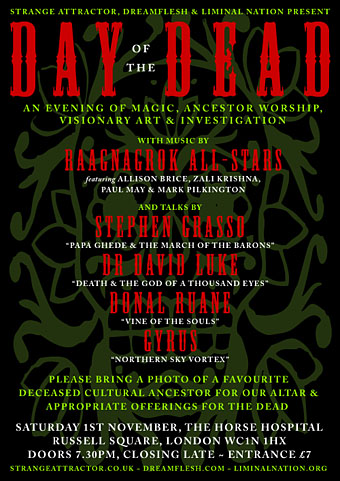
And while we’re on the subject of music and Halloween, Mark Pilkington is playing as part of the Raagnagrok All-Stars on November 1st at the Horse Hospital, London, as part of a Day of the Dead event. More about that here.

Happy Halloween!

Previously on { feuilleton }
Another playlist for Halloween
White Noise: Electric Storms, Radiophonics and the Delian Mode
The Séance at Hobs Lane
A playlist for Halloween
Ghost Box

Berni Wrightson in The Mist

mist.jpg

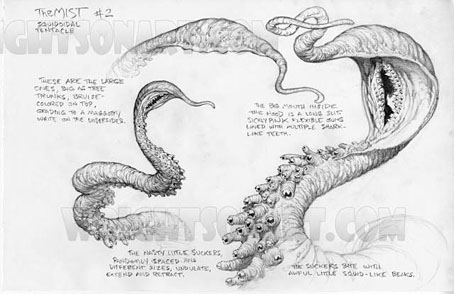
It’s not giving too much away to let enthusiasts of tentacular horror know that Frank Darabont’s film of The Mist, currently fogging up UK cinema screens, contains these questing things among its torments. The Mist is based on a 1980 novella by Stephen King and the film has a decent King pedigree for once, with the director having previously made The Shawshank Redemption and The Green Mile while the creature designs are partly the work of Berni Wrightson, one of King’s artist collaborators. Wrightson’s web gallery has a number of his sketches on display although if you haven’t seen the film you should be warned that they spoil some of the surprises.

My good friend Mark Pilkington—weirdness wrangler, editor of Strange Attractor and all-round ubiquitous presence—reviews the film in this month’s Sight and Sound where he points out some of the Lovecraftian resonances. Tentacles aside, there’s a lumbering monstrosity near the end which manages to be far more Lovecraftian than the Cloverfield creature and I wouldn’t have minded seeing more of the larger presences than the lesser beasties. The film’s lead character is a movie poster artist and the opening scene nods to an earlier film with an equally Lovecraftian atmosphere by having Drew Struzan’s art for John Carpenter’s The Thing on the wall in the background. The film’s siege situation is more the kind of story you’d get from an earlier writer, William Hope Hodgson, another purveyor of the malevolent tentacle.

Berni Wrightson and your not-so-humble narrator appeared together recently in Centipede Press’s A Lovecraft Retrospective: Artists Inspired by H.P. Lovecraft (yes, I am going to keep going on about this book for the next few months…sue me). Wrightson is represented there by his comic strip adaptation of Cool Air but his Mist drawings would have made equally worthwhile additions. If nothing else, 2008 is turning out to be a good year for horror enthusiasts.

Previously on { feuilleton }
The monstrous tome
Octopulps
Druillet meets Hodgson

The art of Laurie Hassold

hassold.jpg

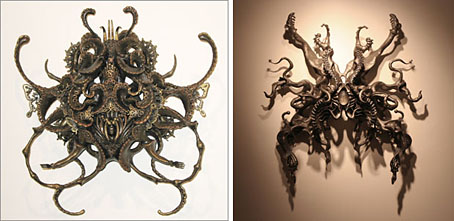
left: Bent Fork (The Beginning of Hunger) (2007).
right: Strange Attractor IV: Zygomorph (2006).

“My core interest in making art lies in blurring the boundaries between art, science, literature and psychology,” says Laurie Hassold, and seeing that this is the week the monstrosities of Cloverfield are unleased upon America, it’s perhaps appropriate that some organic weirdness is on display at Bert Green Fine Art in Los Angeles. Laurie Hassold’s show runs until March 1st, 2008.

Via Phantasmaphile.

Previously on { feuilleton }
The art of Jean Louis Ricaud