Symbolist cinema

dracula1.jpg

Symbolist? Arguably. Decadent? Certainly. Watching Francis Ford Coppola’s Dracula (1992) again this weekend I thought it worth making note of some of these resonances. The real age of Symbolist cinema was the Silent Era from around 1910 onwards, something I discussed in more detail here. That being so, several films made since can be taken as Symbolist (more usually Decadent) productions even if this was never their original intention. Kenneth Anger‘s Magic Lantern Cycle comes immediately to mind, so too Sergei Parajanov’s The Colour of Pomegranates.
dracula3.jpg

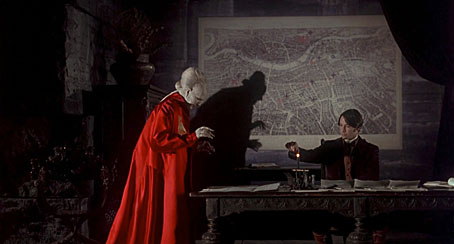
Bram Stoker’s novel was published in 1897 at the ebbing of the fin de siècle but vampires and vampirism were already recurrent Symbolist themes. Aesthetic magus Walter Pater wrote of the Mona Lisa in 1893, “She is older than the rocks among which she sits; like the vampire, she has been dead many times, and learned the secrets of the grave…” Dracula almost demands a Symbolist interpretation, and for now Coppola’s production is the closest we get. I’ve found this makes the film more satisfying in a way: you can ignore the shoddy performances by secondary characters and concentrate on the decor and details (and the tremendous score by Wojciech Kilar). Some of the following screen grabs argue my point.
dracula2.jpg

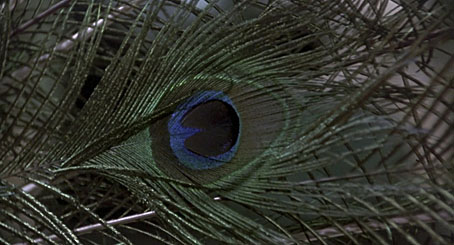
Oh look, peacock feathers. I loved the artificiality of this film, the excessive palette, the obvious models and miniatures, the layering of images. The dissolve from a peacock feather to Jonathan Harker’s infernal train journey is a great moment.
Continue reading “Symbolist cinema”

The Epigenesis by Melechesh

epigenesis.jpg

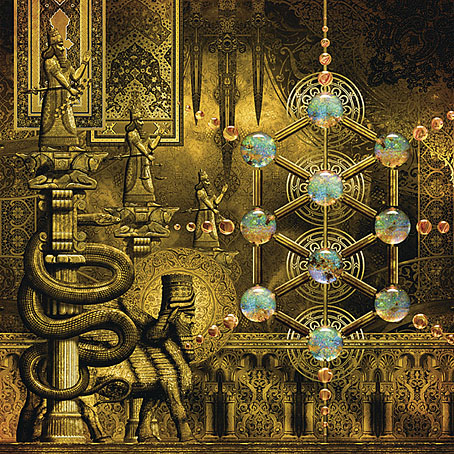
This new piece of work, a cover illustration for metal band Melechesh, was still in progress only a month ago but the album in question, The Epigenesis, has been announced so I can post it here. This follows a design I produced for an earlier Melechesh album, Emissaries, in 2006, both of which refer to the Sumerian mythology which powers the band’s music. There’s some vague Parajanov influence in this piece which isn’t the kind of thing that usually extends to the metal world but Sergei Parajanov’s films were one of the reference points the band offered. The suspended carpets at the top left are the most obvious allusion to the director but for the composition as a whole I also had in mind the tableaux scenes he creates in The Colour of Pomegranates and other films.

The Epigenesis will be released on the Nuclear Blast label on October 1st, 2010.

Elsewhere on { feuilleton }
The album covers archive

Previously on { feuilleton }
Short films by Sergei Parajanov
New things for October

Weekend links 3

orator.jpg

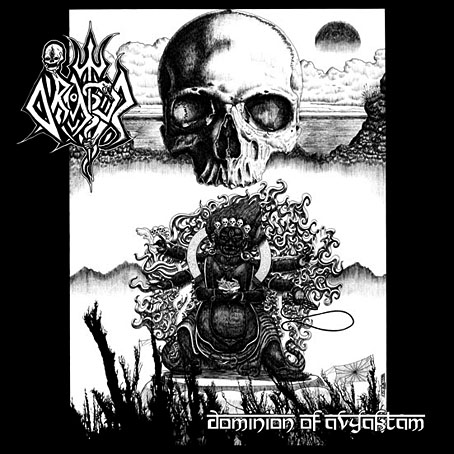
It’s a curious feeling when a drawing which is nearly 26 years old makes it out into the world. The image above is the cover of a new 7″ single release, Dominion of Avyaktam by metal band Orator, the picture being something I drew in 1984 entitled Mahakala after the Tibetan deity which it depicts. The inspiration was the cover of another recording, a Nonesuch Explorer album, Tibetan Buddhism – Tantras Of Gyütö: Mahakala, and also the track Mahakala by 23 Skidoo from their 1983 album The Culling is Coming. The skull is drawn from a real one I was given. Looking at this today none of the elements seem to work together—and the landscape stuff looks like a lazy way of filling in space—but it’s nice to see it find a home. Dominion of Avyaktam is out now on the Legion of Death label.

• Surprise of the week: two books I’ve worked on were nominated for Nebula Awards, Jeff VanderMeer’s Finch, and Kage Baker’s The Hotel Under the Sand whose interior I designed.

• More music: a recording of Paul Schütze’s Third Site played live in 1999 (with Clive Bell, Raoul Björkenheim, Simon Hopkins & Thomas Köner’s voice) is now available as a free download on his website. More Schütze: Paul Schütze & Simon Hopkins playing a set at the Horbar in Hamburg on December 28, 2009.

• The incredible pinscreen animations of Alexander Alexeieff and Claire Parker are finally available on DVD. Also new to DVD, Alan Bennett at the BBC, a four-disc set of some of his TV plays including a particular favourite of mine, his Kafkaesque drama The Insurance Man.

• More Ghost Box business: Jon Brooks aka The Advisory Circle has a blog. And Ghost Box’s Jim Jupp was interviewed recently by Peter Bebergal at Mystery Theater. Related (forgot to mention this last week): The ASDA Mix, a great mixtape of spooky retro weirdness by Moon Wiring Club available for free at The Wire.

The trailer for Mellodrama, a documentary about the Mellotron by Dianna Dillworth.

• The Parajanov Festival will be screening some of the director’s films in London and Bristol.

• Lots of weird and wonderful exhibits at the ~Wunderkammer~.

Short films by Sergei Parajanov

parajanov.jpg

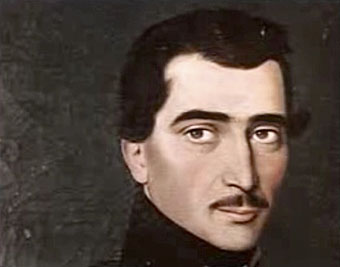
Hakob Hovnatanyan (1967).

I’ve been enthusing for years about the unique films of Sergei Parajanov (1924–1990), usually in vain since his work hasn’t always been easy to see and is (for now) poorly served by DVD. His two masterworks, Shadows of Our Forgotten Ancestors (1964) and The Colour of Pomegranates (1968), have both been issued on disc but in shoddy versions with prints that are scratched and desaturated, and the latter suffers from poor subtitling. Parajanov’s films make bold use of colour and a washed-out print does him no favours at all. In an ideal world the BFI or Criterion would give these films the attention they deserve.

Grumbles aside, Ubuweb comes up trumps again by posting three of Parajanov’s shorter works, none of which I’d seen before. These give some idea of his distinctive tableaux style, and his recurrent preoccupation with decorative details and close views of objects.

Parajanov.com

Previously on { feuilleton }
The Disasters of War