Maurice Leloir’s Three Musketeers

leloir03.jpg

Just after Christmas I watched the recent French film adaptation of The Count of Monte Cristo, after which I resolved to finally read The Three Musketeers, something I’d been intending to do since reading The Count of Monte Cristo four years ago. I’m currently two thirds of the way through The Three Musketeers and enjoying it very much despite the familiarity of the story. (I’ve watched Richard Lester’s two-part film adaptation many times.) For the most part, the novel avoids the flaws which make Monte Cristo a laborious read (Umberto Eco described the latter as “one of the most exciting novels ever written and on the other hand…one of the most badly written novels of all time and in any literature”), but The Three Musketeers isn’t without flaws of its own. I don’t think too many people would regard the lack of descriptive detail as a flaw per se—this is an adventure story, after all—but I enjoy a well-crafted description, and Dumas’s sketching of costume and place ranges from the scant to the non-existent. We’re told, for example, that d’Artagnan is a member of the King’s Guard, and that the Guards and the Musketeers are identifiable by the differences of their uniforms. But I don’t recall any instance when we’re told how these differences are manifest, or even how any of the principle characters dress from day to day. The same applies to the settings; much of the novel is set in the Paris of the 1620s but Dumas ignores any scenic description in what would have been a darker, muddier and altogether less salubrious city than his own Paris of the 1840s.
leloir01.jpg

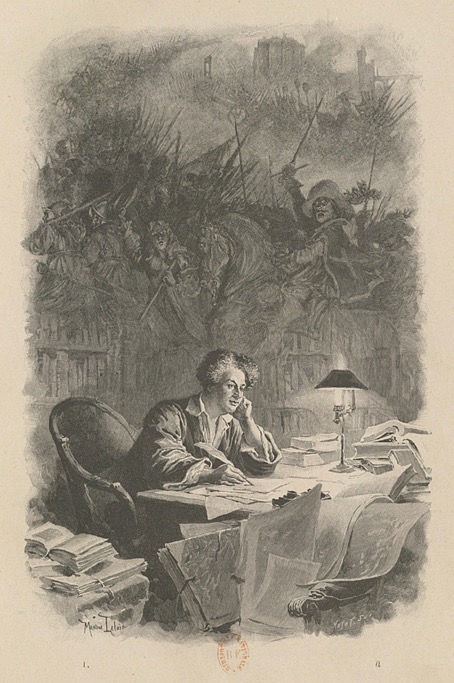
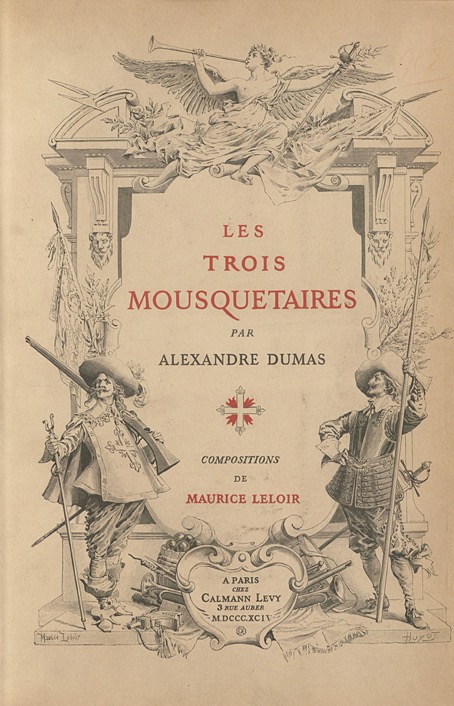
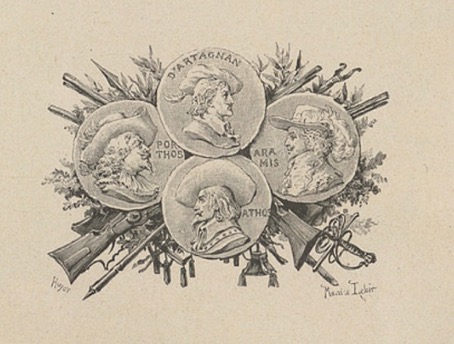
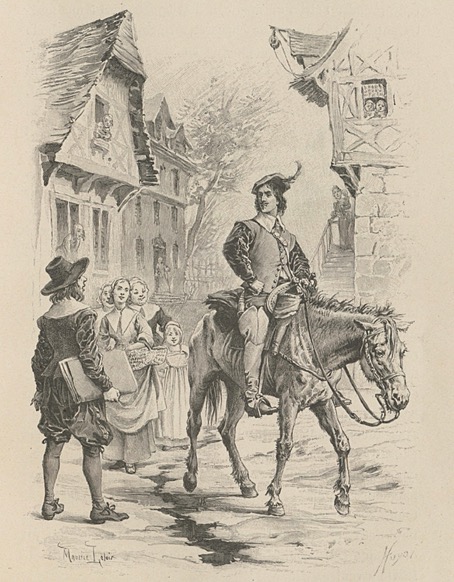
All of which brings us to Monsieur Maurice Leloir (1853–1940) and his illustrations for the novel which were published in a two-volume edition in 1894 (Tome 1 | Tome 2). Leloir was a painter and illustrator with a considerable knowledge of French historical dress; in 1907 he became the founding president of the Société de l’histoire du costume. His illustrations of The Three Musketeers, therefore, may be taken as authoritative when it comes to the costuming of the characters. Leloir was very good with everything else, as it happens; his characterisation is better than those of an earlier edition which makes d’Artagnan and friends barely distinguishable from each other, something not helped by the barbering habits of the day which had every gentleman sporting the same elaborate moustaches.
leloir02.jpg

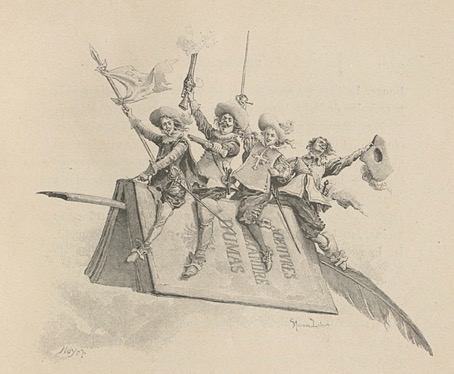
Most of Leloir’s illustrations are placed vignette-style inside the page but a few of the larger ones run across two pages, especially those involving fights or other action scenes. And there are many illustrations, what you see here is a very small sample. A couple of them so closely match scenes in the Richard Lester films that I’m sure the books must have been referred to for details of costuming. Douglas Fairbanks certainly saw them; after playing d’Artagnan in his own film production of The Three Musketeers he invited Maurice Leloir to advise with the costuming of another Dumas adaptation, The Iron Mask, in 1929.
leloir05.jpg

leloir06.jpg

Continue reading “Maurice Leloir’s Three Musketeers”

Weekend links 780

ginsburg.jpg

An early illustration by Burne Hogarth from Federal Illustrator, Winter 1931–1932, credited to the artist’s original name, Bernard Spinoza Ginsburg. (Via)

• RIP Simon House, a musician whose death was announced in the same week as news of a remixed edition of Hall Of The Mountain Grill by Hawkwind, the first of the group’s albums to feature House on violin and keyboards. House’s keyboards made a considerable difference to Hawkwind’s sound, expanding the range of their songwriting; the melodramatic scale of Assault And Battery/The Golden Void wouldn’t have been possible without those massed Mellotrons. Post-Hawkwind it was House’s violin that was sought after during his time as a session musician, on songs like Yassassin by David Bowie, and Talking Drum by Japan. He’s also one of the musicians credited on Thomas Dolby’s biggest hit, She Blinded Me With Science (violin again), although his contribution there is easy to mistake for a synthesizer.

• “We did want the name to be weighty and metal-related because it is a kind of a metal band. So what is heavy and what is metal: that was the answer.” Hildur Guðnadóttir talking about Osmium, an experimental quartet comprising Guðnadóttir with James Ginzburg, Rully Shabara and Sam Slater.

• At Criterion: Stephanie Zacharek on Richard Lester’s The Three Musketeers and The Four Musketeers, films from a time “when delighting audiences meant more than catering to the predetermined whims of a dogged fandom”.

• The week in maps: At Public Domain Review, Bernard Sleigh’s Anciente Mappe of Fairyland (ca. 1920 edition); at Nautilus, the first maps of the Earth’s magnetic field.

• The eleventh installment of Smoky Man’s exploration of The Bumper Book of Magic has been posted (in Italian) at (quasi), and in English at Alan Moore World.

• Not on any map: Mark Valentine describes the time he tried to buy a phantom island from the Hudson’s Bay Company.

• At Colossal: “In surreal portraits, Rafael Silveira tends to the garden of consciousness“.

• New music: Osmium by Osmium, and Along The Wind Spear by Survey Channel.

• Anne Billson chooses Anjelica Huston’s ten best roles.

Owls in Towels

Five Owls (1970) by Canned Heat | Night Owl (1996) by System 7 | Owls And Flowers (2006) by Belbury Poly

Weekend links 440

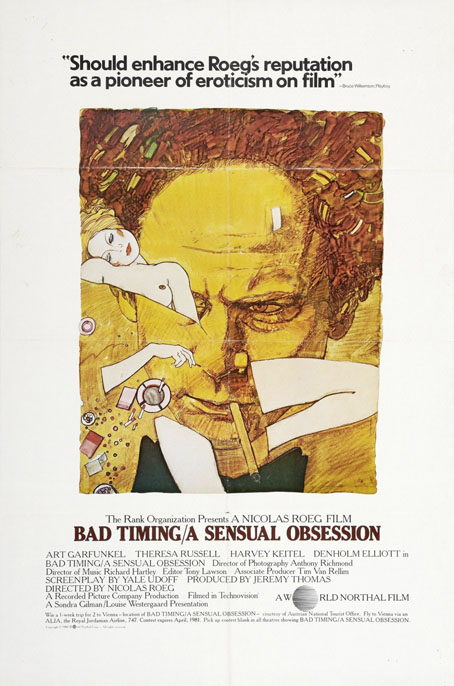
roeg.jpg

The title of that film was originally different [Illusions]… I woke up one day and thought of Bad Timing which sounds exactly like the right title—for my career. Now there was a film I really thought was one to which there would be a different response. Whilst filming I felt sure that this was one for the streets, one that people would really want to see. — Nicolas Roeg

So long to the great Nicolas Roeg, always one of my favourite film-makers. Roeg’s works were naturally attractive when I was a teenager because he’d made a horror film and a science-fiction film; when these eventually turned up on TV it was evident that this was a director working on a level that had more in common with Continental Europe than Hollywood. Beyond the generic content it was his approach to directing that made his films essential: a fragmented editing style derived from Alain Resnais via Richard Lester (see below), a cosmic perspective almost entirely absent from the parochial concerns of British cinema, and a seemingly effortless ability to find visual rhymes in anything. Despite the “bad timing” comment above Roeg was fortunate to be working throughout the 1970s when having an approach that ran counter to the prevailing trends wasn’t an obstacle to maintaining a career; as with Ken Russell, you watch some of the films today and are amazed and grateful that they were made at all. When reading the forthcoming plaudits it would be worth remembering that even the films regarded now as Roeg’s best struggled for acceptance: Pauline Kael dismissed Don’t Look Now as “trash”, US screenings of The Man Who Fell To Earth provided explanatory notes for the hard-of-thinking, Bad Timing was described by its own distributors as “a sick film made by sick people for sick people”, while the distributors of Eureka hated the film so much that for a time it could only be screened in the UK if the director was also present.

• Related: Where to begin with Nicolas Roeg, and Nicolas Roeg: It’s About Time (2015), a 59-minute documentary for the BBC directed by David Thompson. Previous Roeg-related postings on this site include: The Nicolas Roeg Guardian Lecture, 1983 (Roeg discusses Eureka and other films with Philip Strick); Beyond the Fragile Geometry of Space (charting the recurrence of a book title from Don’t Look Now); Canal view (using Google Street View to find the church in Don’t Look Now); and Petulia film posters (designs for a Richard Lester film from 1968 that was photographed by Roeg, and whose fragmentary editing style prefigures the familiar Roeg technique).

• Edward Woodward’s greatest screen role wasn’t a prudish policeman or a mysterious vigilante but was David Callan, a conflicted assassin working for a division of the British Secret Service. Joseph Oldham explains.

• Mixes of the week: A mix for The Wire by Jing, FACT Mix 681 by Kelly Moran, and Crépuscules d’Automne, a seasonal mix by Stephen O’Malley.

• More Gorey: in 1978 Jeremy Brett was playing Dracula in the touring version of the Edward Gorey-designed play.

• Liberated from the LRB paywall for a brief time: George Melly writing in 1992 about René Magritte.

• Welcome to the witch capital of Norway: Chelsea G. Summers investigates.

Space colony artwork from the 1970s.

• At I Love Typography: Magic printed.

Memo From Turner (1970) by Mick Jagger | Wild Hearts (1985) by Roy Orbison | Be Kind To My Mistakes (1987) by Kate Bush

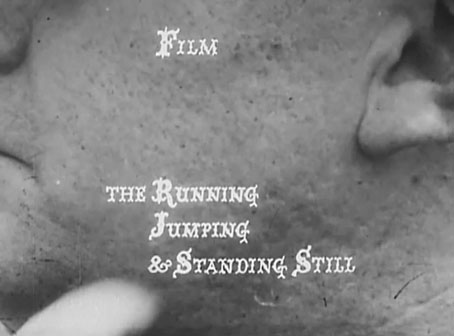
The Running Jumping & Standing Still Film

lester1.jpg

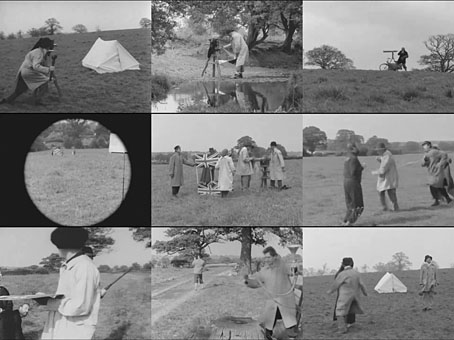
The Beatles’ second feature, Help!, was released on Blu-ray last month. The origin of the film’s visual humour and frenetic style can be found in this short directed by Richard Lester over two weekends in 1959, a collaboration between Lester, Spike Milligan, Peter Sellers and others. It may be nothing more than ten minutes of sight gags but it was enough for The Beatles to seek out Lester as director of their first two features. (Leo McKern, the actor in the opening shot, also appears in Help!) Considering the subsequent influence of those films—from The Monkees’ TV show on into numerous pop videos—this little film is very influential indeed. Watch it here.

lester2.jpg

Previously on { feuilleton }
Petulia film posters

Petulia film posters

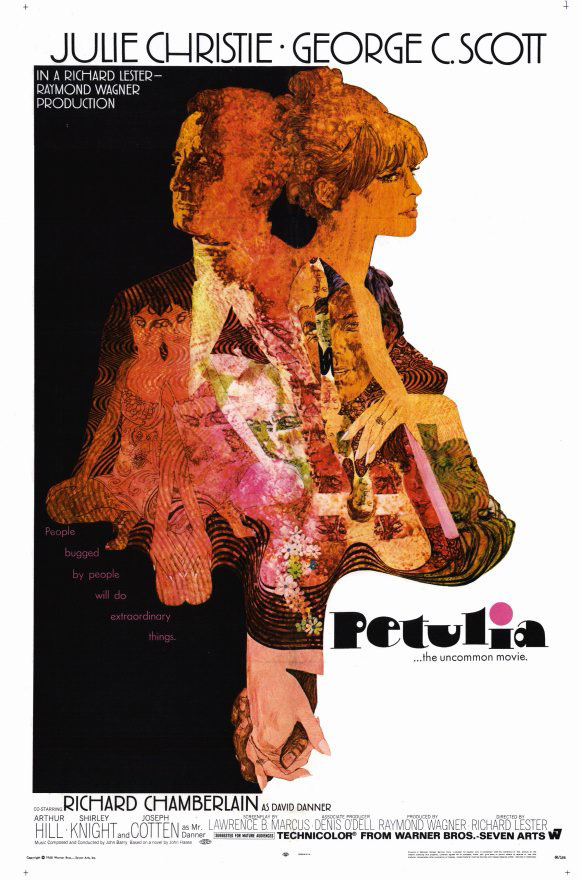
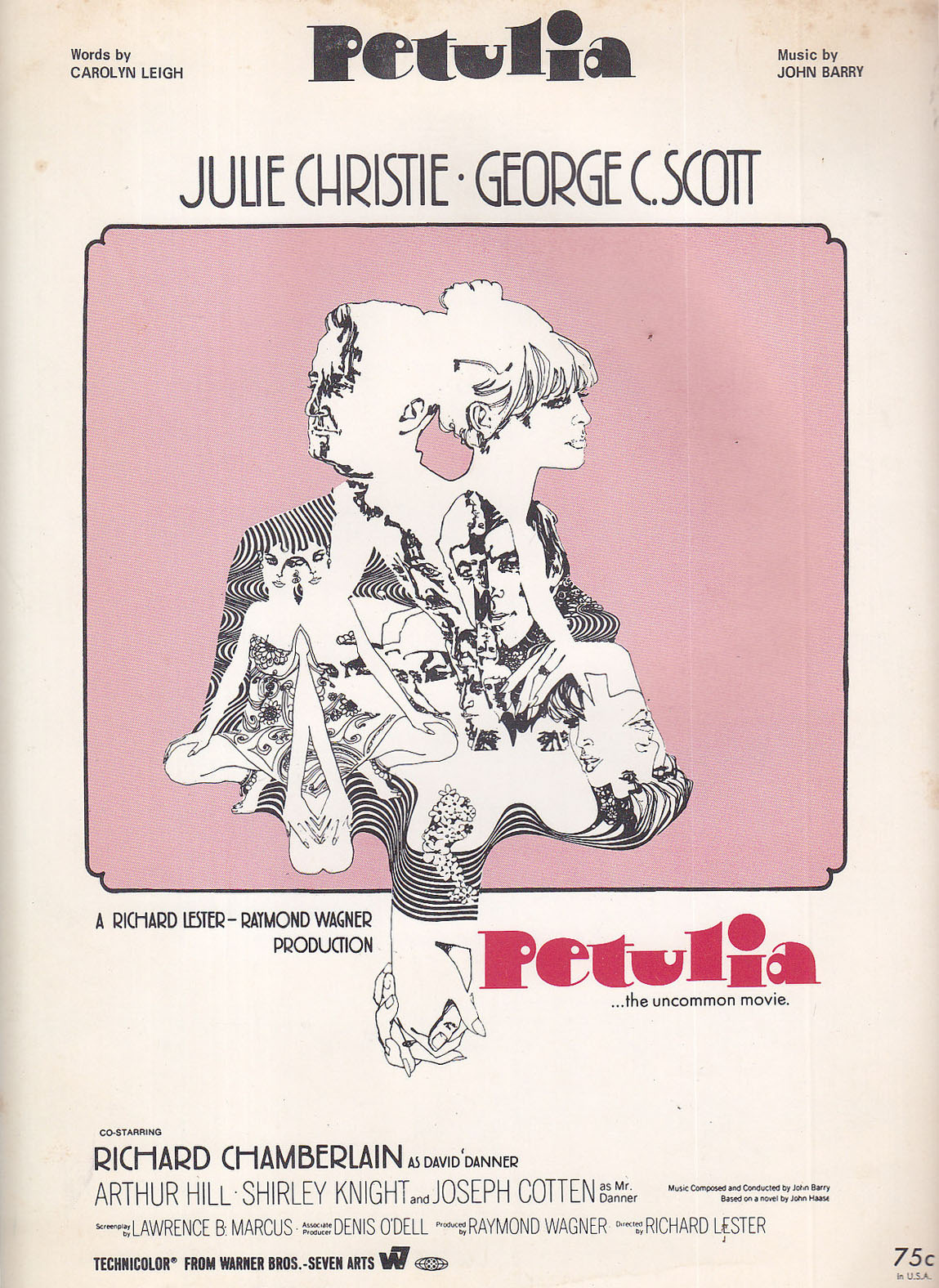
petulia1.jpg

Illustration by Bob Peak.

Further examples of those things you find when you’re searching for something else, these posters for Richard Lester’s Petulia (1968) are a good example of just how differently the same film can be presented by its advertising materials. Petulia (“the uncommon movie”) is a fascinating, unjustly neglected gem, a serious adult drama quite unlike the comedies (or comic dramas) Lester was making before and after. Nicolas Roeg photographed Petulia shortly before embarking on his own directing career, capturing San Francisco just after the Summer of Love in a more documentary fashion than the exploitation films of the period. There are nods to the psychedelic scene with party appearances by Big Brother and the Holding Company, and the Grateful Dead, but the narrative concerns the flipside of hippiedom with a group of middle-class professionals ensnared in adultery and marital failure.

A commonly remarked feature of Petulia is Antony Gibbs’ fragmented editing style which flashes backwards and forwards throughout, even showing events that never happen. The technique is usually taken to be derived from Alain Resnais although Gibbs had earlier edited The Knack…and How to Get It for Lester which is often as fragmented, albeit for a more comic effect. What’s notable about the technique is that Gibbs went on to edit Nicolas Roeg’s first two features, Performance (co-directed with Donald Cammell) and Walkabout, both of which take the fragmentation even further, creating the style which Roeg made his own.

petulia4.jpg

The poster that caught my attention was the marvellous one by Bob Peak who manages to depict the awkward relationship between the two leads—holding hands yet facing away from each other—whilst alluding to the psychedelic backdrop in the details. It’s difficult to tell at a small size but the sheet music design above shows that Peak’s drawing is a complex arrangement of blended faces, the reflected figure of a woman and a pattern of Bridget Riley swirls. If I was still collecting film posters I’d be sorely tempted to buy one of these.

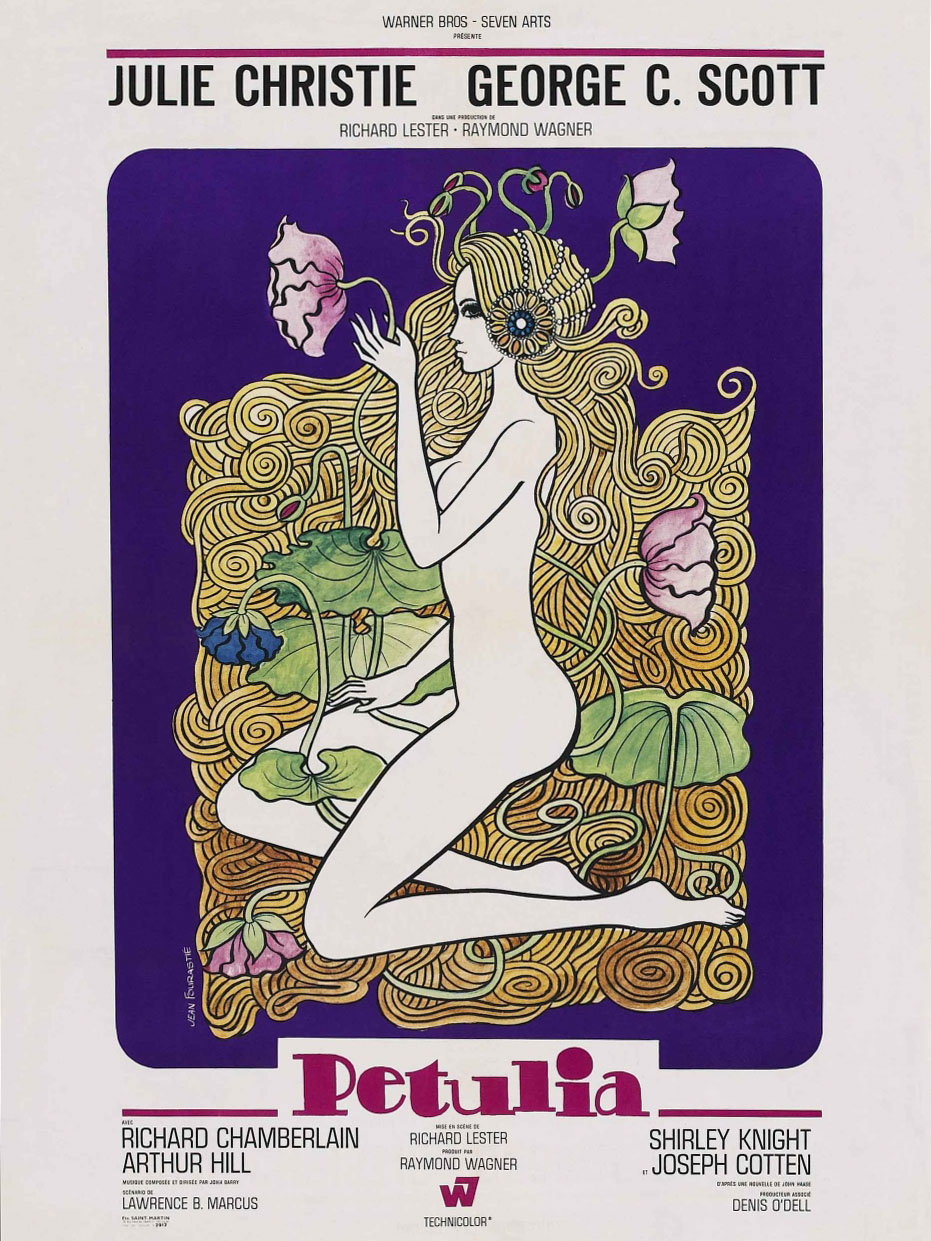
petulia2.jpg

Illustration by Jean Fourastié.

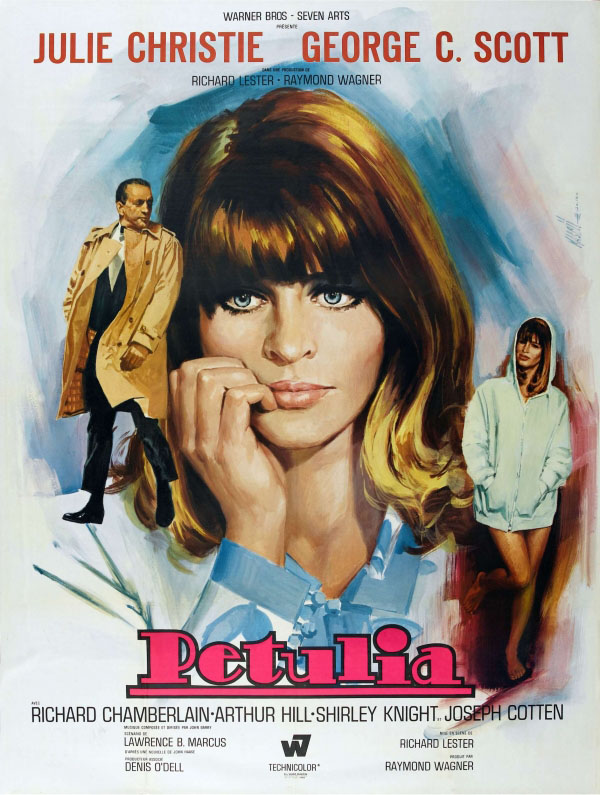
Compared to which this pair of French designs veer off in opposite and unsatisfying directions. Jean Fourastié seems to have been under the impression that the story concerned a San Francisco flower child not a bored housewife, while Jean Mascii’s painting isn’t inaccurate but is more suited to a romance paperback. Big heads were apparently Mascii’s métier even if there were no people in the film.

petulia3.jpg

Illustration by Jean Mascii.

Petulia has been available on DVD for a while now, it’s well worth seeking out. Watch the trailer here.

Previously on { feuilleton }
Lucifer Rising posters
Wild Salomés
Druillet’s vampires
Bob Peak revisited
Alice in Acidland
Salomé posters
Polish posters: Freedom on the Fence
Kaleidoscope: the switched-on thriller
The Robing of The Birds
Franciszek Starowieyski, 1930–2009
Dallamano’s Dorian Gray
Czech film posters
The poster art of Richard Amsel
Bollywood posters
Lussuria, Invidia, Superbia
The poster art of Bob Peak
A premonition of Premonition
Metropolis posters
Film noir posters