Les Temps Morts by René Laloux

temps1.jpg

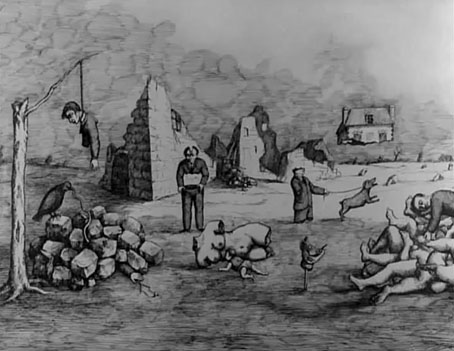
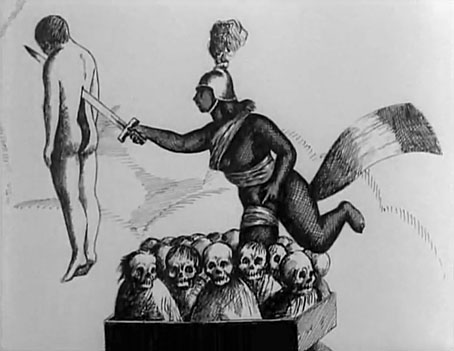
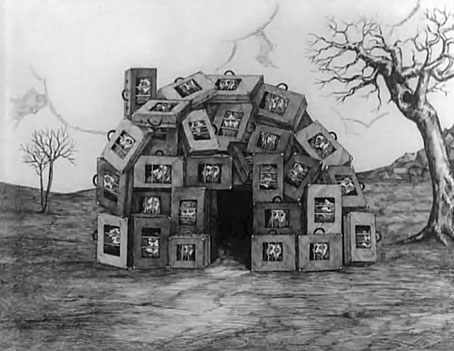
Is Les Temps Morts a French figure of speech? The phrase translates as “idle periods” as well as the more literal “dead times”, so the title of this short film from 1964 may have some punning intent. This was René Laloux’s second film as director, and one I’d not seen before until it turned up on YouTube. It’s an oddly morbid piece not far removed in tone from yesterday’s The Apotheosis of War but a dose of Surrealism courtesy of Roland Topor’s minatory imagination rescues it from Vereshchagin’s moralising.
temps2.jpg

Between some documentary clips of children play-fighting, war scenes, bullfights and bird shoots, Topor’s scratchy ink drawings are brought to life with minimal animation. There’s also some narration in unsubtitled French. Laloux, Topor and soundtrack composer Alain Goraguer followed this with another, lighter short, The Snails (also on YouTube), in 1966, and joined forces again for Laloux’s first animated feature in 1973, the justly-celebrated Fantastic Planet, a science fiction film that’s a lot weirder than the usual Hollywood conceptions of the genre. That’s been on DVD for a while, and is essential viewing for Topor aficionados.

The schizophrenic cinema of René Laloux by Craig Keller.
temps3.jpg

Previously on { feuilleton }
Taxandria, or Raoul Servais meets Paul Delvaux
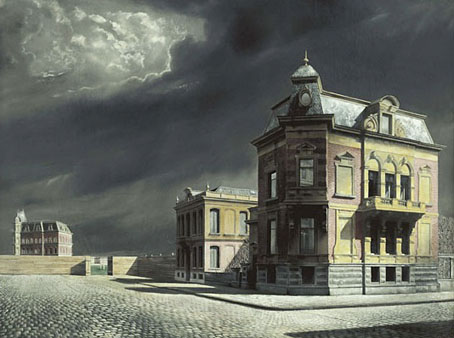
The art of Carel Willink, 1900–1983

willink1.jpg

Townscape (1934).

Carel Willink was a Dutch painter whose self-described brand of “imaginary realism” conjured in its early years a collection of views of desolate plazas, empty lanes and abandoned ruins over which smoke or cloud hangs like an ominous portent. The works of Giorgio de Chirico and Paul Delvaux come to mind when looking at these pictures although Willink’s work has enough unique qualities to stand apart from his more famous contemporaries. I’m also reminded a little of Spanish artist Arnau Alemany who has a similar predilection for isolated architecture.

willink2.jpg

Chateau in Spain (1939).

There’s an official Willink website here, while further paintings can be seen at this Flickr set and also at Ten Dreams.

Elsewhere on { feuilleton }
The fantastic art archive

Previously on { feuilleton }
Bruges-la-Morte
Taxandria, or Raoul Servais meets Paul Delvaux
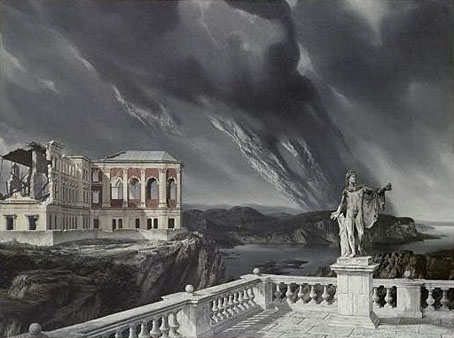
The art of Arnau Alemany

The Colmore Fatagravures

colmore1.jpg

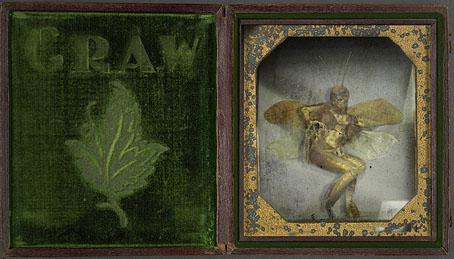
Golden Fairy Specimen.

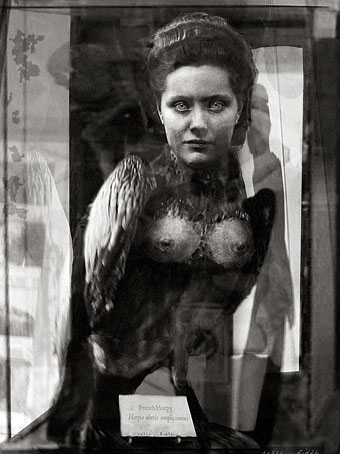
These have already been featured on many other sites but that shouldn’t exclude their presence here. The Wunderkammer concept seems to be a recurrent fascination on the web—see here and here and here, for example—possibly because the nature of the medium lends itself to the accumulation of curiosities. It’s a small step from collecting genuine curios to inventing those the world stubbornly refuses to provide, that’s what we see happening here and also at some of the earlier posts below. About the Colmore Fatagravures we’re told:

A Scottish adventurer, inventor, and photographer named Neville Colmore claimed to have constructed a device capable of “…parting the veil of Faery…”. The device, which he called the “Spectobarathrum”, produced beautiful photo graphic plates he called “fatagravures”, through a now lost process. The original “Spectobarathrum” along with all of the images he claimed to have made were believed destroyed in a fire. (More.)

colmore2.jpg

French Harpy of Questionable Provenance.

In a similar vein, I’ve already mentioned that I’ve done some design and illustration for the Thackery T. Lambshead Cabinet of Curiosities, the sequel to the Lambshead Disease Guide which is forthcoming from HarperCollins. The new book is edited by Ann & Jeff VanderMeer and publication has been announced for June. Jeff unveiled the near-final cover design just before Christmas (not my work, I should note) and a preview of some of the contents, including one of my interior pages. More about this closer to publication.

Previously on { feuilleton }
The specimens of Alex CF
Walmor Corrêa’s Memento Mori
Harpya by Raoul Servais
The art of Ron Pippin
Custom creatures
Jan Švankmajer: The Complete Short Films
Cryptozoology
The Museum of Fantastic Specimens

Weekend links 27

wang.jpg

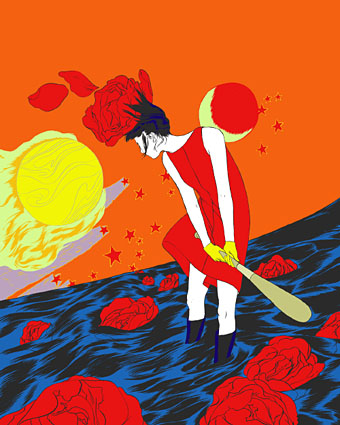
Annie Duels The Sun (2010) by Angie Wang.

I’m interviewed again, this time by James at Cardboard Cutout Sundown. Covering familiar subjects for {feuilleton} readers: art history, design, Lovecraft, the genre/mainstream seesaw, etc. Related: Jeff VanderMeer previewed my design for the forthcoming Steampunk Reloaded.

Battle over legacy of father of Art Nouveau. Prague authorities are demanding the paintings which comprise Alphonse Mucha’s Slav Epic be moved to the capital.

The films that time forgot. David Thomson on ten neglected works including a cult favourite of mine, Jerzy Skolimowski’s Deep End (1970).

The Viatorium Press: “Fine letterpress printing, digital typography, and hand painted illumination.” Among their recent productions is a poem by Clark Ashton Smith.

verne.jpg

À la conquête du pôle (1912); Georges Méliès vs. Jules Verne.

Taxandria, a feature-length collaboration between Raoul Servais, François Schuiten and, er, Alain Robbe-Grillet, is on YouTube. My earlier post about the film is here.

Salvagepunk, or (maybe) Post-post-modernism: “How a music micro-trend heralds an emerging, internet-enabled, aesthetic movement.” See also the latest issue of The Wire.

Drainspotting with Remo Camerota: documenting Japan’s creative manhole covers.

• Yo-ho-ho, and a bottle of squid: a book devoted to Kraken Black Spiced Rum.

After Stanley Kubrick. Christiane Kubrick on life without Stanley K.

• Pills and penises and kissing boys: Tara Sinn’s Kaleidoscopes.

Found Objects: a hauntological dumping ground.

• Sandow Birk’s American Qur’an.

• RIP Frank Kermode.

Feuerland (1968) by Theo Schumann Combo; Feuerland (1977) by Michael Rother; Feuerland (2007) by Justus Köhnke.

Echoes of the Cities

echo1.jpg

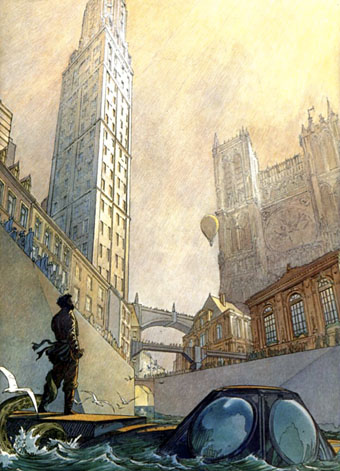
Mysterieux retour du Capitaine Nemo.

This week has been incredibly hectic work-wise but I’ve managed to keep these posts going, so here’s the last one devoted to an appreciation of the Cités Obscures of François Schuiten and Benoît Peeters. A week of posts barely scratches the surface of their vast and involved creation of alternate worlds, fantasy design and architecture, and Borges-like metaphysical speculation. When I try to explain my disaffection with the popular end of American comics, it’s works such as these which I offer as an alternative. The problem, of course, is that only a handful of the books have been translated into English, a detail which tells you all you need to know about English-speaking comics publishers and—since demand fuels the market—their readers.

This final set of pictures is a selection from Schuiten and Peeters’ L’Echo des Cités (1993), a facsimile edition of the main newspaper which serves the cities of the Obscure World. Unfortunately, this remains untranslated but the bulk of the book is full-page illustrations, many of which are among Schuiten’s best. A number of these were later reprinted as limited lithograph prints.

echo2.jpg

Les rêves engloutis d’Oscar Frobelius.

Continue reading “Echoes of the Cities”