Robert Anning Bell’s Poems by Percy Bysshe Shelley

bell01.jpg

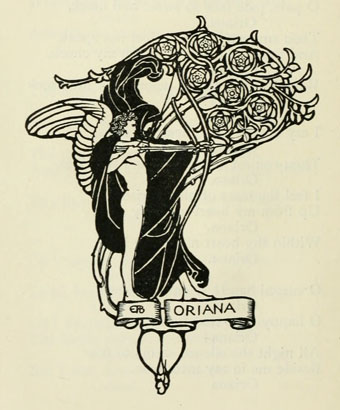
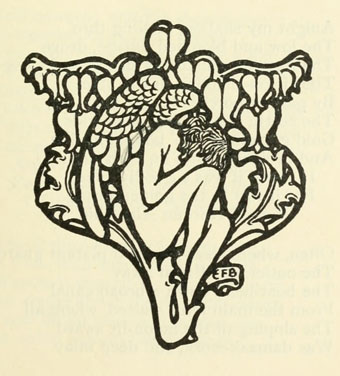
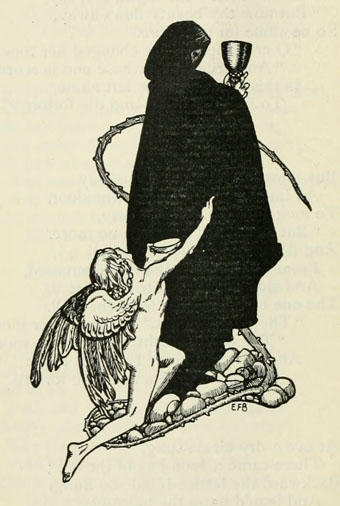
This poetry collection was drawn to my attention a couple of weeks ago when Mr TjZ sent an email containing photos of a copy he’d recently discovered. Poems by Percy Bysshe Shelley was published by George Bell and Sons in 1902. The samples shown here are from a 1907 reprint, a “cheaper reissue” according to the print details which may explain why there’s so much print-through on the obverse side of the illustrated pages. I like Shelley’s poetry, and I like Robert Anning Bell’s illustrations; the pair work well together in this volume which looking back I see posted a link to years ago when writing about Bell’s illustrated edition of The Tempest.

bell02.jpg

The Shelley book may be a cheap reissue but several of the major poems still use red ink to highlight titles or illustrative details. The collection contains a number of Shelley’s longer works, opening with Alastor, or the Spirit of Solitude, a poem that always makes me think of Aleister Crowley. John Symonds in The Great Beast relates that Shelley was one of Crowley’s favourite poets, and that Crowley often identified himself in a pompously romantic fashion with Alastor, even though for most of his life the Beast was seldom without an attendant “Scarlet Woman” or a company of acolytes. Symonds nevertheless refers to Crowley as “Alastor” throughout his biography.

bell03.jpg

bell04.jpg

bell05.jpg

Continue reading “Robert Anning Bell’s Poems by Percy Bysshe Shelley”

Weekend links 663

wt.jpg

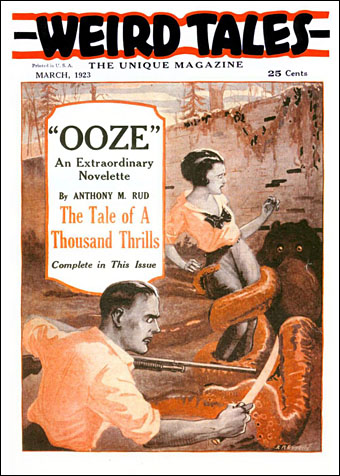
Weird Tales celebrates its centenary this month (although the first issue was on the shelves in February, 1923). Thirty years later, one of the last issues from the initial run had Slime by Joseph Payne Brennan as the story featured on its cover. The magazine maintained a viscous consistency if nothing else. Tentacular art by RR Epperly.

• A big surprise in yesterday’s Bandcamp Friday was the announcement of Singularity, a new album by synth ensemble Node. Or new-ish since the previously unreleased recording is almost 30 years old:

Singularity is the legendary “lost” Node album. Recorded at the same time as their original sessions in 1994 this has DiN stalwart Dave Bessell join Buller & Flood alongside original member Gary Stout who was later replaced by Mel Wesson for the two DiN releases. Presented here for the first time, mastered to modern standards but otherwise untouched and in its original form and recorded to two track with no overdubs.

Node have never been very prolific—two decades separate their first album from their second—so this was very welcome. The new release includes a bonus addition of the 16-minute version of Terminus, one of their best pieces which has only been available previously on a scarce CD-single.

• Steven Watson at Print Mag on skeuomorphic magazine design that turns print into play. Now I want to design a book that fits inside a cassette box.

• RIP jazz giant Wayne Shorter, and David Lindley, co-founder of one of my favourite psychedelic groups, the incredible Kaleidoscope.

• S. Elizabeth at Unquiet Things on The Sensitive Plant, a poem by Percy Shelley illustrated by Charles Robinson.

• Christopher Parker at Smithsonian Magazine asks “Did Salvador Dalí paint this enigmatic artwork?” Yes, he did.

Tangerine Dream in 1973 playing Atem live (with pre-recorded drums) on Spotlight, an Austrian TV show.

• New music: Mohanam by Shakti, and Area Code 601 by William Tyler & The Impossible Truth.

• At Spoon & Tamago: Bento boxes inspired by notable Japanese architecture.

• At Tentaclii: Ian Miller cover art for metal albums.

Northern lights seen across the UK.

New Blue Ooze (1970) by Kaleidoscope | Ooze Out And Away, Onehow (1986) by Harold Budd/Simon Raymonde/Robin Guthrie/Elizabeth Fraser | Ooze (1986) by 23 Skidoo

Laurence Housman’s The Sensitive Plant

sensitive02.jpg

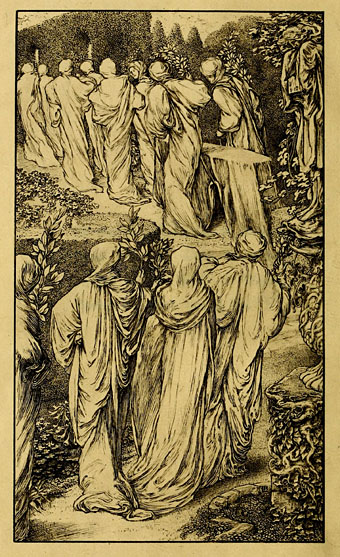
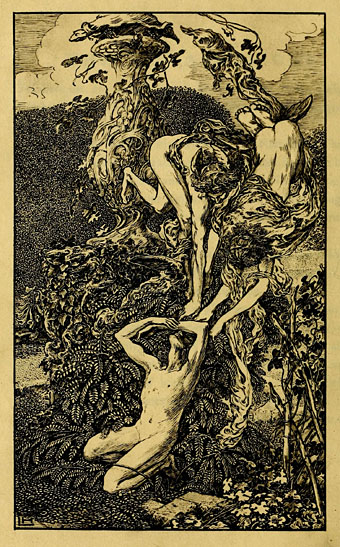
Shelley’s The Sensitive Plant is a lengthy poem written after the death of Percy and Mary Shelley’s first child. Laurence Housman illustrates the sombre garden scenes in a minutely detailed manner, and manages to incorporate some concerns of his own. Pan isn’t mentioned in the poem but Housman adds a Pan figure which he describes in a note as “the garden deity”, and a symbol of nature untamed.

sensitive01.jpg

sensitive03.jpg

Continue reading “Laurence Housman’s The Sensitive Plant”

Aleister Crowley: Wandering The Waste

crowley1.jpg

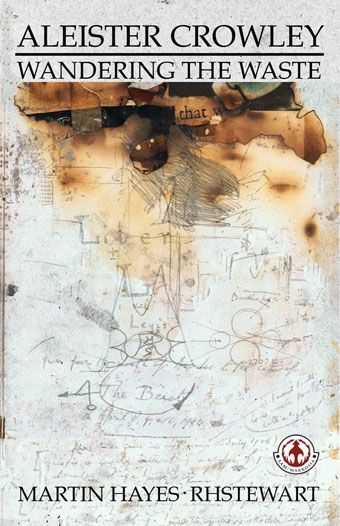
I mentioned this graphic biography of Aleister Crowley earlier in the year but pressure of work has meant it’s taken me all this time to finally read it. Aleister Crowley: Wandering The Waste is written by Martin Hayes and illustrated by RH Stewart. The title alludes to Alastor, or The Spirit of Solitude, a Shelley poem concerning an itinerant poet with whom Crowley often identified.

Crowley isn’t a stranger to the comics world but this book is the first I’ve encountered that devotes itself to the facts of the man’s life rather than using his notorious persona as a general purpose scare figure. Crowley’s life was nothing if not eventful: in addition to the numerous rituals and magickal exploits, he was also a serious mountaineer, and something of a globetrotter before his inheritance ran out; he wrote novels, memoirs, several volumes of poetry, even more volumes of occult philosophy, and was a world-class drug-taker and libertine in an age when sexual escapades of the mildest sort could provoke the deepest outrage.

Given all of this you’d expect somebody to have tried to film his life by now, but doing so presents a number of problems. Period biopics are by their nature very expensive which is why they tend to take the least controversial figures for their subjects. Crowley isn’t only controversial, his life’s work remains esoteric and difficult for a general audience; you’d have to work hard to dispel Devil Rides Out clichés for people who’ve never opened an occult book. There’s no life without the magick, however, so you’re unlikely to get either trying to follow the costume-drama route. In the past I’ve thought that a better solution would be to adopt the jigsaw approach used in François Girard’s Thirty Two Short Films About Glenn Gould (1993); significant moments could be dramatised as they are in the Gould film while other sections could be more graphical, abstract or theoretical.
crowley2.jpg

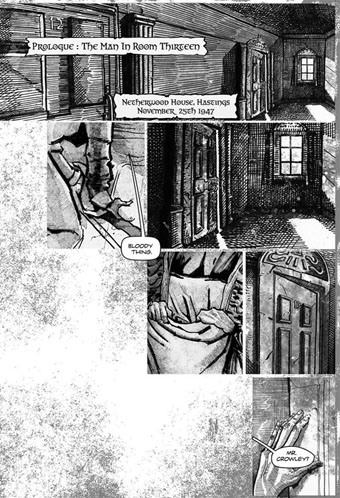
Hayes and Stewart’s book goes for the traditional biopic approach (albeit with some deviations), there being no reason not to when you have an unlimited budget. It’s 1947, and Crowley in his Hastings nursing home remembers his life for a young visitor, delivering a narrative that ranges across seventy years, and which acknowledges the more scandalous moments whilst also repudiating some of the rumours. Hayes backs up his facts with copious endnotes, some of which offer more detail about disputed incidents. Alan Moore and Eddie Campbell’s From Hell is the obvious progenitor here; both books show the strength of comics in being able to deliver historical material in a visual form without having to worry about the constraints of cinema.

Stewart’s artwork is from the sketchy, collaged Sienkiewicz/McKean school of comic art. In some scenes I would have preferred more visual detail but then having drawn historical comics myself I know how difficult it can be having to research the appearance of every last piece of clothing or furniture. (The lettering is also afflicted with a few typos.) Some of the scenes away from 1947 are delivered in a fragmented, hallucinatory style in which occult figures and symbols are confused with Crowley’s memories. The technique enables many years to be covered without padding the book to doorstop size while also keeping the magick as a continual background presence. It’s quite a change to have the aged Crowley as the focus for once, a dishevelled magus rather than the usual libidinous firebrand. After so much turmoil, there’s always a sombre atmosphere around the Great Beast’s less-than-beastly final days, although they were considerably more peaceful than those of some of his wives and associates. Whatever regrets or disappointments Crowley may have felt, his books are still in print, and we’re still talking about him.

The Atlantis Bookshop in London has been showing some of Stewart’s artwork throughout this month. I’ve always liked the way the Atlantis doubles as a mini-gallery, I saw some Austin Spare drawings there a few years ago; it’s a good venue, and the ideal place to view this work. The exhibition will run to December 24th.

Previously on { feuilleton }
Brush of Baphomet by Kenneth Anger
Rex Ingram’s The Magician
The Mysteries of Myra
Aleister Crowley on vinyl
Eleanor Fortescue-Brickdale’s illustrated Tennyson

brickdale01.jpg

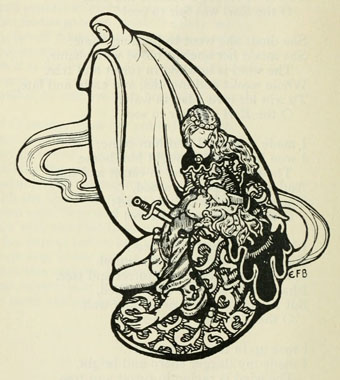
Drawings from an edition of Alfred Tennyson’s Poems illustrated by British artist Eleanor Fortescue-Brickdale (1872–1945) which was published by George Bell & Sons in 1905. The book was part of a series of illustrated poetry collections that included several books featured here in previous posts: Poems by John Keats and Poems by Percy Bysshe Shelley both illustrated by Robert Anning Bell, and The Poems of Edgar Allan Poe illustrated by William Heath Robinson. There was also an edition of Browning illustrated by Byam Shaw at whose art school Ms Fortescue-Brickdale was employed as a teacher. Her Tennyson drawings aren’t entirely to my taste, I’ve omitted the full-page works which are rather static pre-Raphaelite-derived things. Far better are these vignettes whose heavy outlines and sinuous curves resemble both Heath Robinson’s early illustrations and Pamela Coleman Smith‘s famous Tarot card designs. As usual the Internet Archive has the whole book and (should anyone require more Tennyson) Ms Fortescue-Brickdale’s take on that Victorian staple Idylls of the King.

brickdale02.jpg

brickdale03.jpg

brickdale04.jpg

Continue reading “Eleanor Fortescue-Brickdale’s illustrated Tennyson”