Salome’s Last Dance

salome1.jpg

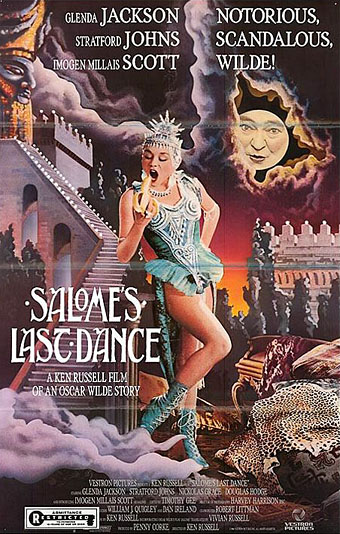
More Wildeana. It’s taken me over two decades to watch this film, and while I can’t really say it was worth the wait it was more entertaining than I expected. Salome’s Last Dance was directed in 1988 by Ken Russell and is his own typically mannered adaptation of the Wilde play. It appeared around the same time as his adaptation of another Victorian work, Bram Stoker’s The Lair of the White Worm, and it was the latter film which caused me to lose my patience with Russell’s excesses and so ignore this one. In Salome’s Last Dance we have Oscar Wilde and Lord Alfred Douglas visiting Alfred Taylor’s London brothel one night in 1892 where Taylor and company stage a performance of Wilde’s banned play.
salome2.jpg

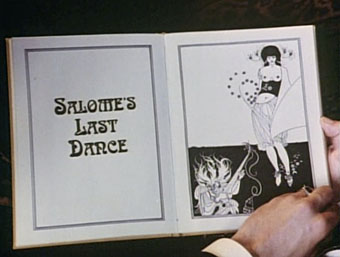
Aubrey Beardsley’s illustrations appear in the title sequence.

If you’re a Wilde enthusiast there are at least two ways you may take this; you can be appalled by Russell’s “translation” of Wilde’s words (Salomé was written in French then translated for English publication in 1894; there’s no reason to re-translate a version the author approved), a translation which is really more of an adaptation, with much of the poetic monologue removed and the tone lowered for a general audience—Wilde’s “Iokannen” is vulgarised to “John the Baptist” throughout. Or you can try and enjoy what is at least a complete performance of the play, even though it more often resembles Carry On Salomé than anything one might have expected Sarah Bernhardt to perform. Injecting a Symbolist drama with slapstick and grotesquery is probably inevitable given the director (Russell is also co-writer and he plays—badly—the role of the Cappadocian). I found it impossible to decide whether Russell was sending up the play because he found it too pompous or whether he felt that an audience wouldn’t sit still for it otherwise. Whatever his intention, the premise is intriguing enough to inspire speculation as to how it might have been treated by other hands.
Continue reading “Salome’s Last Dance”

The Oscar Wilde Galop

wilde_galop.jpg

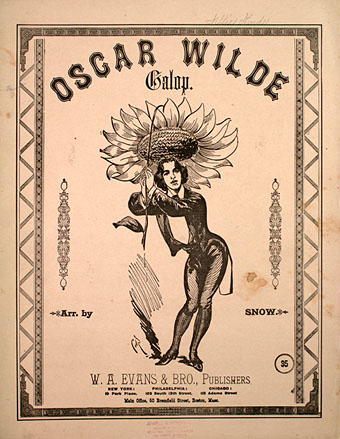
When Oscar Wilde arrived in America to begin his lecture tour in 1882 the excursion provoked considerable comment on both sides of the Atlantic. Wilde was there in his capacity as an ambassador for Aestheticism, a position which had already made him a figure of fun in the pages of Punch magazine while the Aesthetes generally and Wilde in particular had been caricatured the year before by Gilbert & Sullivan in their opera, Patience. The Oscar Wilde Galop was one of a number of topical dance pieces which capitalised on Wilde’s arrival in America, the full score of which can be seen in the Levy Sheet Music Collection at Johns Hopkins University. No one seems to give the name of the composer of these works for some reason, but this piece and others like it can be found on a CD, To Oscar: A Collection of Aesthetic Melodies.

I suspect Oscar would have been flattered by his portrayal on the sheet music, it’s milder than the Punch cartoons and gives him a wasp waist he never possessed even in his youth. Wilde enjoyed his lecture tour, and was always happy to be the centre of attention, of course, but America (and others) paid the price for the ribbing later on, as in this exchange from The Picture of Dorian Gray:

“I am told, on excellent authority, that her father keeps an American dry-goods store,” said Sir Thomas Burdon, looking supercilious.

“My uncle has already suggested pork-packing Sir Thomas.”

“Dry-goods! What are American dry-goods?” asked the duchess, raising her large hands in wonder and accentuating the verb.

“American novels,” answered Lord Henry, helping himself to some quail.

The duchess looked puzzled.

“Don’t mind him, my dear,” whispered Lady Agatha. “He never means anything that he says.”

“When America was discovered,” said the Radical member—and he began to give some wearisome facts. Like all people who try to exhaust a subject, he exhausted his listeners. The duchess sighed and exercised her privilege of interruption. “I wish to goodness it never had been discovered at all!” she exclaimed. “Really, our girls have no chance nowadays. It is most unfair.”

“Perhaps, after all, America never has been discovered,” said Mr. Erskine; “I myself would say that it had merely been detected.”

“Oh! but I have seen specimens of the inhabitants,” answered the duchess vaguely. “I must confess that most of them are extremely pretty. And they dress well, too. They get all their dresses in Paris. I wish I could afford to do the same.”

“They say that when good Americans die they go to Paris,” chuckled Sir Thomas, who had a large wardrobe of Humour’s cast-off clothes.

“Really! And where do bad Americans go to when they die?” inquired the duchess.

“They go to America,” murmured Lord Henry.

Elsewhere on { feuilleton }
The Oscar Wilde archive

The Savoy magazine

savoy.jpg

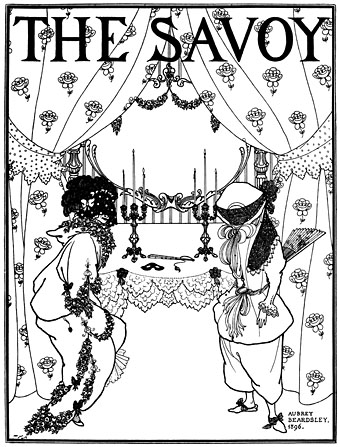
Further retrievals from the depths of the Internet Archive (and thanks to Lord Cornelius Plum for the tip) come in the form of three bound editions of The Savoy magazine, a British art and literary periodical which ran for eight issues from January to December 1896. Aubrey Beardsley was art editor and chief illustrator, Arthur Symons the literary editor and the publisher was the heroic and duplicitous London pornographer Leonard Smithers whose patronage and, it should be noted, exploitation of Beardsley’s work kept the artist solvent during his last two years.

A thesis could be written (and no doubt has been) exploring the curious symbiosis between pornography publishers and the artistic avant garde. Smithers was a proud purveyor of what he called “smut” but he also complained about all the money he lost supporting poets and down-at-heel writers. Posterity can thank him for publishing Teleny, the classic early work of gay fiction attributed to Oscar Wilde, as well as Beardsley’s Lysistrata illustrations and The Savoy, a magazine founded in the fallout of the Wilde scandal when The Yellow Book dropped Beardsley from its staff in order to appease its more conservative contributors. The magazine’s run was short due to poor sales after WH Smith’s refused to stock it, worried again about the controversial nature of Beardsley’s art. (Speculative fiction magazine New Worlds faced similar problems with Smith’s in the late Sixties.) This seems astonishing to us now when looking at the world-class roster of contributors to the first issue, a list which included two future Nobel winners—George Bernard Shaw and WB Yeats—as well as Max Beerbohm, Ernest Dowson, Havelock Ellis, JM Whistler, Charles Shannon, William Rothenstein, and Beardsley writing and illustrating the first part of his erotic caprice, Under the Hill.

Beardsley’s illustrations are very familiar from book reproduction but it’s good to see them in the context in which they first appeared, and to be able to read some of the features. The later issues include pages of adverts which always fascinate for their contemporary detail.

The Savoy: Volume 1 | Volume 2 | Volume 3

Elsewhere on { feuilleton }
The Aubrey Beardsley archive
The illustrators archive

Weekend links 5

kamekura.jpg

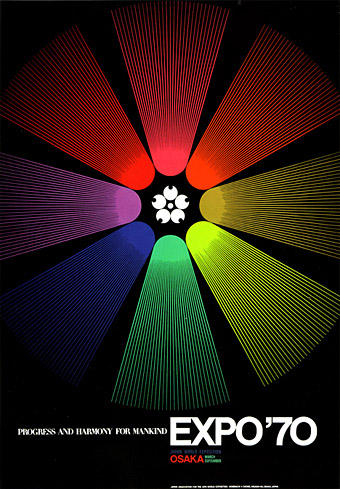
A poster design by Yusaku Kamekura. More here, via A Journey Round My Skull.

First of all this week, there’s a new interview posted which I gave last year to Crows ’n’ Bones magazine. The replies skate around the usual subjects (Cthulhu et al) and you also find out why I don’t think design and illustration for music is going to vanish as soon as some people think.

• A Journey Round My Skull has announced The Raymond Roussel Illustration Contest which is open to all.

• Cover designs: David Pearson on redesigning Cormac McCarthy’s UK covers, a huge improvement on the previous Picador series. Also, The Robert Lesser Pulp Art Collection.

• Last year I discussed Teleny, Or the Reverse of the Medal, the novel of gay erotica attributed to Oscar Wilde, giving a mention in passing to Jon Macy’s comic strip adaptation of the book. That adaptation has now been published and is available via his website.

bradley_kiss.jpg

The Kiss (1896) by Will Bradley.

• More Art Nouveau (because too much is never enough): Will Bradley’s work at Golden Age Comic Book Stories. Can’t understand how I missed this one.

• A discussion: The Magic Mystery and Melancholy of Five Leaves Left by Nick Drake.

• Sandi Vincent’s Flickr pages overflow with Graphis Annual goodness.

• A new edition of the Arthur Radio Voyage is available to download. And Trunk Records’ Jonny Trunk has a mix of obscure vinyl for you.

• Song of the week: We Want War by These New Puritans. Slow motion shots in the video are a plus.

Ode to the Classics

gloeden.jpg

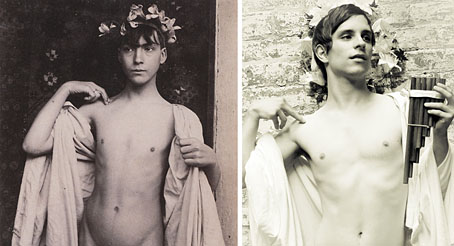
In which photographer Mikel Marton works variations on Wilhelm von Gloeden’s nude studies of the boys of Taormina, Sicily. “Classic” has a double meaning here since Von Gloeden’s photographs are now considered classic works of early homoerotica (Oscar Wilde was an enthusiast) as well as borrowing their props and poses from Classical antiquity. The very attractive model in the new shots is one Barry K and Mikel also posts some pictures by Sascha Schneider whose deeply strange and mystical illustrations have featured here in the past.

Previously on { feuilleton }
Uranian inspirations
Forbidden Colours
Mikel Marton
The art of Sascha Schneider, 1870–1927
Toxicboy
Evolution of an icon