Roger Dean: artist and designer

Kieran at Sci-Fi-O-Rama was in touch recently asking me to contribute a paragraph about a favourite Roger Dean picture for this feature about the artist. The following splurge of polemic was the result, something I’d been intending to write for a while. Since so many words would have overwhelmed the other contributions it’s being presented here while Kieran’s post has a variety of shorter appreciations and further examples of Dean’s art and design.

dean1.jpg

Pathways (1973). A slightly reworked version of the original painting.

“Science fiction is unfortunate in having a most unsatisfactory framework of existence—it’s considered literary kitsch. I believe it should be the mainstream of literature because all the books that have become important down the generations of civilisation have been books about ideas. Superficially, science fiction would seem to offer the most scope for idea content, but the promise is unfulfilled. Good ideas and good writing rarely coincide. All too often the medium is used for entertainment alone and its potential beyond this should be obvious to everyone. I don’t just mean in the sense of fantasy technology. The potential for anticipating human evolution is there and perhaps the means to bring it about and definitely the means to bring about a social evolution.”

Roger Dean, interviewed in Visions of the Future (1976).

If popularity is often a curse as well as a blessing, it’s been Roger Dean‘s curse to see his work dismissed along with many other products of a decade—the 1970s—with more than its share of cultural heroes and villains. Music journalists in Britain have for years given the impression that the arrival of the Sex Pistols in 1976 swept away all that preceded them, in particular bands such as Yes whose album covers had helped raise the visibility of Dean’s art to an international level. This is not only a lazy assumption, it’s also wrong. When Yes released Going For the One in 1977 it was their first studio album in three years, yet despite the punk explosion it went to no. 1 in the UK album charts, while a rare single release from the band made the UK top ten. Yes were playing sell-out tours in Europe and the US in 1977 and 78, as were Pink Floyd whose The Wall was massively popular worldwide in 1979. Punk didn’t sweep prog away, what happened with its advent was that progressive rock and everything associated with it—Roger Dean’s art included—became critically disreputable almost overnight, such that no music journalist would dare say anything good about it. That disrepute has persisted for thirty years despite a lasting and indelible influence. This is an old argument but some facts often need restating anew. *
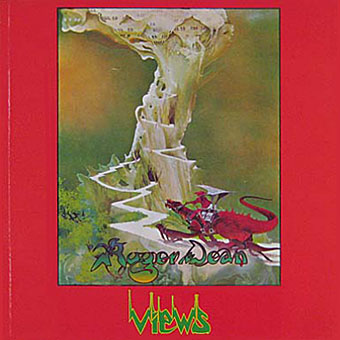
dean6.jpg

Views (1975).

I was 13 in September 1975 when Roger Dean’s first collection of his illustration and design work, Views, was published. At that time, I hadn’t heard any of the music to which his paintings and drawings were attached, and I didn’t even see a copy of the book until February 1976 when I happened to be in London on a school trip and found a big pile of what I guess was the second edition in Foyle’s book shop. This appeared at exactly the right moment. I wasn’t listening to the music but I was reading a lot of science fiction, and was starting to notice and imitate the work of various paperback artists. I recognised many of the pictures in Views from the covers displayed in the window of our local record shop, Cobweb, whose shopping-bag logo was a cowled magician figure à la Dean or Rodney Matthews. It’s difficult to say what struck me about Dean’s work at the time since you rarely articulate your preferences at that age. I think I liked the consistency of vision and the invention which blended the organic and mechanical, the architecture which looked at once ancient and futuristic, and the flat landscapes which put lone pine trees into rocky terrain familiar from Japanese and Chinese prints. For a teenager his style was also relatively easy to imitate if you forgot about basic things such as imagination and finesse, and I spent a year producing a lot of badly-drawn reptiles posed against lurid watercolour skies.
Continue reading “Roger Dean: artist and designer”

Album cover postage stamps

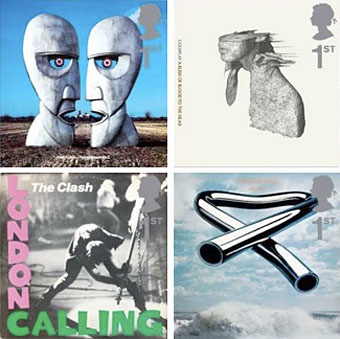
albums1.jpg

top row: The Division Bell by Pink Floyd; A Rush of Blood to the Head by Coldplay.
bottom row: London Calling by The Clash; Tubular Bells by Mike Oldfield.

The Royal Mail follows its series of British Design Classics postage stamps with a series dedicated to what they call “classic” album covers. The design classics in the earlier series deserved the term—a  Mini motor car, a Penguin book cover, the London Underground map, etc—whereas here we have the word “classic” being used in its lazy journalist sense where it becomes a synonym for “popular” and “familiar”, two attributes which often diminish with time.

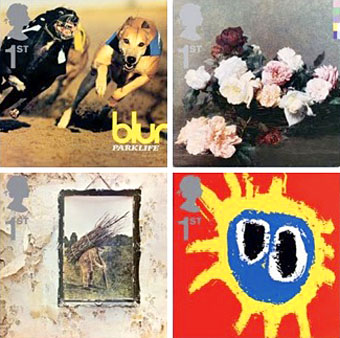
albums2.jpg

top row: Parklife by Blur; Power, Corruption and Lies by New Order.
bottom row: IV by Led Zeppelin; Screamadelica by Primal Scream.

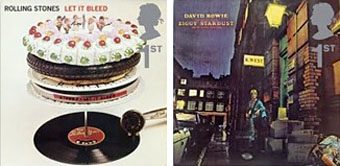
It should be noted that the choice of cover art was limited to releases by UK artists, and the designs had to be readable at the very small size of a postage stamp. Even so, I can’t help but regard this as a missed opportunity. There was no need to feature the Beatles since they’d been given their own set of stamps in 2006, but I’ve never thought of the cover of Let It Bleed (below) as a classic, even though musically it’s one of the best Stones albums. I’d rather choose Andy Warhol’s cover for Sticky Fingers but you can imagine the upset at stamp users being forced to lick a picture of a bulging pair of jeans. As for Pink Floyd’s Division Bell, it’s a typically striking design from Storm Thorgerson but does anyone really think it’s more classic than earlier Floyd covers, not least the Dark Side of the Moon prism which even people who hate the band can instantly recognise? Nearly all these choices seem confused or compromised; the Clash cover is the token punk offering—Royal Mail wouldn’t dare choose Never Mind the Bollocks—but Ray Lowry’s design was copied from an Elvis Presley sleeve; Led Zeppelin’s IV is a great album but other releases had far better covers; Primal Scream, another great album but the whole sleeve design is perfunctory; the Blur choice is merely bewildering.

albums3.jpg

left: Let It Bleed by The Rolling Stones; right: The Rise and Fall of Ziggy Stardust and the Spiders from Mars by David Bowie.

As far as designers go, Hipgnosis (via Storm T), Peter Saville (New Order), and Stylorouge (Blur) are included here but there’s nothing from Barney Bubbles, Malcolm Garrett, 23 Envelope, Neville Brody, Designer’s Republic or any of the other pioneering British designers of the past 30 years. The trouble with those names, of course, is that many of the artists they worked for aren’t popular or familiar enough to the average British stamp purchaser so their work can’t be deemed “classic”. A best of British, then, which could have been a lot better.

Classic Album Covers will be issued on January 10th, 2010.

Elsewhere on { feuilleton }
The album covers archive

Previously on { feuilleton }
British Design Classics
Stamps of horror
Endangered insects postage stamps
James Bond postage stamps
Please Mr. Postman

Reasons To Be Cheerful: the Barney Bubbles revival

reasons.jpg

My long and rambling post about the work of Barney Bubbles in January 2007 generated a considerable flurry of renewed interest in the great designer and ended by saying “We’re overdue a decent book-length examination of his work and his influence.” Just over a year later, here we are…. Paul Gorman was one of the contributors to the lengthy comments thread and I’m really pleased to see him take up the challenge to bring Barney’s work to a wider and, one hopes, new audience. Reasons To Be Cheerful (title borrowed from an Ian Dury song) is scheduled to be published by Adelita in November 2008.

bb.jpg

left: Doremi Fasol Latido by Hawkwind (1972).
right: Ian Dury & the Blockheads logo design (late 70s).

“He was so good I couldn’t have really competed with him.”
Sir Peter Blake

Reasons To Be Cheerful is a celebration of the life and work of one of the greatest designers of recent times: Barney Bubbles.

Bubbles—real name Colin Fulcher—was a giant of graphic design whose prodigious output is revered by musicians, artists, fellow designers and music and pop culture fans.

Reasons To Be Cheerful is published November 2008 to coincide with the 25th anniversary of the artist’s death. Author Paul Gorman is also curating a companion exhibition with Sir Paul Smith.

Barney Bubbles’ body of work included early posters for the Rolling Stones, brand and product design for Sir Terence Conran, psychedelic art with poster maestro Stanley Mouse, layouts for underground magazines OZ and Friends and collaborations with many bands and performers, from counter-culture collective Hawkwind to new wave stars Elvis Costello, Ian Dury, Nick Lowe, Graham Parker, The Damned and Billy Bragg.

Bubbles links the colourful underground optimism of the 60s to the sardonic and manipulative art which accompanied punk’s explosion from 1976 onwards, and influenced a generation of design talent including Neville Brody, Malcolm Garrett and Peter Saville.

The lavishly illustrated Reasons To Be Cheerful will contain hundreds of images and many full-colour plates.

About the Author
Paul Gorman is a popular culture historian and author of The Look: Adventures in Rock & Pop Fashion, and the top ten bestselling Straight with Boy George.

Paul Gorman’s The Look: Adventures in Rock and Pop Fashion

Previously on { feuilleton }
Barney Bubbles: artist and designer

Two today

erte.jpg

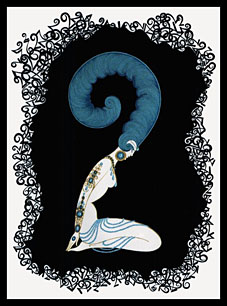
Numeral by Erté. Via Fabulon.

In which { feuilleton } celebrates its second birthday. As always, it’s a surprise seeing what catches the attention of readers or random browsers. The five most popular posts from the past year were as follows:

The art of ejaculation. I saw Cary Kwok’s work mentioned in a gay magazine so followed it up on the web, whereupon it occurred to me that the male moment of climax was rarely depicted visually outside the world of porn. Hence a necessarily small list of all the examples I could think of which was then linked on a couple of popular sex-related sites.

Two guys kissing. My ungenerous reaction in May to the death of Jerry Falwell, using a splendidly erotic photo by Jack Slomovits. It’s mainly the title which attracts people, I think, some of the most popular search phrases bringing people here are “two guys kissing” or “two gays kissing”. One can only hope that the searchers aren’t disappointed.

The art of Takato Yamamoto. I’m surprised this has been so popular considering the artist isn’t very well-known. If I was a publisher I’d be arranging reprints of his books for Europe and the US.

Barney Bubbles: artist and designer. No surprise that this is still receiving attention seeing as it’s now linked on the Barney Bubbles Wikipedia page as well as a great many design blogs.

Neville Brody and Fetish Records. In a similar vein, one of my earliest posts is still very popular as well, possibly because there isn’t a good selection of Brody’s early album art anywhere else.

And since I started making static archive pages for some categories (for my convenience as much as that of readers), the Gay artists archive has proved very popular even though it’s not been there for long. That’s either an indicator of the readership demographic or evidence that people are more curious than they often let on.

Thanks again for reading!

John x

Alex Steinweiss: creator of the album cover

steinweiss2.jpg

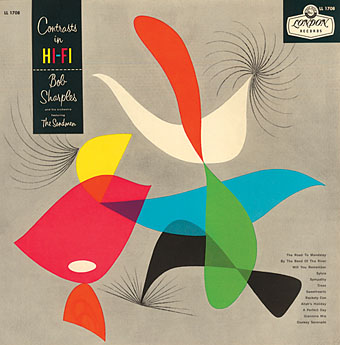
Contrasts in Hi-Fi by Bob Sharples.

A Tribute to Alex Steinweiss
The Creator of the Album Cover

Robert Berman Gallery announces an exhibition of Alex Steinwiss. Original album covers, paintings, and collages by Steinweiss, and special tribute by selected artists. Co-curated by Kevin Reagan and Greg Escalante.

In 1939, a 23 year-old graphic designer revolutionized the music industry. No longer would records come in plain brown wrappers. As Art Director at Columbia Records, Steinweiss created the ‘album package.’ His idea was to create a visual to complement the musical. It was an instant success, and spawned an entire new field of illustration and design: Album Cover Art. Steinweiss was the king of the genre; his covers are still regarded as icons.In his four decade career, Steinweiss created album covers for musical luminaries such as Louis Armstrong, Duke Ellington, Igor Stravinsky and Benny Goodman.

steinweiss1.jpg

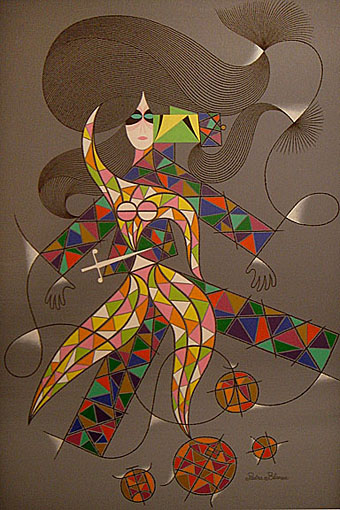
The Miraculous Mandarin (circa 1977).

The Steinweiss exhibition will feature 50 of his original cover designs, plus 50 original ‘tribute’ works, created specifically for this show. Artists that are honoring Steinweiss in the show include: Clive Barker, Bill Barminski, Ron English, Mick Haggerty, Raymond Pettibon, Shag, and Glenn Wexler. The featured artists have created album covers for a wide range of musicians, including Black Flag, Dixie Chicks, Goo Goo Dolls, Supertramp, and Rob Zombie.

“Steinweiss is 90 years old this year; this tribute is long over-due. The art community is excited to have a chance to pay homage to Alex’s unprecedented contribution to album cover art,” says Kevin Reagan, three time GRAMMY winning Art Director.

“It’s amazing to discover this one man, this un-sung hero, who is responsible for inventing the album. Steinweiss should be a household name,” says Greg Escalante, curator of Juxtapoz, and co-founder of Copro-Nason Gallery.

“The opportunity to highlight ‘the art of music’ is exciting. You have the energy of two different genres, and their combination is explosive,” says gallery owner Robert Berman. “Just plain design didn’t mean a damn thing,” Steinweiss says. You had to know music. I had to find a way to bring out the beauty of the music and the story.” (dwell, 10/07)

Alex Steinweiss lives in Sarasota, Florida, where he continues to design and paint.

A Tribute to Alex Steinweiss
Gala Opening: January 19th
Show runs through February 12th, 2008

Robert Berman Gallery
Bergamot Station Arts Center
2525 Michigan Avenue, C2
Santa Monica, CA 90404

Alex Steinweiss at the Art Director’s Club Hall of Fame
For the Record: The Life and Work of Alex Steinweiss at Amazon
Alex Steinweiss at Soundfountain

Elsewhere on { feuilleton }
The album covers archive