Against Nature: The hybrid forms of modern sculpture

sculpture.jpg

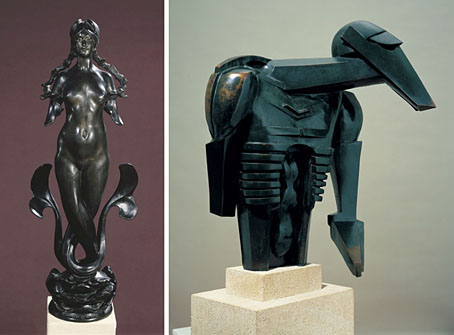
left: Morgan Le Fay by Pierre Roche (1904).
right: The Rock Drill by Jacob Epstein (1913–14).

An exhibition of ‘fantastic’ sculpture opened at the Henry Moore Institute in Leeds last week with some fascinating juxtapositions, ranging from Fernand Khnopff’s Mask to Jacob Epstein’s marvellous Rock Drill which is more commonly one of the landmarks of the Tate Britain collection. Also on display is some work by a Romanian artist I hadn’t come across before, Dimitrie Paciurea (1873–1932), whose chimeras might seem influenced by Symbolism but which look a lot stranger than the usual Symbolist statuary.

Against Nature runs until May 4th, 2008.

Sculpture has frequently been used as a medium of metamorphosis. Its malleable materials allow fantastic forms to become real as it mixes human, animal and vegetal components. This was never more so than during the late 19th century when many sculptors turned their back on classical notions of anatomy and used sculpture as a vehicle for the imagination. This exhibition begins in the late 19th century and presents a common fascination with the world of the hybrid across the various art movements of the 20th century right up to recent years with the work of Louise Bourgeois.

Figures drawn from classical mythology—sphinxes, chimeras and centaurs—were the stock subjects of late 19th century Salon exhibitions. Meanwhile, outside the gallery, the pressures of industrialisation and of Darwin’s theory of evolution provided compelling new contexts for the hybrid. To say that sculpture was ‘against nature’ at this time is to suggest two lines of enquiry: firstly that sculpture could create impossible beings that went beyond the natural order, but which evolution could potentially deliver; secondly, that sculpture presents absurd fantasy creatures by means of realistic modelling so as to suggest their ‘real life’ existence.

Despite the various positions of each successive avant-garde movement—symbolism, futurism, vorticism, constructivism, surrealism—fantasy sculpture and anatomical reinvention run across them all. Sculptors soon moved from taking on mythological subjects to inventing their own modern monsters, drawing on the machine as much as on myth, as with Jacob Epstein’s Rock Drill (1913-14).

This exhibition introduces little known sculptors from across Europe and the Americas and places them in a freakish family tree which also includes some of the ‘iconic’ images of modern sculpture. Thus the exhibition includes works by Hans Arp, Umberto Boccioni, Max Ernst, Julio González and Germaine Richier alongside Thomas Theodor Heine and Dimitrie Paciurea. It suggests a new way of looking at the emergence of modern sculpture and at its underlying continuities c.1890s–1980s.

Elsewhere on { feuilleton }
The fantastic art archive

Previously on { feuilleton }
Bruges-la-Morte
The Cult of Antinous

Judex, from Feuillade to Franju

judex1.jpg

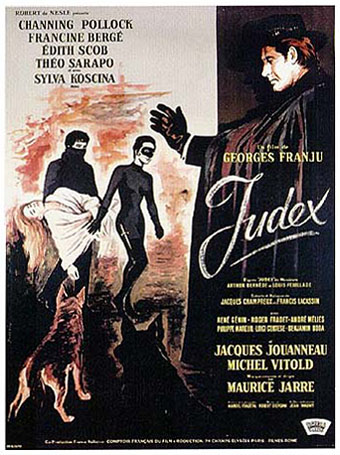
Monsieur Wiley in yesterday’s comments reminded me of George Franju’s seldom seen Judex, a 1963 film based on the Feuillade serials of the same name. Louis Feuillade (1873–1925), as you really ought to know by now, was the director of the original Fantômas serials (1913–14) and also Les Vampires (1915–16), obvious forerunners of Diabolik with all their black-clad nocturnal prowling. Feuillade’s criminals were clebrated by the Surrealists, Blaise Cendrars, Jean Cocteau and others but the director received stern reviews from less liberal critics for apparently promoting immorality:

“That a man of talent, an artist, as the director of most of the great films which have been the success and glory of Gaumont, starts again to deal with this unhealthy genre (the crime film), obsolete and condemned by all people of taste, remains for me a real problem.”

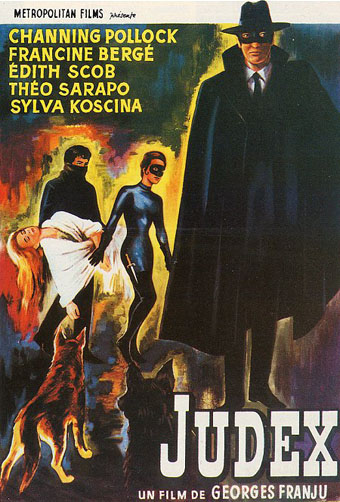
Hence the arrival in 1917 of Judex (The Judge), possibly the first costumed avenger in cinema, with his broad-brimmed hat and cloak, secret lair and network of helpful circus performers. Fictional immorality is less of a concern these days which perhaps explains why Fantômas and Les Vampires were resurrected on DVD first while Judex only appeared recently. I must admit that it’s Feuillade’s criminals which have always interested me for the most part, even if (as with many silent films) the romance of the concept is often more attractive than the actual work. (There are exceptions, of course; the Lon Cheney Phantom of the Opera is far better than the book.) Feuillade and his writer, Arthur Bernède, produced a series of spin-off novels while the films were being made (you thought novelizations were a recent thing?) and this page has some nice reproductions of the covers.

judex4.jpg

Judex turned up again in 1934, in a film directed by Maurice Champreux before Franju gave his own twist to the character. Franju is most famous for his exceptional horror film, Les Yeux sans Visage (1960) which still packs a punch today; I saw it at a cinema several years ago and one notorious scene drew gasps from an unprepared audience. Nearly everything else of his, Judex included, appears to be out of circulation. Franju began his career as a maker of documentary shorts whose approach to the medium was inspired by the juxtapositions of the Surrealists. In the celebrated Le Sang des bêtes (1949), he contrasted scenes of day-to-day life in Paris with film of animals being killed in the city’s slaughterhouses. This attitude was carried over into his dramas—Les Yeux manages to be lyrical as well as horrifying—and was impressive enough for Jean Cocteau to declare he’d happily entrust his work to Franju. This perhaps explains why Franju’s work has been so overlooked since his death in 1987, both he and Cocteau were mavericks who don’t easily fit the usual narrative of French cinema history.

judex3.jpg

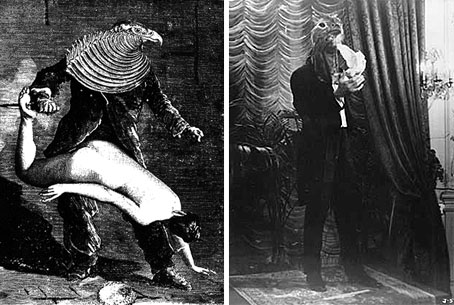
left: Une Semaine de Bonté (1934) by Max Ernst; right Channing Pollock as Judex.

Franju’s Judex was portrayed by an American stage magician, Channing Pollock, whose act with doves was put to use in the film. There’s a great scene of a masked ball (the only part of the film I’ve yet seen) with all the characters wearing bird masks that looks like a page from Max Ernst’s collage novel, Une Semaine de Bonté, brought to life. Senses of Cinema compares the remake with the original:

Franju sought in particular to recapture Feuillade’s sense of documentary and his playfulness. He reproduced with as much exactitude as possible the costumes and settings which Feuillade filmed in scrupulous detail. Feuillade’s street-scapes are now an invaluable documentary record, but Franju also paid particular attention to reproducing the elaborate interior designs and furnishings of the day, resulting in settings of quite extraordinary detail and clutter. Franju also sought, despite the playfulness, to avoid any camp satire of these elements by over-emphasis or any special attention being paid to them.

In the title role, Franju pulled off his most brilliant coup by casting the master prestidigitator of his day, near godlike in his handsomeness, Channing Pollock. Pollock’s skills as a magician were employed to produce a dazzling array of apparent magical occurrences involving, most particularly, disappearing doves, a plot device that Feuillade uses to enable the regular rescue of the heroine and others by Judex. Franju’s Judex is a far livelier, less sombre, more inventive and more mysterious character than that of Feuillade.

judex2.jpg

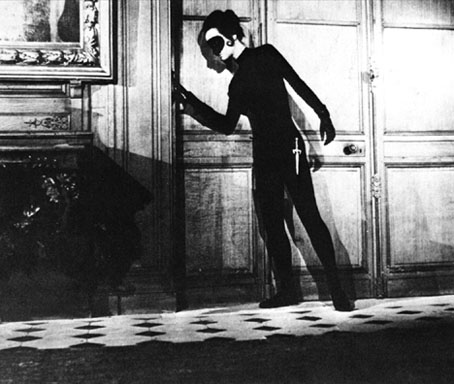
Francine Bergé as the villainous Diana Monti in Franju’s Judex (1963).

Edith Scob (the faceless girl in Les Yeux) played Jacqueline, the imperilled heroine, while Francine Bergé incarnates yet another cat-suited Feuilladesque villain. The cat-suits returned, along with the masks, in a further Feuillade homage, Nuits Rouges (1974), a feature film cobbled together from a French TV series. This page has stills from all of these and this site concerning French pulp characters (from which much of the information above was swiped) goes into more detail about the creation of Judex. There you can also read about other fascinating personages such as Belphegor, Phantom of the Louvre (another creation of Arthur Bernède), Ferocias and the Mysterious Doctor Cornelius.

And so to the inevitable question: how long do we have to wait for a Judex DVD?

See also:
Fantastic, Mysterious, and Adventurous Victoriana by Jess Nevins
Les Vampires at the Internet Archive

Previously on { feuilleton }
Danger Diabolik
Boys Own Books
Alla Nazimova’s Salomé
Meshes of the Afternoon by Maya Deren
Fantômas
La Villa Santo Sospir by Jean Cocteau

Fantastic art from Pan Books

larkin_fantastic.jpg

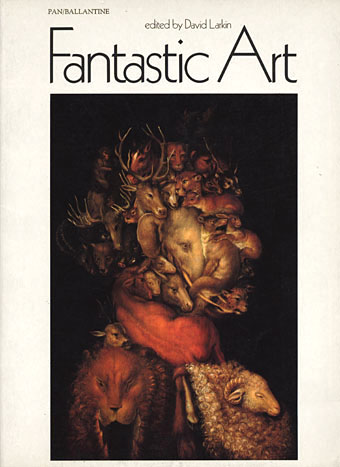
Fantastic Art (1973).
Cover: Earth by Arcimboldo.

I’d thought of writing something about this book series even before I started this blog since there’s very little information to be found about it online. I can’t compete with the serious Penguin-heads, and I’m not much of a dedicated book collector anyway, but I do have a decent collection of the art books that Pan/Ballantine published in the UK throughout the 1970s. The books were published simultaneously by Ballantine/Peacock Press in the US, and nearly all were edited by David Larkin, with Betty Ballantine overseeing the American editions. Two of the series, the Dalí and Magritte, were among the first art books I owned. Over the years I’ve gradually accumulated most of the set, and I always look for their distinctive white spines in secondhand shops.

The Pan books were a uniform size, approximately A4 (297 x 210 mm), with a single picture on each recto page surrounded by generous margins. The reproductions were excellent, printed on quality paper, and all featured specially-commissioned introductions (JG Ballard for the Dalí book) with those pages printed on textured sheets. Each book was beautifully designed, the opening pages and introductions often featuring black-and-white vignettes if the artists in question produced line drawings. David Larkin’s focus was on art that tended to the fantastic, visionary or imaginative, something that was in vogue throughout the Seventies after psychedelic art had ransacked the Victorian and Edwardian eras for inspiration a few years earlier. Aubrey Beardsley had been rediscovered in the mid-Sixties (turning up on the cover of Sgt. Pepper) and underground magazines such as Oz and IT helped create a renewed interest in art that would look good when you were stoned or tripping. The Pan books weren’t “head books” as such but its probably fair to say that the series was supported and made possible by the prevailing attitudes of the time.
larkin_magritte.jpg

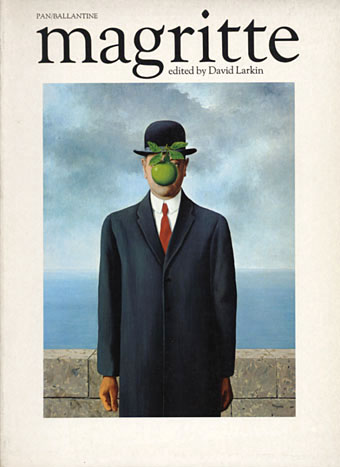
Magritte (1972).
Cover: The Son of Man.

As the series developed the format evolved away from fine art towards contemporary fantasy art, and as a result became less interesting for me, although the success of the Frank Frazetta books undoubtedly meant that this was the way the sales were going. The demand for the Ernst and Rousseau titles can be gauged by the remainder cut-outs on their covers. The final volumes (which I’ve never bought) featured artists such as Brian Froud (The Dark Crystal), Alan Lee (The Lord of the Rings) and others, with their Faeries, Giants, Castles and Gnomes books. I’m still missing a couple of the earlier numbers which I could now order online but that would spoil the game of letting chance deliver the goods, wouldn’t it?

Fantastic Art is easily my favourite, a great collection of visionary work through the ages beginning with Bosch and proceeding through Goya, John Martin, Richard Dadd, the Symbolists and the Surrealists to what was then contemporary work by artists such as Hundertwasser. This was one of the first of the series and seems to be the key volume in the way it provides an overview of the art that would follow.
larkin_dali.jpg

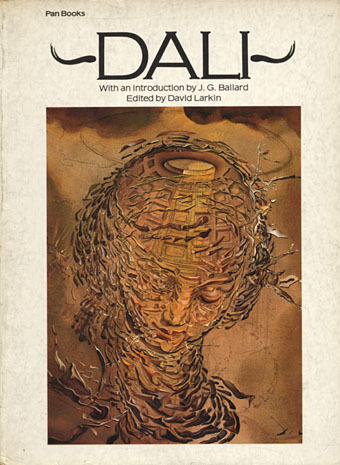
Dali (1974).
Cover: Raphaelesque Head Exploding.

A great introduction by JG Ballard in this one, replete with the usual phrases about “the dark causeways of our spinal columns”.
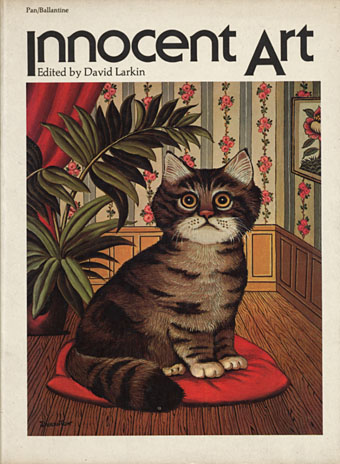
larkin_innocent.jpg

Innocent Art (1974).
Cover: Cat by André Duranton.

A collection of what used to be called naive painting, ie: work by unschooled “Sunday painters” such as Rousseau. Outsider art is the preferred term these days even though the work itself hasn’t always changed.
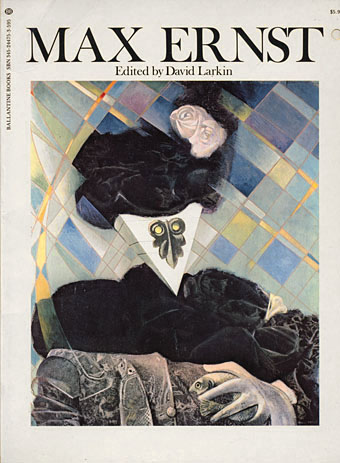
larkin_ernst.jpg

Max Ernst (1975).
Cover: Euclid.

Ernst’s later work in this book was the most abstract and experimental of the series. Europe After the Rain was printed across a fold-out sheet so that its full width could be displayed.
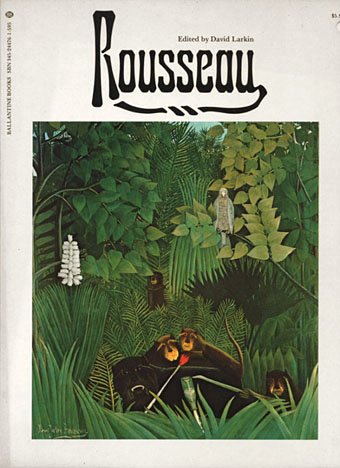
larkin_rousseau.jpg

Rousseau (1975).
Cover: The Merry Jesters.

larkin_dreamers.jpg

The English Dreamers (1975).
Cover: The Bridesmaid by John Everett Millais.
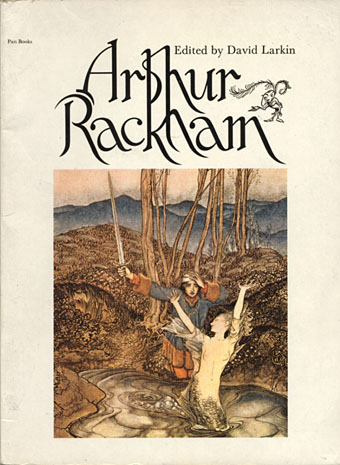
larkin_rackham.jpg

Arthur Rackham (1975).
Cover: Clerk Colville (from Some British Ballads).
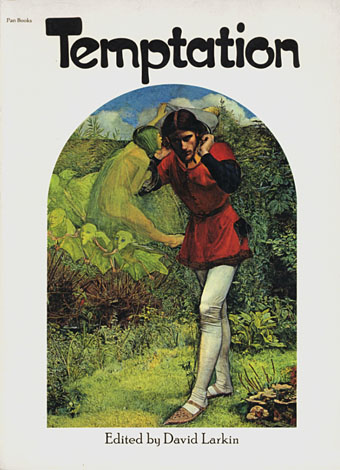
larkin_temptation.jpg

Temptation (1975).
Cover: Ferdinand Lured by Ariel by John Everett Millais.

An unusual collection with a wide range of pictures (Bosch, Alma-Tadema, Balthus). Mainly concerns sexual temptation for female bodies but also includes Biblical and other temptations.
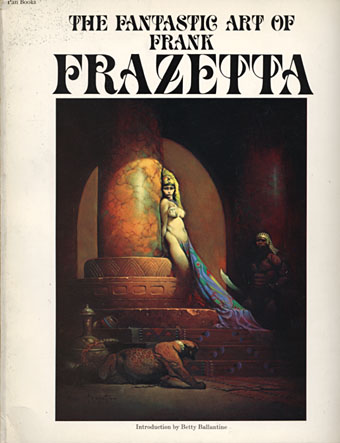
larkin_frazetta1.jpg

The Fantastic Art of Frank Frazetta (1975).
Cover: Egyptian Queen.

The book that launched a thousand metal albums. Volume One here was the first attempt to collect Frazetta’s work and was easily the most popular title of the series, going through many reprintings and prompting three follow-up volumes. Many of the reproductions are superior to their equivalents in Taschen’s later Icon collection. This was the first one I bought after the Surrealist books and, while I’ve never been a muscle obsessive, I couldn’t help but notice all the male flesh on display.
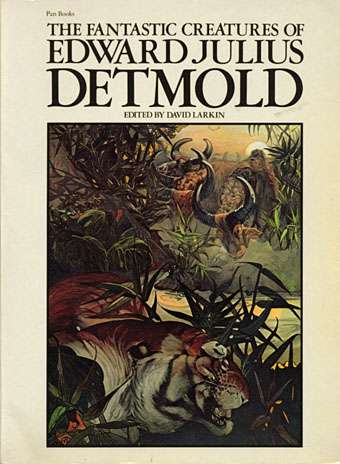
larkin_detmold.jpg

The Fantastic Creatures of Edward Julius Detmold (1976).
Cover: Shere Khan in the jungle (from The Jungle Book).
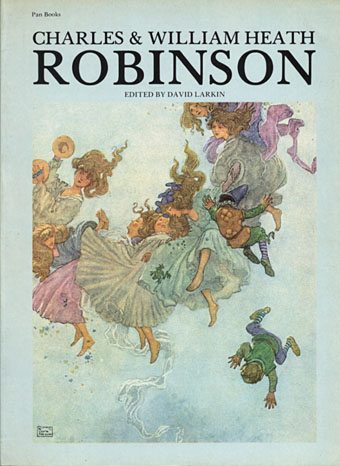
larkin_robinson.jpg

Charles and William Heath Robinson (1976).
Cover: Elfin Mount (from Hans Andersen’s Fairy Tales).

A collection of the Robinsons’ fairy tale paintings. A break from the format with a blue cover.
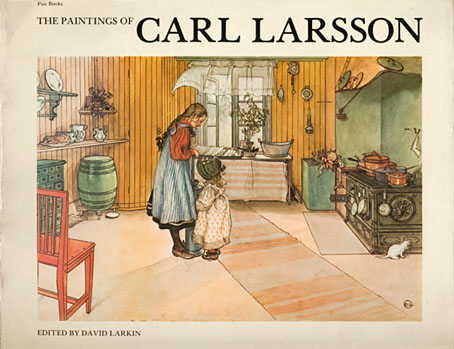
larkin_larsson.jpg

The Paintings of Carl Larsson (1976).
Cover: The Kitchen.

Another break with the format, the book being printed landscape to suit Larsson’s drawings and paintings. As with the Ernst book, a fold-out page was a special feature.
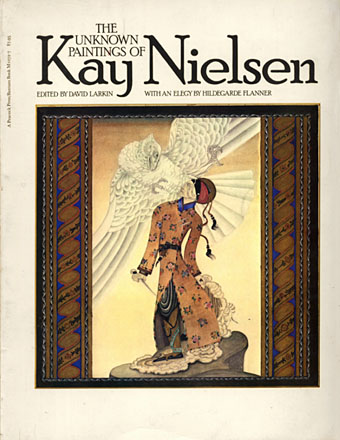
larkin_nielsen.jpg

The Unknown Paintings of Kay Nielsen (1977).
Cover: The Tale of the Third Dervish.

A collection of Nielsen’s work derived from Turkish and Persian miniatures.
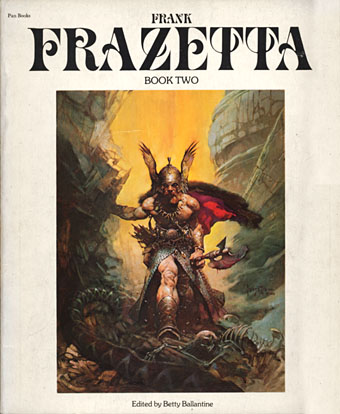
larkin_frazetta2.jpg

Frank Frazetta, Book Two (1977).
Cover: Dark Kingdom.
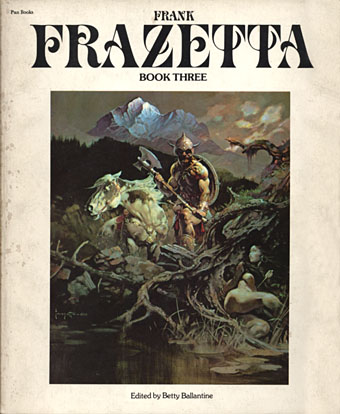
larkin_frazetta3.jpg

Frank Frazetta, Book Three (1978).
Cover painting: Nightwinds.
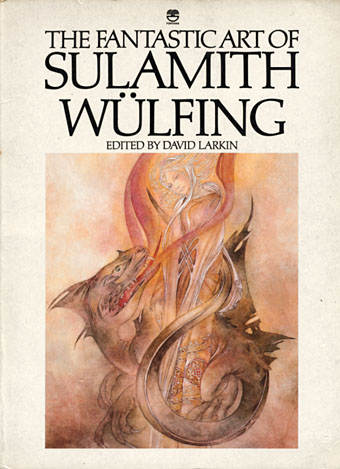
larkin_wulfing.jpg

The Fantastic Art of Sulamith Wülfing (1978).
Cover: The Big Dragon.

Part of the series but published by Fontana/Collins, not Pan.

Elsewhere on { feuilleton }
The fantastic art archive
The book covers archive
The illustrators archive

Penguin Surrealism

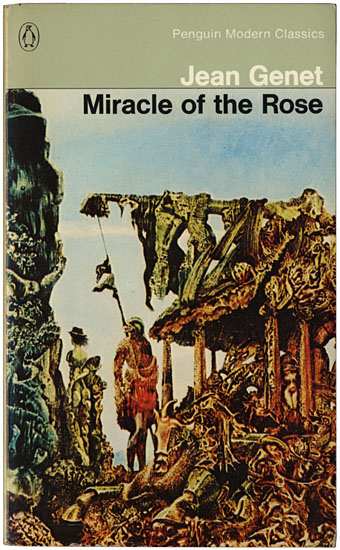
genet.jpg

Design by Germano Facetti with a detail from Europe after the Rain by Max Ernst.

Is this the start of a new meme? Ace Jet 170 features a number of posts about the history of Penguin and Pelican book cover design. (I won’t link to any specific page as the site is full of other good stuff which you really ought to go and look at.) Now Dan Hill at City of Sound has followed suit, inspiring me to dig out a few choice volumes connected by theme, in this case the use of Surrealist paintings for cover art.

See also:
The Penguin Collectors’ Society
The Penguin Paperback Spotters’ Guild (Flickr pool)

Continue reading “Penguin Surrealism”

The art of Bertrand

bertrand1.jpg

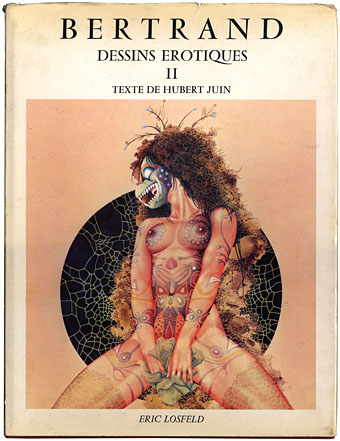
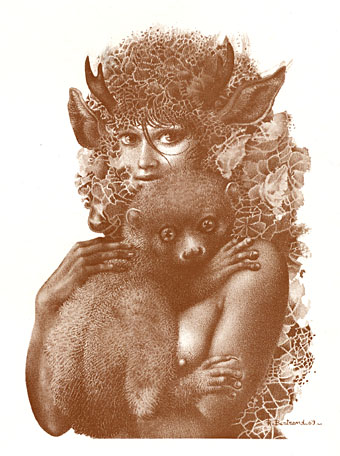
The first question has to be “Bertrand who?” but you won’t receive an answer here since information is scarce (see below). Bertrand’s erotic surrealism first appeared in the late Sixties, going by the dates in collections of his work. Some of his paintings and drawings crept into the underground mags of the period then turned up in odd places throughout the Seventies. The first I saw of any Bertrand art was on the cover of the pre-Savoy publication, Wordworks #6, and a music paper ad for the Chrome 12″, Inworlds.

bertrand2.jpg

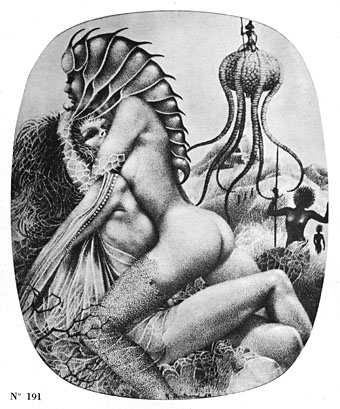
French porn publisher Eric Losfeld produced a couple of large, limited edition collections of Bertrand’s work in the early Seventies. All the drawings reproduced here are from the battered 1971 volume shown above. If it seems surprising that these haven’t been reprinted it may be that Bertrand’s concerns are too weird or simply too unpleasant for contemporary tastes. Many of his ink drawings, and some of his paintings, seem to have begun life as decalcomania splotches, a Surrealist technique invented by Oscar Dominguez as a means of injecting chance into the creative process. Decalcomania produces random patterns which the artist then elaborates upon. Max Ernst’s famous Europe After the Rain, and a number of his other paintings from the 1940s, began life as a field of vaguely organic marks created by pressing thickly applied paint to the canvas with a sheet of glass or paper. Bertrand used ink stains in a similar way, with the result that most of his doe-eyed female figures (and his figures are nearly always women) are fringed by leafy or fungal growths. Many of his scenes are a kind of lesbian equivalent of the human/alien entanglements one finds in William Burroughs’ more elaborate flights of fancy. If his women aren’t being absorbed into some organic mass, they’re often being subject to investigation (even impalement) by spikes or claws, and here we perhaps find the reason his work remains out of print. Feminists then and now would have taken a dim view of Bertrand’s more violent works; even if Taschen did produce a Bertrand collection, it’s unlikely that many of the more grotesque pictures would be included.

All the pictures in the Losfeld books were produced in a short period from 1967–69. What happened to Bertrand afterwards remains a mystery. Did he decide to do pursue a different, more commercial direction? Is he still alive? The books offer no clue but maybe someone out there has the answer.

Update: Nathalie discovers that the artist in question is Raymond Bertrand, and more of his work can be seen here.

bertrand3.jpg

Continue reading “The art of Bertrand”