Directed by Saul Bass

bass1.jpg

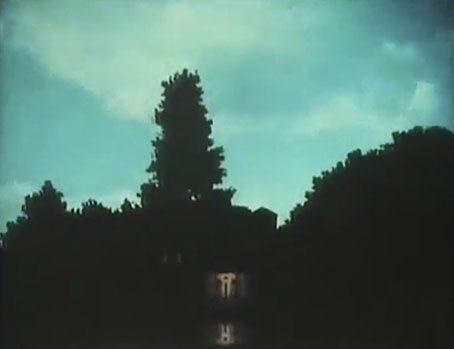
Phase IV (1974).

It’s been a thrill recently poring over the Saul Bass monograph, Saul Bass: A Life in Film & Design by Jennifer Bass & Pat Kirkham, a large volume that weighs a ton and is as revelatory about the career of a great designer (and his wife and frequent collaborator, Elaine Bass) as you’d hope. One pleasure was getting to read about Bass’s film work from his own viewpoint for once. The curious science-fiction film he made in 1974, Phase IV, is well-known enough to have a cult reputation but too often his long involvement with Hollywood is passed over as a footnote to the careers of the directors for whom he worked. In addition to his celebrated title sequences, Bass was also a visual consultant responsible for the planning and filming of what used to be called “special sequences” within films, the most notorious of which is the endlessly argued-over shower scene in Hitchcock’s Psycho (1960). (See this authoritative post by Pat Kirkham on Bass’s special sequences, and the disputed history of those few seconds of black-and-white film.)
bass3.jpg

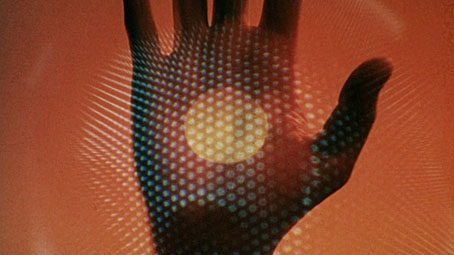
Phase IV (1974).

All of which sent me to YouTube looking for some of the shorter films that Bass directed from the mid-60s on. The monograph explores these and Phase IV in some detail, for the latter showing pages of sketches for unfilmed sequences. I’m not sure these would have improved a film which I find flawed and occasionally ludicrous but it’s good to see what the director had in mind. The film on DVD has no extras at all but a trailer can be found on YouTube that shows off some of the startling imagery, and also includes a few shots that were cut by distributors foolishly eager to try and sell it as a horror film. It’s ironic that a man who gained world recognition for his poster designs wasn’t allowed to design the poster for his own film.
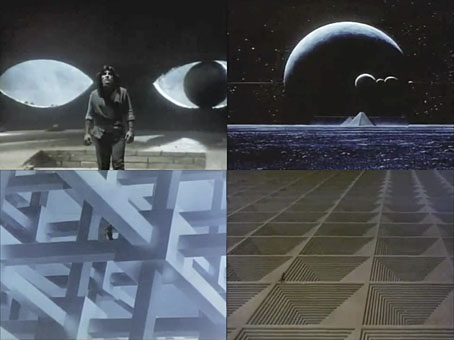
bass2.jpg

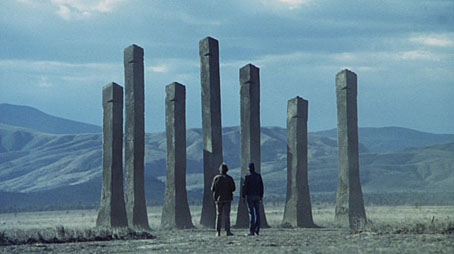
Quest (1984).

Of the short works there’s Why Man Creates (1968) here and here, an examination of the creative impulse that’s been so popular with art teachers over the years that it’s probably been seen by a lot more people than his marauding ants. Both this and The Solar Film (1980), a documentary about solar energy, utilise Bass’s hand-drawn animation. The latter is also of note for its final shot of a baby walking into a sunset, a still of which was turned by Bass into an album cover for Stomu Yamashta in 1984. Also that year, Saul and Elaine produced their strangest work, Quest, a half-hour piece of science fiction based on a Ray Bradbury short story whose quest theme is overly-familiar from a dramatic point-of-view but which typically yields a wealth of memorable visuals. In Phase IV there was a nod to Dalí with the dead man’s hand filled with burrowing ants; in Quest we find imagery borrowed from Magritte (a floating castle-topped mountain) and MC Escher (his Cubic Space Division). The copy on YouTube is rough quality but it’s certainly worth a watch. I’m amused to discover how much Saul & Elaine were prog-rock heads (not that there’s anything wrong with that…): Phase IV has Stomu Yamash’ta and David Vorhaus from White Noise on its soundtrack, The Solar Film features a dubious cover version of Tubular Bells, while the score for Quest is mostly original music (with some borrowings from Holst) that sounds much of the time like Tangerine Dream when they were leaning on their Mellotrons.

Previously on { feuilleton }
Saul Bass album covers
Pablo Ferro on YouTube

Las Pozas panoramas

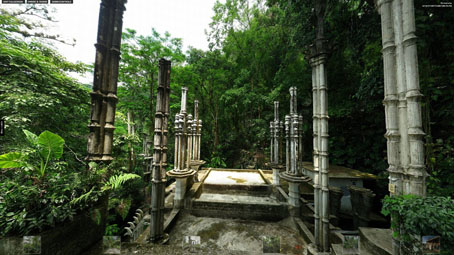
xilitla1.jpg

Photo by Carlos Ernesto Guadarrama Muñoz.

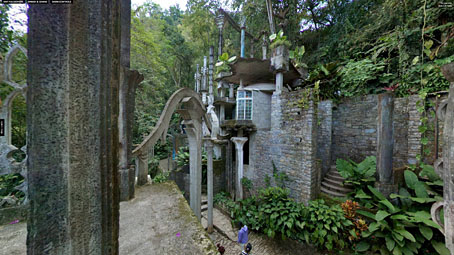
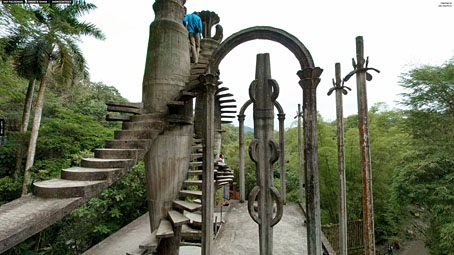
How soon things change. In 2006 when I wrote something about Las Pozas, the unfinished concrete fantasia constructed by Edward James at Xilitla in the Mexican jungle, there was little information about the place on the web. A couple of years later photos had appeared on Flickr and Monty Don had been there with TV cameras for the BBC’s Around the World in 80 Gardens. Now, thanks to 360cities.net, we have a collection of panoramic views inside James’ platforms, plazas and stairways to nowhere. See the complete set of views here.

xilitla2.jpg

Photo by Jose Luis Perez.

Edward James described himself as a poet (and is credited as such on his gravestone), but he’s far better known as one of the primary patrons of Surrealist art and a lifelong proponent of the Surrealist ethos, hence Las Pozas whose construction occupied him up to his death in 1984. In addition to being the model for Magritte’s La reproduction interdite (1937), James also converted Monkton, his home in England, into a Surrealist showcase. It’s a place I’ll be writing about at greater length when I find the time.

xilitla3.jpg

Photo by Jose Luis Perez.

Elsewhere on { feuilleton }
The panoramas archive

Previously on { feuilleton }
Return to Las Pozas
Las Pozas and Edward James

Magritte’s Maldoror

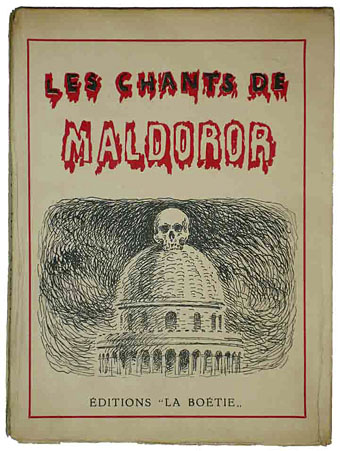
maldoror2.jpg

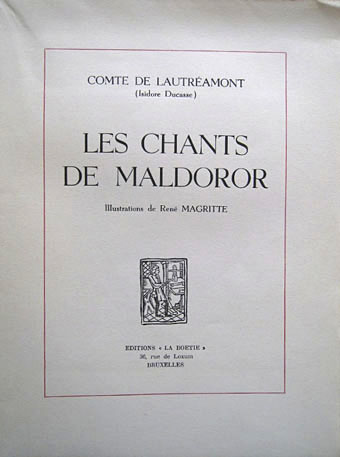
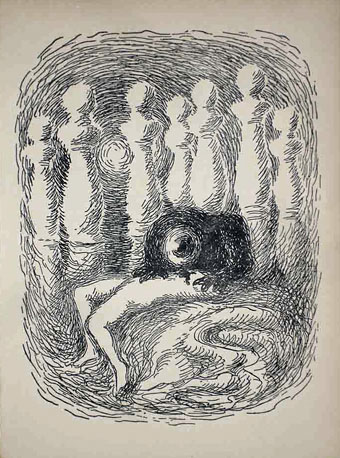
Seen briefly in yesterday’s film about René Magritte were some of the artist’s 77 illustrations created for a 1948 edition of Lautréamont’s Les Chants de Maldoror published by Éditions “La Boetie”, Brussels. The examples here are from various auction sites, and they can’t be counted among Magritte’s best work which probably explains why they’re not reproduced very often. Salvador Dalí’s set of engravings for a 1934 edition were appended last year to a new English translation by RJ Dent for Solar Books. And from French publisher La Baconniere there’s this recent edition with a set of fresh illustrations by TagliaMani (also here).

maldoror4.jpg

maldoror1.jpg

Continue reading “Magritte’s Maldoror”

René Magritte by David Wheatley

magritte1.jpg

René Magritte as portrayed by Patrick McDonnell.

René Magritte died in 1967, the year Eric Duvivier’s La femme 100 têtes appeared in French cinemas. Magritte is even less visible cinematically than Max Ernst, IMDB lists a couple of documentaries and nothing else. There are trace elements elsewhere, notably the Magritte and de Chirico influence in Bertolucci’s Borges’ adaptation The Spider’s Stratagem (1970), but the artist’s arresting visual imagination has always found more of a welcome on book covers than cinema screens.

magritte2.jpg

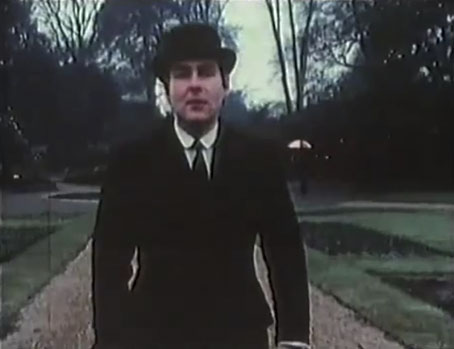
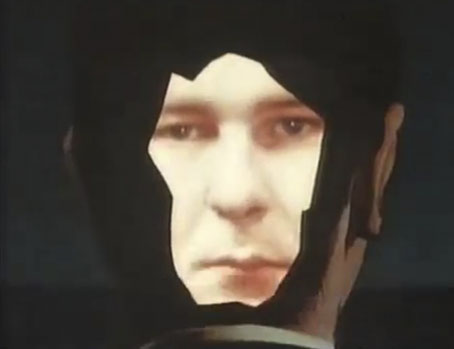
One exception is David Wheatley’s drama documentary René Magritte (1976), yet another work you won’t find listed at IMDB. This was Wheatley’s graduation film which the BBC screened in a 30-minute version (shorn of some apparently clunky dialogue scenes) in 1979, and which secured for Wheatley a place as a regular director for the BBC’s Omnibus and Arena arts programmes. I saw the 1979 broadcast, and caught it again a decade later when one of the channels was having a season of Magritte-related programming, something that’s impossible to imagine in today’s debased television landscape.

For a student film it’s a stunning piece of work, taking a similar approach to Eric Duvivier in bringing to life many of the artist’s more famous pictures: a window shatters to reveal the scene behind it painted on its panes, a mountain hovers ponderously over the sea, a dove made of clouds flies across a stormy sky. Between the artworks there are short biographical scenes. There’s a sole version of the film on YouTube that remains watchable despite being a low-quality recording from video tape that’s also hacked into three parts and subtitled in Danish.

magritte3.jpg

Looking for more information about David Wheatley it was dismaying to find he’d died in 2009, aged 59. Leslie Megahey—a cult TV director of mine—wrote an obituary for the Guardian where he describes some of Wheatley’s other productions including the Arena film Borges and I (1983)—as far as I’m aware the only British TV documentary about Jorge Luis Borges—and Wheatley’s first feature film, an adaptation of Angela Carter’s The Magic Toyshop (1987). I recall enjoying the latter, produced at a time when the success of The Company of Wolves (1984) made it seem there might also be a place in the cinema for Angela Carter’s imagination; we know how that worked out. The Magic Toyshop doesn’t seem to have had a DVD release so good luck to anyone searching for it. As for René Magritte, if anyone runs across a better online copy be sure to leave a comment.

Previously on { feuilleton }
The Public Voice by Lejf Marcussen

Alice in Liverpool

caterpillar.jpg

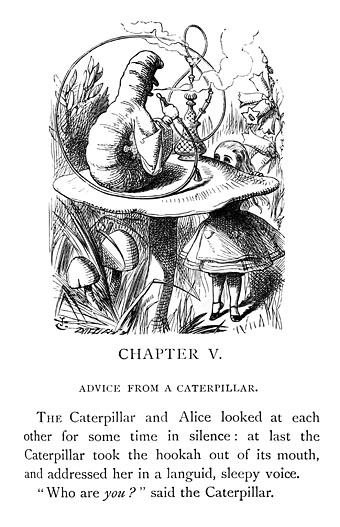
Alice and the Caterpillar (1865) by John Tenniel.

It’s perhaps surprising that an art gallery, rather than a library, is holding a huge survey exhibition about Alice, but then Carroll’s creation has been and still is the inspiration of artists, photographers, theatrical designers, animators, film-makers.

Thus Marina Warner writing about an exhibition of art based on Lewis Carroll’s Alice books opening at Tate Liverpool this Friday:

Alice in Wonderland will offer visitors a rare opportunity to view Carroll’s own drawings and photographs, alongside Victorian Alice memorabilia and John Tenniel’s preliminary drawings for the first edition of the novel.

Carroll’s stories were soon adopted by other artists. Surrealist artists from the 1930s onwards were drawn towards the fantastical world of Wonderland where natural laws were suspended. From the 1960s through the 1970s, Carroll’s Alice tales also prompted conceptual artists to explore language and its relationship to perception, and the stories inspired further responses in Pop and Psychedelic art. Expect to see works by artists ranging from Salvador Dalí and René Magritte, to Peter Blake and Yayoi Kusama. (more)

The exhibition runs to January 29th, 2012, and I suppose this gives me a convenient opportunity to point again to my psychedelic Alice calendars which have been updated for the forthcoming year.

Previously on { feuilleton }
Coulthart calendars for 2012
Scenes from a carriage
Through the Psychedelic Looking-Glass: the 2011 calendar
Jabberwocky
Alice in Acidland
Return to Wonderland
Dalí in Wonderland
Virtual Alice
Psychedelic Wonderland: the 2010 calendar
Charles Robinson’s Alice’s Adventures in Wonderland
Humpty Dumpty variations
Alice in Wonderland by Jonathan Miller
The Illustrators of Alice