Snowbound cinema

uk_snow.jpg

A satellite view of snow across Great Britain on January 7, 2010.

Walking the snow-laden streets this week felt like a considerable novelty when we rarely have snowfalls of any depth here and what there is never lasts much longer than a day. The current low temperatures which began just before Christmas may be inducing a national trauma but the genuinely wintery weather makes a change from the dreary weeks of rain and cold which usually prevail until April.

Whilst trudging through the crusted ice I found myself remembering favourite films which make the most of winter landscapes. Here’s a short list to follow the earlier winter-themed posts.

McCabe & Mrs Miller (1971)
Several Westerns before this one had featured winter scenes but I think Robert Altman’s was the first to be set at the height of winter in a snowbound town. Memorable for Vilmos Zsigmond’s photography, Leonard Cohen’s lugubrious songs, Warren Beatty’s doomed businessman stomping around wrapped in furs muttering “Pain, pain, pain!”, and the finale when he’s hunted down by a trio of assassins.

The Shining (1980)
Has anyone not seen this film? Despite the artificial snow, Kubrick’s direction and John Alcott’s photography communicate authentic chills, both meteorological and metaphysical.
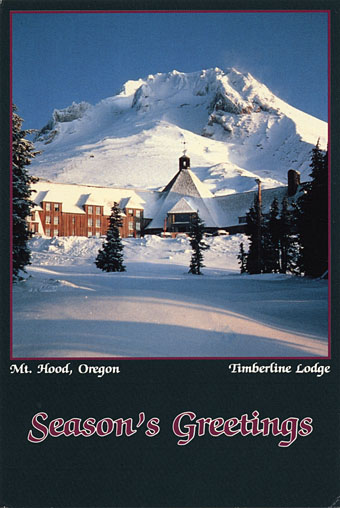
timberline.jpg

Yes, it’s a genuine Christmas postcard from Oregon’s Timberline Lodge which became the model for Kubrick’s Overlook Hotel. Writer Tom Veitch sent me this some years ago.

The Thing (1982)
John Carpenter’s grisly Antarctic horror is the film I still find to be his best. Like his earlier Assault on Precinct 13, this is another siege situation borrowed from Howard Hawks only this time the enemy is within. Until someone films At the Mountains of Madness, this is the closest you’ll get to Lovecraft’s polar nightmares.

Runaway Train (1985)
Few people know this: escaped convicts Jon Voight and Eric Roberts find themselves on the titular train with rail worker Rebecca De Mornay, and it’s a long ride through frozen landscapes as they try to escape the law and the train itself before it crashes. Andrei Konchalovsky directs a story by Akira Kurosawa rewritten by Edward Bunker (who has a cameo) and others. The result is a strange blend of hardboiled drama and existential symbolism with a great score by Trevor Jones.

Fargo (1996)
One of the Coen Brothers’ best. Watching this again over Christmas along with many of their other films, it was amusing to see Steve Buscemi transform from Fargo‘s vicious and splenetic kidnapper to the mild-mannered character he plays in The Big Lebowski. Despite the statement at the beginning of the film, Fargo isn’t a true story but its existence became tangled with some curious real-life events.?

Update: I was reminded on Twitter about Altman’s bizarre future Ice Age drama, Quintet, which I should have mentioned above. Not as successful as the earlier film but its setting certainly suits the weather.

Previously on { feuilleton }
Bruegel in winter
Winter panoramas
Winter music
Winter light
Kubrick shirts
At the Mountains of Madness
Images by Robert Altman

Dan O’Bannon, 1946–2009

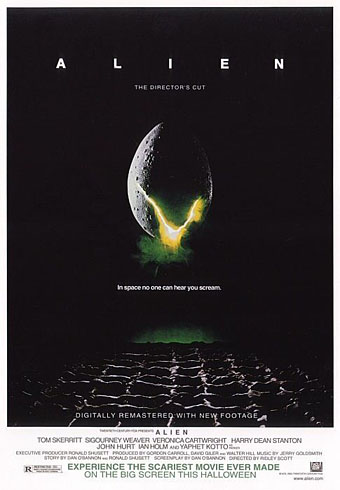
alien.jpg

Re-release poster by Bemis Balkind.

Alien was a big deal for me when it appeared in late 1979, one of those films that seems to arrive at exactly the right moment. I’d just left school, I was eagerly reading reprints of French and Belgian comic strips in Heavy Metal magazine, and also paperback reprints of science fiction stories from New Worlds; I was listening to Hawkwind and becoming increasingly obsessed with HP Lovecraft. I was, in short, the target audience for a serious SF-themed horror film with contributions from major artists like HR Giger and Jean “Moebius” Giraud, and I went to see it three times in a row.

Watching Star Wars two years earlier (for which Dan O’Bannon created the computer displays), I’d enjoyed the special effects but been disappointed by its space-opera tone and dumb heroics. HR Giger’s large-format Necronomicon art book was published in the UK the same year and the sight of his work was a revelation for the way it pushed Dalí-esque Surrealism to a pitch of unprecedented mutation and malevolence. A year later his paintings were appearing in Omni magazine but it was Alien which exploded his popularity. Throughout 1979 you could hardly open a magazine or newspaper without finding a Giger interview or examples of his work. Alien benefited from the SF boom that Star Wars generated but Dan O’Bannon didn’t need George Lucas’s feeble mythology to point him towards science fiction, he’d already made one low-budget sf film, Dark Star, with John Carpenter, and was planning the effects for Jodorowsky’s ill-fated Dune project years before the world had heard of Luke Skywalker. Dune introduced him to Moebius, and the pair collaborated on an SF-noir strip, The Long Tomorrow, which was published in Heavy Metal in 1977. But it was Giger’s connection with the Dune project which proved crucial for Alien:

“(Dune) collapsed so badly,” O’Bannon says, “that I ended up in L.A. without any money, without an apartment, without a car, with half my belongings back in Paris and the other half in storage.”

He retreated to the sofa of a friend, screenwriter Ron Shusett, and didn’t leave it for a week. But depressed or not, O’Bannon knew he had to get back to work. He got his files and typewriter out of storage, and he and Shusett went to work on stacks and stacks of partially completed ideas.

“We pulled out one that I liked very much,” he says, “an old script called Memory that was half-finished and was basically what the first half of Alien is now. I told Ron I’d never been able to figure out the rest of the story. So he read it and said, ‘Well, you told me another idea you had once for a movie. It was the one where gremlins get onto a B-17 bomber during World War II and give the pilots a lot of trouble. So why don’t you make that the second half and put it on a spaceship?’

“That was a great idea, but then we had to figure out the monster. Well, I hadn’t been able to get Hans Rudi Giger off my mind since I left France. His paintings had a profound effect on me. I had never seen anything that was quite as horrible and at the same time as beautiful as his work. And so I ended up writing a script about a Giger monster.”

The working title was Star Beast. O’Bannon had a fortunate brainstorm late one night as he continued to write while Shusett slept. “I was writing dialogue and one of the characters said, ‘What are we going to do about the alien?’ The word came out of the page at me and I said, ‘Alien. It’s a noun and an adjective.’ So I went in the other room and shook Ron awake and told him and he said, ‘Yeah, OK,’ and went back to sleep. But I knew I had found a really hot title.”

The Book of Alien (1979) by Paul Scanlon and Michael Gross

Lest we forget, it was O’Bannon who insisted that Ridley Scott look at Giger’s work during the production of the film after artist Ron Cobb failed to produce a sufficiently nightmarish creature. O’Bannon’s script was mauled by Walter Hill who removed sub-plots, and further scenes were trimmed to speed the pace, but Alien‘s unique atmosphere remains as potent today as it was in 1979. It’s ironic that O’Bannon died in the week that James Cameron’s Avatar (which happens to star Sigourney Weaver) is released. To watch all four Alien films in sequence is to witness progressively diminishing returns, and it was Cameron’s sequel which set the pattern for the later films by dropping the adjective part of the O’Bannon’s title in favour of the noun. There had been plenty of movie monsters before but it was the inhuman quality which we label “alien” that O’Bannon and Giger brought to SF cinema. It’s a quality that few have been able to deliver since, not least in Avatar which (from what I’ve seen) looks less alien than something Frank R Paul might have painted in the 1930s. O’Bannon did a lot more after Alien, of course, but it’s his first big success which will always mean the most to me. I recommend Ridley Scott’s director’s cut from 2003 which restored scenes and shots removed from the original release.

Remembering the late, great Dan O’Bannon
The first action heroine: Ellen Ripley and Alien, 30 years on

Previously on { feuilleton }
Alejandro Jodorowsky’s Dune
The monstrous tome

Lovecraft: Fear of the Unknown DVD

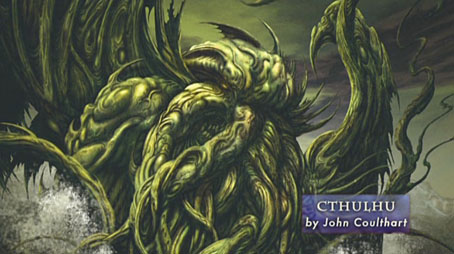
cthulhu_dvd.jpg

It’s that thing again…

There’s much to loathe about this time of year—the short and dismal days whose appalling weather will persist until mid-March, the trees denuded at last of their leaves, the Chinese Water Torture of Xmas trivia—but the post this week at least brought some compensations. As well as the copies of Dodgem Logic there was a box of Penguin book cover postcards which I won in a Guardian Books giveaway, and also the long-awaited arrival of Frank Woodward’s documentary Lovecraft: Fear of the Unknown on DVD. I’ve mentioned this latter work before, of course, but I’ll repeat that it’s the best documentary to date concerning the life and career of HPL, and features several pieces of my own artwork as well as contributions from other fine Lovecraftian illustrators. Among the interviewees are Neil Gaiman, John Carpenter, Guillermo Del Toro, Caitlin R Kiernan, Peter Straub, Ramsey Campbell and Lovecraft scholar ST Joshi. The DVD is only Region 1/NTSC at the moment, but is available also as a Blu-ray disc if you need to see the aforementioned in high-definition. The film runs for 90-minutes and the disc includes an additional 70-minutes of interviews, a Lovecraft art gallery and more. Essential viewing for all aficionados.

Elsewhere on { feuilleton }
The Lovecraft archive

New things for July

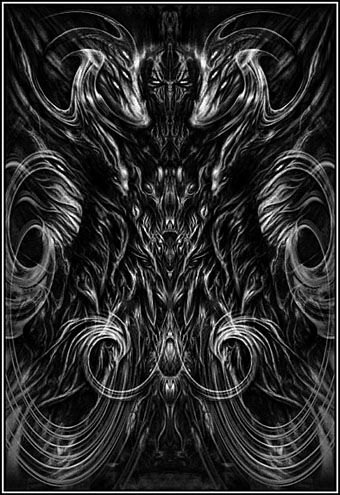
between.jpg

In Spaces Between from The Great Old Ones (1999).

Some noteworthy pieces of news as the month draws to a rain-sodden and dismal conclusion.

• Frank Woodward was in touch this week to let me know that his excellent HP Lovecraft documentary, Lovecraft: Fear of the Unknown, will at last be appearing on DVD in October. This is a feature-length appraisal of Lovecraft’s life, work and influence, and includes contributions from Neil Gaiman, John Carpenter, Guillermo Del Toro, Caitlin R Kiernan, Peter Straub, Ramsey Campbell and Lovecraft scholar ST Joshi. A number of my artworks are included throughout and they’ll probably also be featured in a gallery section on the disc. The film was shot in HD so it’s being released on Blu-ray as well as regular DVD.

• Also Lovecraft-related, and also due out shortly, is DM Mitchell’s follow-up to the landmark Starry Wisdom anthology of Lovecraft-inspired texts and graphics. That volume was acclaimed in some quarters and condemned in others; I don’t doubt that this new work, Songs of the Black Wurm Gism, will manage the same. Contributors include David Britton, Grant Morrison and yours truly. The cover is Alan Moore’s splendid portrait of Asmodeus.

• Last but not least, Paul Schütze was also in touch this week with news that two more audio works have been added to his online catalogue. Soundworks 01 is his atmospherics created with with Andrew Hulme from the recent TV drama series Red Riding, while Tokyo/Osaka Live is two pieces of improvisation with Simon Hopkins. Both releases are available through iTunes.